Attribute and simile classifiers for face verification
Neeraj KumarA. BergP. BelhumeurS. Nayar
Proposes novel attribute and simile classifiers that capture high-level visual traits and reference similarities, dramatically cutting face verification error rates on unconstrained benchmarks without requiring image pair alignment.
Automatic face verification systems often struggle in unconstrained, real-world conditions where lighting, pose, facial expressions, and camera quality vary widely. While conventional methods frequently fail under these uncontrolled settings or rely on computationally expensive and brittle image-alignment processes, humans can verify identities across varied conditions with exceptional accuracy.
The article evaluates two high-level visual trait methods—attribute classifiers and simile classifiers—to determine whether extracting human-interpretable and reference-based visual characteristics can improve unconstrained face verification without requiring pairwise image alignment.
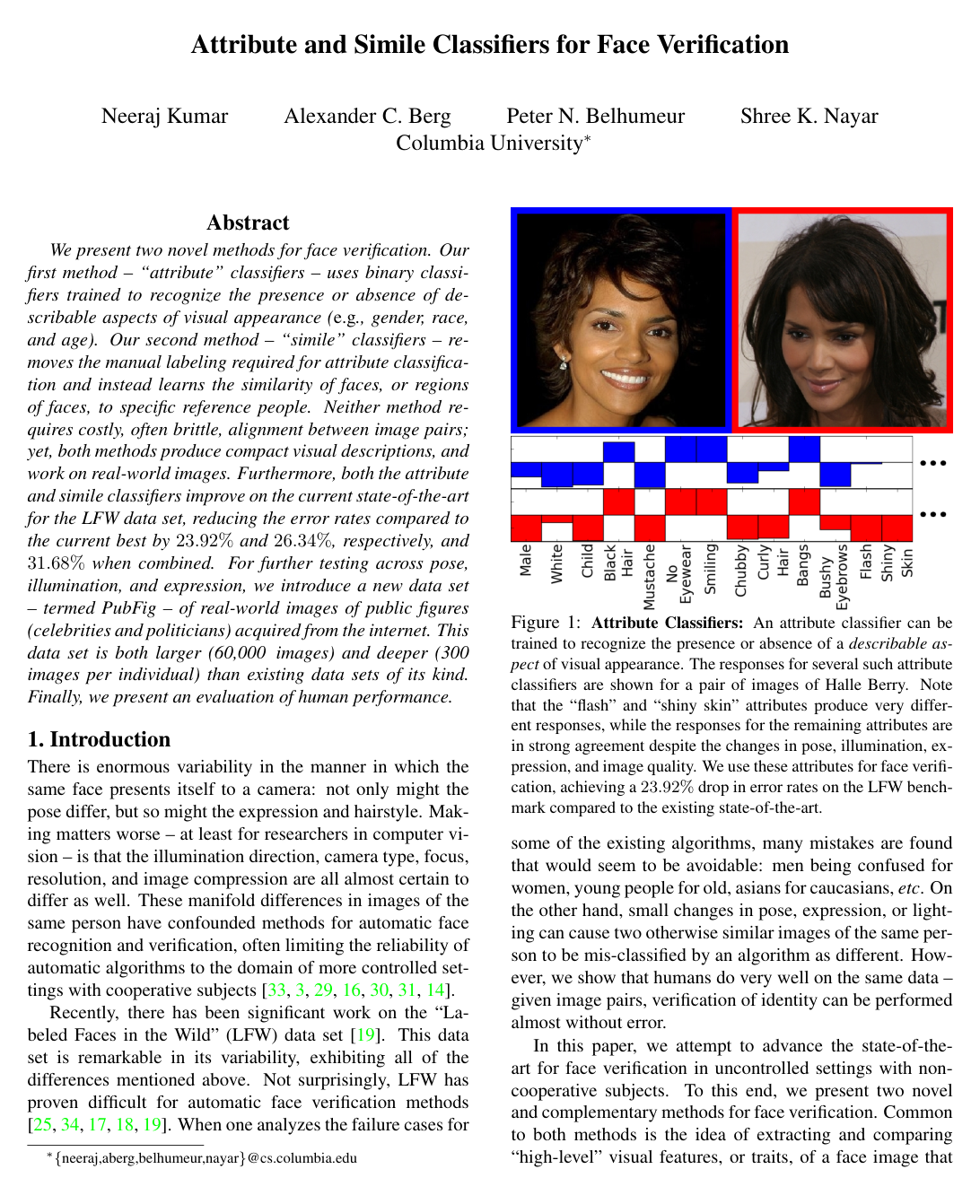
The researchers developed two distinct classification approaches. The attribute classifier trains binary support vector machines on 65 describable visual characteristics such as gender, race, age, and facial features, utilizing over 125,000 crowd-sourced image labels for training. The simile classifier removes the need for manual labeling by training binary classifiers to measure how closely specific regions of an unaligned face resemble corresponding regions across 60 reference individuals. Both techniques generate compact visual trait vectors for each image independently. The system then compares these trait vectors using a separate verification classifier. The models were benchmarked on the standard Labeled Faces in the Wild dataset and a newly compiled dataset of public figures called PubFig, which comprises 60,000 web-collected images across 200 individuals.
The study established several key findings. First, both trait-based approaches significantly outperform previous state-of-the-art benchmarks on Labeled Faces in the Wild: attribute classifiers reduced error rates by 23.92%, simile classifiers reduced error rates by 26.34%, and a hybrid combination of both reduced error rates by 31.68%, achieving an overall accuracy of 85.29%. Second, crowd-sourced baseline testing revealed human verification accuracy on the same benchmark reaches 99.20% on full images and 97.53% on tightly cropped faces. Third, human testing showed an accuracy of 94.27% when the face was entirely obscured and only background and context were visible, demonstrating that background context can easily bias evaluations if not strictly masked out during algorithm training.
These results indicate that high-level visual trait representations offer a robust, computationally efficient alternative to traditional low-level pixel alignment. By computing compact descriptors for each image independently, systems can scale more effectively without costly pairwise matching. Furthermore, the ability to train simile classifiers without manual annotation provides a scalable path to build robust visual models at lower operational costs. However, the large gap between the hybrid algorithm's 85.29% accuracy and human performance of 97.53% on cropped faces indicates substantial room for progress before automated systems can match human reliability in uncontrolled environments.
Decision-makers and practitioners deploying face verification in real-world scenarios should adopt high-level visual trait frameworks and strictly enforce facial masking to prevent background context from artificially inflating accuracy. Organizations should leverage the newly released, deeper PubFig dataset to evaluate algorithmic resilience against explicit variations in lighting, pose, and expression. Future development should focus on expanding the reference pool for simile classifiers and scaling recognition experiments across more diverse identity sets.
A primary operational limitation is the initial data acquisition requirement: attribute classifiers demand large volumes of high-quality manual labels, whereas simile classifiers depend on having multiple diverse images per reference individual. Additionally, automated face and fiducial detection systems can occasionally fail to detect faces in highly unconstrained photos, which slightly impacts automated pipeline consistency. Overall, the methodology provides strong, statistically validated improvements over prior methods on standard benchmarks, but caution is warranted when deploying in production environments where non-frontal poses and extreme lighting remain challenging.
- Paper: Describing Objects by their Attributes, Ali Farhadi et al. (2009). This paper establishes the foundational computer vision paradigm of using semantic attribute classifiers for descriptive visual recognition that directly precedes high-level facial trait classification.
- Paper: Learning a similarity metric discriminatively, with application to face verification, Sumit Chopra et al. (2005). It introduces discriminative metric learning and Siamese networks for unconstrained face verification, defining the pair comparison problem addressed by attribute and simile classifiers.
- Paper: Eigenfaces vs. Fisherfaces: Recognition Using Class Specific Linear Projection, Peter N. Belhumeur et al. (1996). This classic work details low-level projection baselines and the fundamental challenges that lighting and expression variations pose to traditional face verification.
- Paper: Face Recognition Based on Fitting a 3D Morphable Model, Volker Blanz et al. (2003). It presents 3D morphable model fitting as an explicit alignment strategy to handle pose and lighting variations, serving as a primary point of comparison for alignment-free trait methods.
- Paper: The CMU Pose, Illumination, and Expression Database, Terence Sim et al. (2003). This paper introduces the CMU PIE benchmark systematically isolating pose, illumination, and expression variations in facial recognition.
- Paper: Active Appearance Models Revisited, Iain Matthews et al. (2004). It provides the standard formulation for Active Appearance Models, representing the generative alignment and fiducial fitting techniques that trait classifiers seek to avoid or streamline.
- Paper: Detecting Faces in Images: A Survey, Ming-Hsuan Yang et al. (2002). This survey provides a comprehensive analysis of early appearance-based and feature-based face detection and localization pipelines.
- Paper: Deep Learning Face Attributes in the Wild, Ziwei Liu et al. (2015). It advances the facial attribute classification paradigm by replacing shallow classifiers with deep convolutional networks trained directly on unconstrained in-the-wild facial attributes.
- Paper: Deep Learning Face Representation by Joint Identification-Verification, Yi Sun et al. (2014). This work evolves face verification from hand-crafted attribute descriptors to end-to-end deep representation learning using joint identification and verification supervision.
- Paper: Learning Face Representation from Scratch, Dong Yi et al. (2014). It builds upon the public dataset and benchmark evaluation needs highlighted by PubFig by introducing the CASIA-WebFace dataset for training modern deep facial representations.
- Paper: Deep Face Recognition, Omkar M. Parkhi et al. (2015). It demonstrates how large-scale curated web datasets and deep metric learning supersede intermediate attribute-based representations for unconstrained face verification.
- Paper: Gender Shades: Intersectional Accuracy Disparities in Commercial Gender Classification, Joy Buolamwini et al. (2018). It directly critiques and evaluates subgroup disparities and demographic biases in commercial facial attribute and gender classification pipelines.
- Paper: ArcFace: Additive Angular Margin Loss for Deep Face Recognition, Jiankang Deng et al. (2018). It represents the modern culmination of unconstrained face verification by utilizing additive angular margin losses to learn robust hyperspherical feature embeddings.
- Paper: MS-Celeb-1M: A Dataset and Benchmark for Large-Scale Face Recognition, Yandong Guo et al. (2016). It scales the public figure dataset and entity disambiguation concept introduced with PubFig up to a million identities.
- Paper: VGGFace2: A Dataset for Recognising Faces across Pose and Age, Qiong Cao et al. (2017). It provides a massive-scale dataset explicitly designed to model variations in pose and age across thousands of identities for deep facial recognition.