Boosting for transfer learning
Wenyuan DaiQiang YangGui-Rong XueYong Yu
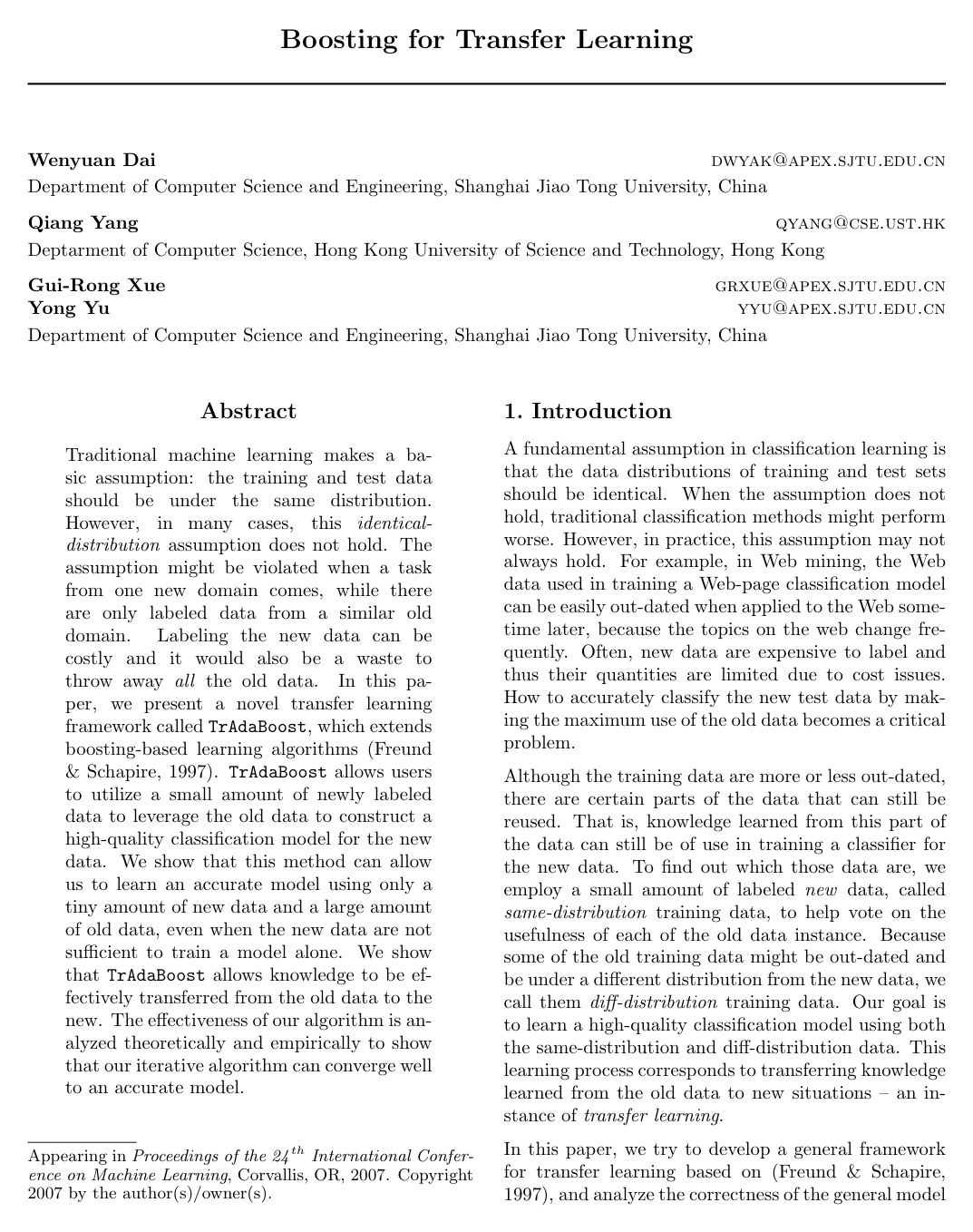
Proposes TrAdaBoost, an extension of AdaBoost that iteratively reweights source-domain instances to filter out conflicting data, enabling accurate classification in a new target domain using only a minimal set of labeled target samples.
Organizations often struggle when applying machine learning to new operational domains because newly collected data is scarce and expensive to label manually. While large amounts of historical data may exist from older or related domains, data patterns frequently shift over time, violating standard assumptions that training and testing conditions are identical. Standard models trained strictly on scarce new data perform poorly, while blindly adding outdated data can degrade model quality due to negative interference.
The article evaluates a novel transfer learning framework, called TrAdaBoost, designed to construct high-performance classification models for new target domains by intelligently reusing large volumes of older, differently distributed historical data alongside a minimal quantity of newly labeled data.
The authors conducted both theoretical mathematical proofs and empirical experiments across nine benchmark datasets, including text and tabular classifications. Their approach extends traditional iterative boosting methods by automatically adjusting data importance over 100 iterations. In each cycle, older instances that conflict with the newly labeled target data are down-weighted to minimize their influence, while older instances that align well with the target distribution retain higher influence to expand the training set.
The experimental and theoretical results demonstrate several key findings. First, TrAdaBoost consistently outperformed baseline support vector machine algorithms across supervised and semi-supervised evaluations, often cutting error rates by 20% to over 60% compared to models trained on combined data without transfer mechanisms. Second, the framework delivers its highest value when newly labeled data is very scarce—specifically when the ratio of new to old data is below 0.10. Third, the theoretical convergence proofs established that weighted error on the older data approaches zero over time while test accuracy on the target domain systematically improves.
These findings indicate that organizations can significantly lower data labeling costs, accelerate deployment timelines, and reduce model error by safely reusing legacy data assets rather than discarding them. Leaders must note, however, that when new domain data is already abundant (exceeding a 0.20 ratio to historical data), the benefits of transfer learning diminish, and training directly on new data becomes equally or slightly more effective.
Technical leaders looking to reduce annotation expenses should pilot TrAdaBoost on classification tasks with severe data scarcity, provided an older related dataset is available. Before broad deployment, engineering teams should evaluate the quality and similarity of the historical data, as poor-quality auxiliary data yields smaller accuracy gains. Next steps should focus on benchmarking algorithm runtimes, as the method requires approximately 50 to 100 iterations to achieve optimal convergence, and extending the framework to handle legacy data drawn from multiple distinct historical distributions simultaneously.
- Paper: A Decision-Theoretic Generalization of On-Line Learning and an Application to Boosting, Yoav Freund et al. (1997). This seminal paper introduces the theoretical framework of AdaBoost and sample reweighting upon which TrAdaBoost's iterative instance adaptation is directly constructed.
- Paper: Experiments with a New Boosting Algorithm, Yoav Freund et al. (1996). This work establishes the practical mechanics and empirical foundations of the AdaBoost algorithm that the source adapts for cross-domain transfer learning.
- Paper: Analysis of Representations for Domain Adaptation, Shai Ben-David et al. (2006). This paper establishes the formal theoretical framework and divergence bounds for domain adaptation that motivate distribution alignment and instance weighting across domains.
- Paper: Correcting Sample Selection Bias by Unlabeled Data, Jiayuan Huang et al. (2006). This work formulates instance reweighting to correct for distribution shifts between training and test sets using unlabeled target data.
- Paper: BoosTexter: A Boosting-based System for Text Categorization, ROBERT E. SCHAPIRE et al. (2000). This paper develops boosting techniques specialized for text categorization, providing the algorithmic context for the source's empirical evaluation on text classification tasks.
- Paper: Transductive Inference for Text Classification using Support Vector Machines, T. Joachims (1999). This study introduces transductive learning using target data, establishing a baseline paradigm for leveraging test-domain information alongside labeled training samples.
- Paper: A Survey on Transfer Learning, Sinno Jialin Pan et al. (2010). This foundational survey provides a comprehensive taxonomy of transfer learning, contextualizing instance-reweighting methods like TrAdaBoost within the broader transfer landscape.
- Paper: A theory of learning from different domains, Shai Ben-David et al. (2010). This paper expands learning theory for domain adaptation by establishing formal generalization bounds for hypotheses trained on mixtures of source and target data.
- Paper: A Comprehensive Survey on Transfer Learning, Fuzhen Zhuang et al. (2019). This comprehensive survey categorizes modern transfer learning mechanisms, systematically reviewing and comparing instance-weighting paradigms against newer feature and deep transfer strategies.
- Paper: Adapting Visual Category Models to New Domains, Kate Saenko et al. (2010). This work extends domain adaptation beyond sample reweighting by learning asymmetric metric transformations between source and target feature spaces.
- Paper: Return of Frustratingly Easy Domain Adaptation, Baochen Sun et al. (2015). This article builds on domain adaptation principles by offering an efficient statistical alignment method that matches second-order feature correlations across domains.
- Paper: A Survey on Deep Transfer Learning, Chuanqi Tan et al. (2018). This survey examines how classical transfer learning paradigms, including instance-based reweighting, have evolved into deep neural network architectures.
- Paper: Unsupervised Domain Adaptation by Backpropagation, Yaroslav Ganin et al. (2015). This work advances domain adaptation from instance reweighting to deep adversarial feature learning via gradient reversal.
- Paper: Moment Matching for Multi-Source Domain Adaptation, Xingchao Peng et al. (2018). This paper addresses the specific future direction noted in the source by transferring knowledge from multiple distinct source distributions simultaneously.