
keyword
probability flow ODE
A probability flow ODE is a deterministic ordinary differential equation associated with a diffusion model that yields trajectories sharing the exact same time-dependent marginal probability distributions as the underlying stochastic differential equation. By replacing the random diffusion component with an adjusted drift term derived from the score function, it establishes a continuous, invertible transport map between a complex data distribution and a tractable prior distribution, such as a standard Gaussian. This deterministic formulation operates as a continuous normalizing flow, enabling unique latent-space encodings, exact likelihood evaluation via the continuous change of variables formula, and accelerated sampling through standard numerical ODE solvers.
8 items
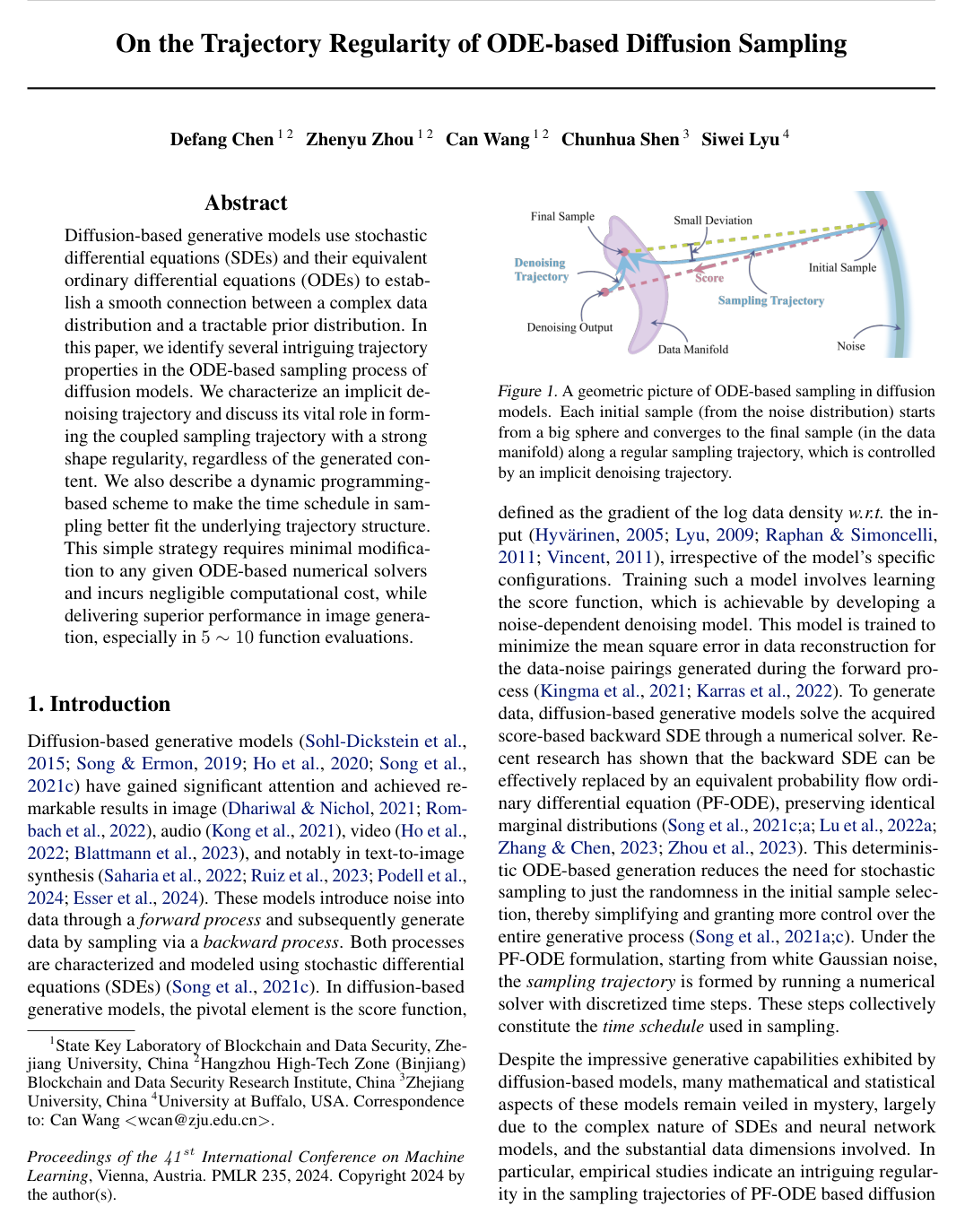
On the Trajectory Regularity of ODE-based Diffusion Sampling
Defang Chen, Zhenyu Zhou, Can Wang, Chunhua Shen, Siwei Lyu
Why you should read this
Reveals universal shape regularities in probability flow ODE sampling paths of diffusion models and derives a dynamic programming schedule that substantially improves few-step image generation across standard numerical solvers.
Diffusion-based generative models use stochastic differential equations (SDEs) and their equivalent ordinary differential equations (ODEs) to establish a smooth connection between a complex data distribution and a tractable prior distribution. In this paper, we identify several intriguing trajectory properties in the ODE-based sampling process of diffusion models. We characterize an implicit denoising trajectory and discuss its vital role in forming the coupled sampling trajectory with a strong shape regularity, regardless of the generated content. We also describe a dynamic programming-based scheme to make the time schedule in sampling better fit the underlying trajectory structure. This simple strategy requires minimal modification to any given ODE-based numerical solvers and incurs negligible computational cost, while delivering superior performance in image generation, especially in 5 ∼ 10 function evaluations.
Added
2026-10-05
Improved Techniques for Maximum Likelihood Estimation for Diffusion ODEs
Kaiwen Zheng, Cheng Lu, Jianfei Chen, Jun Zhu
Why you should read this
Proposes a suite of training and evaluation techniques—including velocity parameterization, high-order flow matching finetuning, and training-free truncated-normal dequantization—that enables diffusion ODEs to achieve state-of-the-art exact likelihood estimation without variational dequantization or data augmentation.
Diffusion models have exhibited excellent performance in various domains. The probability flow ordinary differential equation (ODE) of diffusion models (i.e., diffusion ODEs) is a particular case of continuous normalizing flows (CNFs), which enables deterministic inference and exact likelihood evaluation. However, the likelihood estimation results by diffusion ODEs are still far from those of the state-of-the-art likelihood-based generative models. In this work, we propose several improved techniques for maximum likelihood estimation for diffusion ODEs, including both training and evaluation perspectives. For training, we propose velocity parameterization and explore variance reduction techniques for faster convergence. We also derive an error-bounded high-order flow matching objective for finetuning, which improves the ODE likelihood and smooths its trajectory. For evaluation, we propose a novel training-free truncated-normal dequantization to fill the training-evaluation gap commonly existing in diffusion ODEs. Building upon these techniques, we achieve state-of-the-art likelihood estimation results on image datasets (2.56 on CIFAR-10, 3.43/3.69 on ImageNet-32) without variational dequantization or data augmentation.
Added
2026-10-03
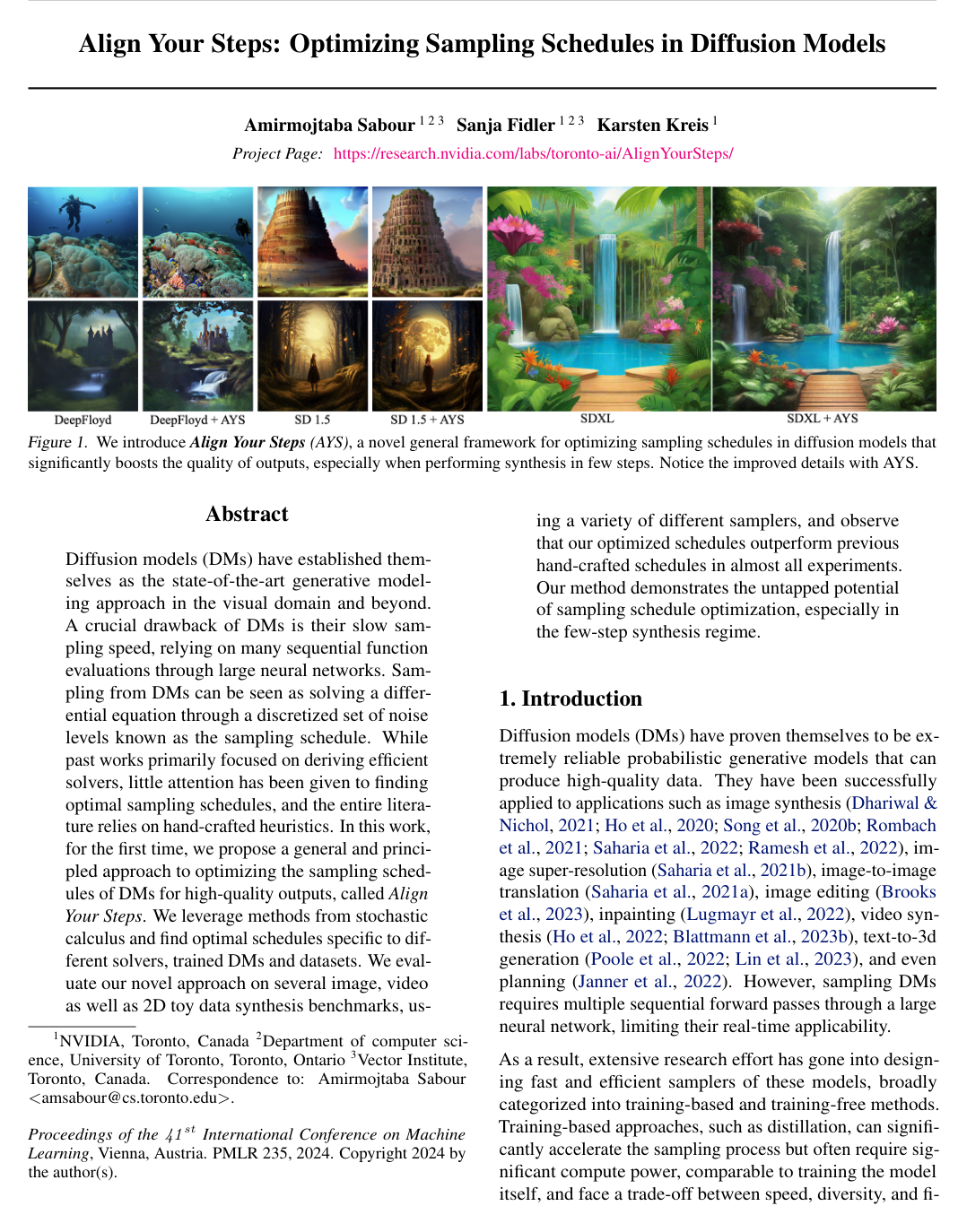
Align Your Steps: Optimizing Sampling Schedules in Diffusion Models
Amirmojtaba Sabour, Sanja Fidler, Karsten Kreis
Why you should read this
Proposes a principled stochastic-calculus framework to find dataset- and solver-optimal noise sampling schedules that substantially improve diffusion model generation quality in few-step synthesis regimes without requiring model retraining.
Added
2026-10-02
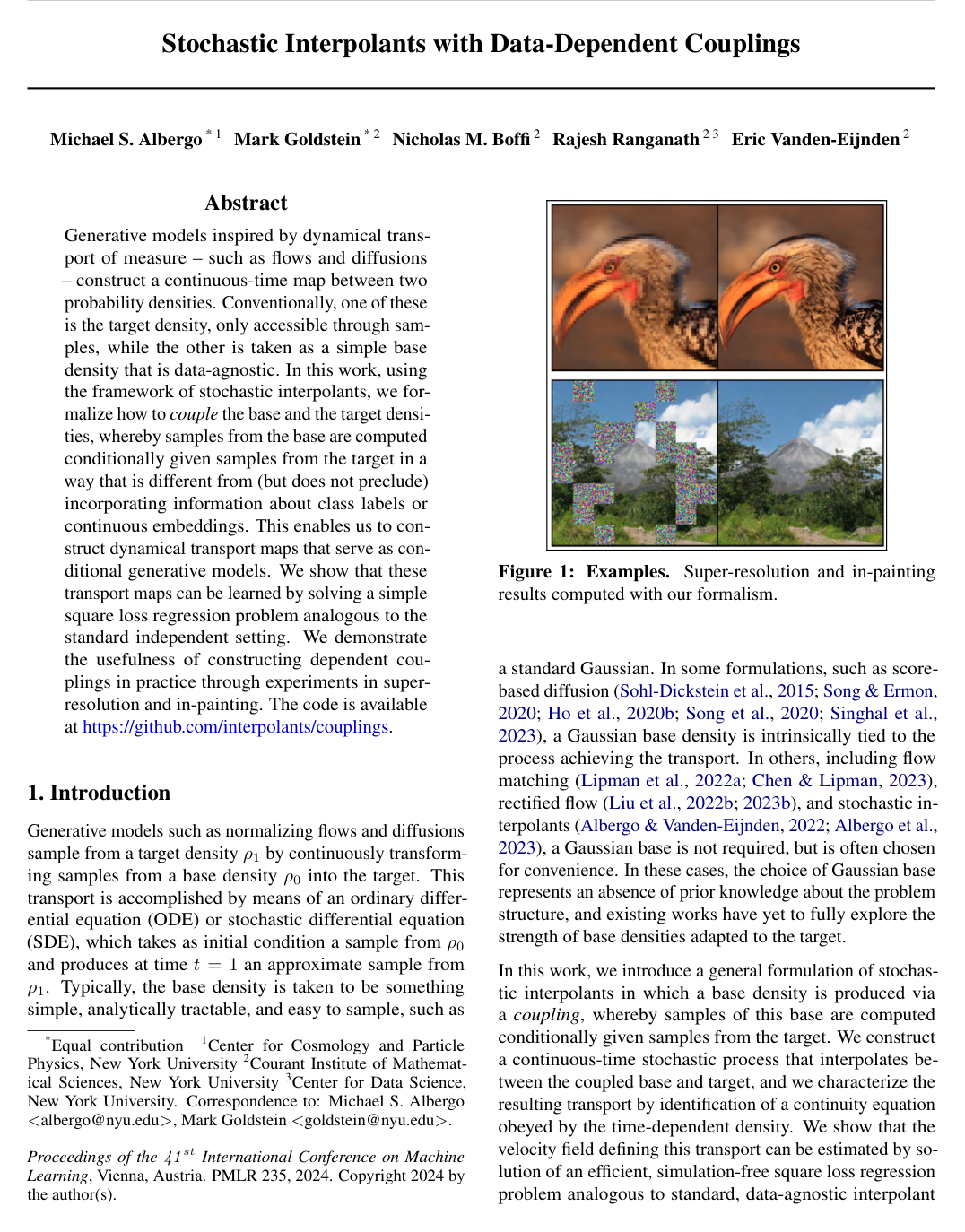
Stochastic Interpolants with Data-Dependent Couplings
Michael S. Albergo, Mark Goldstein, Nicholas Matthew Boffi, Rajesh Ranganath, Eric Vanden-Eijnden
Why you should read this
Proposes a framework for building continuous-time generative models by coupling base and target distributions conditioned on data, enabling efficient simulation-free training for conditional image super-resolution and in-painting tasks.
Generative models inspired by dynamical transport of measure – such as flows and diffusions – construct a continuous-time map between two probability densities. Conventionally, one of these is the target density, only accessible through samples, while the other is taken as a simple base density that is data-agnostic. In this work, using the framework of stochastic interpolants, we formalize how to couple the base and the target densities, whereby samples from the base are computed conditionally given samples from the target in a way that is different from (but does not preclude) incorporating information about class labels or continuous embeddings. This enables us to construct dynamical transport maps that serve as conditional generative models. We show that these transport maps can be learned by solving a simple square loss regression problem analogous to the standard independent setting. We demonstrate the usefulness of constructing dependent couplings in practice through experiments in super-resolution and in-painting. The code is available at https://github.com/interpolants/couplings.
Added
2026-10-02
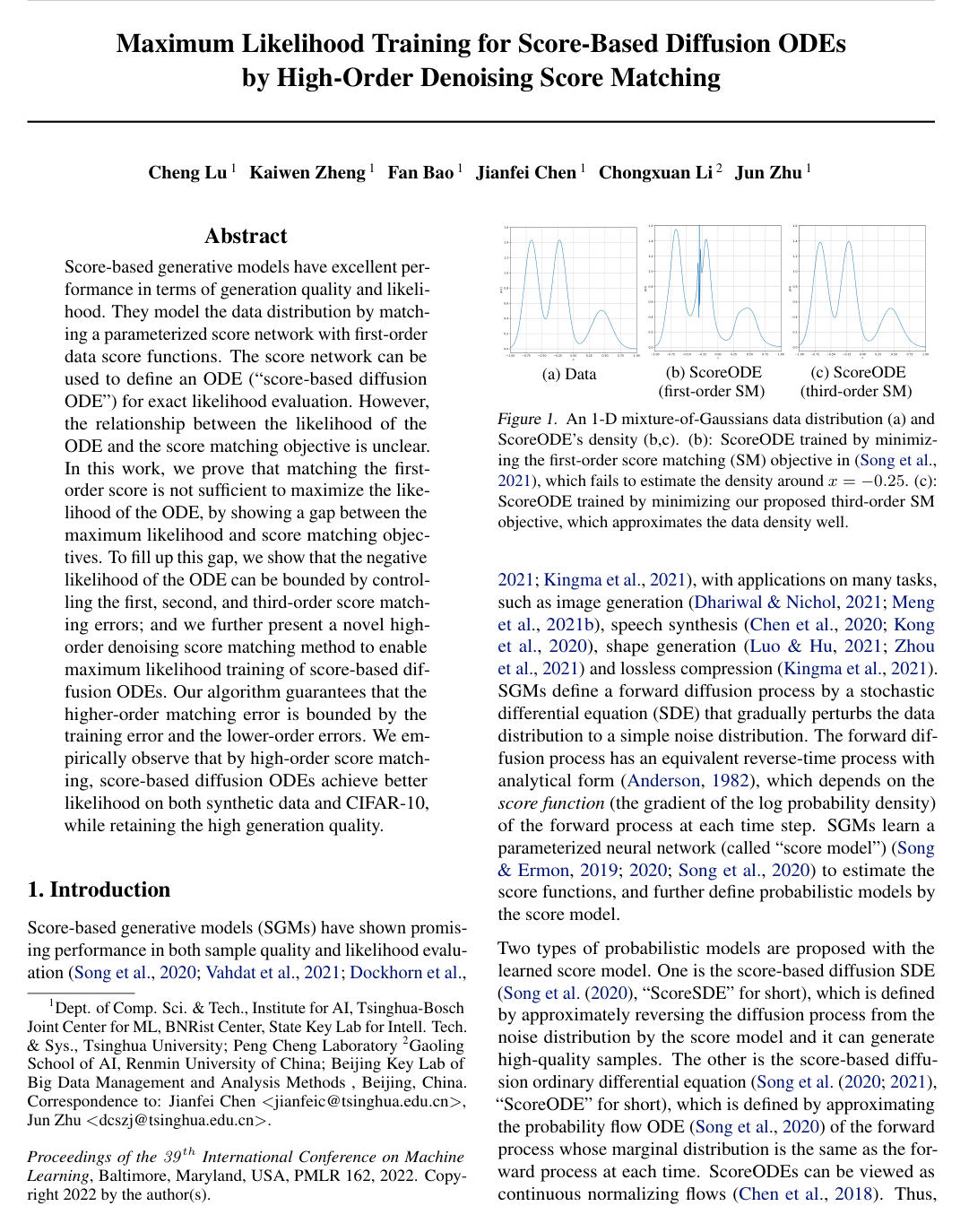
Maximum Likelihood Training for Score-based Diffusion ODEs by High Order Denoising Score Matching
Cheng Lu, Kaiwen Zheng, Fan Bao, Jianfei Chen, Chongxuan Li, Jun Zhu
Why you should read this
Proves that first-order score matching fails to maximize the likelihood of score-based diffusion ODEs and proposes a high-order denoising score matching method that bounds the ODE likelihood error using higher-order score terms to achieve superior likelihood evaluation without sacrificing sample quality.
Score-based generative models have excellent performance in terms of generation quality and likelihood. They model the data distribution by matching a parameterized score network with first-order data score functions. The score network can be used to define an ODE (“score-based diffusion ODE”) for exact likelihood evaluation. However, the relationship between the likelihood of the ODE and the score matching objective is unclear. In this work, we prove that matching the first-order score is not sufficient to maximize the likelihood of the ODE, by showing a gap between the maximum likelihood and score matching objectives. To fill up this gap, we show that the negative likelihood of the ODE can be bounded by controlling the first, second, and third-order score matching errors; and we further present a novel high-order denoising score matching method to enable maximum likelihood training of score-based diffusion ODEs. Our algorithm guarantees that the higher-order matching error is bounded by the training error and the lower-order errors. We empirically observe that by high-order score matching, score-based diffusion ODEs achieve better likelihood on both synthetic data and CIFAR-10, while retaining the high generation quality.
Added
2026-09-26
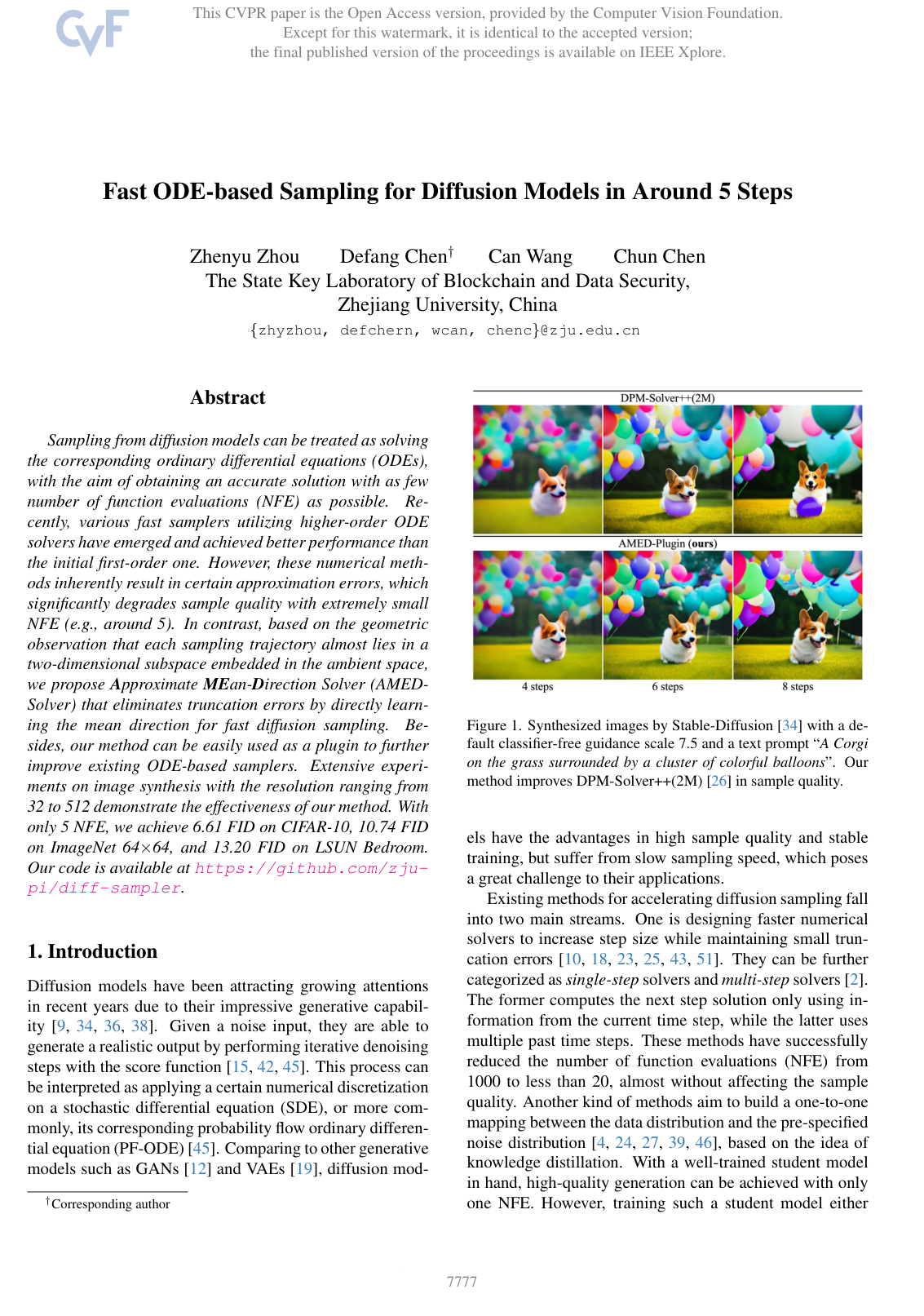
Fast ODE-based Sampling for Diffusion Models in Around 5 Steps
Zhenyu Zhou, Defang Chen, Can Wang, Chun Chen
Why you should read this
Proposes AMED-Solver, a single-step ODE solver that exploits the two-dimensional subspace geometry of diffusion sampling trajectories to eliminate truncation errors and generate high-quality images in only around 5 evaluation steps.
Sampling from diffusion models can be treated as solving the corresponding ordinary differential equations (ODEs), with the aim of obtaining an accurate solution with as few number of function evaluations (NFE) as possible. Recently, various fast samplers utilizing higher-order ODE solvers have emerged and achieved better performance than the initial first-order one. However, these numerical methods inherently result in certain approximation errors, which significantly degrades sample quality with extremely small NFE (e.g., around 5). In contrast, based on the geometric observation that each sampling trajectory almost lies in a two-dimensional subspace embedded in the ambient space, we propose Approximate MEan-Direction Solver (AMED-Solver) that eliminates truncation errors by directly learning the mean direction for fast diffusion sampling. Besides, our method can be easily used as a plugin to further improve existing ODE-based samplers. Extensive experiments on image synthesis with the resolution ranging from 32 to 512 demonstrate the effectiveness of our method. With only 5 NFE, we achieve 6.61 FID on CIFAR-10, 10.74 FID on ImageNet 64x64, and 13.20 FID on LSUN Bedroom. Our code is available at https://github.com/zju-pi/diff-sampler.
Added
2026-09-26
Stochastic Interpolants: A Unifying Framework for Flows and Diffusions
Michael S. Albergo, Nicholas M. Boffi, Eric Vanden-Eijnden
Why you should read this
Introduces a unifying framework of "stochastic interpolants" that bridges flow-based and diffusion-based generative models, allowing exact probability density function transformations in finite time with tunable noise levels.
A class of generative models that unifies flow-based and diffusion-based methods is introduced. These models extend the framework proposed in Albergo and Vanden-Eijnden (2023), enabling the use of a broad class of continuous-time stochastic processes called stochastic interpolants to bridge any two probability density functions exactly in finite time. These interpolants are built by combining data from the two prescribed densities with an additional latent variable that shapes the bridge in a flexible way. The time-dependent density function of the interpolant is shown to satisfy a transport equation as well as a family of forward and backward Fokker-Planck equations with tunable diffusion coefficient. Upon consideration of the time evolution of an individual sample, this viewpoint leads to both deterministic and stochastic generative models based on probability flow equations or stochastic differential equations with an adjustable level of noise. The drift coefficients entering these models are time-dependent velocity fields characterized as the unique minimizers of simple quadratic objective functions, one of which is a new objective for the score. We show that minimization of these quadratic objectives leads to control of the likelihood for generative models built upon stochastic dynamics, while likelihood control for deterministic dynamics is more stringent. We also construct estimators for the likelihood and the cross entropy of interpolant-based generative models, and we discuss connections with other methods such as score-based diffusion models, stochastic localization, probabilistic denoising, and rectifying flows. In addition, we demonstrate that stochastic interpolants recover the Schrödinger bridge between the two target densities when explicitly optimizing over the interpolant. Finally, algorithmic aspects are discussed and the approach is illustrated on numerical examples.
Added
2026-05-14

Denoising Diffusion Implicit Models
Jiaming Song, Chenlin Meng, Stefano Ermon
Why you should read this
Develops a deterministic sampling process (non-Markovian) that allows diffusion models to generate high-quality images in 10-50 steps instead of 1000.
Denoising diffusion probabilistic models (DDPMs) have achieved high quality image generation without adversarial training, yet they require simulating a Markov chain for many steps to produce a sample. To accelerate sampling, we present denoising diffusion implicit models (DDIMs), a more efficient class of iterative implicit probabilistic models with the same training procedure as DDPMs. In DDPMs, the generative process is defined as the reverse of a Markovian diffusion process. We construct a class of non-Markovian diffusion processes that lead to the same training objective, but whose reverse process can be much faster to sample from. We empirically demonstrate that DDIMs can produce high quality samples to faster in terms of wall-clock time compared to DDPMs, allow us to trade off computation for sample quality, and can perform semantically meaningful image interpolation directly in the latent space.
Added
2026-02-25