
keyword
point clouds
A point cloud is a set of discrete data points distributed across a three-dimensional coordinate system that represents the external surfaces and spatial geometry of physical objects or scenes. Typically acquired through depth-sensing technologies such as LiDAR scanners, RGB-D cameras, or multi-view photogrammetry, each point is primarily defined by its spatial coordinates and may also include additional attributes such as color, intensity, or surface normals. Unlike structured grid formats like digital images or voxel arrays, point clouds are naturally unordered, irregularly distributed, and sparse, lacking explicit topological connectivity. They serve as a foundational data representation in spatial computing, playing a critical role in applications such as autonomous navigation, robotic perception, 3D object detection, semantic segmentation, and surface reconstruction.
23 items
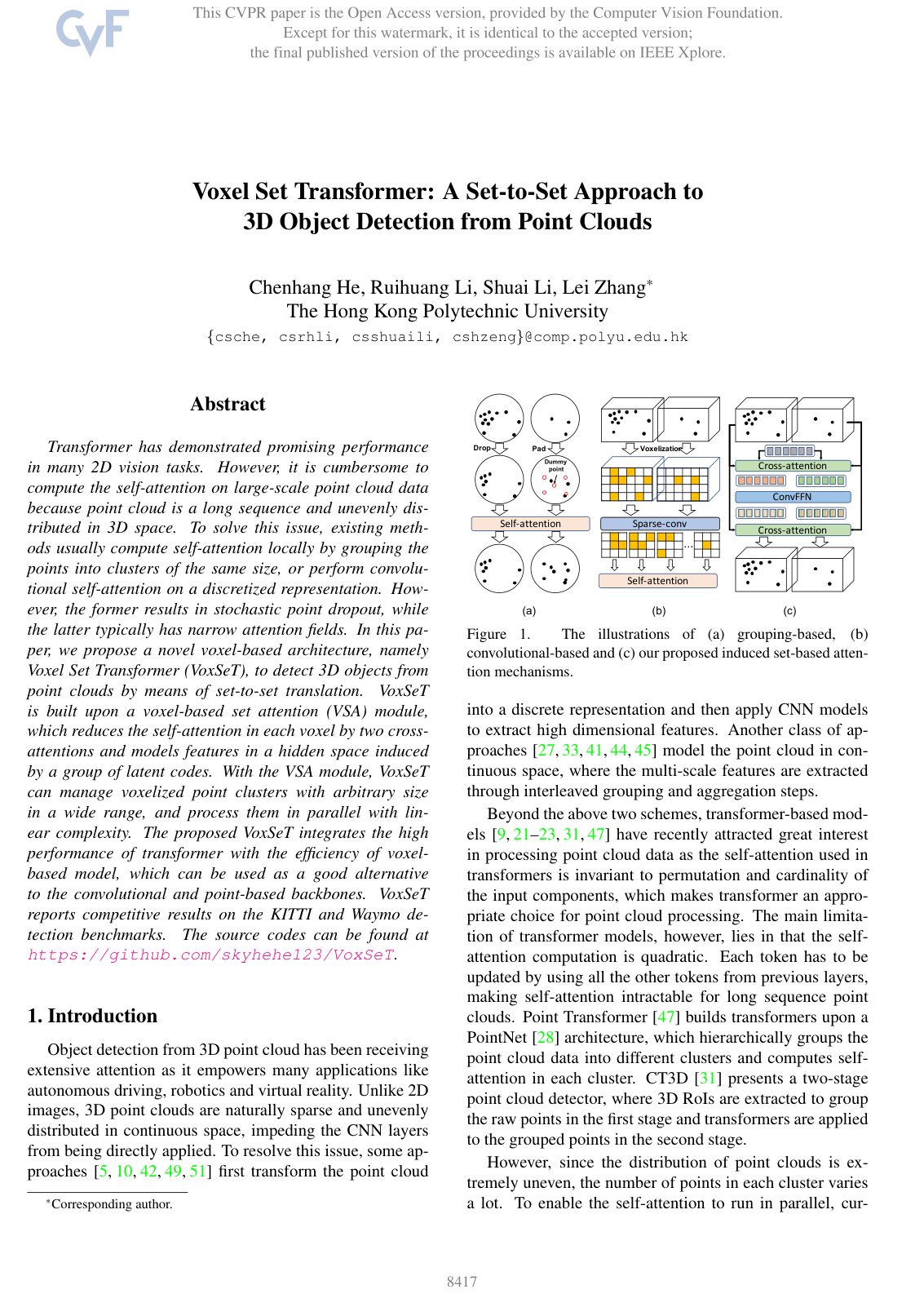
Voxel Set Transformer: A Set-to-Set Approach to 3D Object Detection from Point Clouds
Chenhang He, Ruihuang Li, Shuai Li, Lei Zhang
Why you should read this
Proposes Voxel Set Transformer, a linear-complexity backbone that processes arbitrary-sized 3D point clusters in parallel through latent-code induced cross-attentions to achieve efficient and competitive 3D object detection on large-scale point clouds.
Transformer has demonstrated promising performance in many 2D vision tasks. However, it is cumbersome to compute the self-attention on large-scale point cloud data because point cloud is a long sequence and unevenly distributed in 3D space. To solve this issue, existing methods usually compute self-attention locally by grouping the points into clusters of the same size, or perform convolutional self-attention on a discretized representation. However, the former results in stochastic point dropout, while the latter typically has narrow attention fields. In this paper, we propose a novel voxel-based architecture, namely Voxel Set Transformer (VoxSeT), to detect 3D objects from point clouds by means of set-to-set translation. VoxSeT is built upon a voxel-based set attention (VSA) module, which reduces the self-attention in each voxel by two cross-attentions and models features in a hidden space induced by a group of latent codes. With the VSA module, VoxSeT can manage voxelized point clusters with arbitrary size in a wide range, and process them in parallel with linear complexity. The proposed VoxSeT integrates the high performance of transformer with the efficiency of voxel-based model, which can be used as a good alternative to the convolutional and point-based backbones. VoxSeT reports competitive results on the KITTI and Waymo detection benchmarks. The source codes can be found at https://github.com/skyhehe123/VoxSeT.
Added
2026-10-05
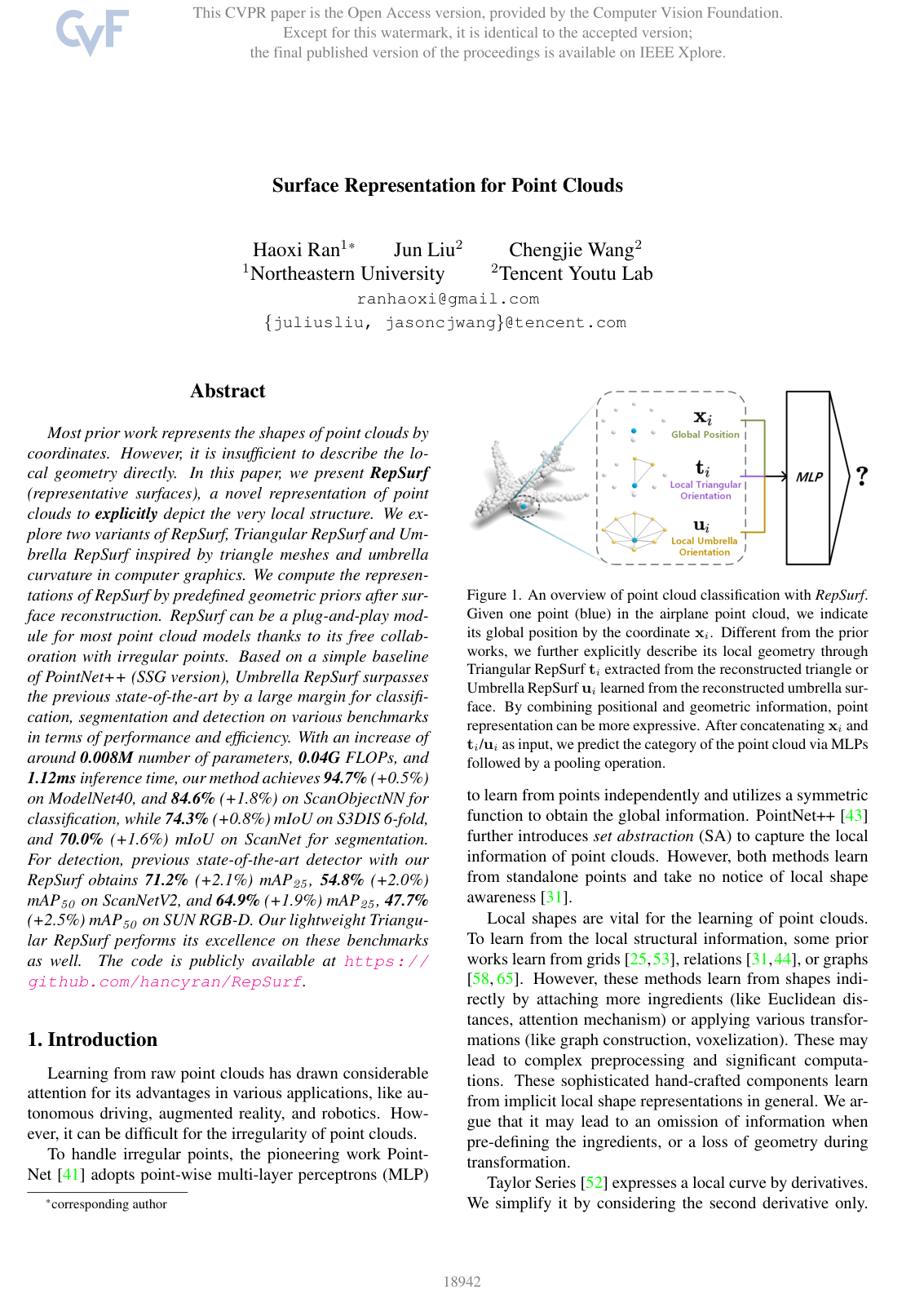
Surface Representation for Point Clouds
Haoxi Ran, Jun Liu, Chengjie Wang
Why you should read this
Proposes RepSurf, a lightweight, plug-and-play surface representation that explicitly models local geometry using graphics-inspired triangle and umbrella primitives to boost accuracy across 3D classification, segmentation, and detection tasks with negligible computational overhead.
Most prior work represents the shapes of point clouds by coordinates. However, it is insufficient to describe the local geometry directly. In this paper, we present RepSurf (representative surfaces), a novel representation of point clouds to explicitly depict the very local structure. We explore two variants of RepSurf, Triangular RepSurf and Umbrella RepSurf inspired by triangle meshes and umbrella curvature in computer graphics. We compute the representations of RepSurf by predefined geometric priors after surface reconstruction. RepSurf can be a plug-and-play module for most point cloud models thanks to its free collaboration with irregular points. Based on a simple baseline of PointNet++ (SSG version), Umbrella RepSurf surpasses the previous state-of-the-art by a large margin for classification, segmentation and detection on various benchmarks in terms of performance and efficiency. With an increase of around 0.008M number of parameters, 0.04G FLOPs, and 1.12ms inference time, our method achieves 94.7% (+0.5%) on ModelNet40, and 84.6% (+1.8%) on ScanObjectNN for classification, while 74.3% (+0.8%) mIoU on S3DIS 6-fold, and 70.0% (+1.6%) mIoU on ScanNet for segmentation. For detection, previous state-of-the-art detector with our RepSurf obtains 71.2% (+2.1%) mAP25, 54.8% (+2.0%) mAP50 on ScanNetV2, and 64.9% (+1.9%) mAP25, 47.7% (+2.5%) mAP50 on SUN RGB-D. Our lightweight Triangular RepSurf performs its excellence on these benchmarks as well. The code is publicly available at https://github.com/hancyran/RepSurf.
Added
2026-10-05
TransFusion: Robust LiDAR-Camera Fusion for 3D Object Detection with Transformers
Xuyang Bai, Zeyu Hu, Xinge Zhu, Qingqiu Huang, Yilun Chen, Hongbo Fu, Chiew-Lan Tai
Why you should read this
Introduces TransFusion, a transformer-based 3D object detection framework that replaces rigid point-pixel calibrations with an adaptive soft-association mechanism to maintain state-of-the-art accuracy under poor illumination and sensor misalignment.
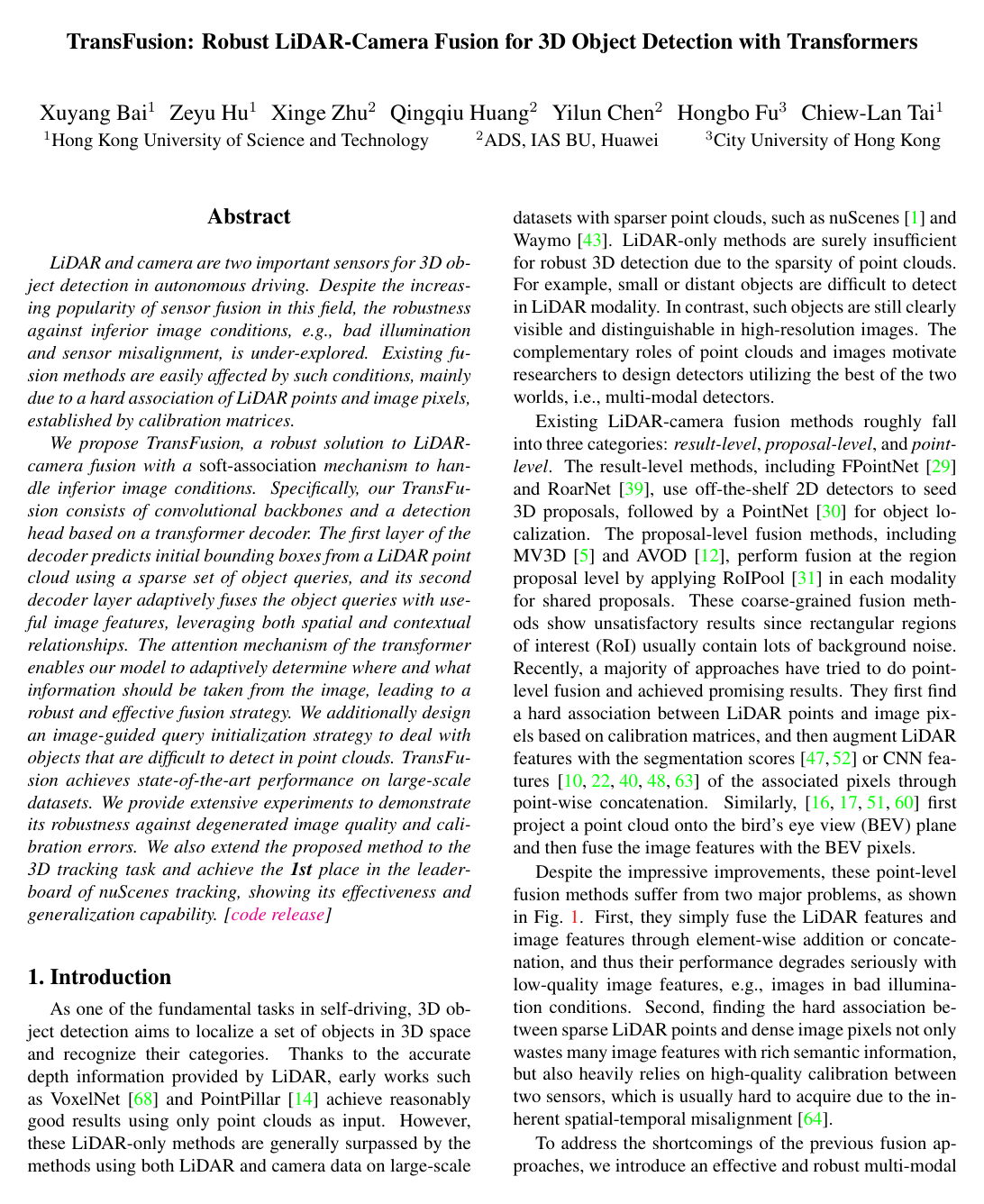
LiDAR and camera are two important sensors for 3D object detection in autonomous driving. Despite the increasing popularity of sensor fusion in this field, the robustness against inferior image conditions, e.g., bad illumination and sensor misalignment, is under-explored. Existing fusion methods are easily affected by such conditions, mainly due to a hard association of LiDAR points and image pixels, established by calibration matrices. We propose TransFusion, a robust solution to LiDAR-camera fusion with a soft-association mechanism to handle inferior image conditions. Specifically, our TransFusion consists of convolutional backbones and a detection head based on a transformer decoder. The first layer of the decoder predicts initial bounding boxes from a LiDAR point cloud using a sparse set of object queries, and its second decoder layer adaptively fuses the object queries with useful image features, leveraging both spatial and contextual relationships. The attention mechanism of the transformer enables our model to adaptively determine where and what information should be taken from the image, leading to a robust and effective fusion strategy. We additionally design an image-guided query initialization strategy to deal with objects that are difficult to detect in point clouds. TransFusion achieves state-of-the-art performance on large-scale datasets. We provide extensive experiments to demonstrate its robustness against degenerated image quality and calibration errors. We also extend the proposed method to the 3D tracking task and achieve the 1st place in the leaderboard of nuScenes tracking, showing its effectiveness and generalization capability.
Added
2026-10-05
Equivariance with Learned Canonicalization Functions
Sékou-Oumar Kaba, Arnab Kumar Mondal, Yan Zhang, Yoshua Bengio, Siamak Ravanbakhsh
Why you should read this
Proposes an end-to-end learnable canonicalization framework that enables arbitrary standard neural networks to achieve exact group equivariance with theoretical universality and faster inference than architecture-constrained alternatives.
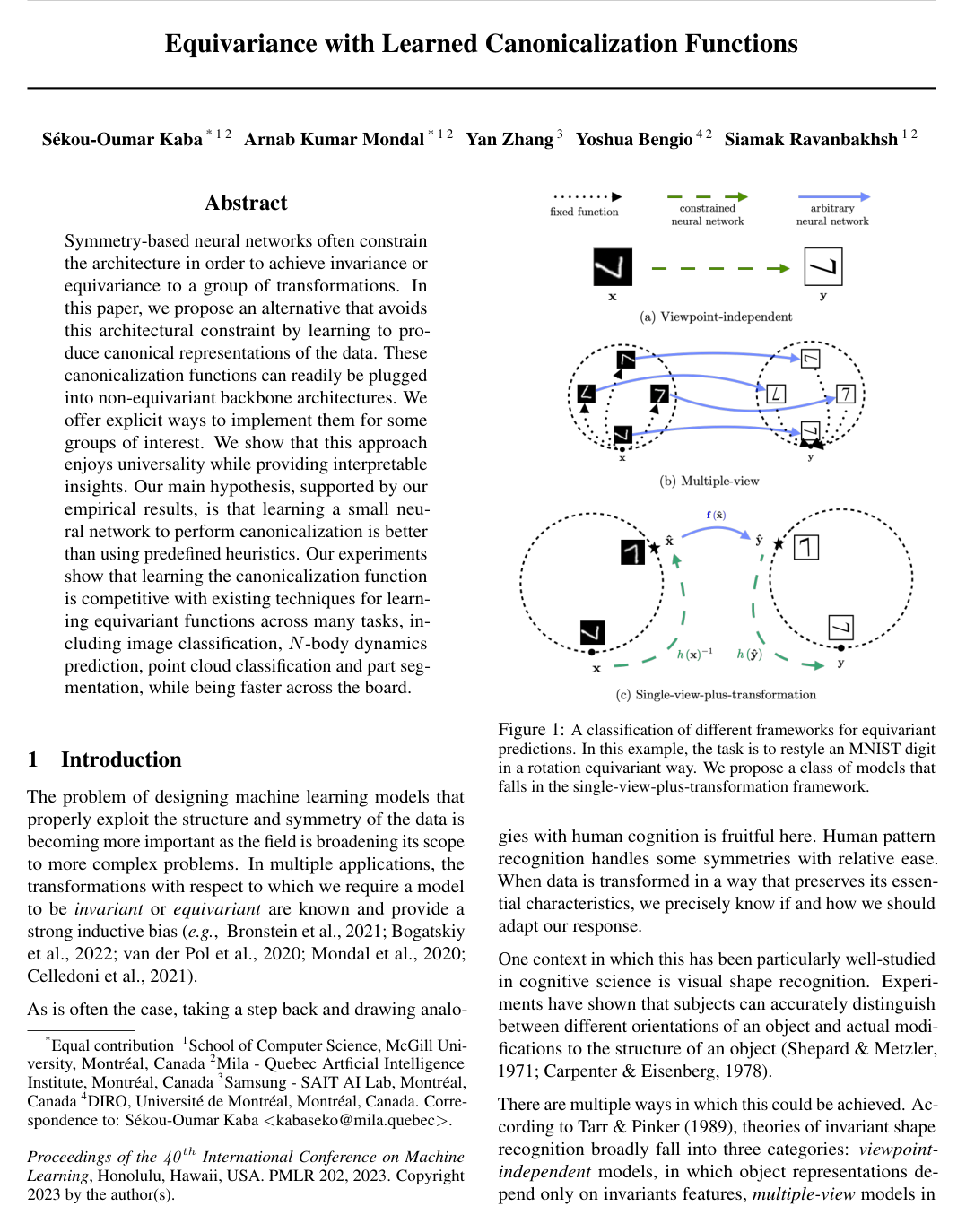
Symmetry-based neural networks often constrain the architecture in order to achieve invariance or equivariance to a group of transformations. In this paper, we propose an alternative that avoids this architectural constraint by learning to produce canonical representations of the data. These canonicalization functions can readily be plugged into non-equivariant backbone architectures. We offer explicit ways to implement them for some groups of interest. We show that this approach enjoys universality while providing interpretable insights. Our main hypothesis, supported by our empirical results, is that learning a small neural network to perform canonicalization is better than using predefined heuristics. Our experiments show that learning the canonicalization function is competitive with existing techniques for learning equivariant functions across many tasks, including image classification, N-body dynamics prediction, point cloud classification and part segmentation, while being faster across the board.
Added
2026-10-01
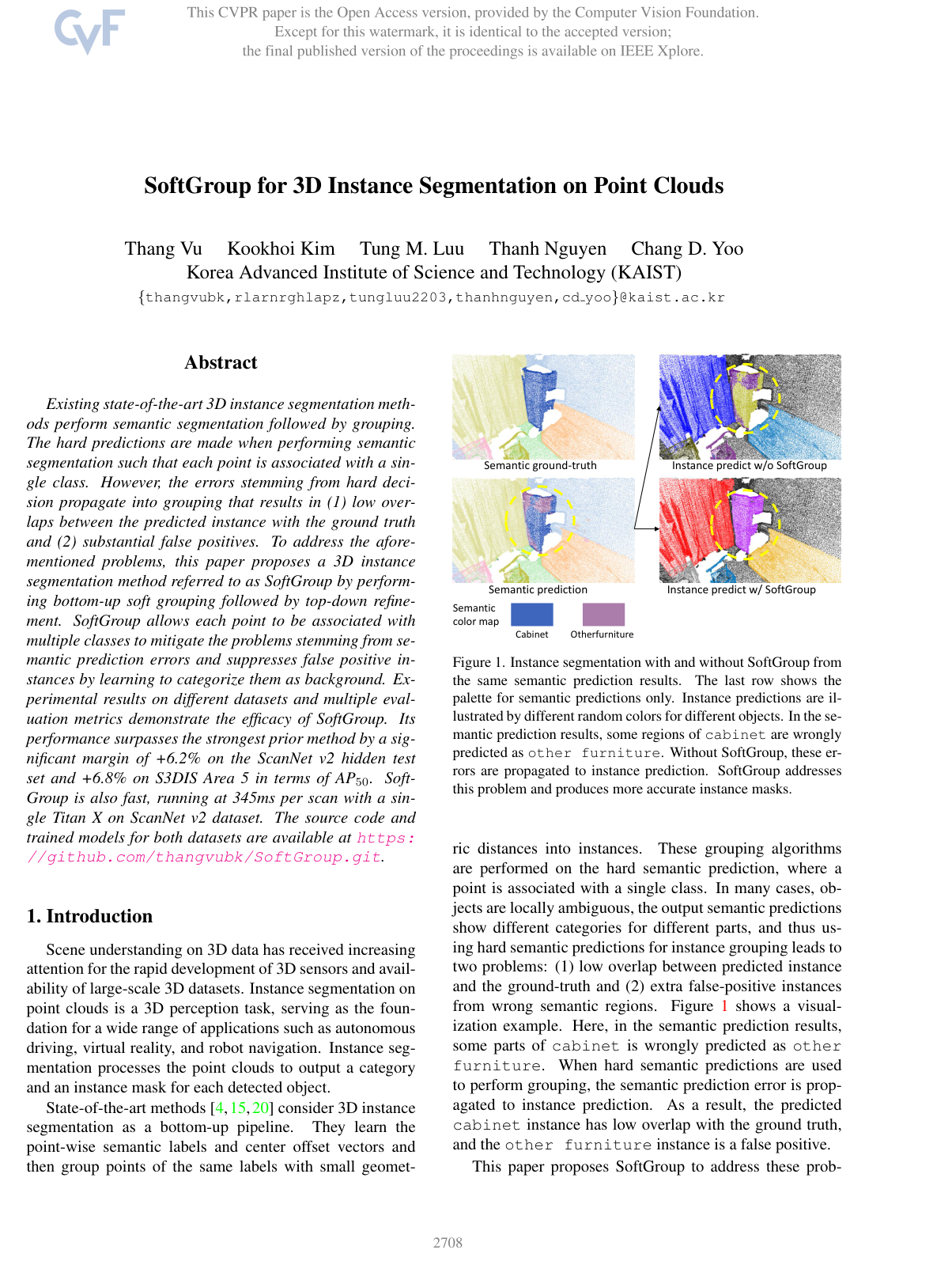
SoftGroup for 3D Instance Segmentation on Point Clouds
Thang Vu, Kookhoi Kim, Tung Minh Luu, Thanh Xuan Nguyen, Chang D. Yoo
Why you should read this
Proposes SoftGroup, a 3D instance segmentation method that associates points with multiple semantic classes during bottom-up grouping to prevent error propagation, achieving substantial accuracy gains and fast inference on ScanNet v2 and S3DIS.
Existing state-of-the-art 3D instance segmentation methods perform semantic segmentation followed by grouping. The hard predictions are made when performing semantic segmentation such that each point is associated with a single class. However, the errors stemming from hard decision propagate into grouping that results in (1) low overlaps between the predicted instance with the ground truth and (2) substantial false positives. To address the aforementioned problems, this paper proposes a 3D instance segmentation method referred to as SoftGroup by performing bottom-up soft grouping followed by top-down refinement. SoftGroup allows each point to be associated with multiple classes to mitigate the problems stemming from semantic prediction errors and suppresses false positive instances by learning to categorize them as background. Experimental results on different datasets and multiple evaluation metrics demonstrate the efficacy of SoftGroup. Its performance surpasses the strongest prior method by a significant margin of +6.2% on the ScanNet v2 hidden test set and +6.8% on S3DIS Area 5 in terms of AP_50. SoftGroup is also fast, running at 345ms per scan with a single Titan X on ScanNet v2 dataset. The source code and trained models for both datasets are available at \url{this https URL}.
Added
2026-09-26
SVGA-Net: Sparse Voxel-Graph Attention Network for 3D Object Detection from Point Clouds
Qingdong He, Zhengning Wang, Hao Zeng, Yi Zeng, Yijun Liu
Why you should read this
Proposes an end-to-end 3D object detection framework that couples spherical voxel complete graphs with global nearest-neighbor graph attention to effectively capture both local point interactions and cross-voxel context directly from raw LiDAR data.
Accurate 3D object detection from point clouds has become a crucial component in autonomous driving. However, the volumetric representations and the projection methods in previous works fail to establish the relationships between the local point sets. In this paper, we propose Sparse Voxel-Graph Attention Network (SVGA-Net), a novel end-to-end trainable network which mainly contains voxel-graph module and sparse-to-dense regression module to achieve comparable 3D detection tasks from raw LIDAR data. Specifically, SVGA-Net constructs the local complete graph within each divided 3D spherical voxel and global KNN graph through all voxels. The local and global graphs serve as the attention mechanism to enhance the extracted features. In addition, the novel sparse-to-dense regression module enhances the 3D box estimation accuracy through feature maps aggregation at different levels. Experiments on KITTI detection benchmark and Waymo Open dataset demonstrate the efficiency of extending the graph representation to 3D object detection and the proposed SVGA-Net can achieve decent detection accuracy.
Added
2026-09-26
BEVFusion: A Simple and Robust LiDAR-Camera Fusion Framework
Tingting Liang, Hongwei Xie, Kaicheng Yu, Zhongyu Xia, Zhiwei Lin, Yongtao Wang, Tao Tang, Bing Wang, Zhi Tang
Why you should read this
Presents BEVFusion, a LiDAR-camera fusion framework for 3D object detection that eliminates camera dependence on LiDAR inputs, achieving superior performance on standard benchmarks while maintaining high accuracy during sensor malfunctions in autonomous driving scenarios.
Fusing the camera and LiDAR information has become a de-facto standard for 3D object detection tasks. Current methods rely on point clouds from the LiDAR sensor as queries to leverage the feature from the image space. However, people discovered that this underlying assumption makes the current fusion framework infeasible to produce any prediction when there is a LiDAR malfunction, regardless of minor or major. This fundamentally limits the deployment capability to realistic autonomous driving scenarios. In contrast, we propose a surprisingly simple yet novel fusion framework, dubbed BEVFusion, whose camera stream does not depend on the input of LiDAR data, thus addressing the downside of previous methods. We empirically show that our framework surpasses the state-of-the-art methods under the normal training settings. Under the robustness training settings that simulate various LiDAR malfunctions, our framework significantly surpasses the state-of-the-art methods by 15.7% to 28.9% mAP. To the best of our knowledge, we are the first to handle realistic LiDAR malfunction and can be deployed to realistic scenarios without any post-processing procedure. The code is available at this https URL.
Added
2026-09-26
PointGPT: Auto-regressively Generative Pre-training from Point Clouds
Guangyan Chen, Meiling Wang, Yi Yang, Kai Yu, Li Yuan, Yufeng Yue
Why you should read this
Proposes an autoregressive generative pre-training framework for 3D point clouds that arranges patches using Morton ordering and applies a dual masking strategy to prevent shape leakage, achieving state-of-the-art representation learning performance across standard benchmarks.
Large language models (LLMs) based on the generative pre-training transformer (GPT) [46] have demonstrated remarkable effectiveness across a diverse range of downstream tasks. Inspired by the advancements of the GPT, we present PointGPT, a novel approach that extends the concept of GPT to point clouds, addressing the challenges associated with disorder properties, low information density, and task gaps. Specifically, a point cloud auto-regressive generation task is proposed to pre-train transformer models. Our method partitions the input point cloud into multiple point patches and arranges them in an ordered sequence based on their spatial proximity. Then, an extractor-generator based transformer decoder [27], with a dual masking strategy, learns latent representations conditioned on the preceding point patches, aiming to predict the next one in an auto-regressive manner. To explore scalability and enhance performance, a larger pre-training dataset is collected. Additionally, a subsequent post-pre-training stage is introduced, incorporating a labeled hybrid dataset. Our scalable approach allows for learning high-capacity models that generalize well, achieving state-of-the-art performance on various downstream tasks. In particular, our approach achieves classification accuracies of 94.9% on the ModelNet40 dataset and 93.4% on the ScanObjectNN dataset, outperforming all other transformer models. Furthermore, our method also attains new state-of-the-art accuracies on all four few-shot learning benchmarks. Codes are available at https://github.com/CGuangyan-BIT/PointGPT.
Added
2026-09-26
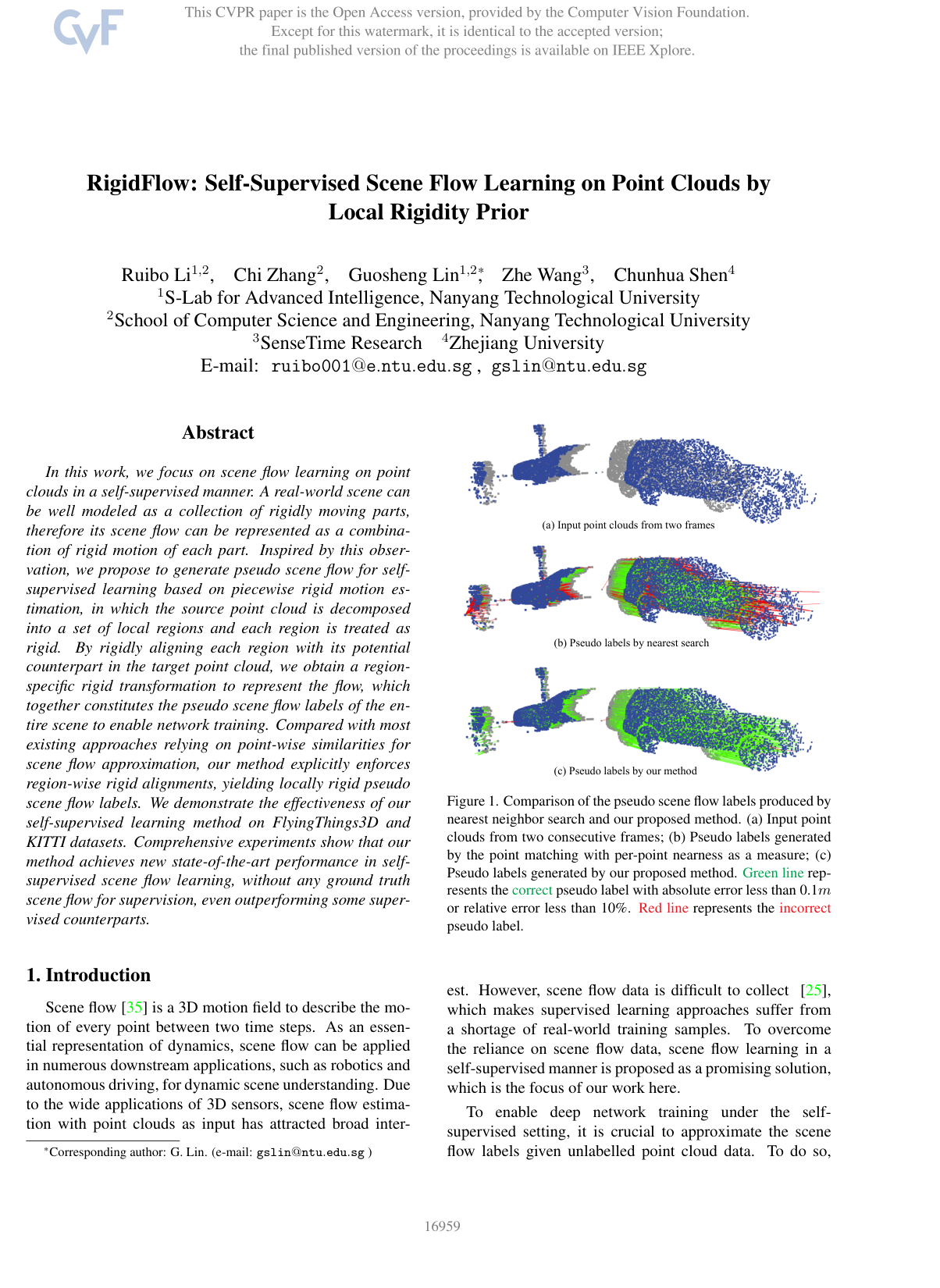
RigidFlow: Self-Supervised Scene Flow Learning on Point Clouds by Local Rigidity Prior
Ruibo Li, Chi Zhang, Guosheng Lin, Zhe Wang, Chunhua Shen
Why you should read this
Proposes a self-supervised point cloud scene flow learning framework that derives accurate pseudo labels by decomposing scenes into local regions and enforcing piecewise rigid alignments, surpassing several fully supervised methods on standard benchmarks without requiring ground-truth supervision.
In this work, we focus on scene flow learning on point clouds in a self-supervised manner. A real-world scene can be well modeled as a collection of rigidly moving parts, therefore its scene flow can be represented as a combination of rigid motion of each part. Inspired by this observation, we propose to generate pseudo scene flow for self-supervised learning based on piecewise rigid motion estimation, in which the source point cloud is decomposed into a set of local regions and each region is treated as rigid. By rigidly aligning each region with its potential counterpart in the target point cloud, we obtain a region-specific rigid transformation to represent the flow, which together constitutes the pseudo scene flow labels of the entire scene to enable network training. Compared with most existing approaches relying on point-wise similarities for scene flow approximation, our method explicitly enforces region-wise rigid alignments, yielding locally rigid pseudo scene flow labels. We demonstrate the effectiveness of our self-supervised learning method on FlyingThings3D and KITTI datasets. Comprehensive experiments show that our method achieves new state-of-the-art performance in self-supervised scene flow learning, without any ground truth scene flow for supervision, even outperforming some supervised counterparts.
Added
2026-09-26
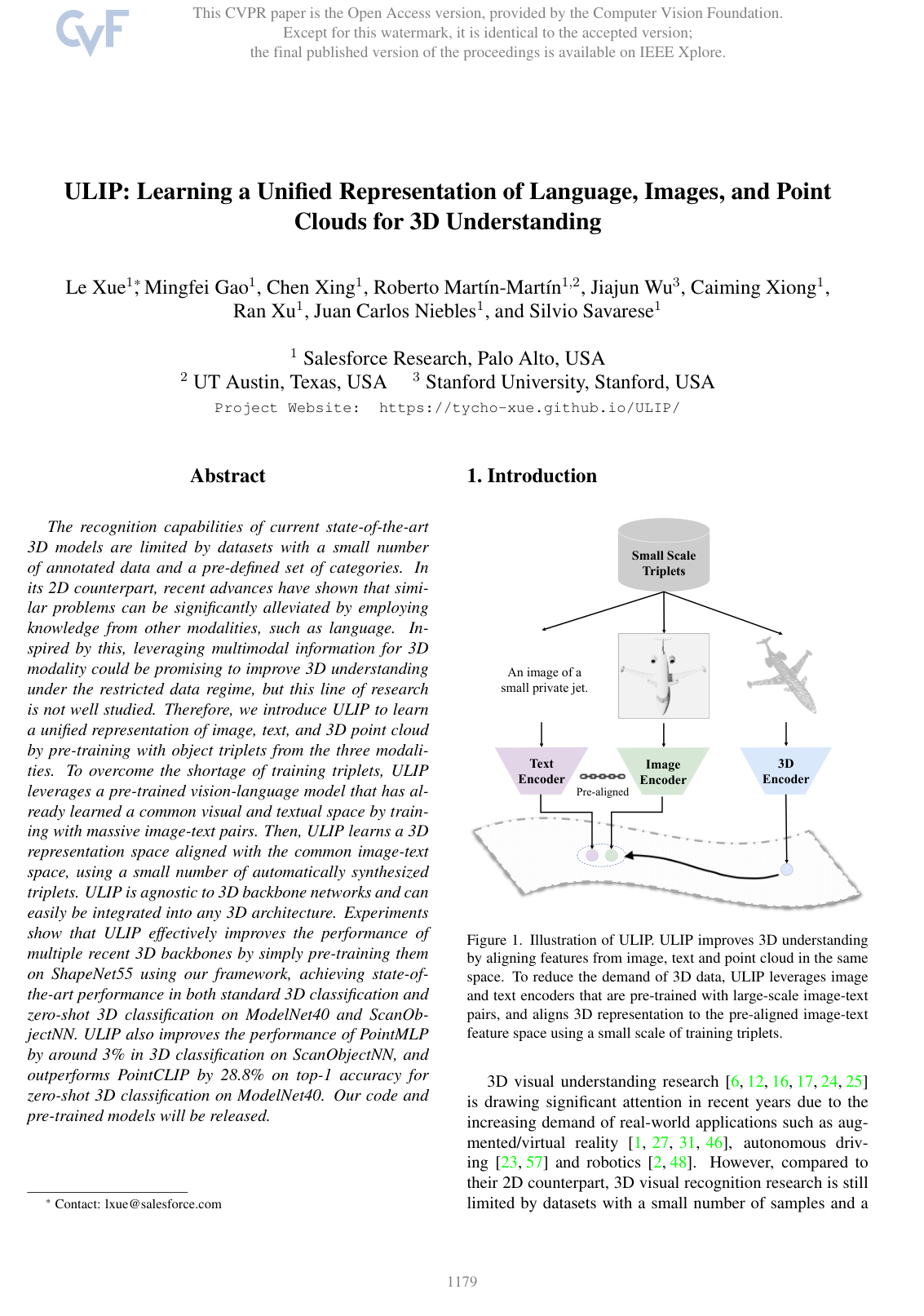
ULIP: Learning a Unified Representation of Language, Images, and Point Clouds for 3D Understanding
Le Xue, Mingfei Gao, Chen Xing, Roberto Martín-Martín, Jiajun Wu, Caiming Xiong, Ran Xu, Juan Carlos Niebles, Silvio Savarese
Why you should read this
Introduces a model-agnostic pre-training framework that aligns 3D point cloud encoders with frozen vision-language models using synthesized multimodal triplets, substantially boosting zero-shot and standard 3D recognition performance across various architectures.
The recognition capabilities of current state-of-the-art 3D models are limited by datasets with a small number of annotated data and a pre-defined set of categories. In its 2D counterpart, recent advances have shown that similar problems can be significantly alleviated by employing knowledge from other modalities, such as language. Inspired by this, leveraging multimodal information for 3D modality could be promising to improve 3D understanding under the restricted data regime, but this line of research is not well studied. Therefore, we introduce ULIP to learn a unified representation of image, text, and 3D point cloud by pre-training with object triplets from the three modalities. To overcome the shortage of training triplets, ULIP leverages a pre-trained vision-language model that has already learned a common visual and textual space by training with massive image-text pairs. Then, ULIP learns a 3D representation space aligned with the common image-text space, using a small number of automatically synthesized triplets. ULIP is agnostic to 3D backbone networks and can easily be integrated into any 3D architecture. Experiments show that ULIP effectively improves the performance of multiple recent 3D backbones by simply pre-training them on ShapeNet55 using our framework, achieving state-of-the-art performance in both standard 3D classification and zero-shot 3D classification on ModelNet40 and ScanObjectNN. ULIP also improves the performance of PointMLP by around 3% in 3D classification on ScanObjectNN, and outperforms PointCLIP by 28.8% on top-1 accuracy for zero-shot 3D classification on ModelNet40. Our code and pre-trained models will be released.
Added
2026-09-26
CAGroup3D: Class-Aware Grouping for 3D Object Detection on Point Clouds
Haiyang Wang, Lihe Ding, Shaocong Dong, Shaoshuai Shi, Aoxue Li, Jianan Li, Zhenguo Li, Liwei Wang
Why you should read this
Introduces a two-stage fully sparse convolutional framework for 3D indoor object detection that overcomes bottom-up grouping errors by enforcing semantic consistency during proposal generation and using an efficient sparse RoI pooling module to recover missed geometric features directly from the backbone.
We present a novel two-stage fully sparse convolutional 3D object detection framework, named CAGroup3D. Our proposed method first generates some high-quality 3D proposals by leveraging the class-aware local group strategy on the object surface voxels with the same semantic predictions, which considers semantic consistency and diverse locality abandoned in previous bottom-up approaches. Then, to recover the features of missed voxels due to incorrect voxel-wise segmentation, we build a fully sparse convolutional RoI pooling module to directly aggregate fine-grained spatial information from backbone for further proposal refinement. It is memory-and-computation efficient and can better encode the geometry-specific features of each 3D proposal. Our model achieves state-of-the-art 3D detection performance with remarkable gains of +3.6% on ScanNet V2 and +2.6% on SUN RGB-D in term of [email protected]. Code will be available at https://github.com/Haiyang-W/CAGroup3D.
Added
2026-09-26
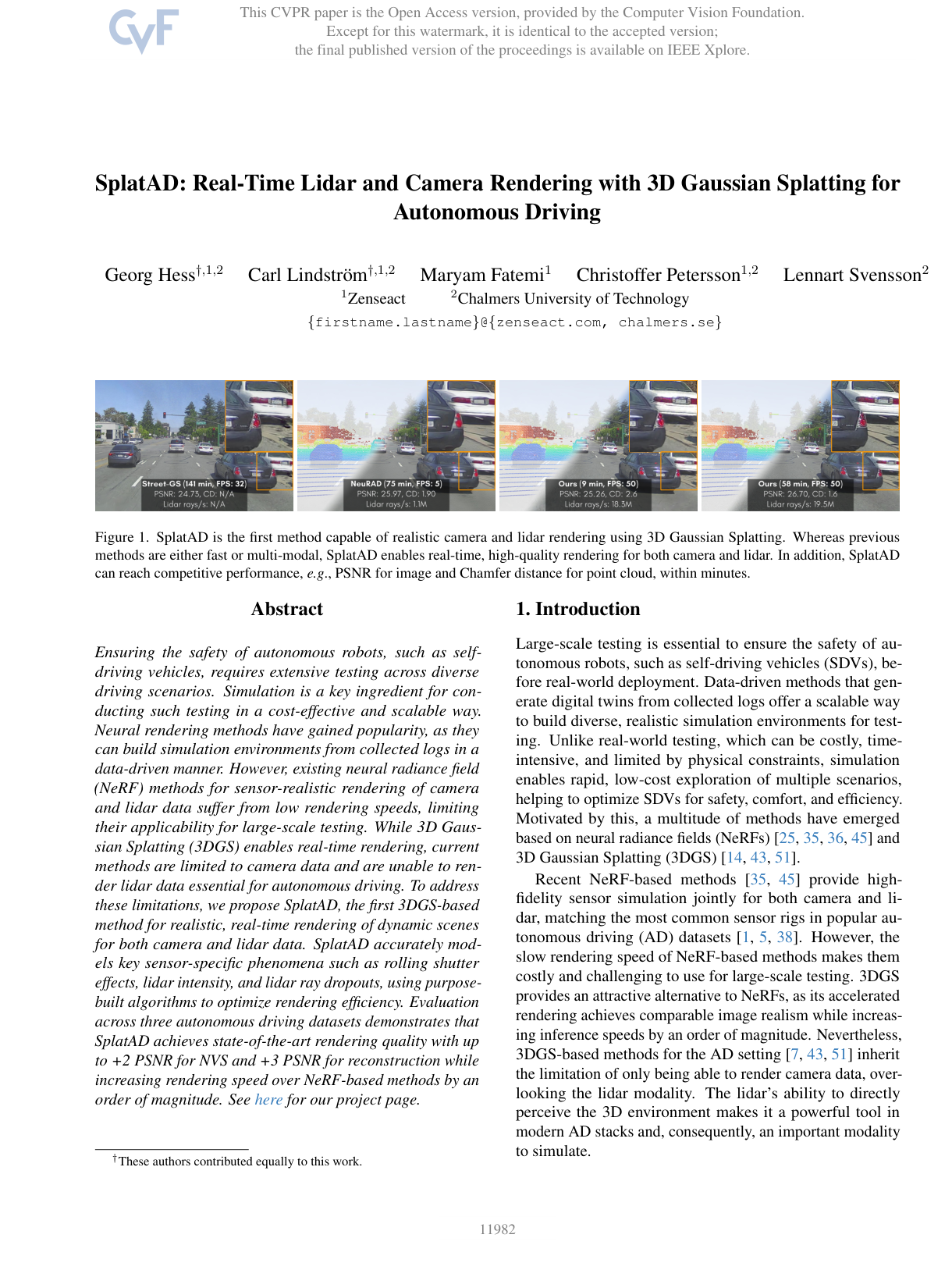
SplatAD: Real-Time Lidar and Camera Rendering with 3D Gaussian Splatting for Autonomous Driving
Georg Hess, Carl Lindstrm, Maryam Fatemi, Christoffer Petersson, Lennart Svensson
Why you should read this
Introduces the first 3D Gaussian Splatting framework for simultaneous real-time rendering of both camera and lidar data in dynamic autonomous driving scenes, accurately modeling sensor-specific effects like rolling shutter and ray dropouts while rendering an order of magnitude faster than NeRF-based alternatives.
Ensuring the safety of autonomous robots, such as self-driving vehicles, requires extensive testing across diverse driving scenarios. Simulation is a key ingredient for conducting such testing in a cost-effective and scalable way. Neural rendering methods have gained popularity, as they can build simulation environments from collected logs in a data-driven manner. However, existing neural radiance field (NeRF) methods for sensor-realistic rendering of camera and lidar data suffer from low rendering speeds, limiting their applicability for large-scale testing. While 3D Gaussian Splatting (3DGS) enables real-time rendering, current methods are limited to camera data and are unable to render lidar data essential for autonomous driving. To address these limitations, we propose SplatAD, the first 3DGS-based method for realistic, real-time rendering of dynamic scenes for both camera and lidar data. SplatAD accurately models key sensor-specific phenomena such as rolling shutter effects, lidar intensity, and lidar ray dropouts, using purpose-built algorithms to optimize rendering efficiency. Evaluation across three autonomous driving datasets demonstrates that SplatAD achieves state-of-the-art rendering quality with up to +2 PSNR for NVS and +3 PSNR for reconstruction while increasing rendering speed over NeRF-based methods by an order of magnitude. See here for our project page.
Added
2026-09-26
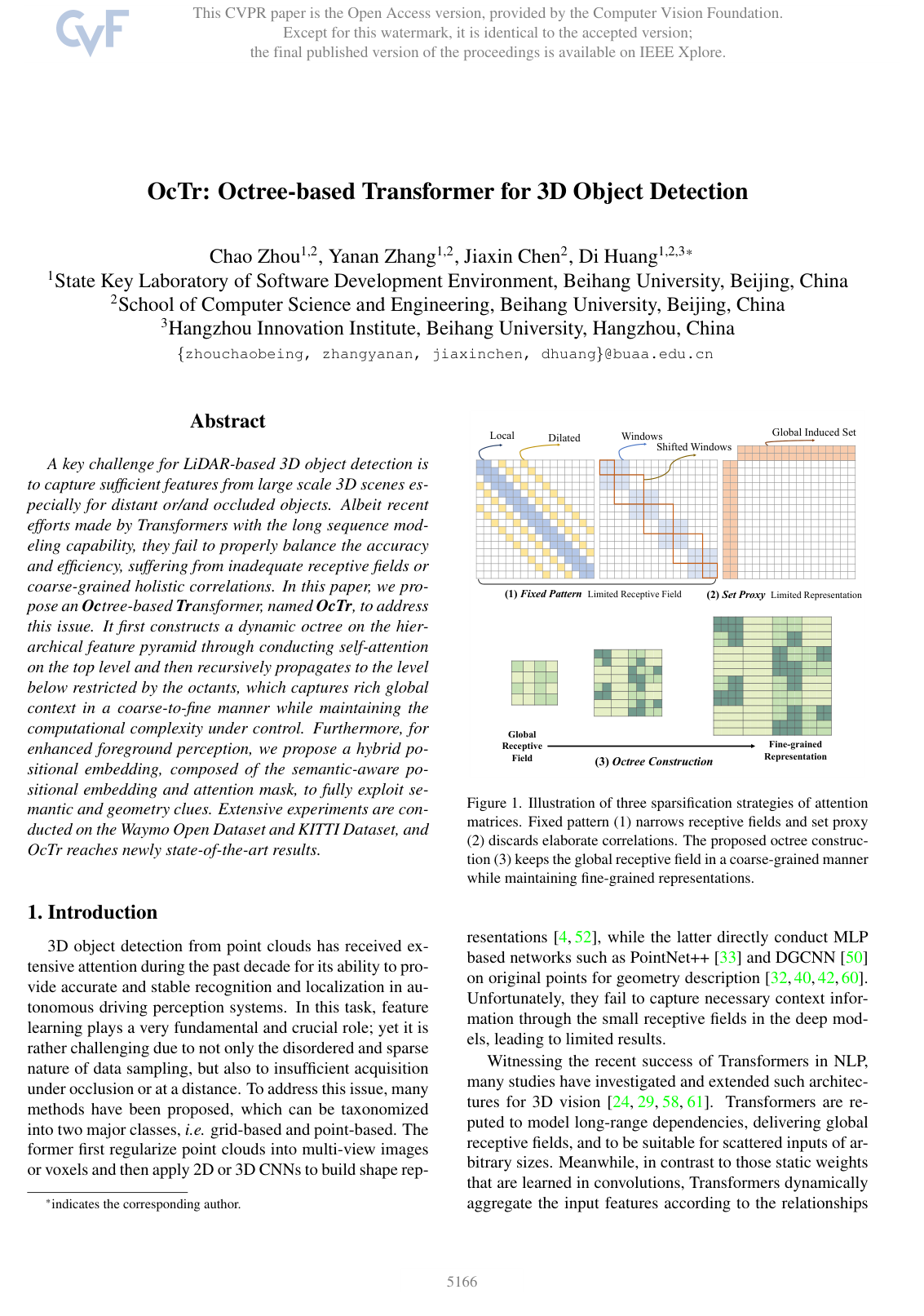
OcTr: Octree-Based Transformer for 3D Object Detection
Chao Zhou, Yanan Zhang, Jiaxin Chen, Di Huang
Why you should read this
Proposes an octree-based Transformer architecture that captures coarse-to-fine global context through hierarchical dynamic self-attention, reducing computational complexity to linear while achieving state-of-the-art 3D object detection on large-scale LiDAR point clouds.
A key challenge for LiDAR-based 3D object detection is to capture sufficient features from large scale 3D scenes especially for distant or/and occluded objects. Albeit recent efforts made by Transformers with the long sequence modeling capability, they fail to properly balance the accuracy and efficiency, suffering from inadequate receptive fields or coarse-grained holistic correlations. In this paper, we propose an Octree-based Transformer, named OcTr, to address this issue. It first constructs a dynamic octree on the hierarchical feature pyramid through conducting self-attention on the top level and then recursively propagates to the level below restricted by the octants, which captures rich global context in a coarse-to-fine manner while maintaining the computational complexity under control. Furthermore, for enhanced foreground perception, we propose a hybrid positional embedding, composed of the semantic-aware positional embedding and attention mask, to fully exploit semantic and geometry clues. Extensive experiments are conducted on the Waymo Open Dataset and KITTI Dataset, and OcTr reaches newly state-of-the-art results.
Added
2026-09-26
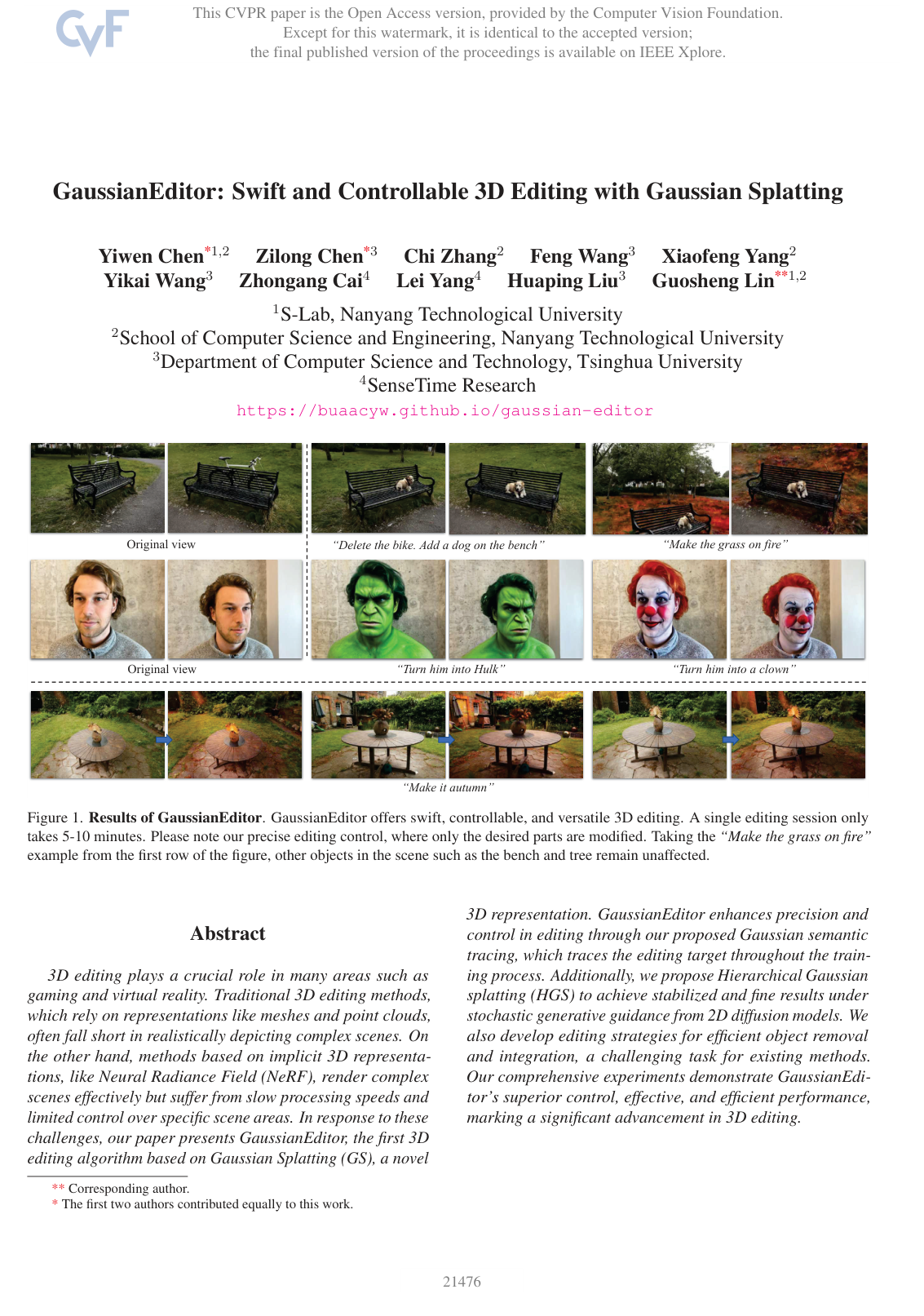
GaussianEditor: Swift and Controllable 3D Editing with Gaussian Splatting
Yiwen Chen, Zilong Chen, Chi Zhang, Feng Wang, Xiaofeng Yang, Yikai Wang, Zhongang Cai, Lei Yang, Huaping Liu, Guosheng Lin
Why you should read this
Proposes GaussianEditor, the first 3D editing framework built on Gaussian Splatting that uses semantic tracing and hierarchical constraints to enable fast, highly localized object insertion, removal, and text-guided scene modification within minutes.
3D editing plays a crucial role in many areas such as gaming and virtual reality. Traditional 3D editing methods, which rely on representations like meshes and point clouds, often fall short in realistically depicting complex scenes. On the other hand, methods based on implicit 3D representations, like Neural Radiance Field (NeRF), render complex scenes effectively but suffer from slow processing speeds and limited control over specific scene areas. In response to these challenges, our paper presents GaussianEditor, the first 3D editing algorithm based on Gaussian Splatting (GS), a novel 3D representation. GaussianEditor enhances precision and control in editing through our proposed Gaussian semantic tracing, which traces the editing target throughout the training process. Additionally, we propose Hierarchical Gaussian splatting (HGS) to achieve stabilized and fine results under stochastic generative guidance from 2D diffusion models. We also develop editing strategies for efficient object removal and integration, a challenging task for existing methods. Our comprehensive experiments demonstrate GaussianEditor's superior control, effective, and efficient performance, marking a significant advancement in 3D editing.
Added
2026-09-26
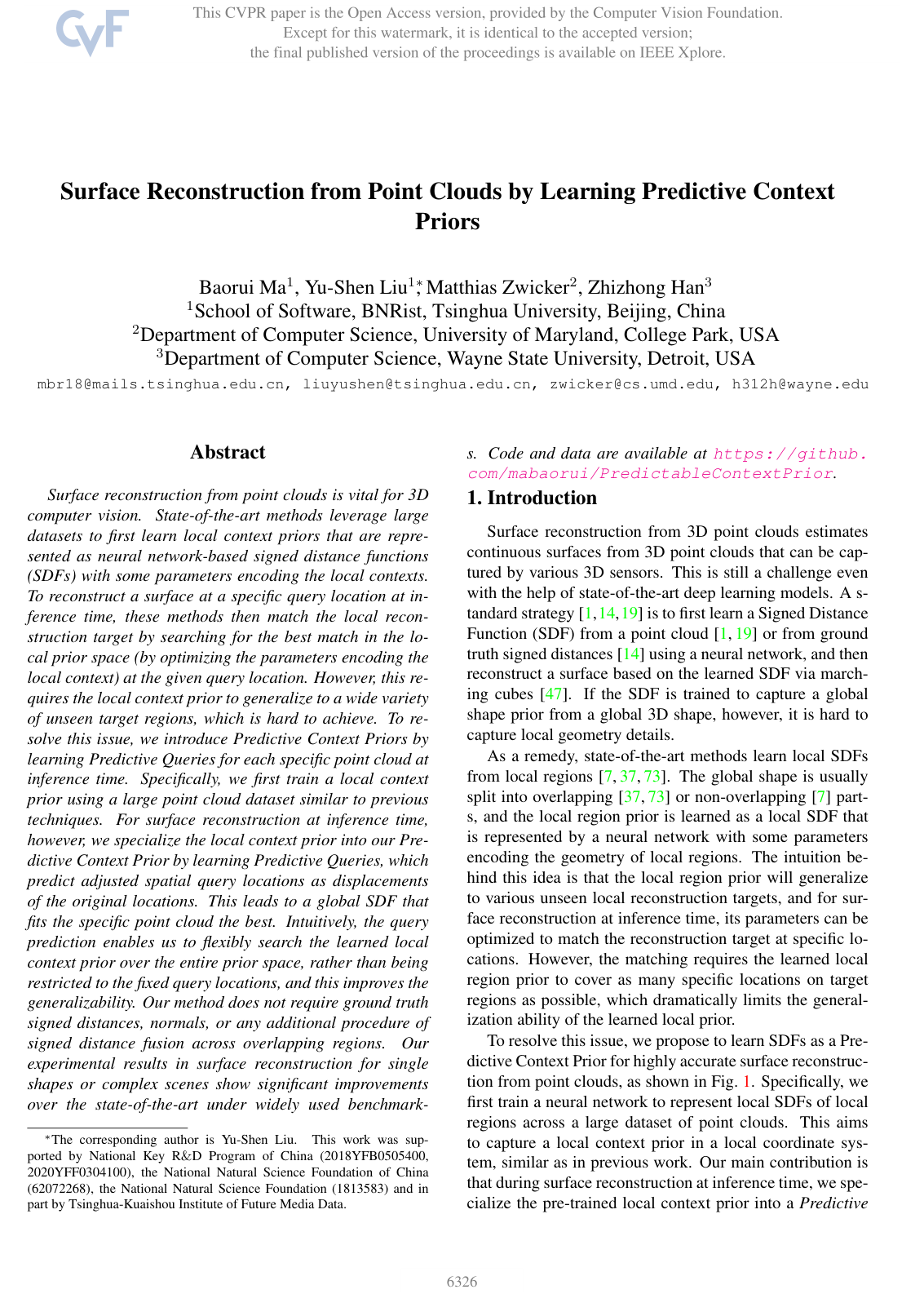
Surface Reconstruction from Point Clouds by Learning Predictive Context Priors
Baorui Ma, Yu-Shen Liu, Matthias Zwicker, Zhizhong Han
Why you should read this
Presents a surface reconstruction framework that learns test-time predictive query displacements to flexibly query pre-trained local signed distance functions, achieving accurate 3D geometry without requiring ground truth normals or distances.
Surface reconstruction from point clouds is vital for 3D computer vision. State-of-the-art methods leverage large datasets to first learn local context priors that are represented as neural network-based signed distance functions (SDFs) with some parameters encoding the local contexts. To reconstruct a surface at a specific query location at inference time, these methods then match the local reconstruction target by searching for the best match in the local prior space (by optimizing the parameters encoding the local context) at the given query location. However, this requires the local context prior to generalize to a wide variety of unseen target regions, which is hard to achieve. To resolve this issue, we introduce Predictive Context Priors by learning Predictive Queries for each specific point cloud at inference time. Specifically, we first train a local context prior using a large point cloud dataset similar to previous techniques. For surface reconstruction at inference time, however, we specialize the local context prior into our Predictive Context Prior by learning Predictive Queries, which predict adjusted spatial query locations as displacements of the original locations. This leads to a global SDF that fits the specific point cloud the best. Intuitively, the query prediction enables us to flexibly search the learned local context prior over the entire prior space, rather than being restricted to the fixed query locations, and this improves the generalizability. Our method does not require ground truth signed distances, normals, or any additional procedure of signed distance fusion across overlapping regions. Our experimental results in surface reconstruction for single shapes or complex scenes show significant improvements over the state-of-the-art under widely used benchmarks. Code and data are available at https://github.com/mabaorui/PredictableContextPrior.
Added
2026-09-26
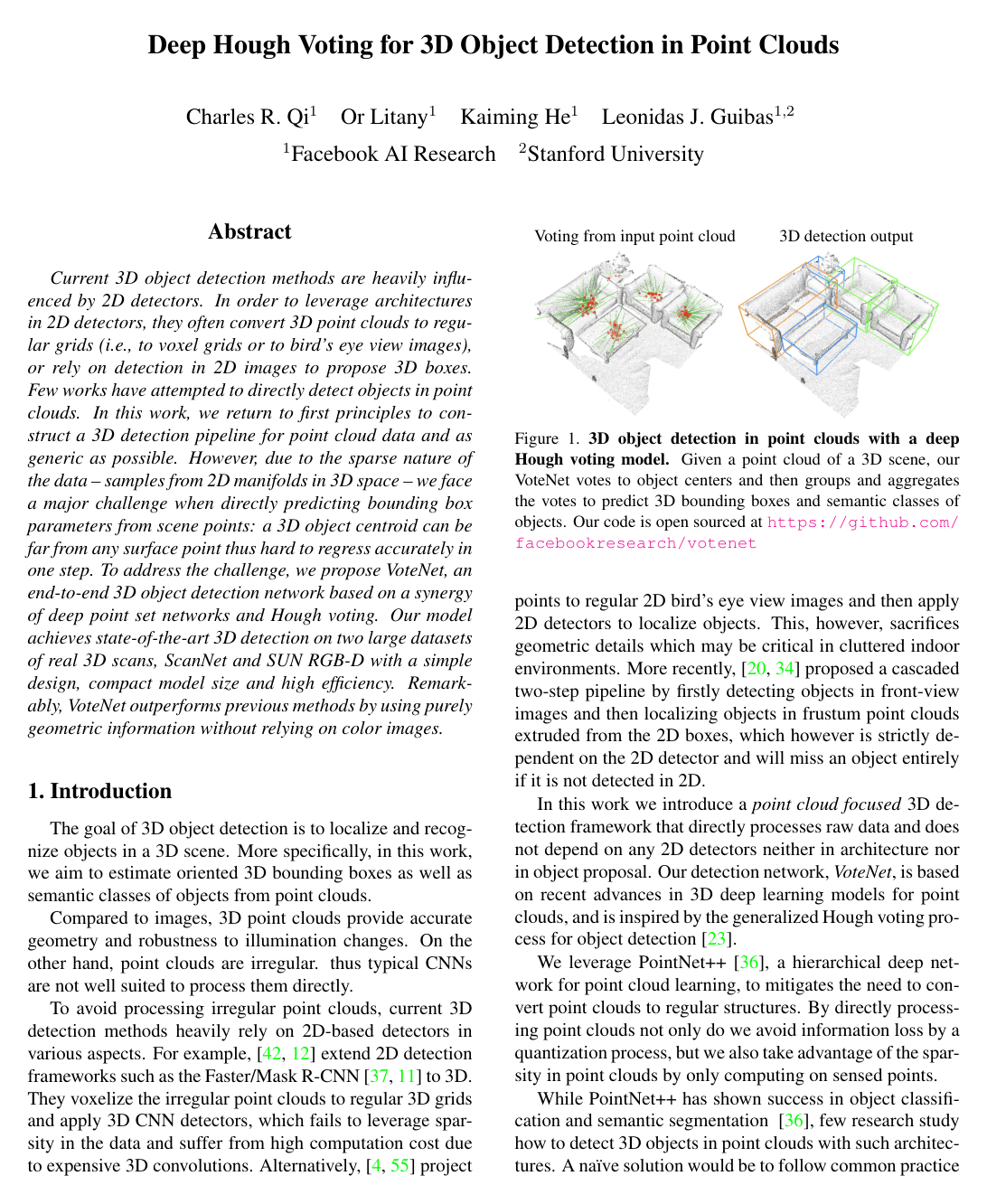
Deep Hough Voting for 3D Object Detection in Point Clouds
Charles R. Qi, Or Litany, Kaiming He, Leonidas J. Guibas
Why you should read this
Introduces VoteNet, an end-to-end 3D object detector that pairs deep point set networks with Hough voting to accurately localize object centroids directly from raw point clouds without voxelization or 2D image guidance.
Current 3D object detection methods are heavily influenced by 2D detectors. In order to leverage architectures in 2D detectors, they often convert 3D point clouds to regular grids (i.e., to voxel grids or to bird's eye view images), or rely on detection in 2D images to propose 3D boxes. Few works have attempted to directly detect objects in point clouds. In this work, we return to first principles to construct a 3D detection pipeline for point cloud data and as generic as possible. However, due to the sparse nature of the data -- samples from 2D manifolds in 3D space -- we face a major challenge when directly predicting bounding box parameters from scene points: a 3D object centroid can be far from any surface point thus hard to regress accurately in one step. To address the challenge, we propose VoteNet, an end-to-end 3D object detection network based on a synergy of deep point set networks and Hough voting. Our model achieves state-of-the-art 3D detection on two large datasets of real 3D scans, ScanNet and SUN RGB-D with a simple design, compact model size and high efficiency. Remarkably, VoteNet outperforms previous methods by using purely geometric information without relying on color images.
Added
2026-09-25
Volumetric and Multi-view CNNs for Object Classification on 3D Data
Charles R. Qi, Hao Su, Matthias Niessner, Angela Dai, Mengyuan Yan, Leonidas J. Guibas
Why you should read this
Proposes improved volumetric and multi-view convolutional neural network architectures to close the performance gap between 3D voxel and 2D view-based representations for 3D object classification.
3D shape models are becoming widely available and easier to capture, making available 3D information crucial for progress in object classification. Current state-of-the-art methods rely on CNNs to address this problem. Recently, we witness two types of CNNs being developed: CNNs based upon volumetric representations versus CNNs based upon multi-view representations. Empirical results from these two types of CNNs exhibit a large gap, indicating that existing volumetric CNN architectures and approaches are unable to fully exploit the power of 3D representations. In this paper, we aim to improve both volumetric CNNs and multi-view CNNs according to extensive analysis of existing approaches. To this end, we introduce two distinct network architectures of volumetric CNNs. In addition, we examine multi-view CNNs, where we introduce multi-resolution filtering in 3D. Overall, we are able to outperform current state-of-the-art methods for both volumetric CNNs and multi-view CNNs. We provide extensive experiments designed to evaluate underlying design choices, thus providing a better understanding of the space of methods available for object classification on 3D data.
Added
2026-09-24
FAST-LIO2: Fast Direct LiDAR-Inertial Odometry
Wei Xu, Yixi Cai, Dongjiao He, Jiarong Lin, Fu Zhang
Why you should read this
Introduces a direct LiDAR-inertial odometry framework that matches raw point clouds using a dynamic incremental k-d tree, enabling highly accurate mapping at up to 100 Hz without hand-engineered feature extraction across diverse LiDAR sensors and embedded processors.
This paper presents FAST-LIO2: a fast, robust, and versatile LiDAR-inertial odometry framework. Building on a highly efficient tightly-coupled iterated Kalman filter, FAST-LIO2 has two key novelties that allow fast, robust, and accurate LiDAR navigation (and mapping). The first one is directly registering raw points to the map (and subsequently update the map, i.e., mapping) without extracting features. This enables the exploitation of subtle features in the environment and hence increases the accuracy. The elimination of a hand-engineered feature extraction module also makes it naturally adaptable to emerging LiDARs of different scanning patterns; The second main novelty is maintaining a map by an incremental k-d tree data structure, ikd-Tree, that enables incremental updates (i.e., point insertion, delete) and dynamic re-balancing. Compared with existing dynamic data structures (octree, R*-tree, nanoflann k-d tree), ikd-Tree achieves superior overall performance while naturally supports downsampling on the tree. We conduct an exhaustive benchmark comparison in 19 sequences from a variety of open LiDAR datasets. FAST-LIO2 achieves consistently higher accuracy at a much lower computation load than other state-of-the-art LiDAR-inertial navigation systems. Various real-world experiments on solid-state LiDARs with small FoV are also conducted. Overall, FAST-LIO2 is computationally-efficient (e.g., up to 100 Hz odometry and mapping in large outdoor environments), robust (e.g., reliable pose estimation in cluttered indoor environments with rotation up to 1000 deg/s), versatile (i.e., applicable to both multi-line spinning and solid-state LiDARs, UAV and handheld platforms, and Intel and ARM-based processors), while still achieving higher accuracy than existing methods. Our implementation of the system FAST-LIO2, and the data structure ikd-Tree are both open-sourced on Github.
Added
2026-09-24
3D Semantic Segmentation with Submanifold Sparse Convolutional Networks
Benjamin Graham, Martin Engelcke, Laurens van der Maaten
Why you should read this
Develops sparse convolutional operations that maintain spatial sparsity across network layers, enabling highly efficient and accurate 3D semantic segmentation on point cloud data.
Convolutional networks are the de-facto standard for analyzing spatio-temporal data such as images, videos, and 3D shapes. Whilst some of this data is naturally dense (e.g., photos), many other data sources are inherently sparse. Examples include 3D point clouds that were obtained using a LiDAR scanner or RGB-D camera. Standard "dense" implementations of convolutional networks are very inefficient when applied on such sparse data. We introduce new sparse convolutional operations that are designed to process spatially-sparse data more efficiently, and use them to develop spatially-sparse convolutional networks. We demonstrate the strong performance of the resulting models, called submanifold sparse convolutional networks (SSCNs), on two tasks involving semantic segmentation of 3D point clouds. In particular, our models outperform all prior state-of-the-art on the test set of a recent semantic segmentation competition.
Added
2026-09-18
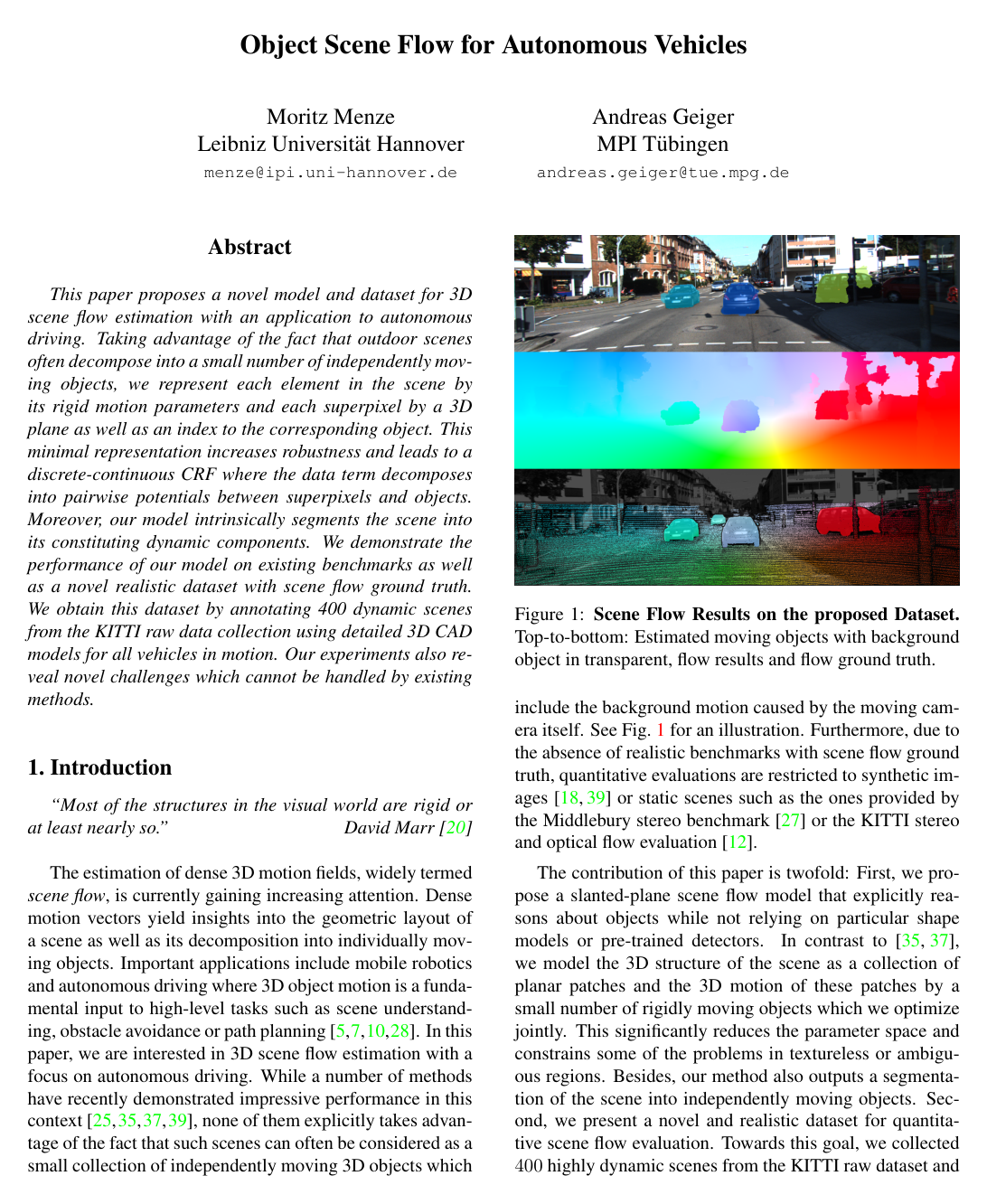
Object scene flow for autonomous vehicles
Moritz Menze, Andreas Geiger
Why you should read this
Proposes a discrete-continuous CRF formulation that models dynamic driving scenes as collections of rigidly moving 3D planar superpixels alongside the first realistic 400-scene dynamic benchmark with semi-dense 3D ground truth.
This paper proposes a novel model and dataset for 3D scene flow estimation with an application to autonomous driving. Taking advantage of the fact that outdoor scenes often decompose into a small number of independently moving objects, we represent each element in the scene by its rigid motion parameters and each superpixel by a 3D plane as well as an index to the corresponding object. This minimal representation increases robustness and leads to a discrete-continuous CRF where the data term decomposes into pairwise potentials between superpixels and objects. Moreover, our model intrinsically segments the scene into its constituting dynamic components. We demonstrate the performance of our model on existing benchmarks as well as a novel realistic dataset with scene flow ground truth. We obtain this dataset by annotating 400 dynamic scenes from the KITTI raw data collection using detailed 3D CAD models for all vehicles in motion. Our experiments also reveal novel challenges which cannot be handled by existing methods.
Added
2026-09-16