
keyword
feature fusion
Feature fusion is the process of combining feature representations extracted from multiple sources, network layers, scales, or data modalities into a unified representation to improve the performance of machine learning models. In deep learning architectures, this technique integrates complementary information, such as fine-grained spatial details from early network layers and high-level semantic context from deeper layers, or heterogeneous data across different modalities like imagery, depth data, and text. Features are typically merged using operations such as concatenation, element-wise addition, channel-wise weighting, or attention mechanisms that dynamically prioritize the most informative attributes. By establishing a richer and more discriminative feature space, feature fusion enables neural networks to capture complex relationships and achieve greater predictive accuracy in tasks such as object detection, semantic segmentation, and multimodal perception.
21 items
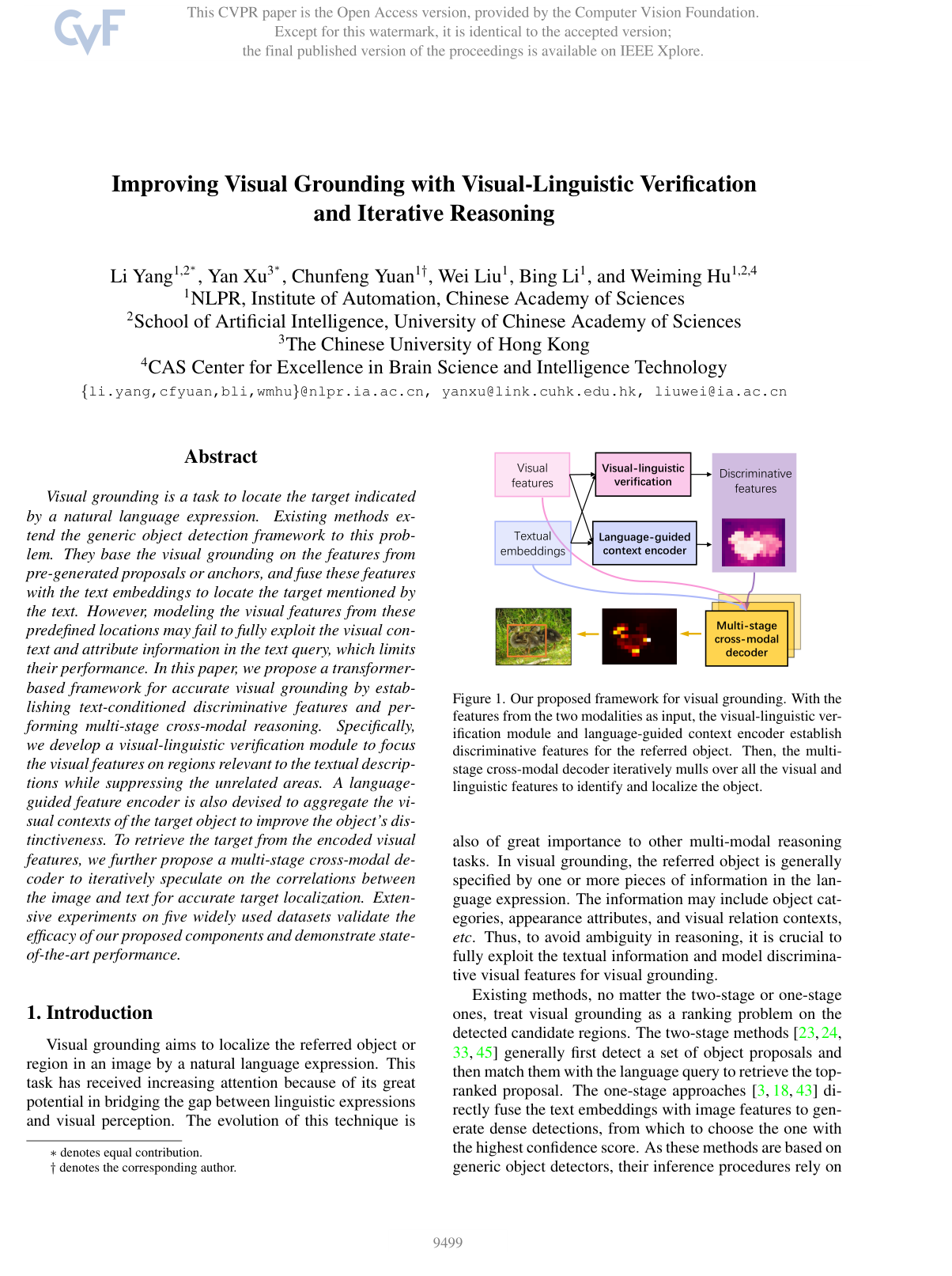
Improving Visual Grounding with Visual-Linguistic Verification and Iterative Reasoning
Li Yang, Yan Xu, Chunfeng Yuan, Wei Liu, Bing Li, Weiming Hu
Why you should read this
Presents a transformer-based visual grounding framework that integrates visual-linguistic verification, language-guided context encoding, and iterative multi-stage decoding to localize referred objects directly without relying on predefined proposals or anchor boxes.
Visual grounding is a task to locate the target indicated by a natural language expression. Existing methods extend the generic object detection framework to this problem. They base the visual grounding on the features from pre-generated proposals or anchors, and fuse these features with the text embeddings to locate the target mentioned by the text. However, modeling the visual features from these predefined locations may fail to fully exploit the visual content and attribute information in the text query, which limits their performance. In this paper, we propose a transformer-based framework for accurate visual grounding by establishing text-conditioned discriminative features and performing multi-stage cross-modal reasoning. Specifically, we develop a visual-linguistic verification module to focus the visual features on regions relevant to the textual descriptions while suppressing the unrelated areas. A language-guided feature encoder is also devised to aggregate the visual contexts of the target object to improve the object's distinctiveness. To retrieve the target from the encoded visual features, we further propose a multi-stage cross-modal decoder to iteratively speculate on the correlations between the image and text for accurate target localization. Extensive experiments on five widely used datasets validate the efficacy of our proposed components and demonstrate state-of-the-art performance.
Added
2026-10-05
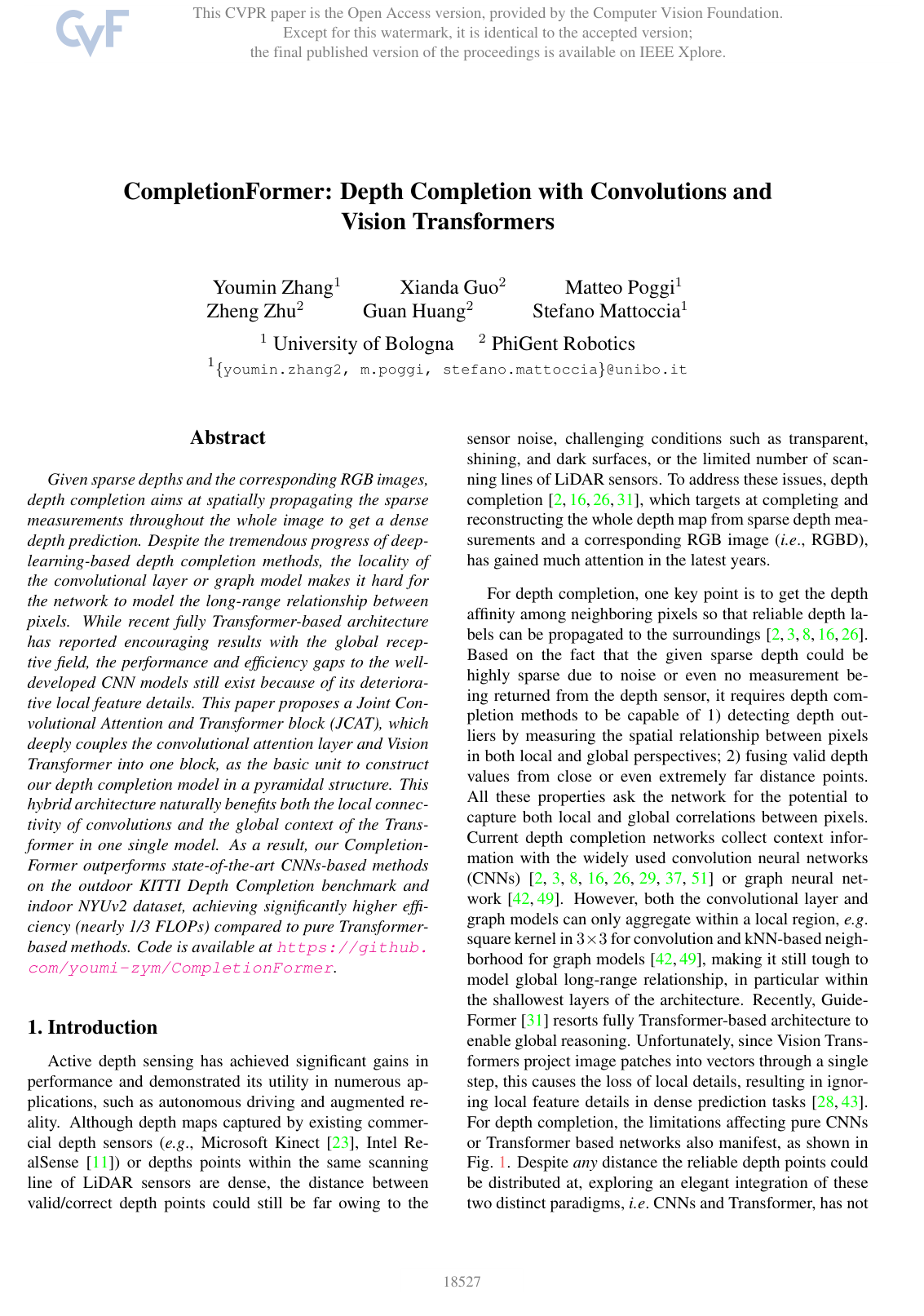
CompletionFormer: Depth Completion with Convolutions and Vision Transformers
Youmin Zhang, Xianda Guo, Matteo Poggi, Zheng Zhu, Guan Huang, Stefano Mattoccia
Why you should read this
Proposes CompletionFormer, a pyramidal depth completion architecture that integrates convolutional attention with vision transformers in a single-branch model, achieving state-of-the-art accuracy on KITTI and NYUv2 benchmarks while requiring nearly one-third the computation of pure transformer approaches.
Given sparse depths and the corresponding RGB images, depth completion aims at spatially propagating the sparse measurements throughout the whole image to get a dense depth prediction. Despite the tremendous progress of deep-learning-based depth completion methods, the locality of the convolutional layer or graph model makes it hard for the network to model the long-range relationship between pixels. While recent fully Transformer-based architecture has reported encouraging results with the global receptive field, the performance and efficiency gaps to the well-developed CNN models still exist because of its deteriorative local feature details. This paper proposes a Joint Convolutional Attention and Transformer block (JCAT), which deeply couples the convolutional attention layer and Vision Transformer into one block, as the basic unit to construct our depth completion model in a pyramidal structure. This hybrid architecture naturally benefits both the local connectivity of convolutions and the global context of the Transformer in one single model. As a result, our CompletionFormer outperforms state-of-the-art CNNs-based methods on the outdoor KITTI Depth Completion benchmark and indoor NYUv2 dataset, achieving significantly higher efficiency (nearly 1/3 FLOPs) compared to pure Transformer-based methods. Code is available at https://github.com/youmi-zym/CompletionFormer.
Added
2026-10-05
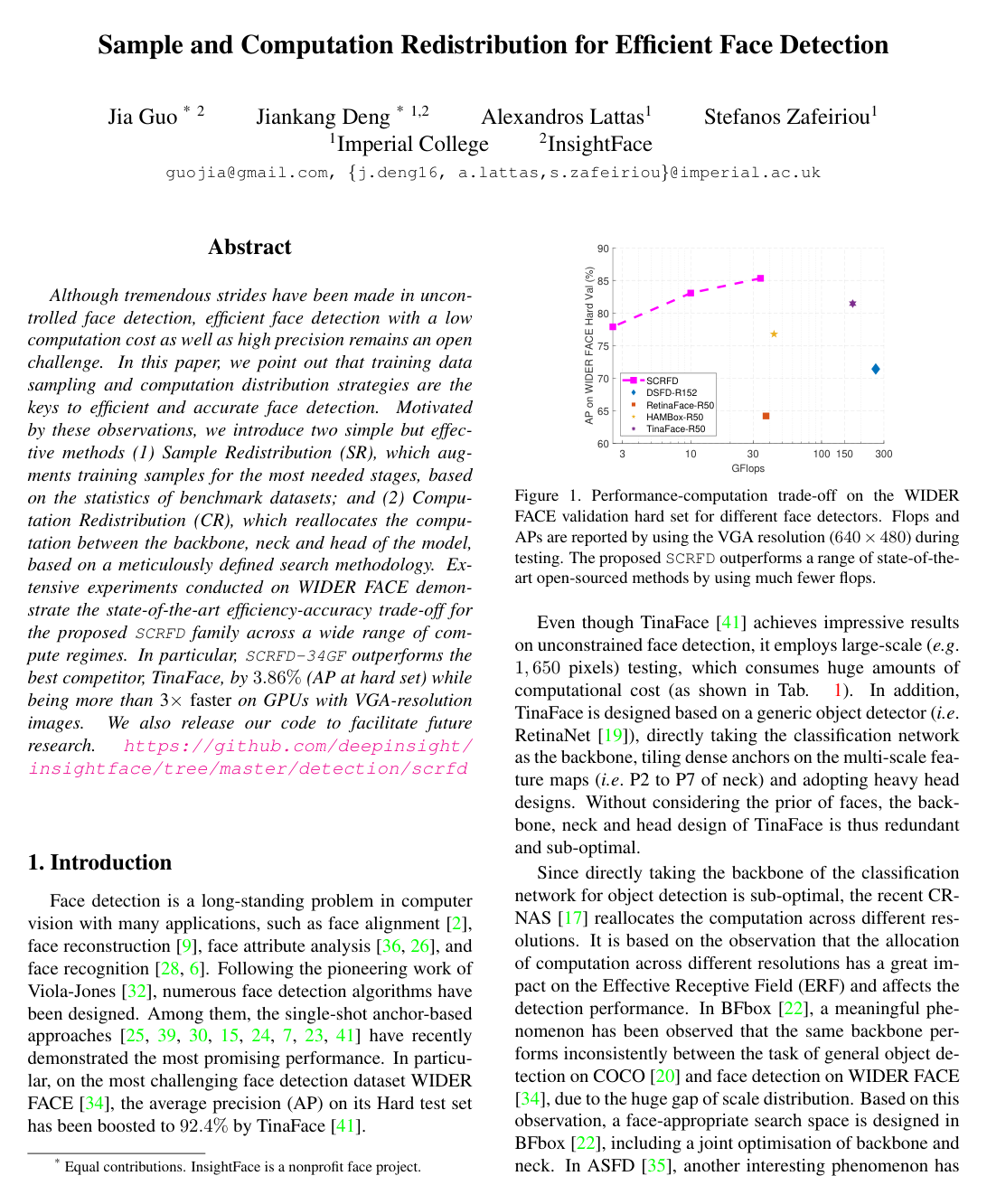
Sample and Computation Redistribution for Efficient Face Detection
Jia Guo, Jiankang Deng, Alexandros Lattas, Stefanos Zafeiriou
Why you should read this
Develops the SCRFD face detection framework by strategically redistributing training samples and network computation, achieving state-of-the-art accuracy on WIDER FACE while running more than three times faster than prior models.
Although tremendous strides have been made in uncontrolled face detection, efficient face detection with a low computation cost as well as high precision remains an open challenge. In this paper, we point out that training data sampling and computation distribution strategies are the keys to efficient and accurate face detection. Motivated by these observations, we introduce two simple but effective methods (1) Sample Redistribution (SR), which augments training samples for the most needed stages, based on the statistics of benchmark datasets; and (2) Computation Redistribution (CR), which reallocates the computation between the backbone, neck and head of the model, based on a meticulously defined search methodology. Extensive experiments conducted on WIDER FACE demonstrate the state-of-the-art efficiency-accuracy trade-off for the proposed \scrfd family across a wide range of compute regimes. In particular, \scrfdf{34} outperforms the best competitor, TinaFace, by (AP at hard set) while being more than \emph{3 faster} on GPUs with VGA-resolution images. We also release our code to facilitate future research.
Added
2026-10-05
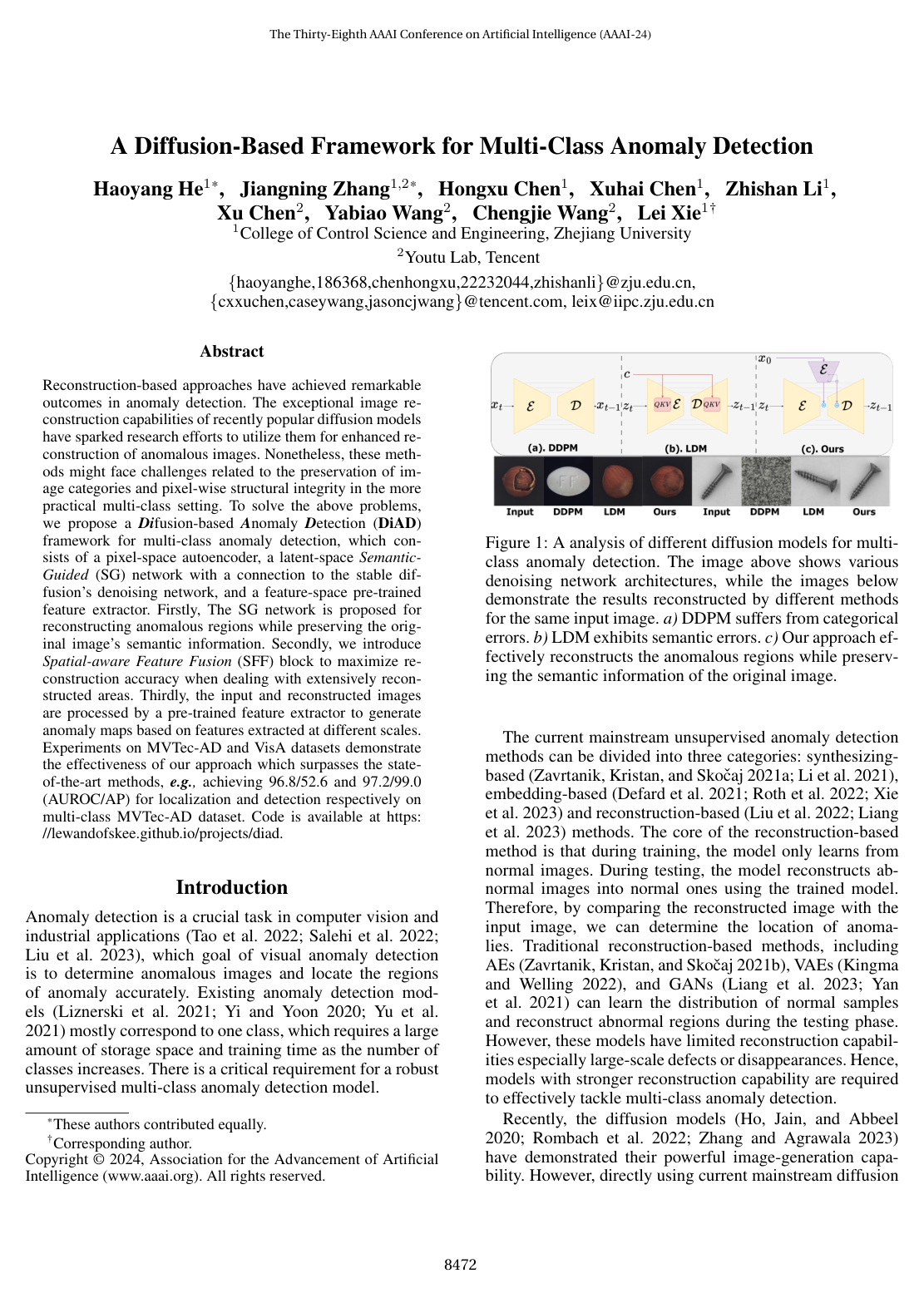
A Diffusion-Based Framework for Multi-Class Anomaly Detection
Haoyang He, Jiangning Zhang, Hongxu Chen, Xuhai Chen, Zhishan Li, Xu Chen, Yabiao Wang, Chengjie Wang, Lei Xie
Why you should read this
Proposes a semantic-guided diffusion framework that solves class confusion and structural distortion during reconstruction, achieving state-of-the-art multi-class anomaly detection and localization on the MVTec-AD and VisA benchmarks.
Reconstruction-based approaches have achieved remarkable outcomes in anomaly detection. The exceptional image reconstruction capabilities of recently popular diffusion models have sparked research efforts to utilize them for enhanced reconstruction of anomalous images. Nonetheless, these methods might face challenges related to the preservation of image categories and pixel-wise structural integrity in the more practical multi-class setting. To solve the above problems, we propose a Diffusion-based Anomaly Detection (DiAD) framework for multi-class anomaly detection, which consists of a pixel-space autoencoder, a latent-space Semantic-Guided (SG) network with a connection to the stable diffusion's denoising network, and a feature-space pre-trained feature extractor. Firstly, the SG network is proposed for reconstructing anomalous regions while preserving the original image's semantic information. Secondly, we introduce Spatial-aware Feature Fusion (SFF) block to maximize reconstruction accuracy when dealing with extensively reconstructed areas. Thirdly, the input and reconstructed images are processed by a pre-trained feature extractor to generate anomaly maps based on features extracted at different scales. Experiments on MVTec-AD and VisA datasets demonstrate the effectiveness of our approach which surpasses the state-of-the-art methods, e.g., achieving 96.8/52.6 and 97.2/99.0 (AUROC/AP) for localization and detection respectively on multi-class MVTec-AD dataset. Code is available at https://lewandofskee.github.io/projects/diad.
Added
2026-10-05
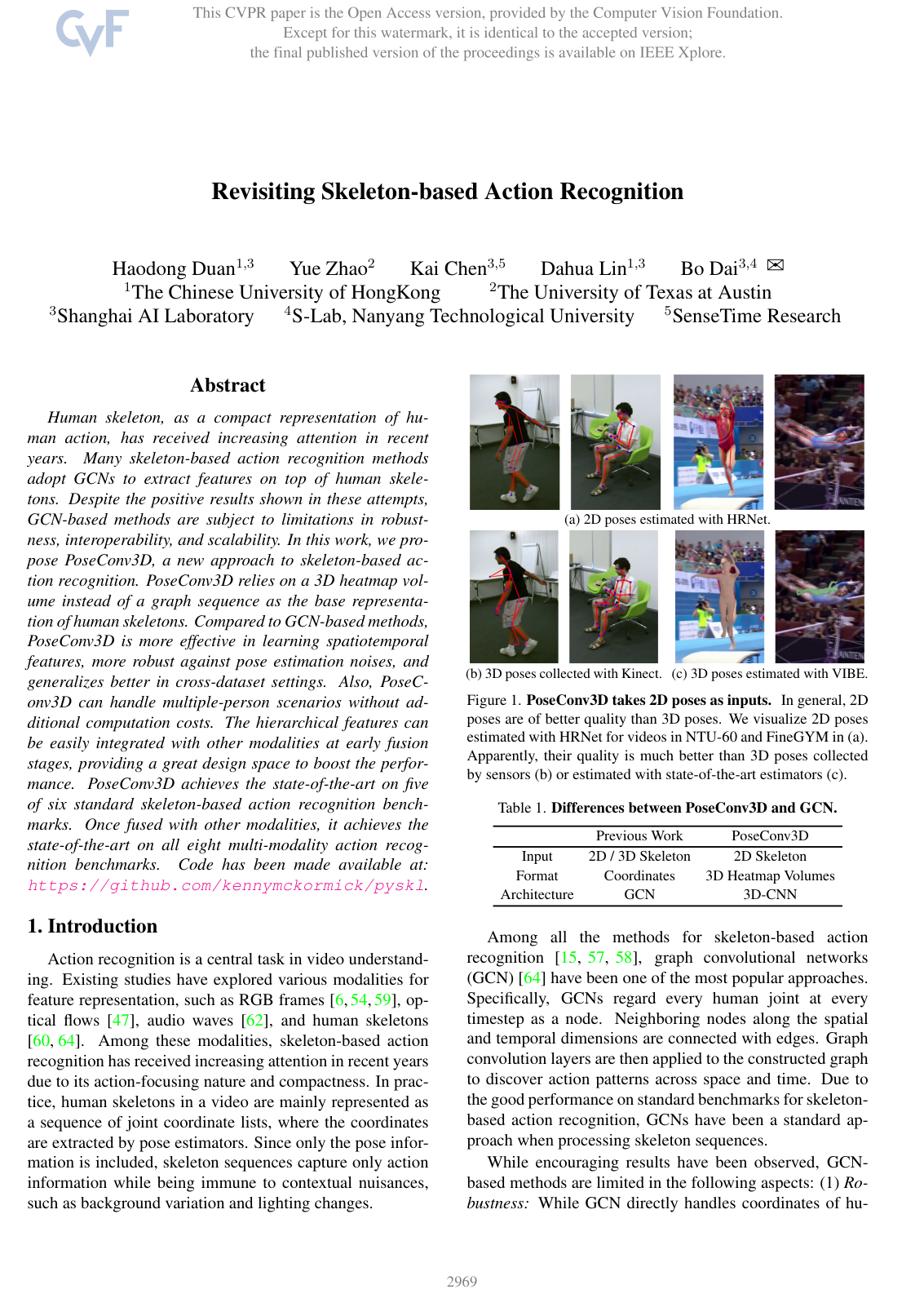
Revisiting Skeleton-based Action Recognition
Haodong Duan, Yue Zhao, Kai Chen, Dahua Lin, Bo Dai
Why you should read this
Proposes PoseConv3D, a 3D-CNN framework that replaces traditional graph-based representations with 3D heatmap volumes of 2D skeletons to achieve state-of-the-art action recognition while handling multi-person scenes and multi-modal fusion without added computational complexity.
Human skeleton, as a compact representation of human action, has received increasing attention in recent years. Many skeleton-based action recognition methods adopt GCNs to extract features on top of human skeletons. Despite the positive results shown in these attempts, GCN-based methods are subject to limitations in robustness, interoperability, and scalability. In this work, we propose PoseConv3D, a new approach to skeleton-based action recognition. PoseConv3D relies on a 3D heatmap volume instead of a graph sequence as the base representation of human skeletons. Compared to GCN-based methods, PoseConv3D is more effective in learning spatiotemporal features, more robust against pose estimation noises, and generalizes better in cross-dataset settings. Also, PoseConv3D can handle multiple-person scenarios without additional computation costs. The hierarchical features can be easily integrated with other modalities at early fusion stages, providing a great design space to boost the performance. PoseConv3D achieves the state-of-the-art on five of six standard skeleton-based action recognition benchmarks. Once fused with other modalities, it achieves the state-of-the-art on all eight multi-modality action recognition benchmarks. Code has been made available at: https://github.com/kennymckormick/pyskl.
Added
2026-10-05
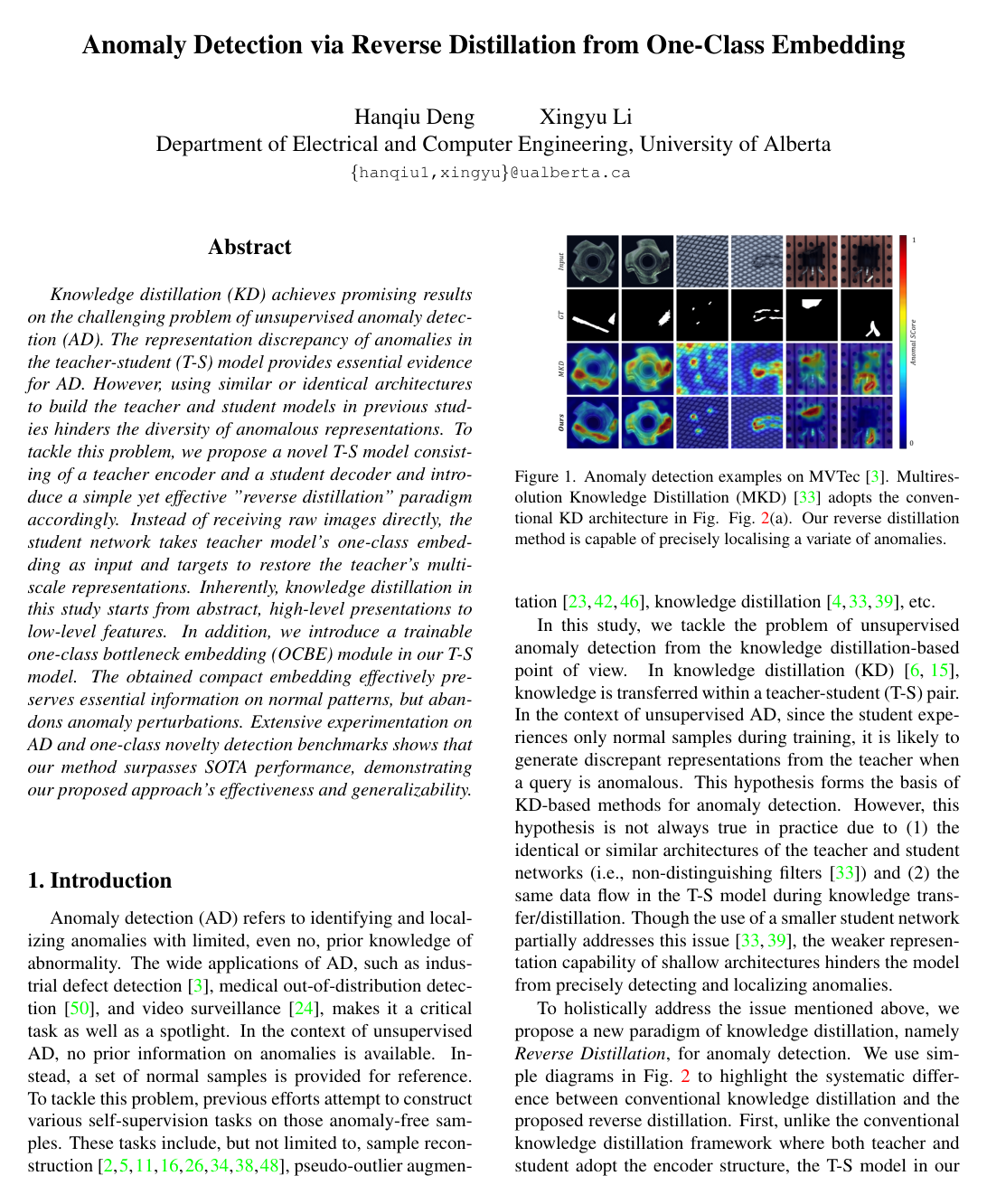
Anomaly Detection via Reverse Distillation from One-Class Embedding
Hanqiu Deng, Xingyu Li
Why you should read this
Introduces a reverse knowledge distillation paradigm that reconstructs multiscale teacher features from a one-class bottleneck embedding, preventing the student network from restoring anomalies and establishing new state-of-the-art accuracy in unsupervised anomaly detection.
Knowledge distillation (KD) achieves promising results on the challenging problem of unsupervised anomaly detection (AD).The representation discrepancy of anomalies in the teacher-student (T-S) model provides essential evidence for AD. However, using similar or identical architectures to build the teacher and student models in previous studies hinders the diversity of anomalous representations. To tackle this problem, we propose a novel T-S model consisting of a teacher encoder and a student decoder and introduce a simple yet effective "reverse distillation" paradigm accordingly. Instead of receiving raw images directly, the student network takes teacher model's one-class embedding as input and targets to restore the teacher's multiscale representations. Inherently, knowledge distillation in this study starts from abstract, high-level presentations to low-level features. In addition, we introduce a trainable one-class bottleneck embedding (OCBE) module in our T-S model. The obtained compact embedding effectively preserves essential information on normal patterns, but abandons anomaly perturbations. Extensive experimentation on AD and one-class novelty detection benchmarks shows that our method surpasses SOTA performance, demonstrating our proposed approach's effectiveness and generalizability.
Added
2026-10-05
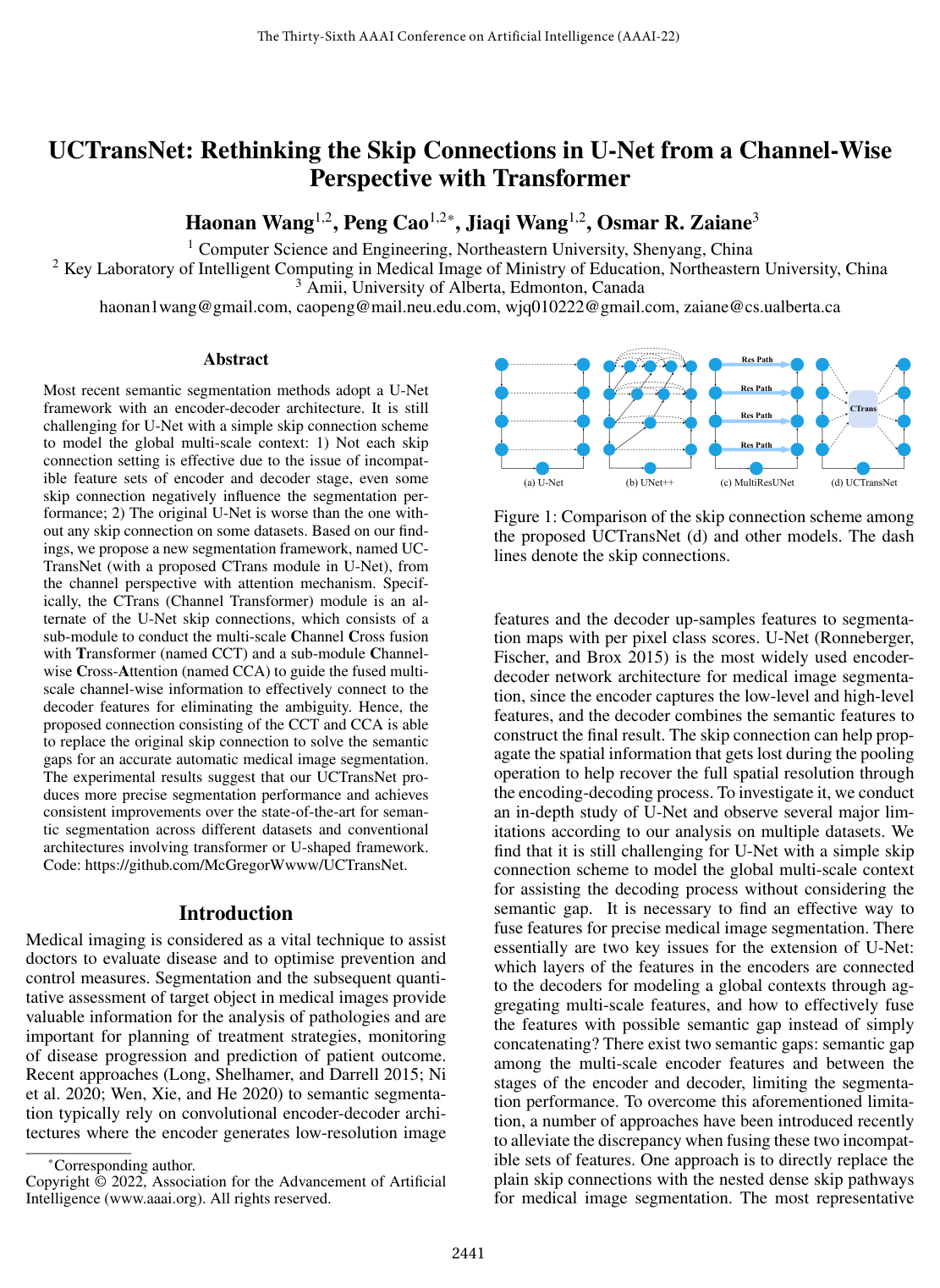
UCTransNet: Rethinking the Skip Connections in U-Net from a Channel-Wise Perspective with Transformer
Haonan Wang, Peng Cao, Jiaqi Wang, Osmar R. Zaïane
Why you should read this
Proposes a channel-wise transformer module that replaces traditional U-Net skip connections to bridge semantic gaps between encoder and decoder features, consistently improving medical image segmentation accuracy across multiple benchmarks.
Most recent semantic segmentation methods adopt a U-Net framework with an encoder-decoder architecture. It is still challenging for U-Net with a simple skip connection scheme to model the global multi-scale context: 1) Not each skip connection setting is effective due to the issue of incompatible feature sets of encoder and decoder stage, even some skip connection negatively influence the segmentation performance; 2) The original U-Net is worse than the one without any skip connection on some datasets. Based on our findings, we propose a new segmentation framework, named UC-TransNet (with a proposed CTrans module in U-Net), from the channel perspective with attention mechanism. Specifically, the CTrans (Channel Transformer) module is an alternate of the U-Net skip connections, which consists of a sub-module to conduct the multi-scale Channel Cross fusion with Transformer (named CCT) and a sub-module Channel-wise Cross-Attention (named CCA) to guide the fused multi-scale channel-wise information to effectively connect to the decoder features for eliminating the ambiguity. Hence, the proposed connection consisting of the CCT and CCA is able to replace the original skip connection to solve the semantic gaps for an accurate automatic medical image segmentation. The experimental results suggest that our UCTransNet produces more precise segmentation performance and achieves consistent improvements over the state-of-the-art for semantic segmentation across different datasets and conventional architectures involving transformer or U-shaped framework.
Added
2026-10-04
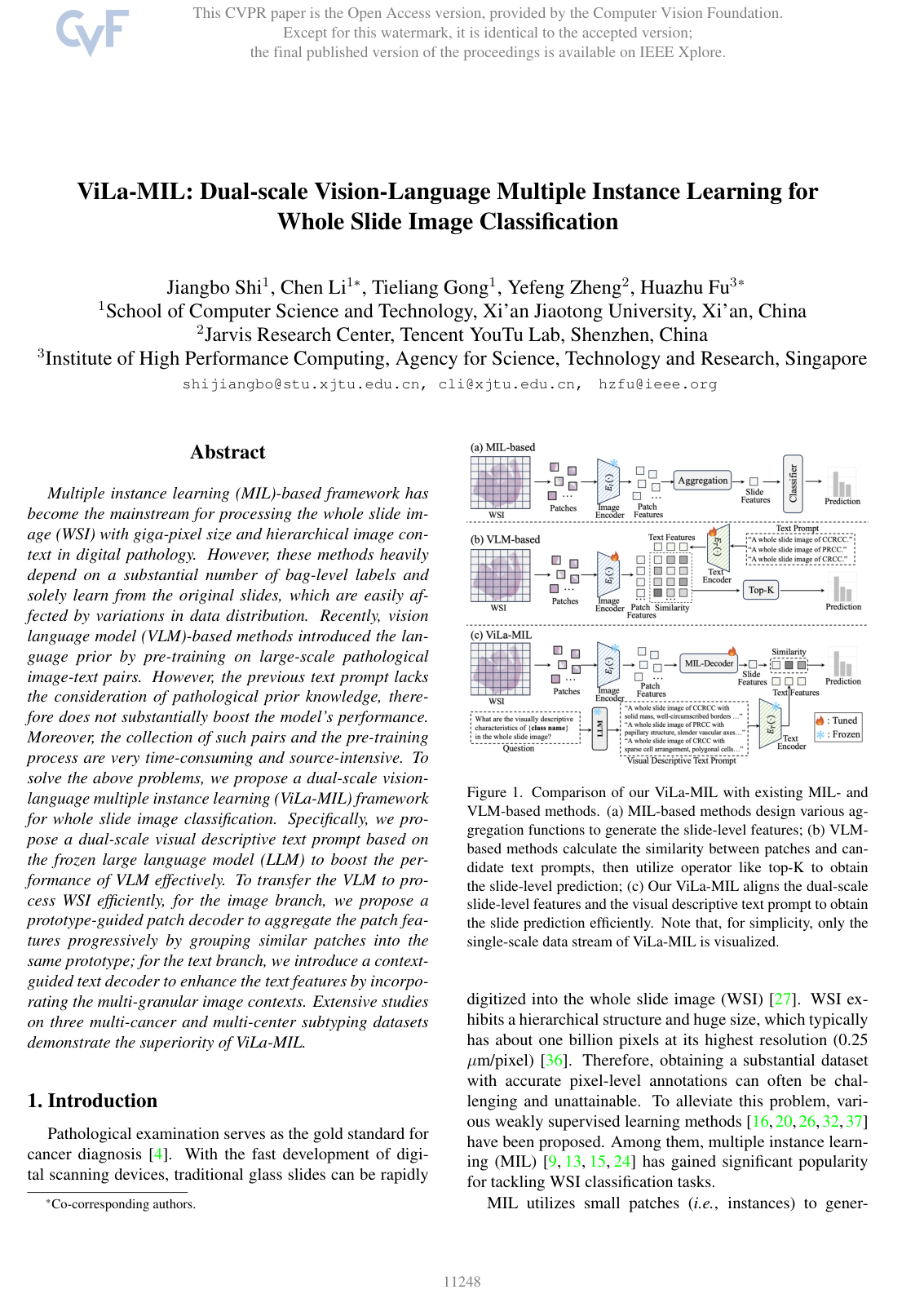
ViLa-MIL: Dual-scale Vision-Language Multiple Instance Learning for Whole Slide Image Classification
Jiangbo Shi, Chen Li, Tieliang Gong, Yefeng Zheng, Huazhu Fu
Why you should read this
Proposes a dual-scale vision-language multiple instance learning framework that uses frozen LLM prompts and lightweight decoders to transfer vision-language models to gigapixel whole slide image classification with minimal labeled data.
Multiple instance learning (MIL)-based framework has become the mainstream for processing the whole slide image (WSI) with giga-pixel size and hierarchical image context in digital pathology. However, these methods heavily depend on a substantial number of bag-level labels and solely learn from the original slides, which are easily affected by variations in data distribution. Recently, vision language model (VLM)-based methods introduced the language prior by pre-training on large-scale pathological image-text pairs. However, the previous text prompt lacks the consideration of pathological prior knowledge, therefore does not substantially boost the model’s performance. Moreover, the collection of such pairs and the pre-training process are very time-consuming and source-intensive. To solve the above problems, we propose a dual-scale vision-language multiple instance learning (ViLa-MIL) framework for whole slide image classification. Specifically, we propose a dual-scale visual descriptive text prompt based on the frozen large language model (LLM) to boost the performance of VLM effectively. To transfer the VLM to process WSI efficiently, for the image branch, we propose a prototype-guided patch decoder to aggregate the patch features progressively by grouping similar patches into the same prototype; for the text branch, we introduce a context-guided text decoder to enhance the text features by incorporating the multi-granular image contexts. Extensive studies on three multi-cancer and multi-center subtyping datasets demonstrate the superiority of ViLa-MIL.
Added
2026-09-26
TrEP: Transformer-Based Evidential Prediction for Pedestrian Intention with Uncertainty
Zhengming Zhang, Renran Tian, Zhengming Ding
Why you should read this
Proposes a compact transformer-based evidential prediction model that captures temporal dynamics from motion features and quantifies pedestrian crossing intention uncertainty to align AI confidence with human annotator disagreements.
With rapid development in hardware (sensors and processors) and AI algorithms, automated driving techniques have entered the public's daily life and achieved great success in supporting human driving performance. However, due to the high contextual variations and temporal dynamics in pedestrian behaviors, the interaction between autonomous-driving cars and pedestrians remains challenging, impeding the development of fully autonomous driving systems. This paper focuses on predicting pedestrian intention with a novel transformer-based evidential prediction (TrEP) algorithm. We develop a transformer module towards the temporal correlations among the input features within pedestrian video sequences and a deep evidential learning model to capture the AI uncertainty under scene complexities. Experimental results on three popular pedestrian intent benchmarks have verified the effectiveness of our proposed model over the state-of-the-art. The algorithm performance can be further boosted by controlling the uncertainty level. We systematically compare human disagreements with AI uncertainty to further evaluate AI performance in confusing scenes. The code is released at https://github.com/zzmonlyyou/TrEP.git.
Added
2026-09-26
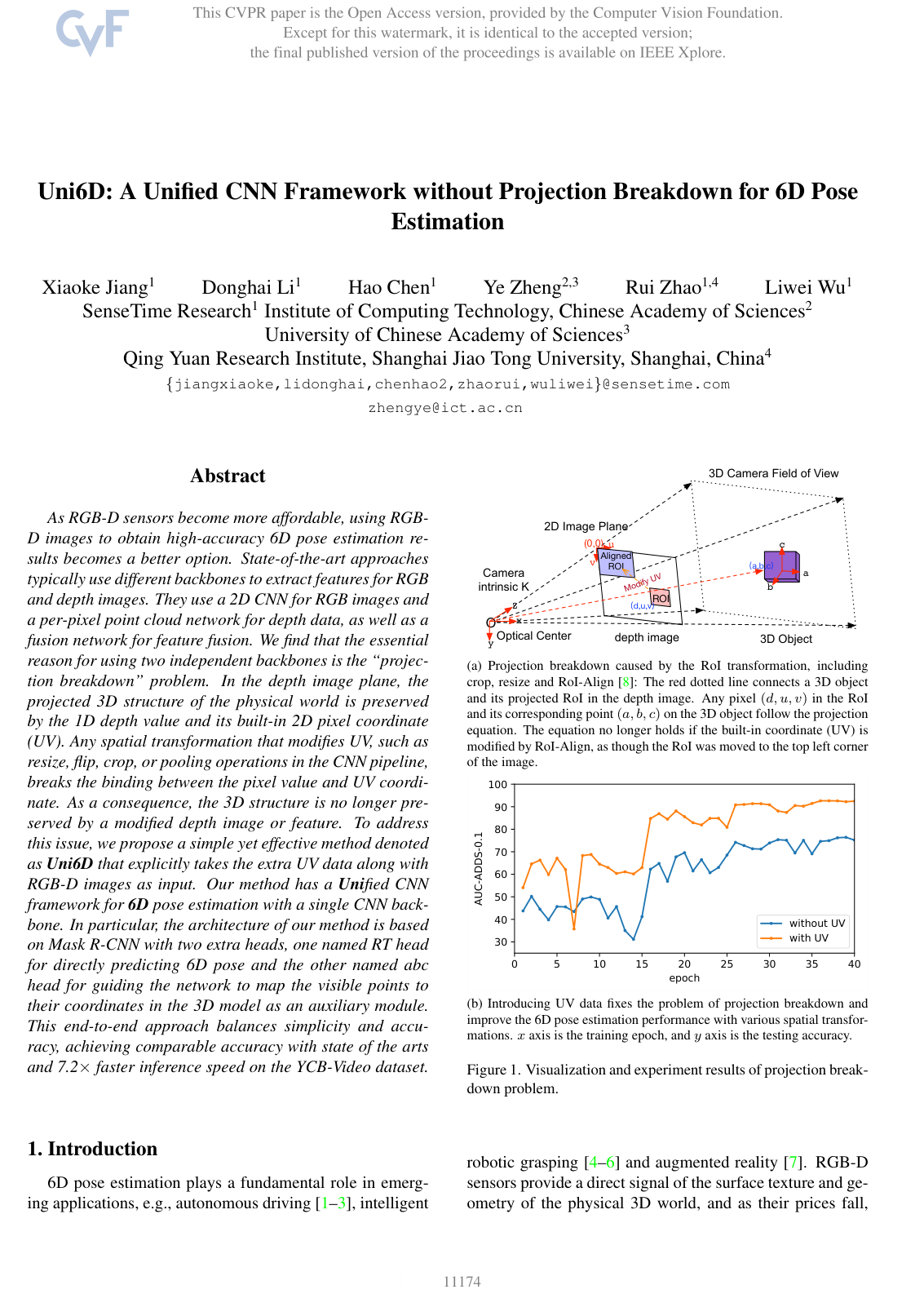
Uni6D: A Unified CNN Framework without Projection Breakdown for 6D Pose Estimation
Xiaoke Jiang, Donghai Li, Hao Chen, Ye Zheng, Rui Zhao, Liwei Wu
Why you should read this
Presents Uni6D, an end-to-end framework that solves the projection breakdown issue in RGB-D processing by feeding explicit UV coordinates into a single 2D CNN backbone, achieving state-of-the-art 6D pose estimation accuracy with over seven times faster inference.
As RGB-D sensors become more affordable, using RGB-D images to obtain high-accuracy 6D pose estimation results becomes a better option. State-of-the-art approaches typically use different backbones to extract features for RGB and depth images. They use a 2D CNN for RGB images and a per-pixel point cloud network for depth data, as well as a fusion network for feature fusion. We find that the essential reason for using two independent backbones is the "projection breakdown" problem. In the depth image plane, the projected 3D structure of the physical world is preserved by the 1D depth value and its built-in 2D pixel coordinate (UV). Any spatial transformation that modifies UV, such as resize, flip, crop, or pooling operations in the CNN pipeline, breaks the binding between the pixel value and UV coordinate. As a consequence, the 3D structure is no longer preserved by a modified depth image or feature. To address this issue, we propose a simple yet effective method denoted as Uni6D that explicitly takes the extra UV data along with RGB-D images as input. Our method has a unified CNN framework for 6D pose estimation with a single CNN backbone. In particular, the architecture of our method is based on Mask R-CNN with two extra heads, one named RT head for directly predicting 6D pose and the other named abc head for guiding the network to map the visible points to their coordinates in the 3D model as an auxiliary module. This end-to-end approach balances simplicity and accuracy, achieving comparable accuracy with state of the arts and 7.2× faster inference speed on the YCB-Video dataset.
Added
2026-09-26
Multimodal Token Fusion for Vision Transformers
Yikai Wang, Xinghao Chen, Lele Cao, Wenbing Huang, Fuchun Sun, Yunhe Wang
Why you should read this
Proposes TokenFusion, an alignment-aware framework that dynamically prunes uninformative tokens across single-modal vision transformers and replaces them with projected inter-modal features to achieve state-of-the-art multimodal fusion without altering base network architectures.
Many adaptations of transformers have emerged to address the single-modal vision tasks, where self-attention modules are stacked to handle input sources like images. Intuitively, feeding multiple modalities of data to vision transformers could improve the performance, yet the inter-modal attentive weights may be diluted, which could thus greatly undermine the final performance. In this paper, we propose a multimodal token fusion method (TokenFusion), tailored for transformer-based vision tasks. To effectively fuse multiple modalities, TokenFusion dynamically detects uninformative tokens and substitute these tokens with projected and aggregated inter-modal features. Residual positional alignment is also adopted to enable explicit utilization of the inter-modal alignments after fusion. The design of TokenFusion allows the transformer to learn correlations among multimodal features, while the single-modal transformer architecture remains largely intact. Extensive experiments are conducted on a variety of homogeneous and heterogeneous modalities and demonstrate that TokenFusion surpasses state-of-the-art methods in three typical vision tasks: multimodal image-to-image translation, RGB-depth semantic segmentation, and 3D object detection with point cloud and images. Code will be released [1, 2].
Added
2026-09-26
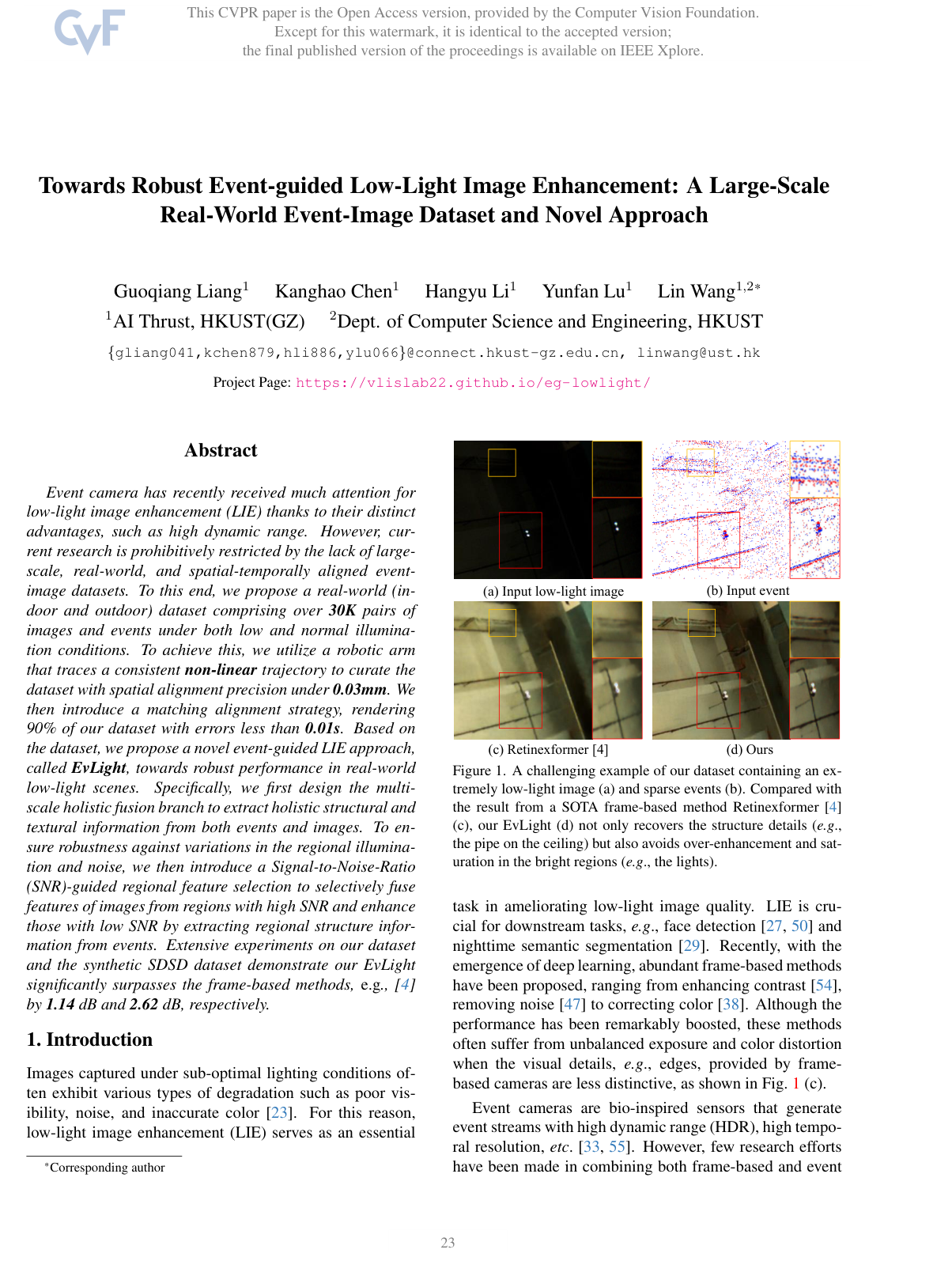
Towards Robust Event-guided Low-Light Image Enhancement: A Large-Scale Real-World Event-Image Dataset and Novel Approach
Guoqiang Liang, Kanghao Chen, Hangyu Li, Yunfan Lu, Lin Wang
Why you should read this
Presents a large-scale, robot-aligned real-world event-image dataset alongside EvLight, a framework that uses signal-to-noise ratio guidance to selectively combine event edges and frame features for low-light image restoration.
Added
2026-09-26
GCFAgg: Global and Cross-View Feature Aggregation for Multi-View Clustering
Weiqing Yan, Yuanyang Zhang, Chenlei Lv, Chang Tang, Guanghui Yue, Liang Liao, Weisi Lin
Why you should read this
Proposes a global and cross-view feature aggregation framework that integrates transformer-based sample relationships with structure-guided contrastive learning to boost multi-view clustering performance on both complete and incomplete datasets.
Multi-view clustering can partition data samples into their categories by learning a consensus representation in unsupervised way and has received more and more attention in recent years. However, most existing deep clustering methods learn consensus representation or view-specific representations from multiple views via view-wise aggregation way, where they ignore structure relationship of all samples. In this paper, we propose a novel multi-view clustering network to address these problems, called Global and Cross-view Feature Aggregation for Multi-View Clustering (GCFAggMVC). Specifically, the consensus data presentation from multiple views is obtained via cross-sample and cross-view feature aggregation, which fully explores the complementary of similar samples. Moreover, we align the consensus representation and the view-specific representation by the structure-guided contrastive learning module, which makes the view-specific representations from different samples with high structure relationship similar. The proposed module is a flexible multi-view data representation module, which can be also embedded to the incomplete multi-view data clustering task via plugging our module into other frameworks. Extensive experiments show that the proposed method achieves excellent performance in both complete multi-view data clustering tasks and incomplete multi-view data clustering tasks.
Added
2026-09-26
I Can Find You! Boundary-Guided Separated Attention Network for Camouflaged Object Detection
Hongwei Zhu, Peng Li, Haoran Xie, Xuefeng Yan, Dong Liang, Dapeng Chen, Mingqiang Wei, Jing Qin
Why you should read this
Proposes a boundary-guided separated attention network that mirrors human perception by decoupling foreground and background streams to locate camouflaged objects with highly ambiguous boundaries, outperforming sixteen state-of-the-art methods across standard benchmarks.
Can you find me? By simulating how humans to discover the so-called ‘perfectly’-camouflaged object, we present a novel boundary-guided separated attention network (call BSA-Net). Beyond the existing camouflaged object detection (COD) wisdom, BSA-Net utilizes two-stream separated attention modules to highlight the separator (or say the camouflaged object’s boundary) between an image’s background and foreground: the reverse attention stream helps erase the camouflaged object’s interior to focus on the background, while the normal attention stream recovers the interior and thus pay more attention to the foreground; and both streams are followed by a boundary guider module and combined to strengthen the understanding of the boundary. The core design of such separated attention is motivated by the COD procedure of humans: find the subtle difference between the foreground and background to delineate the boundary of a camouflaged object, then the boundary can help further enhance the COD accuracy. We validate on three benchmark datasets that our BSA-Net is very beneficial to detect camouflaged objects with the blurred boundaries and similar colors/patterns with their backgrounds. Extensive results exhibit very clear COD improvements on our BSA-Net over sixteen SOTAs.
Added
2026-09-26
FairMOT: On the Fairness of Detection and Re-identification in Multiple Object Tracking
Yifu Zhang, Chunyu Wang, Xinggang Wang, Wenjun Zeng, Wenyu Liu
Why you should read this
Proposes FairMOT, an anchor-free tracking framework that balances object detection and re-identification within a single network to eliminate task competition and achieve state-of-the-art multi-object tracking performance.
Multi-object tracking (MOT) is an important problem in computer vision which has a wide range of applications. Formulating MOT as multi-task learning of object detection and re-ID in a single network is appealing since it allows joint optimization of the two tasks and enjoys high computation efficiency. However, we find that the two tasks tend to compete with each other which need to be carefully addressed. In particular, previous works usually treat re-ID as a secondary task whose accuracy is heavily affected by the primary detection task. As a result, the network is biased to the primary detection task which is not fair to the re-ID task. To solve the problem, we present a simple yet effective approach termed as FairMOT based on the anchor-free object detection architecture CenterNet. Note that it is not a naive combination of CenterNet and re-ID. Instead, we present a bunch of detailed designs which are critical to achieve good tracking results by thorough empirical studies. The resulting approach achieves high accuracy for both detection and tracking. The approach outperforms the state-of-the-art methods by a large margin on several public datasets. The source code and pre-trained models are released at this https URL.
Added
2026-09-18
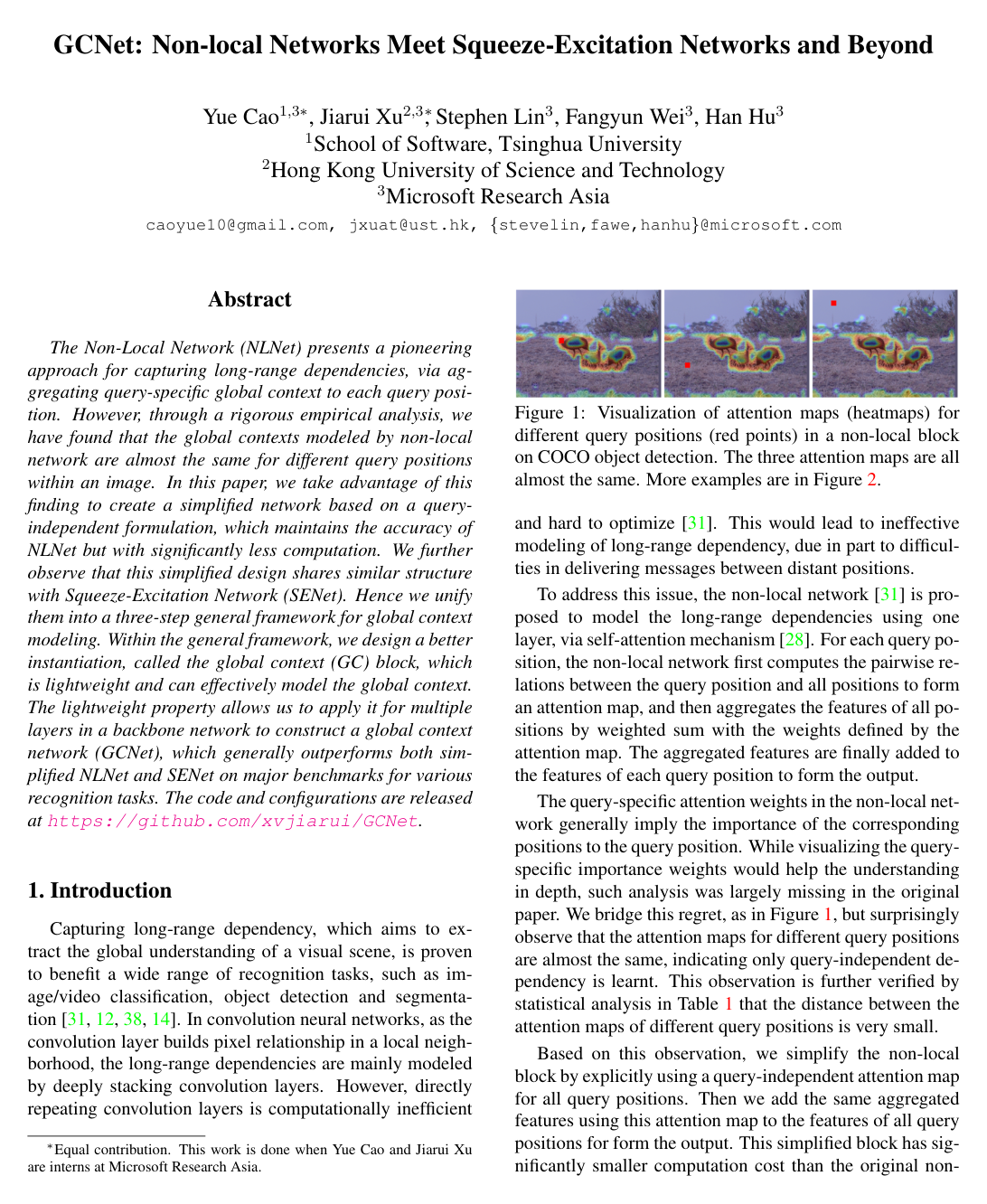
GCNet: Non-Local Networks Meet Squeeze-Excitation Networks and Beyond
Yue Cao, Jiarui Xu, Stephen Lin, Fangyun Wei, Han Hu
Why you should read this
Develops a lightweight Global Context network that unifies Non-Local Networks and Squeeze-Excitation Networks, capturing long-range dependencies with significantly reduced computation across visual recognition tasks.
The Non-Local Network (NLNet) presents a pioneering approach for capturing long-range dependencies, via aggregating query-specific global context to each query position. However, through a rigorous empirical analysis, we have found that the global contexts modeled by non-local network are almost the same for different query positions within an image. In this paper, we take advantage of this finding to create a simplified network based on a query-independent formulation, which maintains the accuracy of NLNet but with significantly less computation. We further observe that this simplified design shares similar structure with Squeeze-Excitation Network (SENet). Hence we unify them into a three-step general framework for global context modeling. Within the general framework, we design a better instantiation, called the global context (GC) block, which is lightweight and can effectively model the global context. The lightweight property allows us to apply it for multiple layers in a backbone network to construct a global context network (GCNet), which generally outperforms both simplified NLNet and SENet on major benchmarks for various recognition tasks. The code and configurations are released at this https URL.
Added
2026-09-18
Ensemble deep learning: A review
M. A. Ganaie, Minghui Hu, M. Tanveer, Ponnuthurai Nagaratnam Suganthan
Why you should read this
Categorizes state-of-the-art deep ensemble learning techniques across bagging, boosting, stacking, and decision fusion strategies, offering a clear framework for improving neural network generalization and real-world performance.
Ensemble learning combines several individual models to obtain better generalization performance. Currently, deep learning architectures are showing better performance compared to the shallow or traditional models. Deep ensemble learning models combine the advantages of both the deep learning models as well as the ensemble learning such that the final model has better generalization performance. This paper reviews the state-of-art deep ensemble models and hence serves as an extensive summary for the researchers. The ensemble models are broadly categorised into bagging, boosting, stacking, negative correlation based deep ensemble models, explicit/implicit ensembles, homogeneous/heterogeneous ensemble, decision fusion strategies based deep ensemble models. Applications of deep ensemble models in different domains are also briefly discussed. Finally, we conclude this paper with some potential future research directions.
Added
2026-09-18
FFA-Net: Feature Fusion Attention Network for Single Image Dehazing
Xu Qin, Zhiling Wang, Yuanchao Bai, Xiaodong Xie, Huizhu Jia
Why you should read this
Proposes FFA-Net, an end-to-end dehazing network that integrates channel and pixel attention with multi-level feature fusion, raising benchmark indoor PSNR from 30.23 dB to 36.39 dB.
In this paper, we propose an end-to-end feature fusion at-tention network (FFA-Net) to directly restore the haze-free image. The FFA-Net architecture consists of three key components: 1) A novel Feature Attention (FA) module combines Channel Attention with Pixel Attention mechanism, considering that different channel-wise features contain totally different weighted information and haze distribution is uneven on the different image pixels. FA treats different features and pixels unequally, which provides additional flexibility in dealing with different types of information, expanding the representational ability of CNNs. 2) A basic block structure consists of Local Residual Learning and Feature Attention, Local Residual Learning allowing the less important information such as thin haze region or low-frequency to be bypassed through multiple local residual connections, let main network architecture focus on more effective information. 3) An Attention-based different levels Feature Fusion (FFA) structure, the feature weights are adaptively learned from the Feature Attention (FA) module, giving more weight to important features. This structure can also retain the information of shallow layers and pass it into deep layers. The experimental results demonstrate that our proposed FFA-Net surpasses previous state-of-the-art single image dehazing methods by a very large margin both quantitatively and qualitatively, boosting the best published PSNR metric from 30.23db to 36.39db on the SOTS indoor test dataset. Code has been made available at GitHub.
Added
2026-09-17
BiSeNet: Bilateral Segmentation Network for Real-time Semantic Segmentation
Changqian Yu, Jingbo Wang, Chao Peng, Changxin Gao, Gang Yu, Nong Sang
Why you should read this
Proposes BiSeNet, a bilateral architecture that decouples spatial detail retention from wide-context feature extraction to resolve the trade-off between speed and accuracy in real-time semantic segmentation, achieving over 100 frames per second on standard benchmarks.
Semantic segmentation requires both rich spatial information and sizeable receptive field. However, modern approaches usually compromise spatial resolution to achieve real-time inference speed, which leads to poor performance. In this paper, we address this dilemma with a novel Bilateral Segmentation Network (BiSeNet). We first design a Spatial Path with a small stride to preserve the spatial information and generate high-resolution features. Meanwhile, a Context Path with a fast downsampling strategy is employed to obtain sufficient receptive field. On top of the two paths, we introduce a new Feature Fusion Module to combine features efficiently. The proposed architecture makes a right balance between the speed and segmentation performance on Cityscapes, CamVid, and COCO-Stuff datasets. Specifically, for a 2048x1024 input, we achieve 68.4% Mean IOU on the Cityscapes test dataset with speed of 105 FPS on one NVIDIA Titan XP card, which is significantly faster than the existing methods with comparable performance.
Added
2026-09-14
UNet++: Redesigning Skip Connections to Exploit Multiscale Features in Image Segmentation
Zongwei Zhou, Md Mahfuzur Rahman Siddiquee, Nima Tajbakhsh, Jianming Liang
Why you should read this
Proposes a nested encoder-decoder architecture with redesigned dense skip pathways and deep supervision, enabling effective multiscale feature aggregation and fast model pruning for medical image segmentation.
The state-of-the-art models for medical image segmentation are variants of U-Net and fully convolutional networks (FCN). Despite their success, these models have two limitations: (1) their optimal depth is apriori unknown, requiring extensive architecture search or inefficient ensemble of models of varying depths; and (2) their skip connections impose an unnecessarily restrictive fusion scheme, forcing aggregation only at the same-scale feature maps of the encoder and decoder sub-networks. To overcome these two limitations, we propose UNet++, a new neural architecture for semantic and instance segmentation, by (1) alleviating the unknown network depth with an efficient ensemble of U-Nets of varying depths, which partially share an encoder and co-learn simultaneously using deep supervision; (2) redesigning skip connections to aggregate features of varying semantic scales at the decoder sub-networks, leading to a highly flexible feature fusion scheme; and (3) devising a pruning scheme to accelerate the inference speed of UNet++. We have evaluated UNet++ using six different medical image segmentation datasets, covering multiple imaging modalities such as computed tomography (CT), magnetic resonance imaging (MRI), and electron microscopy (EM), and demonstrating that (1) UNet++ consistently outperforms the baseline models for the task of semantic segmentation across different datasets and backbone architectures; (2) UNet++ enhances segmentation quality of varying-size objects -- an improvement over the fixed-depth U-Net; (3) Mask RCNN++ (Mask R-CNN with UNet++ design) outperforms the original Mask R-CNN for the task of instance segmentation; and (4) pruned UNet++ models achieve significant speedup while showing only modest performance degradation. Our implementation and pre-trained models are available at this https URL.
Added
2026-09-13