GCNet: Non-Local Networks Meet Squeeze-Excitation Networks and Beyond
Yue CaoJiarui XuStephen LinFangyun WeiHan Hu
Develops a lightweight Global Context network that unifies Non-Local Networks and Squeeze-Excitation Networks, capturing long-range dependencies with significantly reduced computation across visual recognition tasks.
Modern computer vision models rely heavily on understanding full-scene context, known as long-range dependency, to accurately classify images, detect objects, and recognize actions in video. Standard convolutional networks struggle to capture this global context efficiently, while existing self-attention techniques—such as Non-Local Networks—demand high computational power and memory. This computational overhead limits these techniques to only one or two layers within a network architecture.
The article evaluates how Non-Local Networks model global context, identifies structural redundancies within them, and demonstrates a lightweight alternative architecture called the Global Context Network (GCNet).
To conduct the study, the authors performed empirical and statistical analyses of attention behaviors in Non-Local Networks across standard computer vision benchmarks, including COCO for object detection and segmentation, ImageNet for image classification, and Kinetics for action recognition. Based on findings from these analyses, they unified Non-Local Networks and Squeeze-Excitation Networks into a three-step framework covering context modeling, feature transformation, and feature fusion, and tested various architectural combinations against established baseline networks.
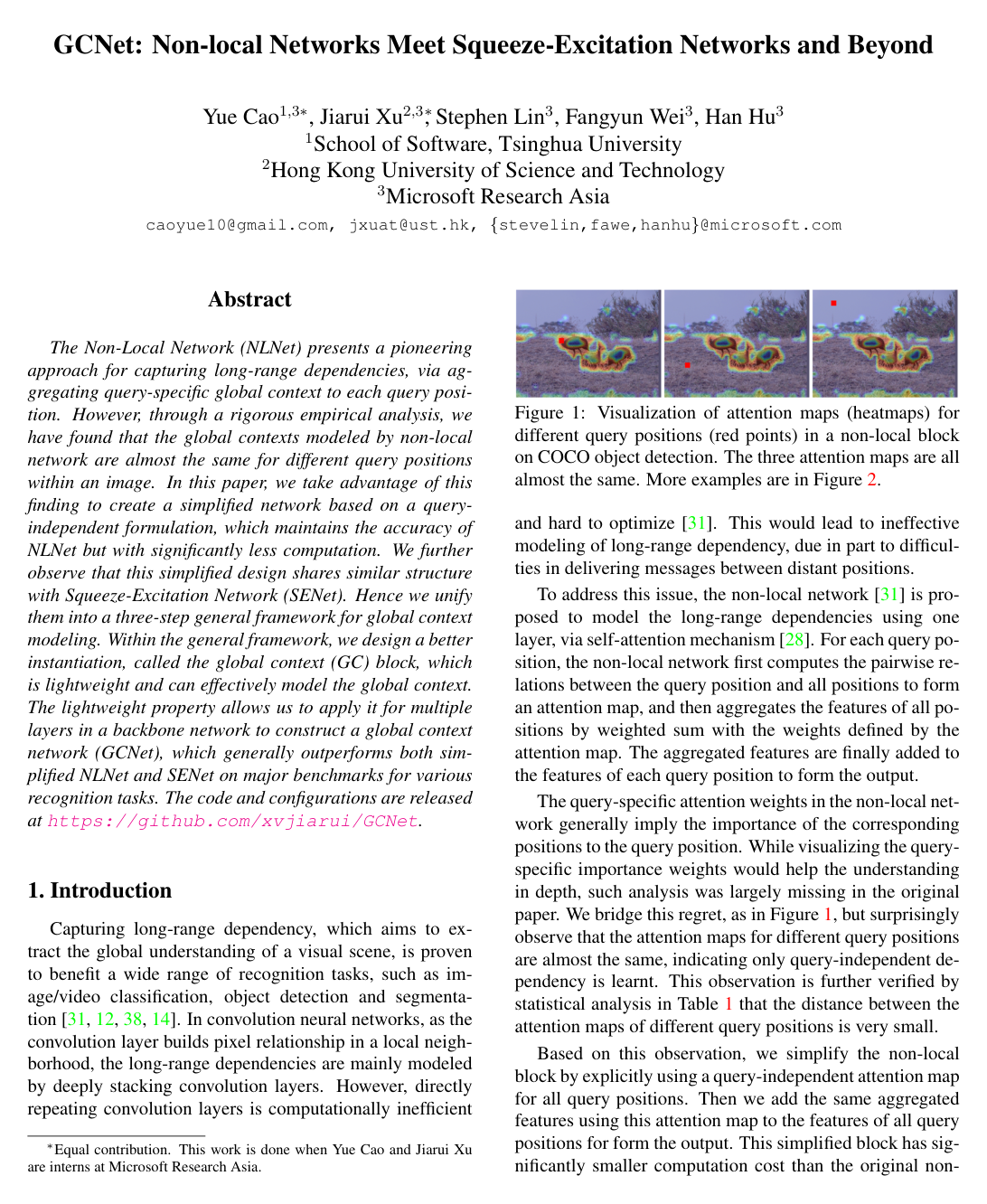
The analysis produced several key findings. First, Non-Local Networks learn attention maps that are almost identical across different positions within an image, proving that calculating expensive position-specific attention maps is largely redundant. Second, replacing these calculations with a shared, position-independent attention map maintains model accuracy while significantly reducing computational operations. Third, combining this simplified attention pooling with a compact bottleneck transformation and addition-based feature fusion creates a lightweight Global Context block that can be integrated across multiple network layers. Across benchmarks, applying this block across all stages improved object detection by 2.7% on COCO, image classification top-1 accuracy by 0.8% on ImageNet, and video action recognition by 1.1% on Kinetics, all while adding less than 0.26% computational overhead.
These findings indicate that artificial intelligence systems can achieve superior global context modeling without suffering the computational and financial burdens typically associated with attention mechanisms. Integrating lightweight global context across all network stages delivers higher recognition accuracy and lower latency compared to heavily restricted, single-layer deployments.
Teams developing and deploying computer vision architectures should adopt Global Context blocks across network backbones to boost visual accuracy with minimal computational cost. Engineering teams can leverage the authors' publicly released implementation to evaluate bottleneck ratios—such as a factor of 16 for standard efficiency or 4 for higher accuracy—based on specific hardware and latency budgets.
The findings are supported with high confidence across multiple standardized image and video benchmarks. However, the study evaluates these mechanisms within standard ResNet-style backbones on benchmark datasets, meaning performance should be re-evaluated when applying the architecture to custom edge-computing hardware or novel backbone designs.
- Paper: Non-local Neural Networks, Xiaolong Wang et al. (2018). Non-Local Neural Networks establish the foundational query-specific global context aggregation module that GCNet directly analyzes and simplifies.
- Paper: Squeeze-and-Excitation Networks, Jie Hu et al. (2018). Squeeze-and-Excitation Networks introduce the lightweight channel attention mechanism that GCNet explicitly unifies with simplified non-local blocks.
- Paper: Group Normalization, Yuxin Wu et al. (2018). Group Normalization provides the batch-independent normalization technique used inside GCNet's bottleneck transform to ease optimization.
- Paper: Path Aggregation Network for Instance Segmentation, Shu Liu et al. (2018). Path Aggregation Network establishes the instance segmentation and feature pyramid framework utilized in GCNet's downstream visual recognition evaluations.
- Paper: ECA-Net: Efficient Channel Attention for Deep Convolutional Neural Networks, Qilong Wang et al. (2019). ECA-Net builds on and directly benchmarks against GCNet while developing an even more efficient, dimensionality-reduction-free channel attention mechanism.
- Paper: Coordinate Attention for Efficient Mobile Network Design, Qibin Hou et al. (2021). Coordinate Attention advances global context and lightweight attention designs like GCNet by factoring spatial coordinate awareness into channel attention modules.
- Paper: ConvNeXt V2: Co-designing and Scaling ConvNets with Masked Autoencoders, Sanghyun Woo et al. (2023). ConvNeXt V2 extends modern convolutional architectures by incorporating global response normalization to capture global context across feature channels.
- Paper: Rethinking Semantic Segmentation from a Sequence-to-Sequence Perspective with Transformers, Sixiao Zheng et al. (2020). SETR explores replacing hybrid convolutional-attention blocks like GCNet with pure transformer self-attention sequences for global context modeling in dense visual recognition.