Towards Robust Event-guided Low-Light Image Enhancement: A Large-Scale Real-World Event-Image Dataset and Novel Approach
Guoqiang LiangKanghao ChenHangyu LiYunfan LuLin Wang
Presents a large-scale, robot-aligned real-world event-image dataset alongside EvLight, a framework that uses signal-to-noise ratio guidance to selectively combine event edges and frame features for low-light image restoration.
Capturing clear visual data in poor lighting conditions is a fundamental challenge for downstream artificial intelligence systems, such as nighttime autonomous navigation, surveillance, and facial recognition. While event cameras—sensors that record brightness changes at high speeds with high dynamic range—offer rich structural and edge information, combining them with standard color cameras has been hindered by a critical data shortage. Prior research lacked large-scale, real-world datasets that accurately align dynamic images and event streams in both space and time, forcing existing methods to rely on synthetic data, static scenes, or uncalibrated inputs.
The article addresses this gap with two main objectives: first, creating a high-precision, real-world dataset of paired low-light and normal-light image-event sequences under complex dynamic motion; and second, developing an event-guided low-light image enhancement framework, named EvLight, that selectively merges image and event features based on local signal quality.
To construct the dataset, the researchers deployed an event camera on a high-precision robotic arm following complex non-linear trajectories across indoor and outdoor environments. They gathered over 30,000 aligned pairs across 91 sequences by recording identical paths under normal lighting and low-light conditions using optical filters. To overcome mechanical and timing variations, they implemented a matching strategy that brought temporal alignment error below 0.01 seconds for 90% of the data and achieved spatial error margins under 0.03 millimeters. Leveraging this dataset, the team designed the EvLight framework. The system uses a signal-to-noise ratio map to extract clean color features from well-lit image regions while selectively drawing boundary and structural details from event streams in dark, high-noise areas, combining them through a holistic attention-based fusion network.
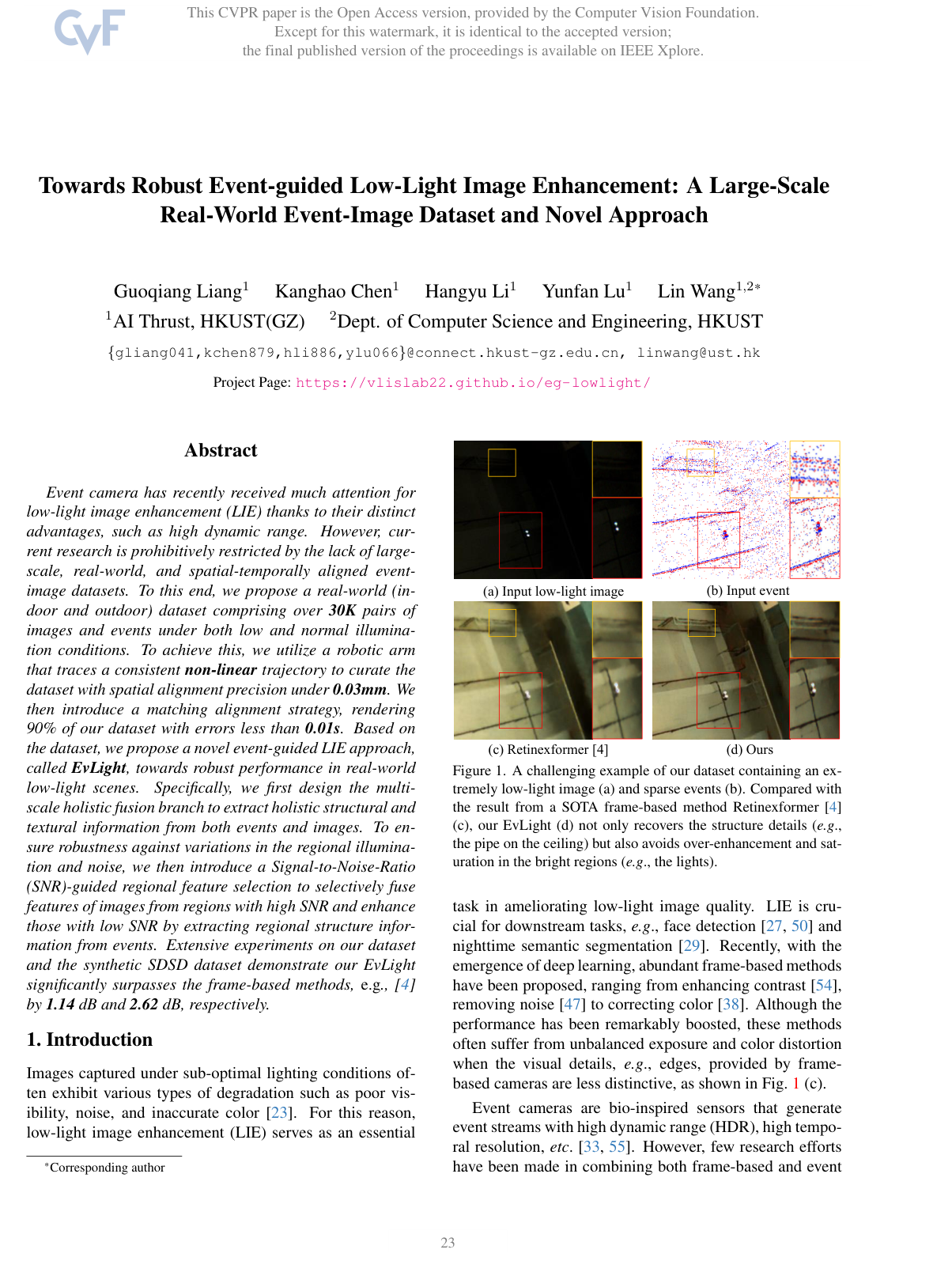
The findings demonstrate clear performance advantages. Across indoor and outdoor benchmarks on the newly collected dataset, EvLight consistently outperformed leading frame-based and event-guided enhancement models, delivering higher structural similarity and visual quality while avoiding common artifacts like over-saturation and color distortion. In evaluations on a benchmark dynamic dataset, EvLight outperformed the previous state-of-the-art frame-based method by 2.62 decibels in reconstruction accuracy (peak signal-to-noise ratio) and exceeded alternative event-guided approaches by around 0.9 decibels indoors. Ablation tests confirmed that the signal-to-noise ratio feature selection is essential, yielding a 0.86-decibel performance gain over basic fusion setups that suffer from noise accumulation.
These results demonstrate that event cameras can significantly enhance low-light computer vision when guided by region-specific noise awareness. For operational systems operating in dark or high-contrast environments, this approach offers a viable path toward robust visibility without severe computational distortion or sensor noise amplification. Moving forward, teams deploying low-light enhancement should consider incorporating event sensors alongside selective fusion mechanisms. Future development should focus on upgrading hardware to achieve automated hardware-level synchronization between cameras and robotic systems, eliminating manual capture overhead and addressing minor sensor artifacts such as chromatic aberrations.
- Paper: SNR-Aware Low-light Image Enhancement, Xiaogang Xu et al. (2022). It introduces SNR-guided feature modulation and dual-branch processing for low-light enhancement, establishing the conceptual foundation for EvLight's SNR-aware image and event feature selection.
- Paper: Event-Based Vision: A Survey, Guillermo Gallego et al. (2019). It provides a comprehensive overview of event cameras, event stream representations, and neuromorphic visual sensing principles essential for understanding event-guided visual enhancement.
- Paper: Learning to See in the Dark, Chen Chen et al. (2018). It provides the seminal benchmark and deep learning methodology for extreme low-light raw image restoration, establishing core baseline problems in low-light noise and amplification.
- Paper: Deep Retinex Decomposition for Low-Light Enhancement, Chen Wei et al. (2018). It establishes paired data collection paradigms and deep Retinex illumination decomposition strategies that serve as standard baselines for low-light restoration.
- Paper: Zero-Reference Deep Curve Estimation for Low-Light Image Enhancement, Chunle Guo et al. (2020). It introduces non-reference curve estimation for dynamic range adjustment, providing key background on contemporary frame-based low-light enhancement techniques.
- Paper: U2Fusion: A Unified Unsupervised Image Fusion Network, Han Xu et al. (2020). It outlines fundamental principles for multi-modal feature fusion and information measurement across complementary imaging sensors.
- Paper: Fourier Priors-Guided Diffusion for Zero-Shot Joint Low-Light Enhancement and Deblurring, Xiaoqian Lv et al. (2024). It extends low-light restoration into zero-shot joint enhancement and deblurring using Fourier-guided diffusion models to handle extreme dynamic degradations.