SNR-Aware Low-light Image Enhancement
Xiaogang XuRuixing WangChi-Wing FuJiaya Jia
Proposes an SNR-guided hybrid architecture that dynamically combines transformers for noisy, low-SNR regions and convolutional operations for higher-SNR areas, outperforming existing state-of-the-art methods across seven low-light benchmark datasets.
Low-light imaging presents significant challenges for automated systems and human operators across night-time security surveillance, autonomous navigation, and consumer photography. In dimly lit settings, images suffer from severe visibility loss and non-uniform noise distributions. Standard neural network approaches apply uniform enhancement operations across the entire scene, which frequently distorts colors, fails to resolve details in pitch-black areas, or amplifies background noise.
The article demonstrates a new framework designed to solve these issues through spatially varying enhancement guided by signal-to-noise ratio (SNR)—a standard metric measuring the ratio between meaningful image information and background noise. The authors evaluate this architecture across multiple public benchmarks and human perceptual tests to establish whether dynamically adjusting local and non-local operations according to regional noise levels outperforms current methods.
The framework pairs an SNR estimation method with a dual-branch neural architecture in its deepest layer. It utilizes standard convolutional blocks for short-range operations in relatively clear, high-signal regions and a specialized transformer module for long-range operations in heavily degraded, low-signal regions. Crucially, the system introduces a selective self-attention mechanism that masks out extremely noisy tokens, preventing corrupted areas from degrading long-range feature extraction. The outputs are then adaptively blended using the estimated SNR map. The framework was evaluated on seven benchmark datasets (such as LOL, SID, SMID, and SDSD) against more than a dozen state-of-the-art baselines, followed by a blind perceptual study involving 100 participants evaluating smartphone imagery.
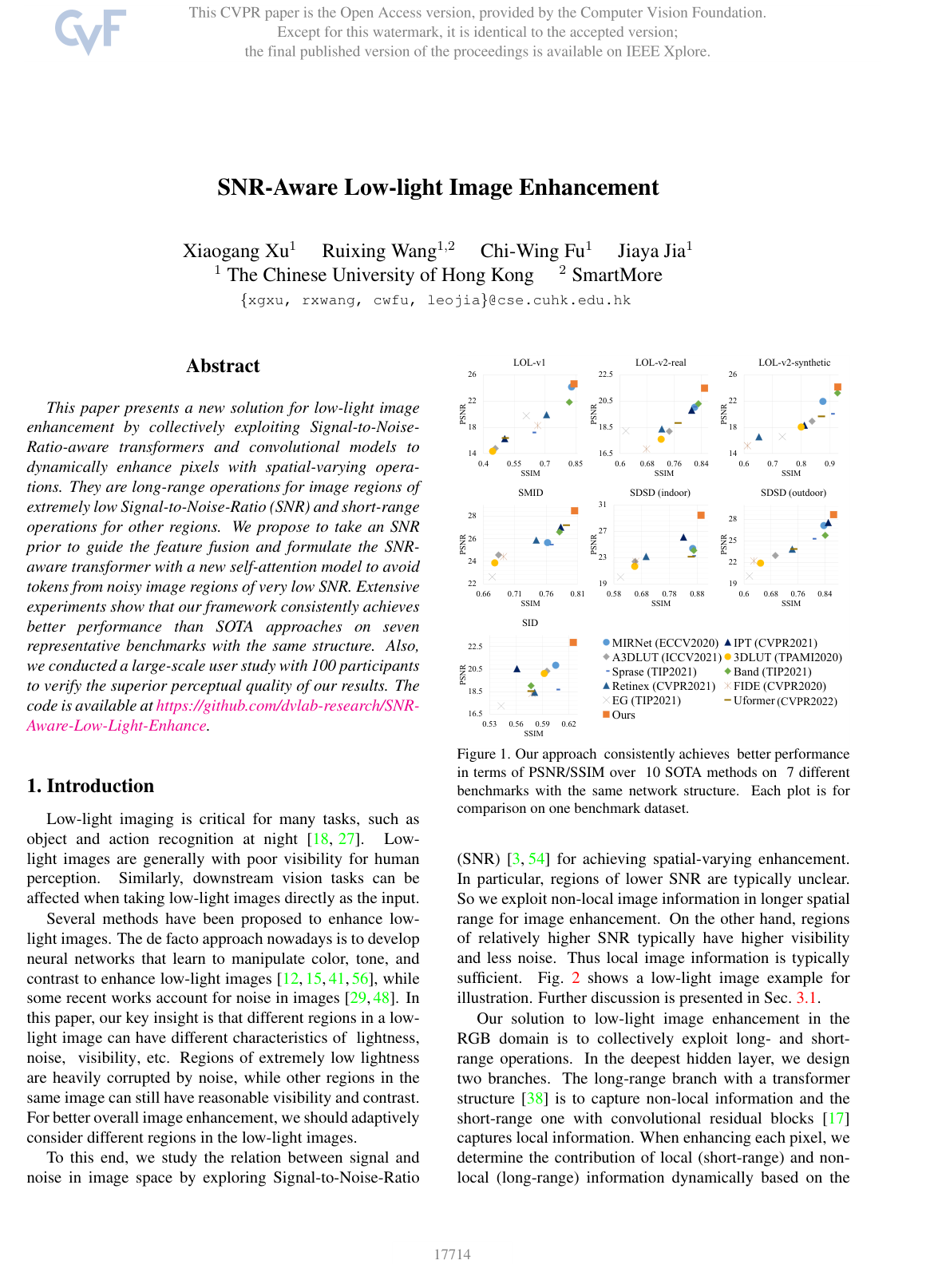
The experimental findings show clear, consistent advantages across all benchmarks. First, the proposed framework achieved higher quantitative fidelity than all comparative methods, reaching 24.61 dB on the LOL-v1 dataset compared to 24.14 dB for the best previous convolutional method and 16.27–16.36 dB for standard visual transformers. Second, ablation studies showed that the complete system outperformed variants that removed either the long-range transformer branch or the short-range convolutional branch, confirming that combining both mechanisms is essential. Third, the user study confirmed statistically significant human preference for the framework over leading baselines in sharpness, noise suppression, color vividness, and natural realism. Finally, tests indicated the model remains robust regardless of the specific denoising algorithm used to estimate the initial noise map.
These results establish that low-light enhancement cannot rely on uniform processing or standard, unconstrained vision transformers, which inadvertently amplify severe noise across global contexts. By implementing spatially adaptive operations, organizations deploying night-time computer vision systems can achieve superior visual clarity and downstream object recognition without requiring specialized sensor hardware upgrades. The model significantly reduces visual artifacts, lowers failure risks in low-visibility autonomous tasks, and delivers higher operational reliability.
Stakeholders and development teams working on low-light enhancement pipelines should evaluate adopting SNR-guided feature extraction as an upgrade over uniform convolutional or standard transformer models. Before widespread operational deployment, engineering teams should conduct targeted pilot evaluations on specific field sensor data. The primary limitations of the current study are its focus on static RGB images and the reliance on approximation heuristics for noise estimation in nearly black regions. Future development should prioritize expanding the framework into low-light video streams by incorporating temporal tracking alongside spatial adaptation, as well as testing generative models to realistically synthesize visual information in completely black environments.
- Paper: Learning to See in the Dark, Chen Chen et al. (2018). Chen et al. introduced foundational datasets and direct raw-sensor learning pipelines for extreme low-light enhancement that motivated subsequent SNR-aware and spatial-varying enhancement strategies.
- Paper: Deep Retinex Decomposition for Low-Light Enhancement, Chen Wei et al. (2018). This work established the widely used Retinex decomposition baseline and the LOL dataset for low-light enhancement that benchmark modern low-light restoration architectures.
- Paper: Zero-Reference Deep Curve Estimation for Low-Light Image Enhancement, Chunle Guo et al. (2020). Zero-DCE provides critical background on dynamic, spatially varying curve estimation for low-light enhancement without over-amplifying noise.
- Paper: EnlightenGAN: Deep Light Enhancement Without Paired Supervision, Yifan Jiang et al. (2019). EnlightenGAN pioneered illumination-guided attention mechanisms to selectively enhance dark regions without corrupting normally exposed areas.
- Paper: Uformer: A General U-Shaped Transformer for Image Restoration, Zhendong Wang et al. (2021). Uformer established a hierarchical window-based transformer architecture for image restoration that informs hybrid transformer-convolutional design in low-level vision.
- Paper: SwinIR: Image Restoration Using Swin Transformer, Jingyun Liang et al. (2021). SwinIR demonstrates how window-based self-attention paired with residual convolutional structures can be effectively utilized for high-fidelity image restoration.
- Paper: Multi-Stage Progressive Image Restoration, Syed Waqas Zamir et al. (2021). MPRNet presents multi-stage progressive restoration and cross-stage feature fusion mechanisms essential for balancing contextual reasoning with spatial detail preservation.
- Paper: LLNet: A deep autoencoder approach to natural low-light image enhancement, Kin Gwn Lore et al. (2015). LLNet pioneered deep neural network solutions for simultaneous brightening and denoising in low-light image processing.
- Paper: TransNeXt: Robust Foveal Visual Perception for Vision Transformers, Dai Shi (2024). TransNeXt builds upon advances in hybrid attention mechanisms by integrating foveal-inspired dual-path perception to enhance long-range and short-range visual representations.