SwinIR: Image Restoration Using Swin Transformer

Jingyun LiangJiezhang CaoGuolei SunKai ZhangLuc Van GoolRadu Timofte

article2021ICCV5,134 citations

Proposes SwinIR, a Swin Transformer-based architecture that outperforms state-of-the-art convolutional networks across super-resolution, denoising, and JPEG artifact removal while using up to 67% fewer parameters.

Listen

Digital image restorationincluding super-resolution, denoising, and compression artifact removalis essential for recovering high-quality visual data from degraded inputs across consumer, industrial, and medical applications. While convolutional neural networks have long served as the standard approach, they struggle to model long-range contextual relationships and process all image regions using fixed, content-independent filters. Early attempts to apply self-attention transformer models to image restoration suffered from heavy computational burdens, artificial border artifacts caused by patch-by-patch processing, and an extreme reliance on massive datasets and hundreds of millions of parameters.

The article evaluates whether an adapted vision transformer architecture, termed SwinIR, can overcome these limitations to serve as a versatile, parameter-efficient baseline for image restoration. The authors set out to demonstrate that shifting-window self-attention combined with residual convolutional layers can outperform existing convolutional and transformer-based methods across diverse restoration tasks.

To test this, the authors designed a three-part modular pipeline consisting of shallow feature extraction, deep feature extraction using residual transformer blocks, and task-specific high-quality image reconstruction. The framework was evaluated across three core problem domains: image super-resolution (classical, lightweight, and real-world), image denoising (grayscale and color), and JPEG compression artifact reduction. Performance was measured using standard signal quality metrics (peak signal-to-noise ratio and structural similarity) across multiple public benchmark datasets, including Set5, Set14, Urban100, Manga109, and LIVE1, against leading convolutional and transformer alternatives.

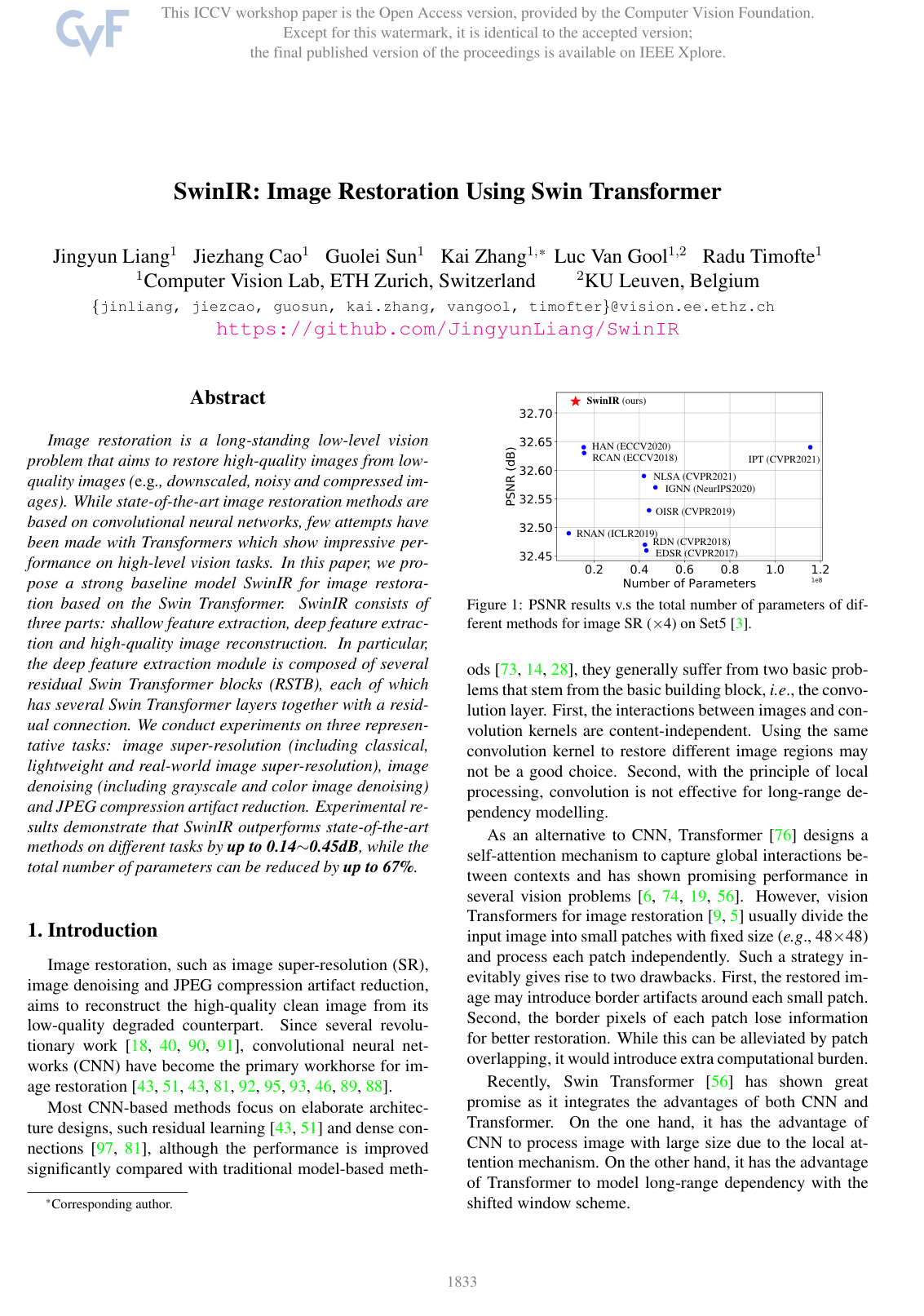
The experimental findings show that the proposed architecture establishes a new performance baseline. Across classical super-resolution tasks, SwinIR outperformed existing state-of-the-art methods by up to 0.45 dB, restoring sharper edges and rich high-frequency textures where alternative methods produced blurred or distorted patterns. On lightweight super-resolution, it achieved superior restoration accuracy while maintaining comparable computational operations and parameter counts. In image denoising and JPEG artifact reduction, the model exceeded leading models like DRUNet and DnCNN, delivering up to a 0.3 dB improvement while requiring up to 67% fewer parameters (11.512.0 million compared to 32.7 million). Furthermore, training analysis demonstrated that the model converged faster and achieved higher accuracy than deep convolutional networks even when trained on small datasets of only a few hundred images, refuting the assumption that vision transformers require millions of pre-training images to be effective.

These findings indicate that organizations deploying automated computer vision and image processing systems can achieve noticeably higher reconstruction quality with substantially smaller model footprints. The reduced parameter footprint lowers the computational and hardware costs required for model deployment in cloud and edge environments without sacrificing fidelity. Moreover, the architecture's ability to generalize across six different restoration settings indicates that teams can maintain a unified technical framework rather than building fragmented pipelines for individual degradation problems.

Based on these results, engineering and technical teams should consider adopting this shifted-window transformer framework as a primary architecture for image enhancement workflows. For deployment in resource-constrained environments, the lightweight variant provides an immediate efficiency trade-off. Before broad commercial deployment, organizations should conduct domain-specific pilot testing on real-world imagery, adjusting the restoration modules and training data to mirror their specific corruption profiles. Future research and development should focus on expanding the architecture to handle other degradation challenges, such as image deblurring and deraining.

Confidence in the findings is high for standard image benchmarks, as the model was rigorously tested across multiple tasks, noise levels, and scaling factors. However, users should note that the base model was primarily evaluated against synthetic degradation pipelines and standard benchmark sets; performance on complex real-world corruptions may require larger training sets and task-specific loss configurations to prevent unmodeled visual artifacts.

Cover for SwinIR: Image Restoration Using Swin Transformer

Abstract

Image restoration is a long-standing low-level vision problem that aims to restore high-quality images from low-quality images (e.g., downscaled, noisy and compressed images). While state-of-the-art image restoration methods are based on convolutional neural networks, few attempts have been made with Transformers which show impressive performance on high-level vision tasks. In this paper, we propose a strong baseline model SwinIR for image restoration based on the Swin Transformer. SwinIR consists of three parts: shallow feature extraction, deep feature extraction and high-quality image reconstruction. In particular, the deep feature extraction module is composed of several residual Swin Transformer blocks (RSTB), each of which has several Swin Transformer layers together with a residual connection. We conduct experiments on three representative tasks: image super-resolution (including classical, lightweight and real-world image super-resolution), image denoising (including grayscale and color image denoising) and JPEG compression artifact reduction. Experimental results demonstrate that SwinIR outperforms state-of-the-art methods on different tasks by \textbf{up to 0.14\sim0.45dB}, while the total number of parameters can be reduced by \textbf{up to 67%}.

Table of Contents

  • 1 Introduction
  • 2 Related Work
  • 2.1 Image Restoration
  • 2.2 Vision Transformer
  • 3 Method
  • 3.1 Network Architecture
  • 3.2 Residual Swin Transformer Block
  • 4 Experiments
  • 4.1 Experimental Setup
  • 4.2 Ablation Study and Discussion
  • 4.3 Results on Image SR
  • 4.4 Results on JPEG Compression Artifact Reduction
  • 4.5 Results on Image Denoising
  • 5 Conclusion
  • References

Knowls

  1. Knowl 1 — SwinIR Overall Architecture for Image Restoration

    model/method

    SwinIR is an image restoration network based on the Swin Transformer. It comprises three sequential modules: shallow feature extraction, deep feature extraction, and high-quality (HQ) image reconstruction.

    1. Shallow Feature Extraction: Given a low-quality (LQ) image ILQRH×W×CinI_{\text{LQ}} \in \mathbb{R}^{H \times W \times C_{\text{in}}} (with spatial dimensions H×WH \times W and channel count CinC_{\text{in}}), a 3×33 \times 3 convolutional layer HSF()H_{\text{SF}}(\cdot) extracts shallow features F0RH×W×CF_0 \in \mathbb{R}^{H \times W \times C}:

    F0=HSF(ILQ)F_0 = H_{\text{SF}}(I_{\text{LQ}})

    1. Deep Feature Extraction: Deep features FDFRH×W×CF_{\text{DF}} \in \mathbb{R}^{H \times W \times C} are extracted using KK residual Swin Transformer blocks (RSTB) followed by a final 3×33 \times 3 convolutional layer HCONV()H_{\text{CONV}}(\cdot):

    Fi=HRSTBi(Fi1),i=1,2,,KFDF=HCONV(FK)\begin{aligned} F_i &= H_{\text{RSTB}_i}(F_{i-1}), \quad i = 1, 2, \dots, K \\ F_{\text{DF}} &= H_{\text{CONV}}(F_K) \end{aligned}

    1. High-Quality Image Reconstruction: For super-resolution (SR), shallow and deep features are aggregated via a long skip connection and processed through an upsampling reconstruction module HREC()H_{\text{REC}}(\cdot) (implemented via sub-pixel convolution layers):

    IRHQ=HREC(F0+FDF)I_{\text{RHQ}} = H_{\text{REC}}(F_0 + F_{\text{DF}})

    For non-upsampling tasks such as image denoising and JPEG compression artifact reduction, a single 3×33 \times 3 convolution layer is used in conjunction with global residual learning to predict the residual between the input and ground-truth images:

    IRHQ=HSwinIR(ILQ)+ILQI_{\text{RHQ}} = H_{\text{SwinIR}}(I_{\text{LQ}}) + I_{\text{LQ}}

  2. Knowl 2 — Residual Swin Transformer Block (RSTB)

    model/method

    The Residual Swin Transformer Block (RSTB) is the core building block of deep feature extraction in SwinIR. For the ii-th RSTB receiving input feature Fi,0RH×W×CF_{i,0} \in \mathbb{R}^{H \times W \times C}, feature transformation occurs in two stages:

    1. Sequential Swin Transformer Layers: A series of LL Swin Transformer layers (STL) extract intermediate representations:

    Fi,j=HSwini,j(Fi,j1),j=1,2,,LF_{i,j} = H_{\text{Swin}_{i,j}}(F_{i,j-1}), \quad j = 1, 2, \dots, L

    1. Convolution and Residual Shortcut: The output of the final STL passes through a 3×33 \times 3 convolution layer HCONVi()H_{\text{CONV}_i}(\cdot), and the original block input Fi,0F_{i,0} is added via an identity connection:

    Fi,out=HCONVi(Fi,L)+Fi,0F_{i,\text{out}} = H_{\text{CONV}_i}(F_{i,L}) + F_{i,0}

    The 3×33 \times 3 convolution layer introduces spatial translation equivariance and the inductive bias of local operations to the Transformer representation, while the residual connection provides a shortcut that facilitates multi-level feature aggregation.

  3. Knowl 3 — Swin Transformer Layer (STL) Formulation in SwinIR

    model/method

    Each Swin Transformer layer (STL) processes an input feature map XRH×W×CX \in \mathbb{R}^{H \times W \times C} by partitioning it into non-overlapping local windows of size M×MM \times M, yielding HWM2\frac{HW}{M^2} local patches of dimension M2×CM^2 \times C. For each local window feature matrix XRM2×CX \in \mathbb{R}^{M^2 \times C}, query (QQ), key (KK), and value (VV) projections are computed using shared linear transformation matrices PQ,PK,PVRC×dP_Q, P_K, P_V \in \mathbb{R}^{C \times d}:

    Q=XPQ,K=XPK,V=XPVQ = X P_Q, \quad K = X P_K, \quad V = X P_V

    Local window self-attention is computed with a learnable relative positional encoding matrix BRM2×M2B \in \mathbb{R}^{M^2 \times M^2}:

    Attention(Q,K,V)=SoftMax(QKTd+B)V\text{Attention}(Q, K, V) = \text{SoftMax}\left(\frac{Q K^T}{\sqrt{d}} + B\right)V

    Multi-head self-attention (MSA) runs hh attention heads in parallel and concatenates their outputs. The full layer transformation, including LayerNorm (LN) and a multi-layer perceptron (MLP) containing two fully connected layers with GELU non-linearities, is defined as:

    X=MSA(LN(X))+XX=MLP(LN(X))+X\begin{aligned} X &= \text{MSA}(\text{LN}(X)) + X \\ X &= \text{MLP}(\text{LN}(X)) + X \end{aligned}

    To allow information exchange across different local windows, consecutive STLs alternate between standard local window partitioning and shifted window partitioning (shifting features by (M/2,M/2)(\lfloor M/2 \rfloor, \lfloor M/2 \rfloor) pixels before window division).

  4. Knowl 4 — Loss Functions for Restoration Objectives in SwinIR

    equation

    SwinIR employs task-specific loss functions between the restored image IRHQI_{\text{RHQ}} and ground truth IHQI_{\text{HQ}}:

    1. Classical and Lightweight Image Super-Resolution: The network is optimized using the pixel-level L1L_1 loss:

    L=IRHQIHQ1\mathcal{L} = \|I_{\text{RHQ}} - I_{\text{HQ}}\|_1

    1. Image Denoising and JPEG Compression Artifact Reduction: The network is optimized using the Charbonnier loss:

    L=IRHQIHQ2+ϵ2\mathcal{L} = \sqrt{\|I_{\text{RHQ}} - I_{\text{HQ}}\|^2 + \epsilon^2}

    where ϵ\epsilon is a constant empirically set to 10310^{-3}.

    1. Real-World Super-Resolution: The model is trained using a weighted combination of pixel loss (L1L_1), GAN loss, and perceptual loss to produce visually sharp textures.
  5. Knowl 5 — Quantitative Evaluation on Classical Image Super-Resolution

    data/table

    SwinIR (configured with K=6K=6 RSTBs, L=6L=6 STLs per block, channel dimension C=180C=180, attention heads h=6h=6, window size M=8M=8, total parameters 11.8M\approx 11.8\text{M}) was evaluated across standard classical image SR benchmarks against representative CNN and Transformer models.

    Method Scale Training Dataset Set5 Set14 BSD100 Urban100 Manga109
    PSNR / SSIM PSNR / SSIM PSNR / SSIM PSNR / SSIM PSNR / SSIM
    RCAN ×2\times 2 DIV2K 38.27 / 0.9614 34.12 / 0.9216 32.41 / 0.9027 33.34 / 0.9384 39.44 / 0.9786
    SAN ×2\times 2 DIV2K 38.31 / 0.9620 34.07 / 0.9213 32.42 / 0.9028 33.10 / 0.9370 39.32 / 0.9792
    NLSA ×2\times 2 DIV2K 38.34 / 0.9618 34.08 / 0.9231 32.43 / 0.9027 33.42 / 0.9394 39.59 / 0.9789
    SwinIR ×2\times 2 DIV2K 38.35 / 0.9620 34.14 / 0.9227 32.44 / 0.9030 33.40 / 0.9393 39.60 / 0.9792
    SwinIR+ ×2\times 2 DIV2K 38.38 / 0.9621 34.24 / 0.9233 32.47 / 0.9032 33.51 / 0.9401 39.70 / 0.9794
    IPT ×2\times 2 ImageNet 38.37 / - 34.43 / - 32.48 / - 33.76 / - - / -
    SwinIR ×2\times 2 DIV2K+Flickr2K 38.42 / 0.9623 34.46 / 0.9250 32.53 / 0.9041 33.81 / 0.9427 39.92 / 0.9797
    SwinIR+ ×2\times 2 DIV2K+Flickr2K 38.46 / 0.9624 34.61 / 0.9260 32.55 / 0.9043 33.95 / 0.9433 40.02 / 0.9800
    RCAN ×4\times 4 DIV2K 32.63 / 0.9002 28.87 / 0.7889 27.77 / 0.7436 26.82 / 0.8087 31.22 / 0.9173
    SAN ×4\times 4 DIV2K 32.64 / 0.9003 28.92 / 0.7888 27.78 / 0.7436 26.79 / 0.8068 31.18 / 0.9169
    HAN ×4\times 4 DIV2K 32.64 / 0.9002 28.90 / 0.7890 27.80 / 0.7442 26.85 / 0.8094 31.42 / 0.9177
    NLSA ×4\times 4 DIV2K 32.59 / 0.9000 28.87 / 0.7891 27.78 / 0.7444 26.96 / 0.8109 31.27 / 0.9184
    SwinIR ×4\times 4 DIV2K 32.72 / 0.9021 28.94 / 0.7914 27.83 / 0.7459 27.07 / 0.8164 31.67 / 0.9226
    SwinIR+ ×4\times 4 DIV2K 32.81 / 0.9029 29.02 / 0.7928 27.87 / 0.7466 27.21 / 0.8187 31.88 / 0.9423
    IPT ×4\times 4 ImageNet 32.64 / - 29.01 / - 27.82 / - 27.26 / - - / -
    RRDB ×4\times 4 DIV2K+Flickr2K 32.73 / 0.9011 28.99 / 0.7917 27.85 / 0.7455 27.03 / 0.8153 31.66 / 0.9196
    SwinIR ×4\times 4 DIV2K+Flickr2K 32.92 / 0.9044 29.09 / 0.7950 27.92 / 0.7489 27.45 / 0.8254 32.03 / 0.9260
    SwinIR+ ×4\times 4 DIV2K+Flickr2K 32.93 / 0.9043 29.15 / 0.7958 27.95 / 0.7494 27.56 / 0.8273 32.22 / 0.9273

    When trained on DIV2K+Flickr2K, SwinIR surpasses IPT (which uses 115.5M parameters and pretraining on over 1.1M ImageNet images) across all scale factors while using only 11.8M parameters (an 90%\approx 90\% parameter reduction compared to IPT).

  6. Knowl 6 — Quantitative Evaluation on Lightweight Image Super-Resolution

    data/table

    For lightweight single-image super-resolution, SwinIR was configured with K=4K=4 RSTBs, L=6L=6 STLs per block, and channel dimension C=60C=60. Multi-Adds were evaluated on a 1280×7201280 \times 720 output HQ image.

    Method Scale Params Mult-Adds Set5 Set14 BSD100 Urban100 Manga109
    PSNR / SSIM PSNR / SSIM PSNR / SSIM PSNR / SSIM PSNR / SSIM
    CARN ×2\times 2 1,592K 222.8G 37.76 / 0.9590 33.52 / 0.9166 32.09 / 0.8978 31.92 / 0.9256 38.36 / 0.9765
    IMDN ×2\times 2 694K 158.8G 38.00 / 0.9605 33.63 / 0.9177 32.19 / 0.8996 32.17 / 0.9283 38.88 / 0.9774
    LAPAR-A ×2\times 2 548K 171.0G 38.01 / 0.9605 33.62 / 0.9183 32.19 / 0.8999 32.10 / 0.9283 38.67 / 0.9772
    LatticeNet ×2\times 2 756K 169.5G 38.15 / 0.9610 33.78 / 0.9193 32.25 / 0.9005 32.43 / 0.9302 - / -
    SwinIR ×2\times 2 878K 195.6G 38.14 / 0.9611 33.86 / 0.9206 32.31 / 0.9012 32.76 / 0.9340 39.12 / 0.9783
    CARN ×4\times 4 1,592K 90.9G 32.13 / 0.8937 28.60 / 0.7806 27.58 / 0.7349 26.07 / 0.7837 30.47 / 0.9084
    IMDN ×4\times 4 715K 40.9G 32.21 / 0.8948 28.58 / 0.7811 27.56 / 0.7353 26.04 / 0.7838 30.45 / 0.9075
    LAPAR-A ×4\times 4 659K 94.0G 32.15 / 0.8944 28.61 / 0.7818 27.61 / 0.7366 26.14 / 0.7871 30.42 / 0.9074
    LatticeNet ×4\times 4 777K 43.6G 32.30 / 0.8962 28.68 / 0.7830 27.62 / 0.7367 26.25 / 0.7873 - / -
    SwinIR ×4\times 4 897K 49.6G 32.44 / 0.8976 28.77 / 0.7858 27.69 / 0.7406 26.47 / 0.7980 30.92 / 0.9151

    SwinIR outperforms previous lightweight models (e.g., CARN, IMDN, LatticeNet) across all benchmarks, gaining up to 0.53 dB0.53\text{ dB} on Manga109 for ×4\times 4 SR while maintaining comparable parameter size and operation counts.

  7. Knowl 7 — Quantitative Evaluation on Grayscale and Color Image Denoising

    data/table

    SwinIR was evaluated for additive white Gaussian noise removal at noise levels σ{15,25,50}\sigma \in \{15, 25, 50\}. SwinIR utilizes 12.0M\approx 12.0\text{M} parameters for denoising compared to 32.7M32.7\text{M} in DRUNet (a 63%63\% reduction).

    Task / Dataset σ\sigma DnCNN FFDNet NLRN RNAN DRUNet SwinIR
    Grayscale Set12 15 32.86 32.75 33.16 - 33.25 33.36
    25 30.44 30.43 30.80 - 30.94 31.01
    50 27.18 27.32 27.64 27.70 27.90 27.91
    Grayscale Urban100 15 32.64 32.40 33.45 - 33.44 33.70
    25 29.95 29.90 30.94 - 31.11 31.30
    50 26.26 26.50 27.49 27.65 27.96 27.98
    Color CBSD68 15 33.90 33.87 - - 34.30 34.42
    25 31.24 31.21 - - 31.69 31.78
    50 27.95 27.96 - 28.27 28.51 28.56
    Color Urban100 15 32.98 33.83 - - 34.81 35.13
    25 30.81 31.40 - - 32.60 32.90
    50 27.59 28.05 - 29.08 29.61 29.82

    SwinIR achieves superior PSNR performance across all noise levels, surpassing DRUNet by up to 0.32 dB0.32\text{ dB} on Urban100 for color denoising at σ=15\sigma = 15.

  8. Knowl 8 — Quantitative Evaluation on JPEG Compression Artifact Reduction

    data/table

    SwinIR was evaluated for JPEG deblocking across compression quality factors q{10,20,30,40}q \in \{10, 20, 30, 40\} on Classic5 and LIVE1 datasets. For this task, SwinIR adopts a window size of M=7M=7 (instead of M=8M=8) to avoid window resonance with the standard 8×88 \times 8 JPEG block grid.

    Dataset qq ARCNN RNAN RDN DRUNet SwinIR
    PSNR / SSIM PSNR / SSIM PSNR / SSIM PSNR / SSIM PSNR / SSIM
    Classic5 10 29.03 / 0.7929 29.96 / 0.8178 30.00 / 0.8188 30.16 / 0.8234 30.27 / 0.8249
    20 31.15 / 0.8517 32.11 / 0.8693 32.15 / 0.8699 32.39 / 0.8734 32.52 / 0.8748
    30 32.51 / 0.8806 33.38 / 0.8924 33.43 / 0.8930 33.59 / 0.8949 33.73 / 0.8961
    40 33.32 / 0.8953 34.27 / 0.9061 34.27 / 0.9061 34.41 / 0.9075 34.52 / 0.9082
    LIVE1 10 28.96 / 0.8076 29.63 / 0.8239 29.67 / 0.8247 29.79 / 0.8278 29.86 / 0.8287
    20 31.29 / 0.8733 32.03 / 0.8877 32.07 / 0.8882 32.17 / 0.8899 32.25 / 0.8909
    30 32.67 / 0.9043 33.45 / 0.9149 33.51 / 0.9153 33.59 / 0.9166 33.69 / 0.9174
    40 33.63 / 0.9198 34.47 / 0.9299 34.51 / 0.9302 34.58 / 0.9312 34.67 / 0.9317

    SwinIR outperforms DRUNet across all quality levels, achieving average PSNR improvements of at least 0.11 dB0.11\text{ dB} on Classic5 and 0.07 dB0.07\text{ dB} on LIVE1, while having 11.5M11.5\text{M} parameters compared to DRUNet's 32.7M32.7\text{M}.

  9. Knowl 9 — Ablation of RSTB Internal Design and Model Hyperparameters

    empirical result

    Ablation experiments conducted on Manga109 for classical ×2\times 2 super-resolution evaluated the design choices within the Residual Swin Transformer Block (RSTB) and network hyperparameters:

    1. Residual Connection and Convolution in RSTB:

      • Without residual connection: 39.42 dB39.42\text{ dB}
      • With residual connection and 1×11 \times 1 convolution: 39.45 dB39.45\text{ dB}
      • With residual connection and three 3×33 \times 3 convolutions: 39.56 dB39.56\text{ dB}
      • With residual connection and a single 3×33 \times 3 convolution: 39.58 dB39.58\text{ dB} The identity residual shortcut contributes +0.16 dB+0.16\text{ dB}, and the 3×33 \times 3 convolution outperforms 1×11 \times 1 convolution by extracting local spatial context.
    2. Hyperparameter Selection:

      • Channel dimension CC: Increasing CC improves PSNR, but parameters scale quadratically; C=180C=180 was selected as the optimal performance-complexity trade-off.
      • RSTB count KK and STL count LL: Performance increases and begins saturating around K=6K=6 and L=6L=6, which was chosen as the standard middle-size baseline.
  10. Knowl 10 — Convergence Speed and Data Efficiency of SwinIR vs. CNNs

    empirical result

    In single-image super-resolution comparisons against the representative CNN-based model RCAN on DIV2K and Flickr2K:

    1. Data Efficiency: Unlike standard Vision Transformers (e.g., IPT) that require millions of pretraining images to achieve strong performance, SwinIR outperforms RCAN across all training dataset sizes, including small regimes (e.g., 25%25\% of DIV2K, consisting of 200 images).
    2. Patch Size Sensitivity: SwinIR outperforms RCAN at all training patch sizes, with the performance gap widening in favor of SwinIR as patch size increases from 3232 to 8080.
    3. Training Convergence: SwinIR converges faster and achieves higher PSNR throughout optimization compared to RCAN, demonstrating that window-based local self-attention avoids the slow convergence typically observed in full-image Vision Transformers.

Coverage note — Qualitative visual comparison figures for super-resolution, denoising, and real-world degradation experiments were omitted in favor of quantitative performance tables and self-contained architectural descriptions.

References

  1. 1.Eirikur Agustsson and Radu Timofte. Ntire 2017 challenge on single image super-resolution: Dataset and study. In IEEE Conference on Computer Vision and Pattern Recognition Workshops, pages 126–135, 2017. 4
  2. 2.Namhyuk Ahn, Byungkon Kang, and Kyung-Ah Sohn. Fast, accurate, and lightweight super-resolution with cascading residual network. In European Conference on Computer Vision, pages 252–268, 2018. 5, 6
  3. 3.Marco Bevilacqua, Aline Roumy, Christine Guillemot, and Marie line Alberi Morel. Low-complexity single-image super-resolution based on nonnegative neighbor embedding. In British Machine Vision Conference, pages 135.1–135.10, 2012. 1, 6
  4. 4.Hu Cao, Yueyue Wang, Joy Chen, Dongsheng Jiang, Xiaopeng Zhang, Qi Tian, and Manning Wang. Swin-unet: Unet-like pure transformer for medical image segmentation. arXiv preprint arXiv:2105.05537, 2021. 2
  5. 5.Jiezhang Cao, Yawei Li, Kai Zhang, and Luc Van Gool. Video super-resolution transformer. arXiv preprint arXiv:2106.06847, 2021. 1, 2
  6. 6.Nicolas Carion, Francisco Massa, Gabriel Synnaeve, Nicolas Usunier, Alexander Kirillov, and Sergey Zagoruyko. End-to-end object detection with transformers. In European Conference on Computer Vision, pages 213–229. Springer, 2020. 1, 2
  7. 7.Lukas Cavigelli, Pascal Hager, and Luca Benini. Cas-cnn: A deep convolutional neural network for image compression artifact suppression. In 2017 International Joint Conference on Neural Networks, pages 752–759, 2017. 2
  8. 8.Pierre Charbonnier, Laure Blanc-Feraud, Gilles Aubert, and Michel Barlaud. Two deterministic half-quadratic regularization algorithms for computed imaging. In International Conference on Image Processing, volume 2, pages 168–172. IEEE, 1994. 3
  9. 9.Hanting Chen, Yunhe Wang, Tianyu Guo, Chang Xu, Yiping Deng, Zhenhua Liu, Siwei Ma, Chunjing Xu, Chao Xu, and Wen Gao. Pre-trained image processing transformer. In IEEE Conference on Computer Vision and Pattern Recognition, pages 12299–12310, 2021. 1, 2, 5, 6, 8
  10. 10.Yunjin Chen and Thomas Pock. Trainable nonlinear reaction diffusion: A flexible framework for fast and effective image restoration. IEEE transactions on pattern analysis and machine intelligence, 39(6):1256–1272, 2016. 2
  11. 11.Wenlong Cheng, Mingbo Zhao, Zhiling Ye, and Shuhang Gu. Mfagan: A compression framework for memory-efficient on-device super-resolution gan. arXiv preprint arXiv:2107.12679, 2021. 2
  12. 12.Xiangxiang Chu, Bo Zhang, Hailong Ma, Ruijun Xu, and Qingyuan Li. Fast, accurate and lightweight super-resolution with neural architecture search. In International Conference on Pattern Recognition, pages 59–64. IEEE, 2020. 5, 6
  13. 13.Jean-Baptiste Cordonnier, Andreas Loukas, and Martin Jaggi. On the relationship between self-attention and convolutional layers. arXiv preprint arXiv:1911.03584, 2019. 2
  14. 14.Kostadin Dabov, Alessandro Foi, Vladimir Katkovnik, and Karen Egiazarian. Image denoising by sparse 3-d transform-domain collaborative filtering. IEEE Transactions on image processing, 16(8):2080–2095, 2007. 1, 7, 8
  15. 15.Tao Dai, Jianrui Cai, Yongbing Zhang, Shu-Tao Xia, and Lei Zhang. Second-order attention network for single image super-resolution. In IEEE Conference on Computer Vision and Pattern Recognition, pages 11065–11074, 2019. 2, 5, 6
  16. 16.Xin Deng, Yutong Zhang, Mai Xu, Shuhang Gu, and Yiping Duan. Deep coupled feedback network for joint exposure fusion and image super-resolution. IEEE Transactions on Image Processing, 30:3098–3112, 2021. 2
  17. 17.Chao Dong, Yubin Deng, Chen Change Loy, and Xiaoou Tang. Compression artifacts reduction by a deep convolutional network. In IEEE International Conference on Computer Vision, pages 576–584, 2015. 2, 7
  18. 18.Chao Dong, Chen Change Loy, Kaiming He, and Xiaoou Tang. Learning a deep convolutional network for image super-resolution. In European Conference on Computer Vision, pages 184–199, 2014. 1, 2
  19. 19.Alexey Dosovitskiy, Lucas Beyer, Alexander Kolesnikov, Dirk Weissenborn, Xiaohua Zhai, Thomas Unterthiner, Mostafa Dehghani, Matthias Minderer, Georg Heigold, Sylvain Gelly, et al. An image is worth 16x16 words: Transformers for image recognition at scale. arXiv preprint arXiv:2010.11929, 2020. 1, 2
  20. 20.Max Ehrlich, Larry Davis, Ser-Nam Lim, and Abhinav Shrivastava. Quantization guided jpeg artifact correction. In European Conference on Computer Vision, pages 293–309, 2020. 7
  21. 21.Gamaleldin Elsayed, Prajit Ramachandran, Jonathon Shlens, and Simon Kornblith. Revisiting spatial invariance with low-rank local connectivity. In International Conference on Machine Learning, pages 2868–2879, 2020. 2, 3
  22. 22.Alessandro Foi, Vladimir Katkovnik, and Karen Egiazarian. Pointwise shape-adaptive dct for high-quality denoising and deblocking of grayscale and color images. IEEE Transactions on Image Processing, 16(5):1395–1411, 2007. 7
  23. 23.Rich Franzen. Kodak lossless true color image suite. source: http://r0k. us/graphics/kodak, 4(2), 1999. 8
  24. 24.Manuel Fritsche, Shuhang Gu, and Radu Timofte. Frequency separation for real-world super-resolution. In IEEE Conference on International Conference on Computer Vision Workshops, pages 3599–3608, 2019. 5, 7
  25. 25.Xueyang Fu, Menglu Wang, Xiangyong Cao, Xinghao Ding, and Zheng-Jun Zha. A model-driven deep unfolding method for jpeg artifacts removal. IEEE Transactions on Neural Networks and Learning Systems, 2021. 2
  26. 26.Xueyang Fu, Zheng-Jun Zha, Feng Wu, Xinghao Ding, and John Paisley. Jpeg artifacts reduction via deep convolutional sparse coding. In IEEE International Conference on Computer Vision, pages 2501–2510, 2019. 2
  27. 27.Ian Goodfellow, Jean Pouget-Abadie, Mehdi Mirza, Bing Xu, David Warde-Farley, Sherjil Ozair, Aaron Courville, and Yoshua Bengio. Generative adversarial nets. In Advances in Neural Information Processing Systems, pages 2672–2680, 2014. 3
  28. 28.Shuhang Gu, Nong Sang, and Fan Ma. Fast image super resolution via local regression. In IEEE Conference on International Conference on Pattern Recognition, pages 3128–3131, 2012. 1, 2
  29. 29.Shuhang Gu, Lei Zhang, Wangmeng Zuo, and Xiangchu Feng. Weighted nuclear norm minimization with application to image denoising. In IEEE conference on computer vision and pattern recognition, pages 2862–2869, 2014. 7, 8
  30. 30.Yong Guo, Jian Chen, Jingdong Wang, Qi Chen, Jiezhang Cao, Zeshuai Deng, Yanwu Xu, and Mingkui Tan. Closed-loop matters: Dual regression networks for single image super-resolution. In IEEE Conference on Computer Vision and Pattern Recognition, pages 5407–5416, 2020. 2
  31. 31.Muhammad Haris, Gregory Shakhnarovich, and Norimichi Ukita. Deep back-projection networks for super-resolution. In IEEE Conference on Computer Vision and Pattern Recognition, pages 1664–1673, 2018. 5, 6
  32. 32.Kaiming He, Jian Sun, and Xiaoou Tang. Single image haze removal using dark channel prior. IEEE transactions on Pattern Analysis and Machine Intelligence, 33(12):2341–2353, 2010. 2
  33. 33.Xiangyu He, Zitao Mo, Peisong Wang, Yang Liu, Mingyuan Yang, and Jian Cheng. Ode-inspired network design for single image super-resolution. In IEEE Conference on Computer Vision and Pattern Recognition, pages 1732–1741, 2019. 6
  34. 34.Jia-Bin Huang, Abhishek Singh, and Narendra Ahuja. Single image super-resolution from transformed self-exemplars. In IEEE Conference on Computer Vision and Pattern Recognition, pages 5197–5206, 2015. 6, 8
  35. 35.Zheng Hui, Xinbo Gao, Yunchu Yang, and Xiumei Wang. Lightweight image super-resolution with information multi-distillation network. In ACM International Conference on Multimedia, pages 2024–2032, 2019. 5, 6
  36. 36.Takashi Isobe, Xu Jia, Shuhang Gu, Songjiang Li, Shengjin Wang, and Qi Tian. Video super-resolution with recurrent structure-detail network. In European Conference on Computer Vision, pages 645–660. Springer, 2020. 2
  37. 37.Xiaozhong Ji, Yun Cao, Ying Tai, Chengjie Wang, Jilin Li, and Feiyue Huang. Real-world super-resolution via kernel estimation and noise injection. In IEEE Conference on Computer Vision and Pattern Recognition Workshops, pages 466–467, 2020. 5, 7
  38. 38.Xixi Jia, Sanyang Liu, Xiangchu Feng, and Lei Zhang. Focnet: A fractional optimal control network for image denoising. In IEEE Conference on Computer Vision and Pattern Recognition, pages 6054–6063, 2019. 2, 7, 8
  39. 39.Justin Johnson, Alexandre Alahi, and Li Fei-Fei. Perceptual losses for real-time style transfer and super-resolution. In European Conference on Computer Vision, pages 694–711. Springer, 2016. 3
  40. 40.Jiwon Kim, Jung Kwon Lee, and Kyoung Mu Lee. Accurate image super-resolution using very deep convolutional networks. In IEEE Conference on Computer Vision and Pattern Recognition, pages 1646–1654, 2016. 1, 2, 6
  41. 41.Yoonsik Kim, Jae Woong Soh, Jaewoo Park, Byeongyong Ahn, Hyun-Seung Lee, Young-Su Moon, and Nam Ik Cho. A pseudo-blind convolutional neural network for the reduction of compression artifacts. IEEE Transactions on Circuits and Systems for Video Technology, 30(4):1121–1135, 2019. 2
  42. 42.Wei-Sheng Lai, Jia-Bin Huang, Narendra Ahuja, and Ming-Hsuan Yang. Deep laplacian pyramid networks for fast and accurate super-resolution. In IEEE Conference on Computer Vision and Pattern Recognition, pages 624–632, 2017. 2
  43. 43.Christian Ledig, Lucas Theis, Ferenc Huszar, Jose Caballero, Andrew Cunningham, Alejandro Acosta, Andrew Aitken, Alykhan Tejani, Johannes Totz, Zehan Wang, et al. Photo-realistic single image super-resolution using a generative adversarial network. In IEEE Conference on Computer Vision and Pattern Recognition, pages 4681–4690, 2017. 1
  44. 44.Wenbo Li, Kun Zhou, Lu Qi, Nianjuan Jiang, Jiangbo Lu, and Jiaya Jia. Lapar: Linearly-assembled pixel-adaptive regression network for single image super-resolution and beyond. arXiv preprint arXiv:2105.10422, 2021. 5, 6
  45. 45.Yawei Li, Kai Zhang, Jiezhang Cao, Radu Timofte, and Luc Van Gool. Localvit: Bringing locality to vision transformers. arXiv preprint arXiv:2104.05707, 2021. 2
  46. 46.Zhen Li, Jinglei Yang, Zheng Liu, Xiaomin Yang, Gwanggil Jeon, and Wei Wu. Feedback network for image super-resolution. In IEEE Conference on Computer Vision and Pattern Recognition, pages 3867–3876, 2019. 1
  47. 47.Dingkang Liang, Xiwu Chen, Wei Xu, Yu Zhou, and Xiang Bai. Transcrowd: Weakly-supervised crowd counting with transformer. arXiv preprint arXiv:2104.09116, 2021. 2
  48. 48.Jingyun Liang, Andreas Lugmayr, Kai Zhang, Martin Danelljan, Luc Van Gool, and Radu Timofte. Hierarchical conditional flow: A unified framework for image super-resolution and image rescaling. In IEEE Conference on International Conference on Computer Vision, 2021. 2
  49. 49.Jingyun Liang, Guolei Sun, Kai Zhang, Luc Van Gool, and Radu Timofte. Mutual affine network for spatially variant kernel estimation in blind image super-resolution. In IEEE Conference on International Conference on Computer Vision, 2021. 2
  50. 50.Jingyun Liang, Kai Zhang, Shuhang Gu, Luc Van Gool, and Radu Timofte. Flow-based kernel prior with application to blind super-resolution. In IEEE Conference on Computer Vision and Pattern Recognition, pages 10601–10610, 2021. 2
  51. 51.Bee Lim, Sanghyun Son, Heewon Kim, Seungjun Nah, and Kyoung Mu Lee. Enhanced deep residual networks for single image super-resolution. In IEEE Conference on Computer Vision and Pattern Recognition Workshops, pages 136–144, 2017. 1, 4, 6
  52. 52.Ding Liu, Bihan Wen, Yuchen Fan, Chen Change Loy, and Thomas S Huang. Non-local recurrent network for image restoration. arXiv preprint arXiv:1806.02919, 2018. 2, 7, 8
  53. 53.Li Liu, Wanli Ouyang, Xiaogang Wang, Paul Fieguth, Jie Chen, Xinwang Liu, and Matti Pietikainen. Deep learning for generic object detection: A survey. International Journal of Computer Vision, 128(2):261–318, 2020. 2
  54. 54.Pengju Liu, Hongzhi Zhang, Kai Zhang, Liang Lin, and Wangmeng Zuo. Multi-level wavelet-cnn for image restoration. In IEEE conference on computer vision and pattern recognition workshops, pages 773–782, 2018. 7, 8
  55. 55.Yun Liu, Guolei Sun, Yu Qiu, Le Zhang, Ajad Chhatkuli, and Luc Van Gool. Transformer in convolutional neural networks. arXiv preprint arXiv:2106.03180, 2021. 2
  56. 56.Ze Liu, Yutong Lin, Yue Cao, Han Hu, Yixuan Wei, Zheng Zhang, Stephen Lin, and Baining Guo. Swin transformer: Hierarchical vision transformer using shifted windows. arXiv preprint arXiv:2103.14030, 2021. 1, 2, 4
  57. 57.Xiaotong Luo, Yuan Xie, Yulun Zhang, Yanyun Qu, Cuihua Li, and Yun Fu. Latticenet: Towards lightweight image super-resolution with lattice block. In European Conference on Computer Vision, pages 272–289, 2020. 5, 6
  58. 58.David Martin, Charless Fowlkes, Doron Tal, and Jitendra Malik. A database of human segmented natural images and its application to evaluating segmentation algorithms and measuring ecological statistics. In IEEE Conference on International Conference on Computer Vision, pages 416–423, 2001. 6
  59. 59.David Martin, Charless Fowlkes, Doron Tal, and Jitendra Malik. A database of human segmented natural images and its application to evaluating segmentation algorithms and measuring ecological statistics. In IEEE International Conference on Computer Vision, pages 416–423, 2001. 8
  60. 60.Yusuke Matsui, Kota Ito, Yuji Aramaki, Azuma Fujimoto, Toru Ogawa, Toshihiko Yamasaki, and Kiyoharu Aizawa. Sketch-based manga retrieval using manga109 dataset. Multimedia Tools and Applications, 76(20):21811–21838, 2017. 4, 5, 6
  61. 61.Yiqun Mei, Yuchen Fan, and Yuqian Zhou. Image super-resolution with non-local sparse attention. In IEEE Conference on Computer Vision and Pattern Recognition, pages 3517–3526, 2021. 2, 5, 6
  62. 62.Tomer Michaeli and Michal Irani. Nonparametric blind super-resolution. In IEEE Conference on International Conference on Computer Vision, pages 945–952, 2013. 2
  63. 63.Ben Niu, Weilei Wen, Wenqi Ren, Xiangde Zhang, Lianping Yang, Shuzhen Wang, Kaihao Zhang, Xiaochun Cao, and Haifeng Shen. Single image super-resolution via a holistic attention network. In European Conference on Computer Vision, pages 191–207, 2020. 2, 4, 5, 6
  64. 64.Yali Peng, Lu Zhang, Shigang Liu, Xiaojun Wu, Yu Zhang, and Xili Wang. Dilated residual networks with symmetric skip connection for image denoising. Neurocomputing, 345:67–76, 2019. 2, 8
  65. 65.Tobias Plotz and Stefan Roth. Neural nearest neighbors networks. arXiv preprint arXiv:1810.12575, 2018. 7, 8
  66. 66.Prajit Ramachandran, Niki Parmar, Ashish Vaswani, Irwan Bello, Anselm Levskaya, and Jonathon Shlens. Stand-alone self-attention in vision models. arXiv preprint arXiv:1906.05909, 2019. 2
  67. 67.HR Sheikh. Live image quality assessment database release 2. http://live. ece. utexas. edu/research/quality, 2005. 7
  68. 68.Wenzhe Shi, Jose Caballero, Ferenc Huszar, Johannes Totz, Andrew P Aitken, Rob Bishop, Daniel Rueckert, and Zehan Wang. Real-time single image and video super-resolution using an efficient sub-pixel convolutional neural network. In IEEE Conference on Computer Vision and Pattern Recognition, pages 1874–1883, 2016. 3
  69. 69.Guolei Sun, Yun Liu, Thomas Probst, Danda Pani Paudel, Nikola Popovic, and Luc Van Gool. Boosting crowd counting with transformers. arXiv preprint arXiv:2105.10926, 2021. 2
  70. 70.Ying Tai, Jian Yang, Xiaoming Liu, and Chunyan Xu. Memnet: A persistent memory network for image restoration. In IEEE International Conference on Computer Vision, pages 4539–4547, 2017. 2
  71. 71.Chunwei Tian, Yong Xu, and Wangmeng Zuo. Image denoising using deep cnn with batch renormalization. Neural Networks, 121:461–473, 2020. 8
  72. 72.Radu Timofte, Vincent De Smet, and Luc Van Gool. Anchored neighborhood regression for fast example-based super-resolution. In IEEE Conference on International Conference on Computer Vision, pages 1920–1927, 2013. 2
  73. 73.Radu Timofte, Vincent De Smet, and Luc Van Gool. A+: Adjusted anchored neighborhood regression for fast super-resolution. In Asian Conference on Computer Vision, pages 111–126, 2014. 1, 2
  74. 74.Hugo Touvron, Matthieu Cord, Matthijs Douze, Francisco Massa, Alexandre Sablayrolles, and Herve J egou. Training data-efficient image transformers & distillation through attention. arXiv preprint arXiv:2012.12877, 2020. 1, 2
  75. 75.Ashish Vaswani, Prajit Ramachandran, Aravind Srinivas, Niki Parmar, Blake Hechtman, and Jonathon Shlens. Scaling local self-attention for parameter efficient visual backbones. arXiv preprint arXiv:2103.12731, 2021. 2, 3
  76. 76.Ashish Vaswani, Noam Shazeer, Niki Parmar, Jakob Uszkoreit, Llion Jones, Aidan N Gomez, Lukasz Kaiser, and Illia Polosukhin. Attention is all you need. arXiv preprint arXiv:1706.03762, 2017. 1, 2, 4
  77. 77.Longguang Wang, Yingqian Wang, Xiaoyu Dong, Qingyu Xu, Jungang Yang, Wei An, and Yulan Guo. Unsupervised degradation representation learning for blind super-resolution. In IEEE Conference on Computer Vision and Pattern Recognition, pages 10581–10590, 2021. 2
  78. 78.Longguang Wang, Yingqian Wang, Zhengfa Liang, Zaiping Lin, Jungang Yang, Wei An, and Yulan Guo. Learning parallax attention for stereo image super-resolution. In IEEE Conference on Computer Vision and Pattern Recognition, pages 12250–12259, 2019. 2
  79. 79.Longguang Wang, Yingqian Wang, Zaiping Lin, Jungang Yang, Wei An, and Yulan Guo. Learning a single network for scale-arbitrary super-resolution. In IEEE Conference on International Conference on Computer Vision, pages 10581–10590, 2021. 2
  80. 80.Xintao Wang, Liangbin Xie, Chao Dong, and Ying Shan. Real-esrgan: Training real-world blind super-resolution with pure synthetic data. arXiv preprint arXiv:2107.10833, 2021. 3
  81. 81.Xintao Wang, Ke Yu, Shixiang Wu, Jinjin Gu, Yihao Liu, Chao Dong, Yu Qiao, and Chen Change Loy. Esrgan: Enhanced super-resolution generative adversarial networks. In European Conference on Computer Vision Workshops, pages 701–710, 2018. 1, 2, 3, 5, 6, 7
  82. 82.Zhendong Wang, Xiaodong Cun, Jianmin Bao, and Jianzhuang Liu. Uformer: A general u-shaped transformer for image restoration. arXiv preprint arXiv:2106.03106, 2021. 2
  83. 83.Yunxuan Wei, Shuhang Gu, Yawei Li, Radu Timofte, Longcun Jin, and Hengjie Song. Unsupervised real-world image super resolution via domain-distance aware training. In IEEE Conference on Computer Vision and Pattern Recognition, pages 13385–13394, 2021. 2
  84. 84.Bichen Wu, Chenfeng Xu, Xiaoliang Dai, Alvin Wan, Peizhao Zhang, Zhicheng Yan, Masayoshi Tomizuka, Joseph Gonzalez, Kurt Keutzer, and Peter Vajda. Visual transformers: Token-based image representation and processing for computer vision. arXiv preprint arXiv:2006.03677, 2020. 2
  85. 85.Zhihao Xia and Ayan Chakrabarti. Identifying recurring patterns with deep neural networks for natural image denoising. In IEEE Winter Conference on Applications of Computer Vision, pages 2426–2434, 2020. 8
  86. 86.Tete Xiao, Mannat Singh, Eric Mintun, Trevor Darrell, Piotr Dollar, and Ross Girshick. Early convolutions help transformers see better. arXiv preprint arXiv:2106.14881, 2021. 2
  87. 87.Roman Zeyde, Michael Elad, and Matan Protter. On single image scale-up using sparse-representations. In International Conference on Curves and Surfaces, pages 711–730, 2010. 6
  88. 88.Kai Zhang, Yawei Li, Wangmeng Zuo, Lei Zhang, Luc Van Gool, and Radu Timofte. Plug-and-play image restoration with deep denoiser prior. IEEE Transactions on Pattern Analysis and Machine Intelligence, 2021. 1, 2, 7, 8
  89. 89.Kai Zhang, Jingyun Liang, Luc Van Gool, and Radu Timofte. Designing a practical degradation model for deep blind image super-resolution. In IEEE Conference on International Conference on Computer Vision, 2021. 1, 3, 5, 7
  90. 90.Kai Zhang, Wangmeng Zuo, Yunjin Chen, Deyu Meng, and Lei Zhang. Beyond a gaussian denoiser: Residual learning of deep cnn for image denoising. IEEE transactions on image processing, 26(7):3142–3155, 2017. 1, 2, 7, 8
  91. 91.Kai Zhang, Wangmeng Zuo, Shuhang Gu, and Lei Zhang. Learning deep cnn denoiser prior for image restoration. In IEEE Conference on Computer Vision and Pattern Recognition, pages 3929–3938, 2017. 1, 7, 8
  92. 92.Kai Zhang, Wangmeng Zuo, and Lei Zhang. Ffdnet: Toward a fast and flexible solution for cnn-based image denoising. IEEE Transactions on Image Processing, 27(9):4608–4622, 2018. 1, 2, 7, 8
  93. 93.Kai Zhang, Wangmeng Zuo, and Lei Zhang. Learning a single convolutional super-resolution network for multiple degradations. In IEEE Conference on Computer Vision and Pattern Recognition, pages 3262–3271, 2018. 1, 2
  94. 94.Lei Zhang, Xiaolin Wu, Antoni Buades, and Xin Li. Color demosaicking by local directional interpolation and nonlocal adaptive thresholding. Journal of Electronic imaging, 20(2):023016, 2011. 8
  95. 95.Yulun Zhang, Kunpeng Li, Kai Li, Lichen Wang, Bineng Zhong, and Yun Fu. Image super-resolution using very deep residual channel attention networks. In European Conference on Computer Vision, pages 286–301, 2018. 1, 2, 4, 5, 6
  96. 96.Yulun Zhang, Kunpeng Li, Kai Li, Bineng Zhong, and Yun Fu. Residual non-local attention networks for image restoration. arXiv preprint arXiv:1903.10082, 2019. 2, 6, 7, 8
  97. 97.Yulun Zhang, Yapeng Tian, Yu Kong, Bineng Zhong, and Yun Fu. Residual dense network for image super-resolution. In IEEE Conference on Computer Vision and Pattern Recognition, pages 2472–2481, 2018. 1, 2, 6
  98. 98.Yulun Zhang, Yapeng Tian, Yu Kong, Bineng Zhong, and Yun Fu. Residual dense network for image restoration. IEEE Transactions on Pattern Analysis and Machine Intelligence, 43(7):2480–2495, 2020. 2, 7, 8
  99. 99.Sixiao Zheng, Jiachen Lu, Hengshuang Zhao, Xiatian Zhu, Zekun Luo, Yabiao Wang, Yanwei Fu, Jianfeng Feng, Tao Xiang, Philip HS Torr, et al. Rethinking semantic segmentation from a sequence-to-sequence perspective with transformers. In IEEE Conference on Computer Vision and Pattern Recognition, pages 6881–6890, 2021. 2
  100. 100.Shangchen Zhou, Jiawei Zhang, Wangmeng Zuo, and Chen Change Loy. Cross-scale internal graph neural network for image super-resolution. arXiv preprint arXiv:2006.16673, 2020. 2, 5, 6

Citation

MLA
Liang, J., et al. “SwinIR: Image Restoration Using Swin Transformer”. 2021 IEEE/CVF International Conference on Computer Vision Workshops (ICCVW), 2021, pp. 1833–44, https://doi.org/10.1109/ICCVW54120.2021.00210.
APA
Liang, J., Cao, J., Sun, G., Zhang, K., Van Gool, L., & Timofte, R. (2021). SwinIR: Image Restoration Using Swin Transformer. 2021 IEEE/CVF International Conference on Computer Vision Workshops (ICCVW), 1833–1844. https://doi.org/10.1109/ICCVW54120.2021.00210
Chicago
Liang, J., J. Cao, G. Sun, K. Zhang, L. Van Gool, and R. Timofte. 2021. “SwinIR: Image Restoration Using Swin Transformer”. 2021 IEEE/CVF International Conference on Computer Vision Workshops (ICCVW), 1833–44. https://doi.org/10.1109/ICCVW54120.2021.00210.
Harvard
Liang, J. et al. (2021) “SwinIR: Image Restoration Using Swin Transformer”, 2021 IEEE/CVF International Conference on Computer Vision Workshops (ICCVW). IEEE, pp. 1833–1844. Available at: https://doi.org/10.1109/ICCVW54120.2021.00210.
Vancouver
1. Liang J, Cao J, Sun G, Zhang K, Van Gool L, Timofte R (2021) SwinIR: Image Restoration Using Swin Transformer. In: 2021 IEEE/CVF International Conference on Computer Vision Workshops (ICCVW). IEEE, pp 1833–1844

BibTeX

@inproceedings{Liang_2021, title={SwinIR: Image Restoration Using Swin Transformer}, url={http://dx.doi.org/10.1109/ICCVW54120.2021.00210}, DOI={10.1109/iccvw54120.2021.00210}, booktitle={2021 IEEE/CVF International Conference on Computer Vision Workshops (ICCVW)}, publisher={IEEE}, author={Liang, Jingyun and Cao, Jiezhang and Sun, Guolei and Zhang, Kai and Van Gool, Luc and Timofte, Radu}, year={2021}, month=Oct, pages={1833–1844} }
Metadata:Crossref

Source Code

This paper has an official code repository available. Click below to access the source code.

View Repository

Access the Paper

This paper is available from its original source. Click below to access the PDF.

Open PDF

License: IEEE