Improving Visual Grounding with Visual-Linguistic Verification and Iterative Reasoning
Li YangYan XuChunfeng YuanWei LiuBing LiWeiming Hu
Presents a transformer-based visual grounding framework that integrates visual-linguistic verification, language-guided context encoding, and iterative multi-stage decoding to localize referred objects directly without relying on predefined proposals or anchor boxes.
Visual grounding involves locating specific objects within images using natural language descriptions, serving as a critical bridge between computer vision and language processing. Conventional methods typically treat this as a ranking problem across predefined candidate regions or anchor boxes. However, this traditional approach often misses fine-grained visual contexts and linguistic cues, creating performance bottlenecks whenever initial object proposals are inaccurate or incomplete.
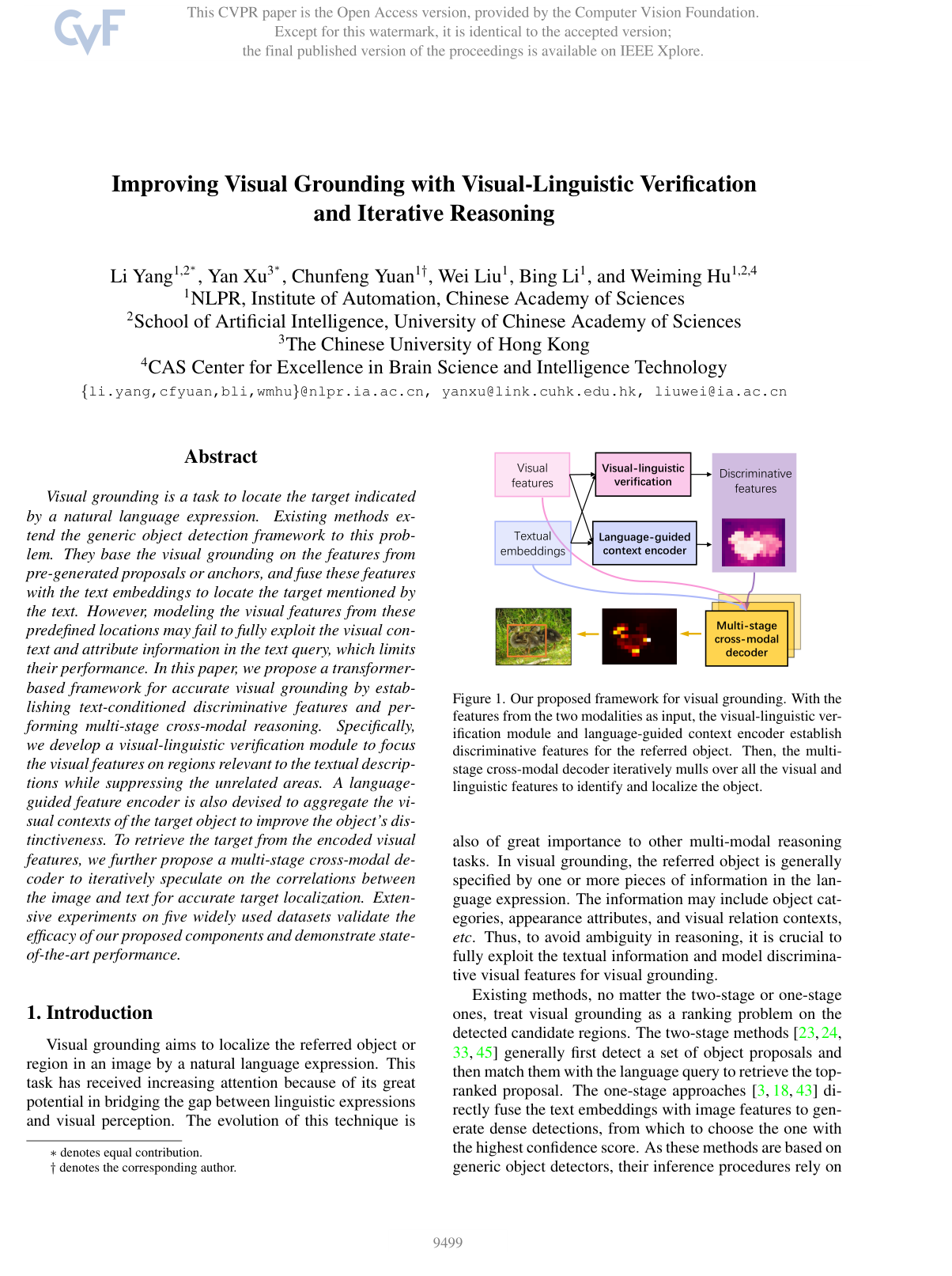
The article demonstrates a dedicated transformer-based framework designed to directly retrieve and localize target objects by generating discriminative, text-guided visual representations and performing multi-stage cross-modal reasoning. To achieve this, the authors designed a visual-linguistic verification module to focus visual features on text-relevant regions while suppressing distractions, a language-guided context encoder to aggregate surrounding spatial and relational context, and an iterative cross-modal decoder that refines target object queries across multiple stages. The framework was evaluated across five standard benchmark datasets: RefCOCO, RefCOCO+, RefCOCOg, ReferItGame, and Flickr30k Entities.
The findings show that the proposed method establishes a new state of the art across all evaluated benchmarks. Compared to leading proposal-based methods, it delivers absolute accuracy gains of up to 4.45% on RefCOCO, 5.94% on RefCOCO+, and 5.49% on RefCOCOg. Against modern one-stage approaches, it improves accuracy on RefCOCO validation and test sets by 5.10 and 6.34 percentage points, while also outperforming prior transformer-based methods like TransVG by 2.14% to 9.37% across the RefCOCO benchmark family. Ablation experiments confirm that incorporating iterative decoder stages, context encoding, and verification progressively raises accuracy from a 63.64% baseline to 71.62%, adding only an 8.81 million parameter increase (about 6.14%) and a 1.68% rise in computational complexity.
These results indicate that directly learning text-conditioned visual features and iteratively reasoning over multimodal cues significantly outperforms both rigid proposal-ranking pipelines and generic transformer fusion architectures. By eliminating reliance on separate object proposal generators, the architecture streamlines training and improves precision without imposing excessive computational overhead. However, the article notes a limitation: the system was trained exclusively on standard visual grounding datasets with restricted vocabulary sizes, which may constrain generalization to broader, open-domain language queries. The authors recommend expanding training to larger-scale datasets to enhance real-world generalization before deploying in open-domain applications.
- Paper: Modeling Context in Referring Expressions, Licheng Yu et al. (2016). Its explicit modeling of visual differences and relational context among candidate objects supplies the grounding challenge that the source addresses with context encoding and iterative reasoning.
- Paper: Flickr30k Entities: Collecting Region-to-Phrase Correspondences for Richer Image-to-Sentence Models, Bryan A. Plummer et al. (2015). Its Flickr30k Entities dataset establishes the region-to-phrase correspondences needed to understand one of the source’s evaluation benchmarks.
- Paper: Generation and Comprehension of Unambiguous Object Descriptions, Junhua Mao et al. (2015). Its early formulation of referring-expression comprehension and discriminative localization provides the task foundations for the source’s direct object-grounding approach.
- Paper: VisualBERT: A Simple and Performant Baseline for Vision and Language, Liunian Harold Li et al. (2019). Its shared Transformer representation of image regions and text, including phrase-to-region grounding, provides relevant architectural groundwork for the source’s cross-modal reasoning.
- Paper: VL-BERT: Pre-training of Generic Visual-Linguistic Representations, Weijie Su et al. (2019). Its pretrained visual-linguistic representations and RefCOCO+ grounding evaluation help establish the multimodal Transformer foundations and benchmark context used by the source.
- Paper: Kosmos-2: Grounding Multimodal Large Language Models to the World, Zhiliang Peng et al. (2023). It carries visual grounding into multimodal language models, linking generated text directly to image regions and extending localization toward interactive, grounded dialogue.