
keyword
batch normalization
Batch normalization is a technique used in deep neural networks to accelerate and stabilize training by standardizing the inputs or intermediate activations of a layer across each mini-batch of data. During training, the operation calculates the mean and variance for each feature across the current batch, normalizes the activations to achieve approximately zero mean and unit variance, and then applies learnable scale and shift parameters to preserve the network capacity to represent complex functions. This process smooths the optimization landscape, promotes more stable gradient behavior, permits the use of higher learning rates, and reduces sensitivity to initial network weights. During inference or testing, fixed population statistics estimated via running averages throughout training are applied in place of mini-batch statistics to produce consistent, deterministic predictions.
36 items
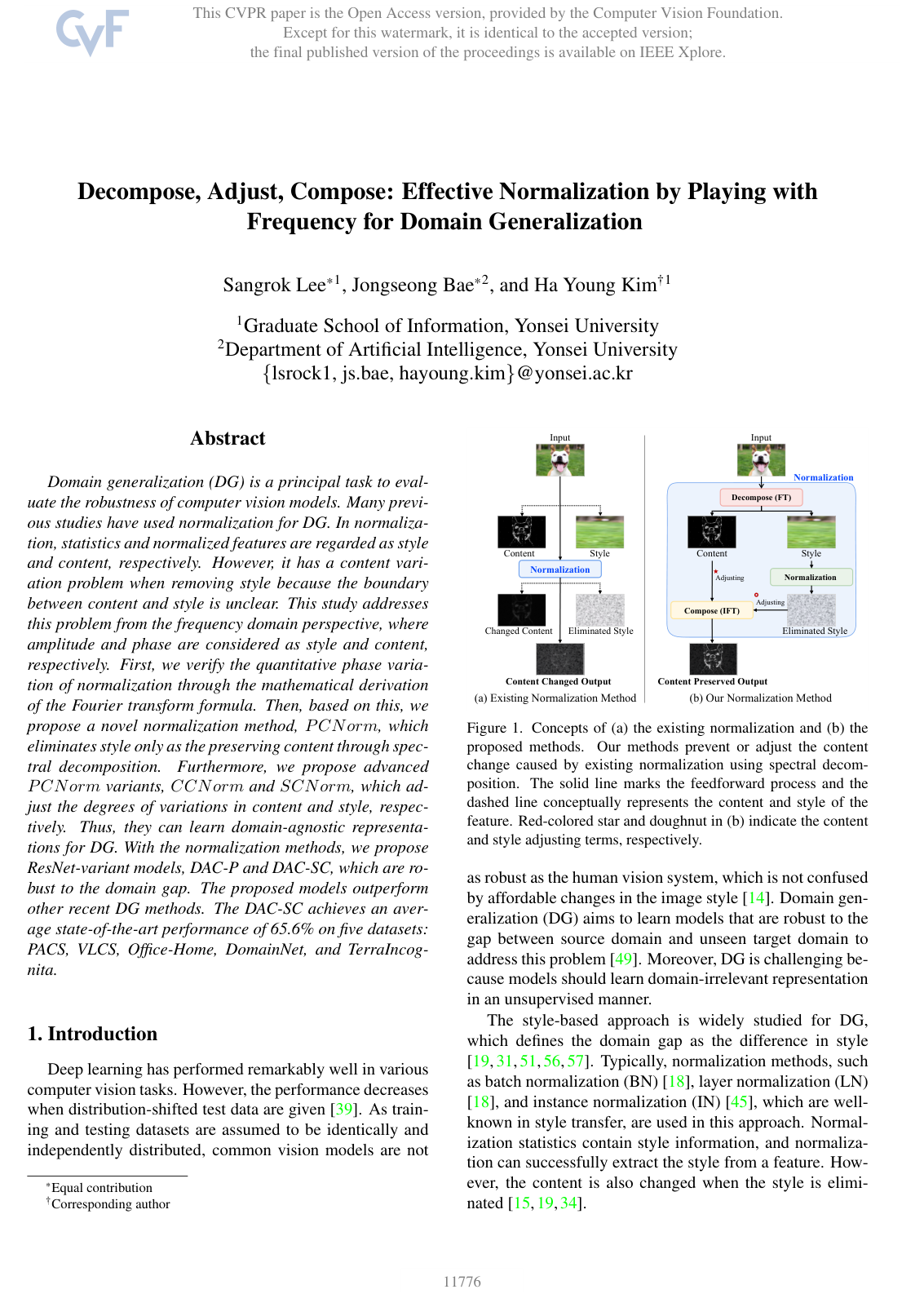
Decompose, Adjust, Compose: Effective Normalization by Playing with Frequency for Domain Generalization
Sangrok Lee, Jongseong Bae, Ha Young Kim
Why you should read this
Proposes a frequency-domain normalization framework that separates and regulates amplitude and phase variations to eliminate domain-specific styles while preserving essential semantic content for domain generalization.
Added
2026-09-26
Semi-supervised Learning with Ladder Networks
Antti Rasmus, Mathias Berglund, M. Honkala, Harri Valpola, T. Raiko
Why you should read this
Introduces a semi-supervised Ladder Network architecture that trains supervised and unsupervised reconstruction targets simultaneously via standard backpropagation, drastically reducing the labeled data needed for high-accuracy image classification without layer-wise pre-training.
We combine supervised learning with unsupervised learning in deep neural networks. The proposed model is trained to simultaneously minimize the sum of supervised and unsupervised cost functions by backpropagation, avoiding the need for layer-wise pre-training. Our work builds on the Ladder network proposed by Valpola (2015), which we extend by combining the model with supervision. We show that the resulting model reaches state-of-the-art performance in semi-supervised MNIST and CIFAR-10 classification, in addition to permutation-invariant MNIST classification with all labels.
Added
2026-09-25
Exploring Generalization in Deep Learning
Behnam Neyshabur, Srinadh Bhojanapalli, David McAllester, Nathan Srebro
Why you should read this
Establishes a theoretical link between loss surface sharpness and PAC-Bayes bounds while evaluating which scale-normalized capacity measures genuinely explain generalization in deep neural networks.
With a goal of understanding what drives generalization in deep networks, we consider several recently suggested explanations, including norm-based control, sharpness and robustness. We study how these measures can ensure generalization, highlighting the importance of scale normalization, and making a connection between sharpness and PAC-Bayes theory. We then investigate how well the measures explain different observed phenomena.
Added
2026-09-25
How Does Batch Normalization Help Optimization?
Shibani Santurkar, Dimitris Tsipras, Andrew Ilyas, Aleksander Madry
Why you should read this
Demonstrates that Batch Normalization accelerates deep network training not by reducing internal covariate shift, but by smoothing the loss surface to induce more predictable and stable gradients.
Batch Normalization (BatchNorm) is a widely adopted technique that enables faster and more stable training of deep neural networks (DNNs). Despite its pervasiveness, the exact reasons for BatchNorm's effectiveness are still poorly understood. The popular belief is that this effectiveness stems from controlling the change of the layers' input distributions during training to reduce the so-called "internal covariate shift". In this work, we demonstrate that such distributional stability of layer inputs has little to do with the success of BatchNorm. Instead, we uncover a more fundamental impact of BatchNorm on the training process: it makes the optimization landscape significantly smoother. This smoothness induces a more predictive and stable behavior of the gradients, allowing for faster training.
Added
2026-09-24
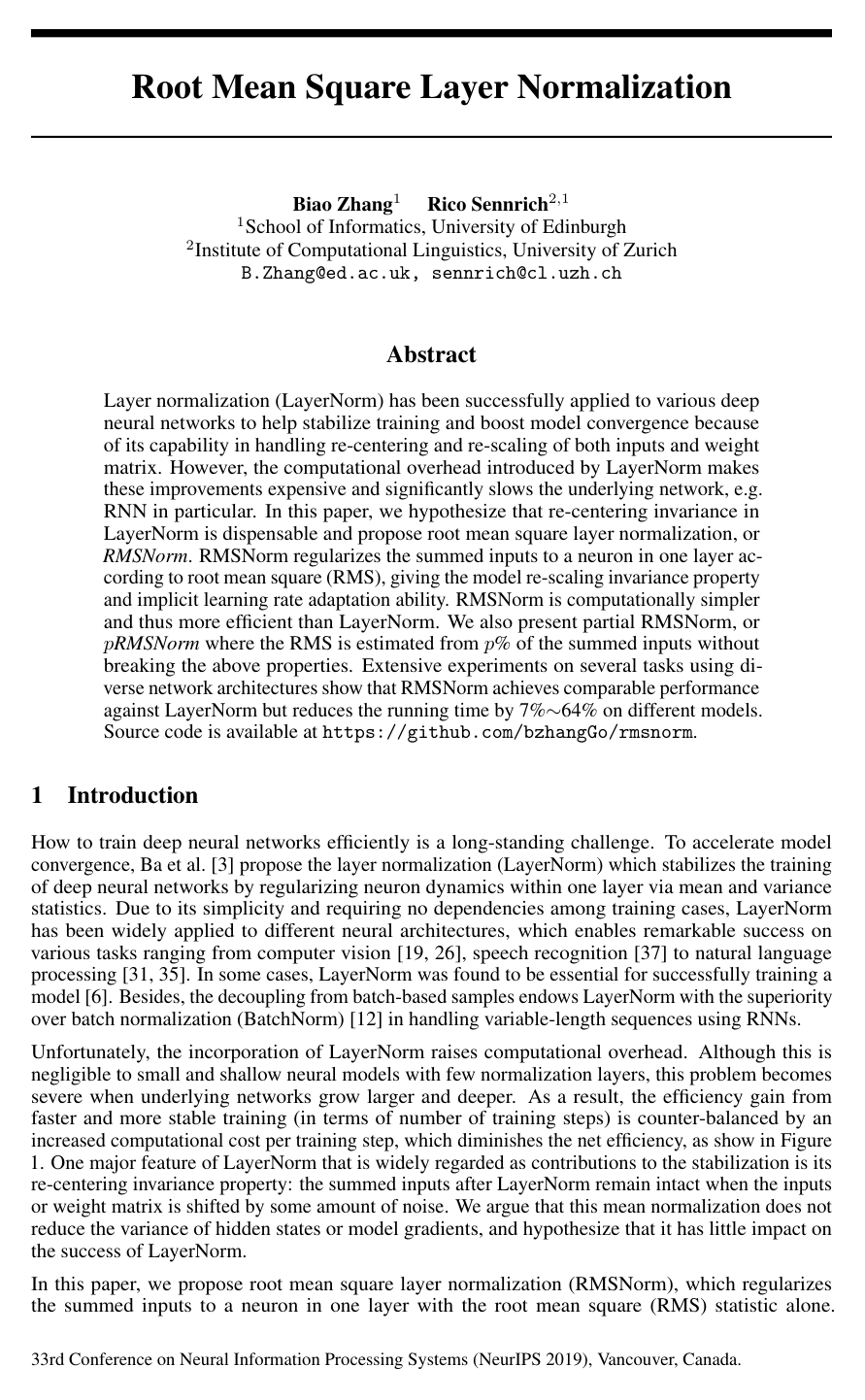
Root Mean Square Layer Normalization
Biao Zhang, Rico Sennrich
Why you should read this
Introduces Root Mean Square Layer Normalization (RMSNorm), a computationally efficient alternative to LayerNorm that removes mean-centering to accelerate training across deep neural networks while preserving model accuracy.
Layer normalization (LayerNorm) has been successfully applied to various deep neural networks to help stabilize training and boost model convergence because of its capability in handling re-centering and re-scaling of both inputs and weight matrix. However, the computational overhead introduced by LayerNorm makes these improvements expensive and significantly slows the underlying network, e.g. RNN in particular. In this paper, we hypothesize that re-centering invariance in LayerNorm is dispensable and propose root mean square layer normalization, or RMSNorm. RMSNorm regularizes the summed inputs to a neuron in one layer according to root mean square (RMS), giving the model re-scaling invariance property and implicit learning rate adaptation ability. RMSNorm is computationally simpler and thus more efficient than LayerNorm. We also present partial RMSNorm, or pRMSNorm where the RMS is estimated from p% of the summed inputs without breaking the above properties. Extensive experiments on several tasks using diverse network architectures show that RMSNorm achieves comparable performance against LayerNorm but reduces the running time by 7%~64% on different models. Source code is available at this https URL.
Added
2026-09-18
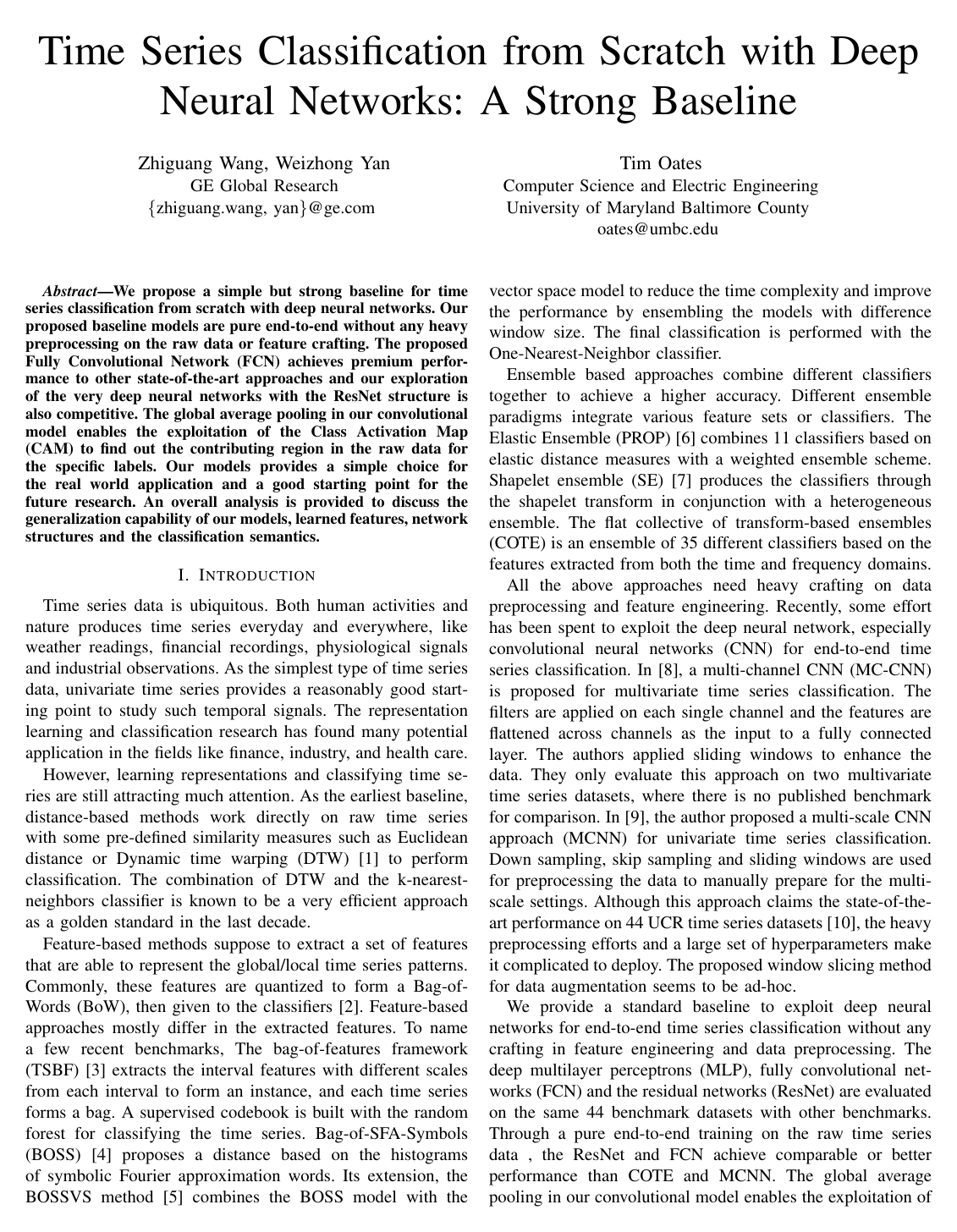
Time series classification from scratch with deep neural networks: A strong baseline
Zhiguang Wang, Weizhong Yan, Tim Oates
Why you should read this
Establishes Fully Convolutional Networks and Residual Networks as standard end-to-end baselines for raw time series classification, eliminating manual feature engineering while providing visual interpretability through Class Activation Maps.
We propose a simple but strong baseline for time series classification from scratch with deep neural networks. Our proposed baseline models are pure end-to-end without any heavy preprocessing on the raw data or feature crafting. The proposed Fully Convolutional Network (FCN) achieves premium performance to other state-of-the-art approaches and our exploration of the very deep neural networks with the ResNet structure is also competitive. The global average pooling in our convolutional model enables the exploitation of the Class Activation Map (CAM) to find out the contributing region in the raw data for the specific labels. Our models provides a simple choice for the real world application and a good starting point for the future research. An overall analysis is provided to discuss the generalization capability of our models, learned features, network structures and the classification semantics.
Added
2026-09-18
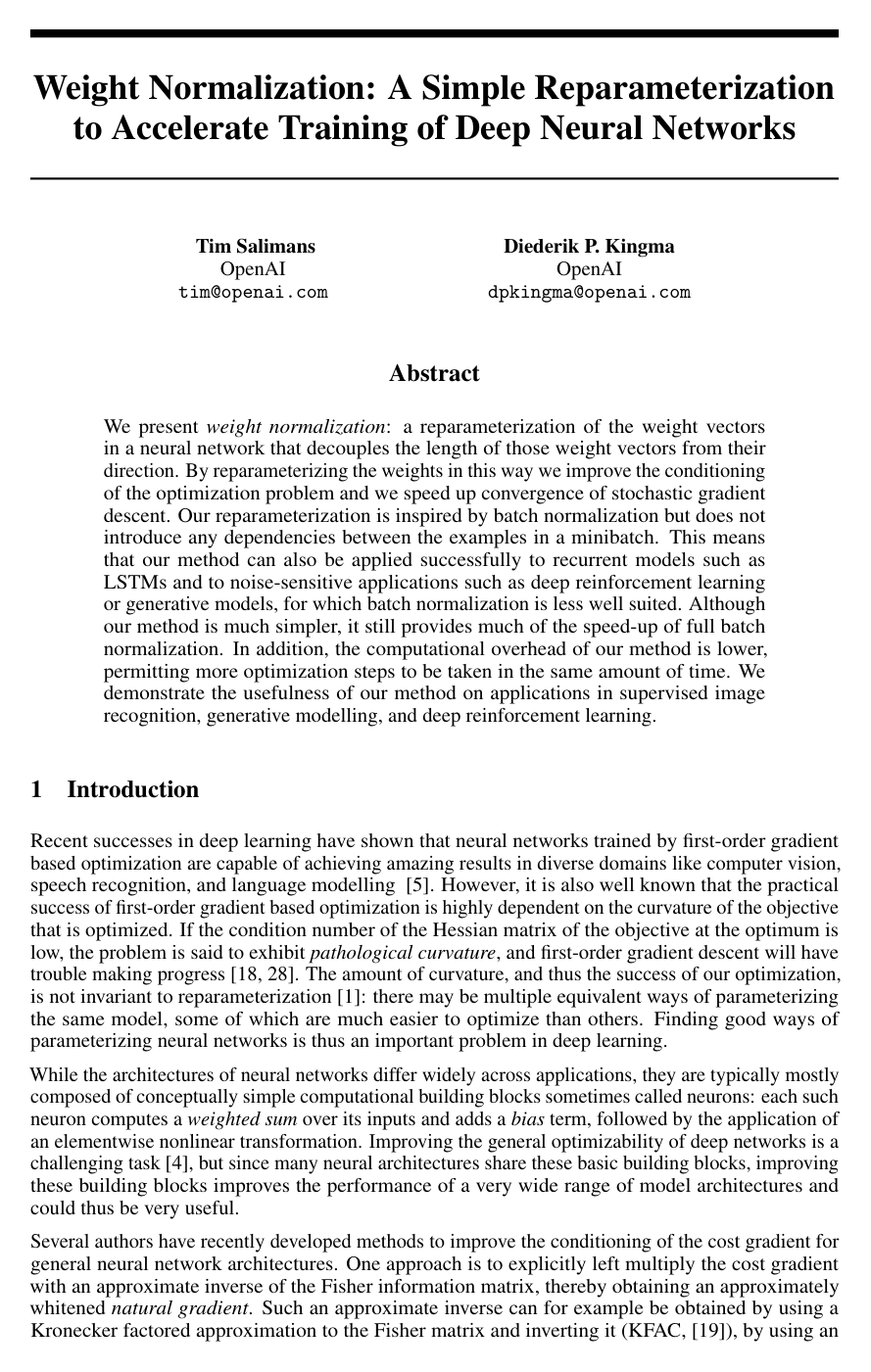
Weight Normalization: A Simple Reparameterization to Accelerate Training of Deep Neural Networks
Tim Salimans, Diederik P. Kingma
Why you should read this
Proposes weight normalization, a computationally efficient reparameterization that decouples weight magnitude from direction to accelerate neural network training without introducing minibatch dependencies.
We present weight normalization: a reparameterization of the weight vectors in a neural network that decouples the length of those weight vectors from their direction. By reparameterizing the weights in this way we improve the conditioning of the optimization problem and we speed up convergence of stochastic gradient descent. Our reparameterization is inspired by batch normalization but does not introduce any dependencies between the examples in a minibatch. This means that our method can also be applied successfully to recurrent models such as LSTMs and to noise-sensitive applications such as deep reinforcement learning or generative models, for which batch normalization is less well suited. Although our method is much simpler, it still provides much of the speed-up of full batch normalization. In addition, the computational overhead of our method is lower, permitting more optimization steps to be taken in the same amount of time. We demonstrate the usefulness of our method on applications in supervised image recognition, generative modelling, and deep reinforcement learning.
Added
2026-09-16
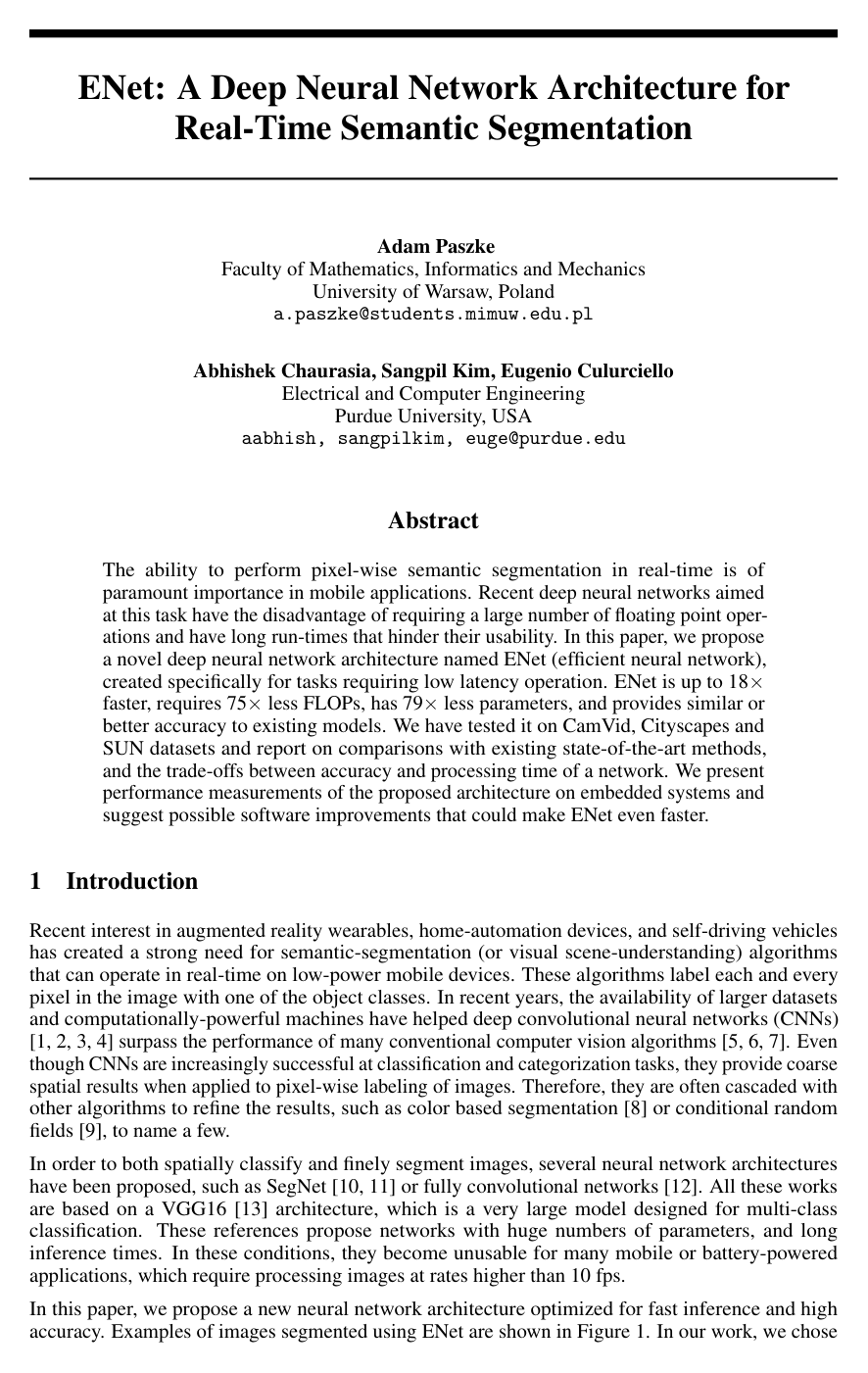
ENet: A Deep Neural Network Architecture for Real-Time Semantic Segmentation
Adam Paszke, Abhishek Chaurasia, Sangpil Kim, Eugenio Culurciello
Why you should read this
Proposes ENet, a lightweight deep neural network architecture that enables real-time semantic segmentation on resource-constrained embedded devices by reducing computational cost and parameter size by over an order of magnitude without sacrificing accuracy.
The ability to perform pixel-wise semantic segmentation in real-time is of paramount importance in mobile applications. Recent deep neural networks aimed at this task have the disadvantage of requiring a large number of floating point operations and have long run-times that hinder their usability. In this paper, we propose a novel deep neural network architecture named ENet (efficient neural network), created specifically for tasks requiring low latency operation. ENet is up to 18 faster, requires 75 less FLOPs, has 79 less parameters, and provides similar or better accuracy to existing models. We have tested it on CamVid, Cityscapes and SUN datasets and report on comparisons with existing state-of-the-art methods, and the trade-offs between accuracy and processing time of a network. We present performance measurements of the proposed architecture on embedded systems and suggest possible software improvements that could make ENet even faster.
Added
2026-09-14
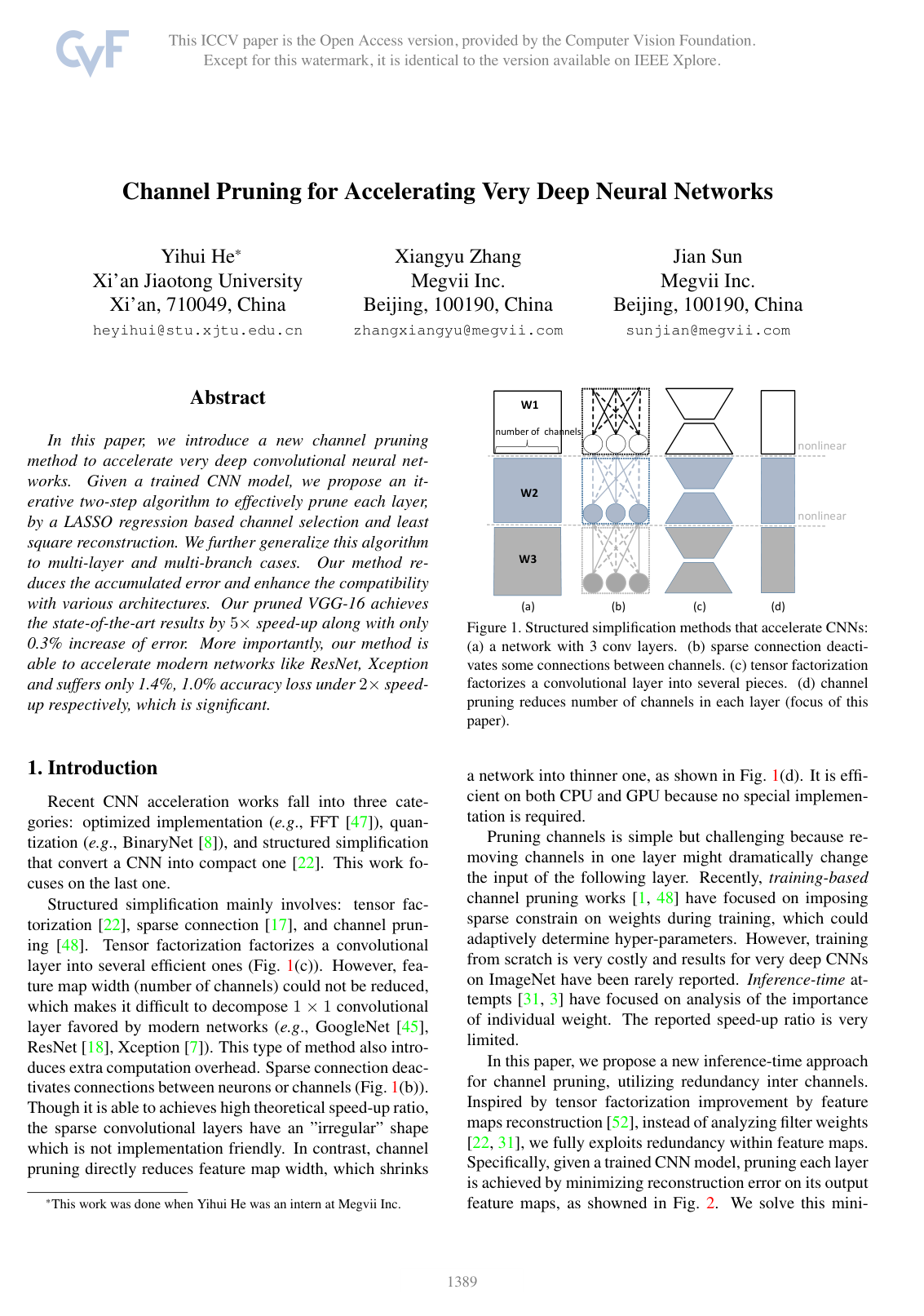
Channel Pruning for Accelerating Very Deep Neural Networks
Yihui He, Xiangyu Zhang, Jian Sun
Why you should read this
Proposes an effective channel pruning method combining LASSO-based channel selection with least-squares feature reconstruction to accelerate deep convolutional networks like ResNet and VGG up to fivefold with minimal accuracy loss.
In this paper, we introduce a new channel pruning method to accelerate very deep convolutional neural this http URL a trained CNN model, we propose an iterative two-step algorithm to effectively prune each layer, by a LASSO regression based channel selection and least square reconstruction. We further generalize this algorithm to multi-layer and multi-branch cases. Our method reduces the accumulated error and enhance the compatibility with various architectures. Our pruned VGG-16 achieves the state-of-the-art results by 5x speed-up along with only 0.3% increase of error. More importantly, our method is able to accelerate modern networks like ResNet, Xception and suffers only 1.4%, 1.0% accuracy loss under 2x speed-up respectively, which is significant. Code has been made publicly available.
Source
https://openaccess.thecvf.com/content_ICCV_2017/papers/He_Channel_Pruning_for_ICCV_2017_paper.pdfAdded
2026-09-14
Self-Normalizing Neural Networks
Günter Klambauer, Thomas Unterthiner, Andreas Mayr, Sepp Hochreiter
Why you should read this
Introduces scaled exponential linear units to induce self-normalization in deep feedforward neural networks, mathematically proving that activations naturally converge toward zero mean and unit variance to prevent vanishing and exploding gradients without explicit batch normalization.
Deep Learning has revolutionized vision via convolutional neural networks (CNNs) and natural language processing via recurrent neural networks (RNNs). However, success stories of Deep Learning with standard feed-forward neural networks (FNNs) are rare. FNNs that perform well are typically shallow and, therefore cannot exploit many levels of abstract representations. We introduce self-normalizing neural networks (SNNs) to enable high-level abstract representations. While batch normalization requires explicit normalization, neuron activations of SNNs automatically converge towards zero mean and unit variance. The activation function of SNNs are "scaled exponential linear units" (SELUs), which induce self-normalizing properties. Using the Banach fixed-point theorem, we prove that activations close to zero mean and unit variance that are propagated through many network layers will converge towards zero mean and unit variance -- even under the presence of noise and perturbations. This convergence property of SNNs allows to (1) train deep networks with many layers, (2) employ strong regularization, and (3) to make learning highly robust. Furthermore, for activations not close to unit variance, we prove an upper and lower bound on the variance, thus, vanishing and exploding gradients are impossible. We compared SNNs on (a) 121 tasks from the UCI machine learning repository, on (b) drug discovery benchmarks, and on (c) astronomy tasks with standard FNNs and other machine learning methods such as random forests and support vector machines. SNNs significantly outperformed all competing FNN methods at 121 UCI tasks, outperformed all competing methods at the Tox21 dataset, and set a new record at an astronomy data set. The winning SNN architectures are often very deep. Implementations are available at: this http URL.
Added
2026-09-14
CNN architectures for large-scale audio classification
Shawn Hershey, Sourish Chaudhuri, Daniel P. W. Ellis, Jort F. Gemmeke, Aren Jansen, Robert C. Moore, Manoj Plakal, Devin Platt, Rif A. Saurous, Bryan Seybold, Malcolm Slaney, Ron J. Weiss, Kevin Wilson
Why you should read this
Demonstrates how computer vision convolutional network architectures adapt to large-scale sound classification across millions of hours of audio, producing learned embeddings that significantly outperform traditional features for acoustic event detection.
Convolutional Neural Networks (CNNs) have proven very effective in image classification and show promise for audio. We use various CNN architectures to classify the soundtracks of a dataset of 70M training videos (5.24 million hours) with 30,871 video-level labels. We examine fully connected Deep Neural Networks (DNNs), AlexNet [1], VGG [2], Inception [3], and ResNet [4]. We investigate varying the size of both training set and label vocabulary, finding that analogs of the CNNs used in image classification do well on our audio classification task, and larger training and label sets help up to a point. A model using embeddings from these classifiers does much better than raw features on the Audio Set [5] Acoustic Event Detection (AED) classification task.
Added
2026-09-12
BinaryConnect: Training Deep Neural Networks with binary weights during propagations
Matthieu Courbariaux, Yoshua Bengio, Jean-Pierre David
Why you should read this
Proposes BinaryConnect, a method for training deep neural networks with binary weights during forward and backward propagation while accumulating gradients in high-precision weights, replacing expensive multiplications with simple additions for efficient hardware implementation without sacrificing accuracy.
Deep Neural Networks (DNN) have achieved state-of-the-art results in a wide range of tasks, with the best results obtained with large training sets and large models. In the past, GPUs enabled these breakthroughs because of their greater computational speed. In the future, faster computation at both training and test time is likely to be crucial for further progress and for consumer applications on low-power devices. As a result, there is much interest in research and development of dedicated hardware for Deep Learning (DL). Binary weights, i.e., weights which are constrained to only two possible values (e.g. -1 or 1), would bring great benefits to specialized DL hardware by replacing many multiply-accumulate operations by simple accumulations, as multipliers are the most space and power-hungry components of the digital implementation of neural networks. We introduce BinaryConnect, a method which consists in training a DNN with binary weights during the forward and backward propagations, while retaining precision of the stored weights in which gradients are accumulated. Like other dropout schemes, we show that BinaryConnect acts as regularizer and we obtain near state-of-the-art results with BinaryConnect on the permutation-invariant MNIST, CIFAR-10 and SVHN.
Added
2026-09-12
Convolutional Networks on Graphs for Learning Molecular Fingerprints
David Duvenaud, Dougal Maclaurin, Jorge Aguilera-Iparraguirre, Rafael Gómez-Bombarelli, Timothy Hirzel, Alán Aspuru-Guzik, Ryan P. Adams
Why you should read this
Proposes a differentiable graph neural network that replaces traditional fixed circular fingerprints with trainable, interpretable representations, enabling end-to-end property prediction directly from molecular structures.
We introduce a convolutional neural network that operates directly on graphs. These networks allow end-to-end learning of prediction pipelines whose inputs are graphs of arbitrary size and shape. The architecture we present generalizes standard molecular feature extraction methods based on circular fingerprints. We show that these data-driven features are more interpretable, and have better predictive performance on a variety of tasks.
Added
2026-09-11

Instance Normalization: The Missing Ingredient for Fast Stylization
Dmitry Ulyanov, Andrea Vedaldi, Victor Lempitsky
Why you should read this
Introduces instance normalization as an effective replacement for batch normalization in feed-forward neural style transfer networks, substantially improving the visual quality of real-time stylized images.
It this paper we revisit the fast stylization method introduced in Ulyanov et. al. (2016). We show how a small change in the stylization architecture results in a significant qualitative improvement in the generated images. The change is limited to swapping batch normalization with instance normalization, and to apply the latter both at training and testing times. The resulting method can be used to train high-performance architectures for real-time image generation. The code will is made available on github at this https URL. Full paper can be found at arXiv:1701.02096.
Added
2026-09-11
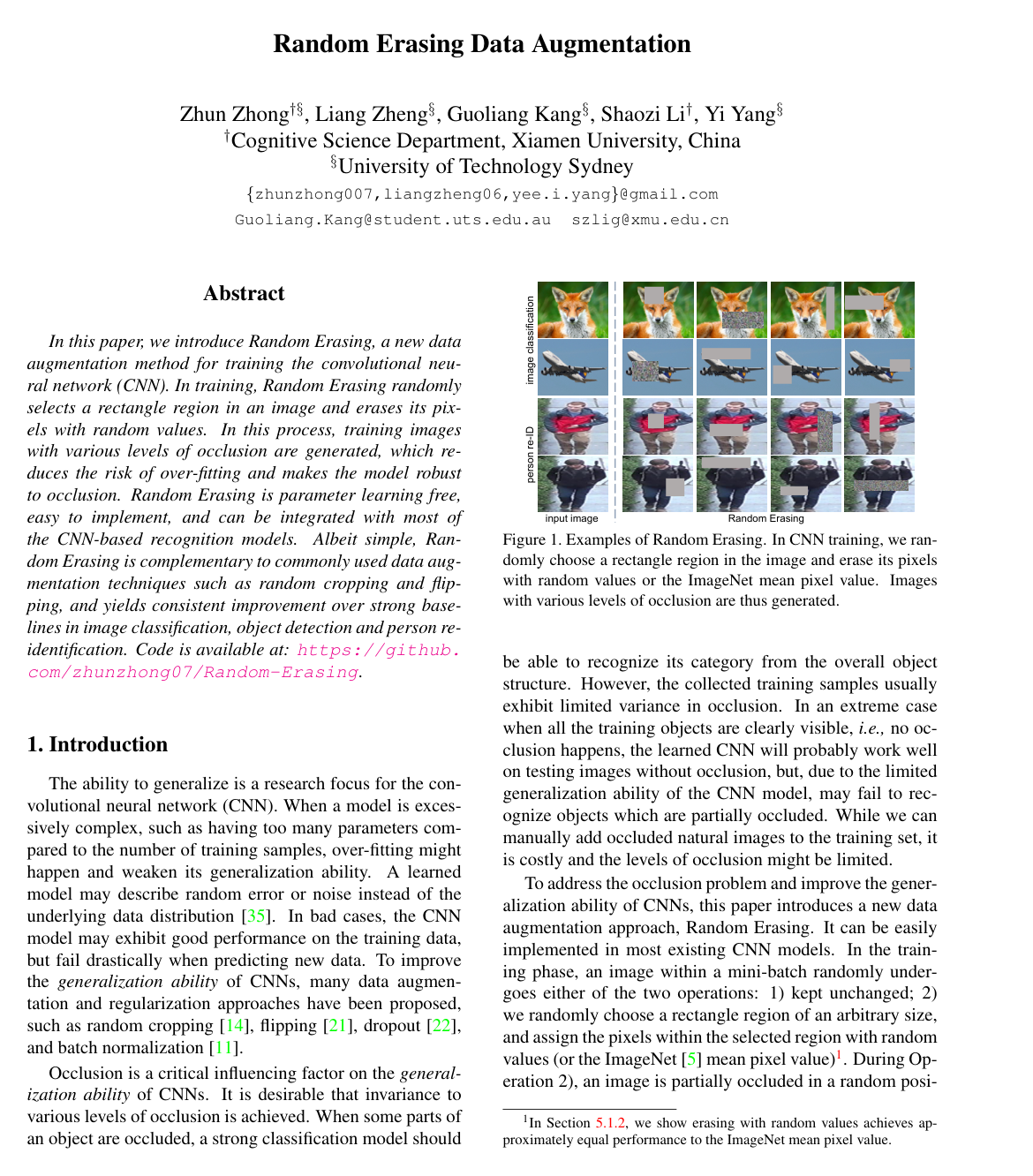
Random Erasing Data Augmentation
Zhun Zhong, Liang Zheng, Guoliang Kang, Shaozi Li, Yi Yang
Why you should read this
Introduces Random Erasing, a parameter-free data augmentation method that simulates occlusion by masking random image patches to reduce overfitting and boost model performance across image classification, object detection, and person re-identification.
In this paper, we introduce Random Erasing, a new data augmentation method for training the convolutional neural network (CNN). In training, Random Erasing randomly selects a rectangle region in an image and erases its pixels with random values. In this process, training images with various levels of occlusion are generated, which reduces the risk of over-fitting and makes the model robust to occlusion. Random Erasing is parameter learning free, easy to implement, and can be integrated with most of the CNN-based recognition models. Albeit simple, Random Erasing is complementary to commonly used data augmentation techniques such as random cropping and flipping, and yields consistent improvement over strong baselines in image classification, object detection and person re-identification. Code is available at: this https URL.
Added
2026-09-11
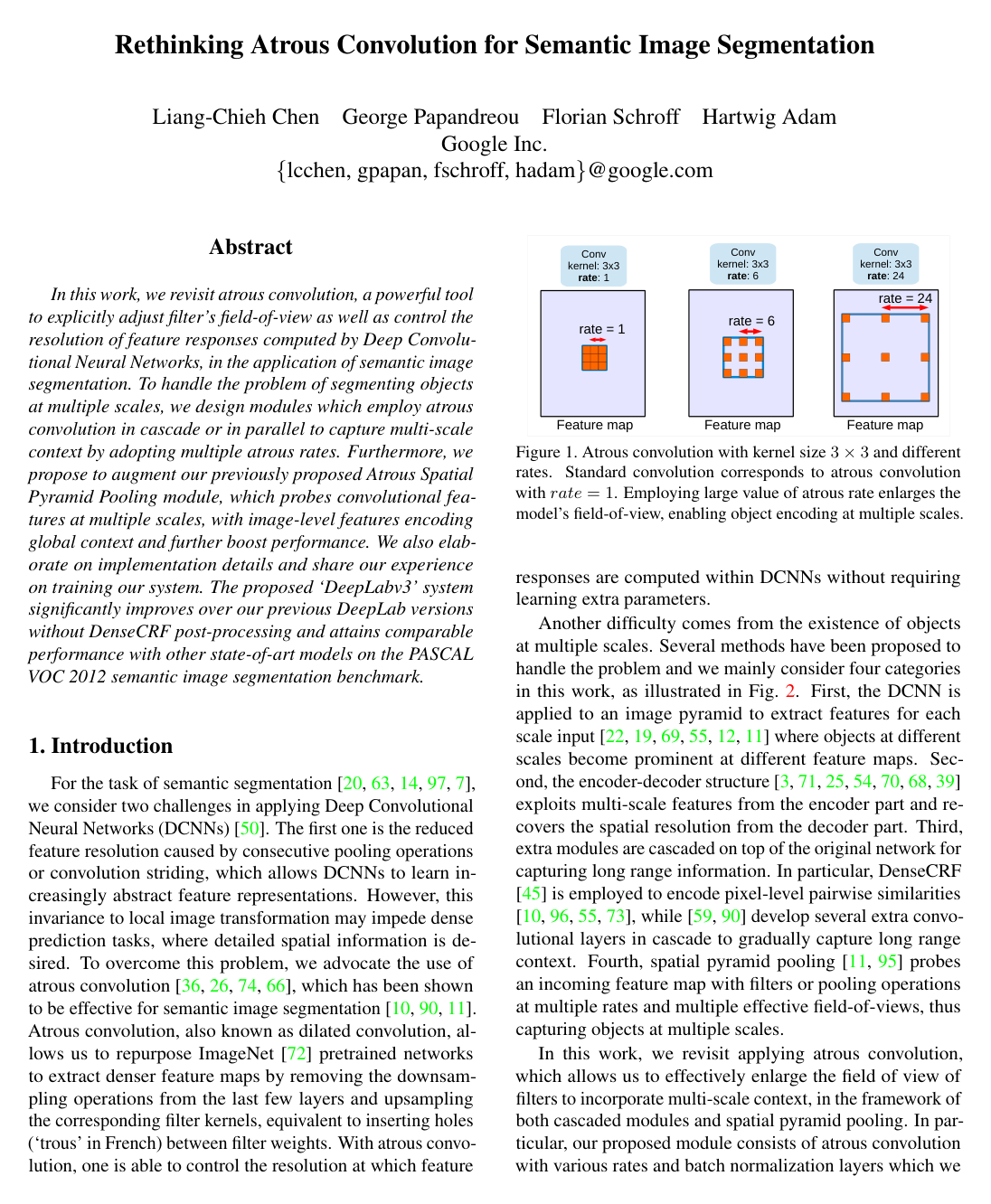
Rethinking Atrous Convolution for Semantic Image Segmentation
Liang-Chieh Chen, George Papandreou, Florian Schroff, Hartwig Adam
Why you should read this
Proposes DeepLabv3, an effective semantic segmentation framework that combines cascading atrous convolutions with an upgraded Atrous Spatial Pyramid Pooling module to capture multi-scale context without relying on conditional random field post-processing.
In this work, we revisit atrous convolution, a powerful tool to explicitly adjust filter's field-of-view as well as control the resolution of feature responses computed by Deep Convolutional Neural Networks, in the application of semantic image segmentation. To handle the problem of segmenting objects at multiple scales, we design modules which employ atrous convolution in cascade or in parallel to capture multi-scale context by adopting multiple atrous rates. Furthermore, we propose to augment our previously proposed Atrous Spatial Pyramid Pooling module, which probes convolutional features at multiple scales, with image-level features encoding global context and further boost performance. We also elaborate on implementation details and share our experience on training our system. The proposed `DeepLabv3' system significantly improves over our previous DeepLab versions without DenseCRF post-processing and attains comparable performance with other state-of-art models on the PASCAL VOC 2012 semantic image segmentation benchmark.
Added
2026-09-11
License
Published with permission
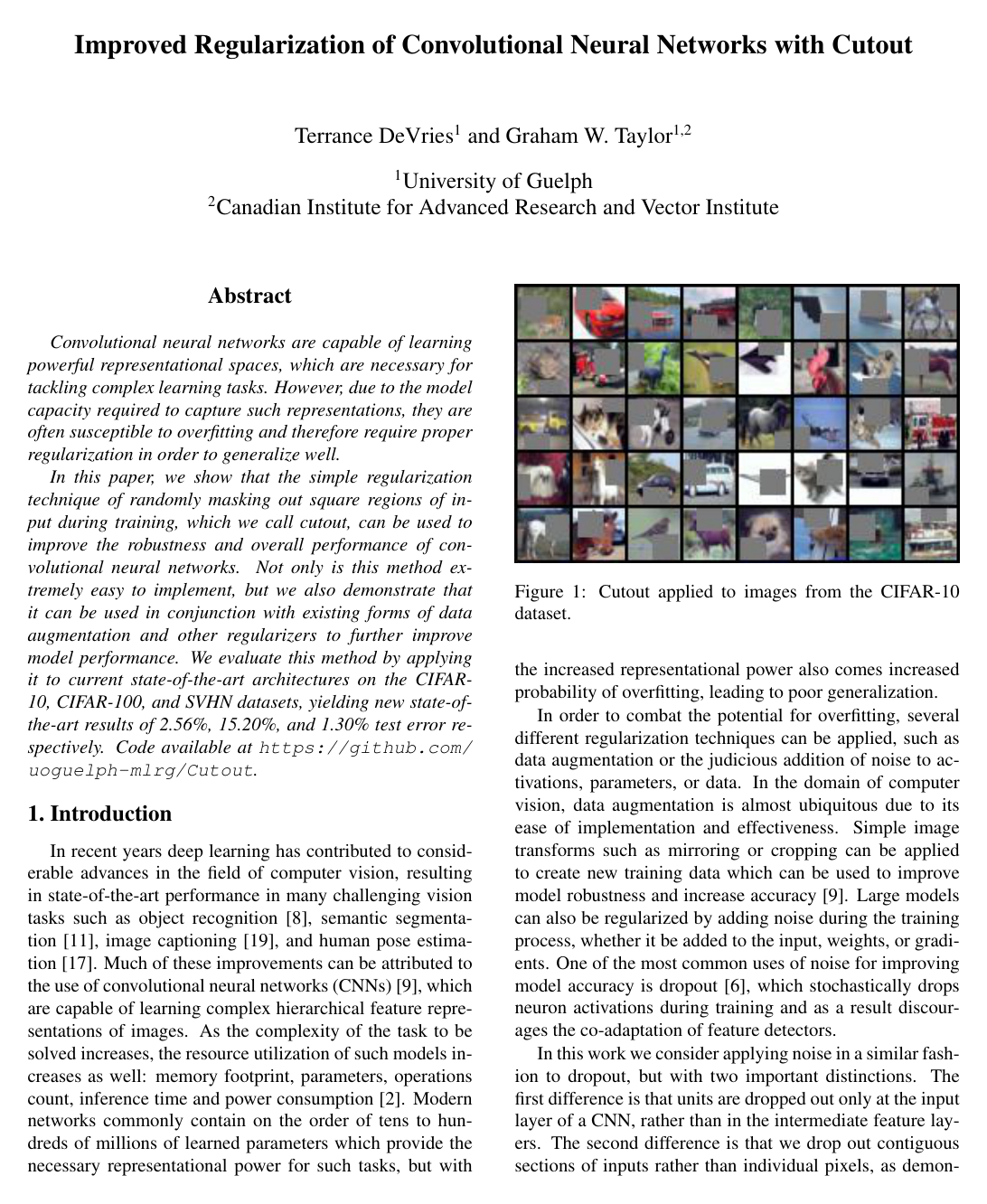
Improved Regularization of Convolutional Neural Networks with Cutout
Terrance Devries, Graham W. Taylor
Why you should read this
Proposes Cutout, an easy-to-implement regularization technique that randomly masks square patches of input images during training to prevent convolutional neural networks from overfitting and boost classification performance across standard benchmarks.
Convolutional neural networks are capable of learning powerful representational spaces, which are necessary for tackling complex learning tasks. However, due to the model capacity required to capture such representations, they are often susceptible to overfitting and therefore require proper regularization in order to generalize well. In this paper, we show that the simple regularization technique of randomly masking out square regions of input during training, which we call cutout, can be used to improve the robustness and overall performance of convolutional neural networks. Not only is this method extremely easy to implement, but we also demonstrate that it can be used in conjunction with existing forms of data augmentation and other regularizers to further improve model performance. We evaluate this method by applying it to current state-of-the-art architectures on the CIFAR-10, CIFAR-100, and SVHN datasets, yielding new state-of-the-art results of 2.56%, 15.20%, and 1.30% test error respectively. Code is available at this https URL
Added
2026-09-11
TensorFlow: A system for large-scale machine learning
Martín Abadi, Paul Barham, Jianmin Chen, Zhifeng Chen, Andy Davis, Jeffrey Dean, Matthieu Devin, Sanjay Ghemawat, Geoffrey Irving, Michael Isard, Manjunath Kudlur, Josh Levenberg, Rajat Monga, Sherry Moore, Derek G. Murray, Benoit Steiner, Paul Tucker, Vijay Vasudevan, Pete Warden, Martin Wicke, Yuan Yu, Xiaoqiang Zheng
Why you should read this
Presents the architecture and computational model of TensorFlow, explaining how its flexible dataflow graph design executes large-scale machine learning workloads across distributed clusters and heterogeneous hardware.
TensorFlow is a machine learning system that operates at large scale and in heterogeneous environments. TensorFlow uses dataflow graphs to represent computation, shared state, and the operations that mutate that state. It maps the nodes of a dataflow graph across many machines in a cluster, and within a machine across multiple computational devices, including multicore CPUs, general-purpose GPUs, and custom designed ASICs known as Tensor Processing Units (TPUs). This architecture gives flexibility to the application developer: whereas in previous "parameter server" designs the management of shared state is built into the system, TensorFlow enables developers to experiment with novel optimizations and training algorithms. TensorFlow supports a variety of applications, with particularly strong support for training and inference on deep neural networks. Several Google services use TensorFlow in production, we have released it as an open-source project, and it has become widely used for machine learning research. In this paper, we describe the TensorFlow dataflow model in contrast to existing systems, and demonstrate the compelling performance that TensorFlow achieves for several real-world applications.
Added
2026-09-10
Enhanced Deep Residual Networks for Single Image Super-Resolution
Bee Lim, Sanghyun Son, Heewon Kim, Seungjun Nah, Kyoung Mu Lee
Why you should read this
Demonstrates that removing batch normalization modules from deep residual networks substantially improves reconstruction performance, establishing the competition-winning EDSR and multi-scale MDSR models as foundational architectures for single-image super-resolution.
Recent research on super-resolution has progressed with the development of deep convolutional neural networks (DCNN). In particular, residual learning techniques exhibit improved performance. In this paper, we develop an enhanced deep super-resolution network (EDSR) with performance exceeding those of current state-of-the-art SR methods. The significant performance improvement of our model is due to optimization by removing unnecessary modules in conventional residual networks. The performance is further improved by expanding the model size while we stabilize the training procedure. We also propose a new multi-scale deep super-resolution system (MDSR) and training method, which can reconstruct high-resolution images of different upscaling factors in a single model. The proposed methods show superior performance over the state-of-the-art methods on benchmark datasets and prove its excellence by winning the NTIRE2017 Super-Resolution Challenge.
Added
2026-09-10
Arbitrary Style Transfer in Real-Time with Adaptive Instance Normalization
Xun Huang, Serge J. Belongie
Why you should read this
Introduces Adaptive Instance Normalization (AdaIN), a technique that aligns feature statistics to achieve real-time style transfer for arbitrary images within a single feed-forward network.
Gatys et al. recently introduced a neural algorithm that renders a content image in the style of another image, achieving so-called style transfer. However, their framework requires a slow iterative optimization process, which limits its practical application. Fast approximations with feed-forward neural networks have been proposed to speed up neural style transfer. Unfortunately, the speed improvement comes at a cost: the network is usually tied to a fixed set of styles and cannot adapt to arbitrary new styles. In this paper, we present a simple yet effective approach that for the first time enables arbitrary style transfer in real-time. At the heart of our method is a novel adaptive instance normalization (AdaIN) layer that aligns the mean and variance of the content features with those of the style features. Our method achieves speed comparable to the fastest existing approach, without the restriction to a pre-defined set of styles. In addition, our approach allows flexible user controls such as content-style trade-off, style interpolation, color & spatial controls, all using a single feed-forward neural network.
Added
2026-09-09