WOUAF: Weight Modulation for User Attribution and Fingerprinting in Text-to-Image Diffusion Models
Changhoon KimKyle MinMaitreya PatelSheng ChengYezhou Yang
Proposes a distributor-oriented framework that embeds user-specific identifiers directly into the weights of text-to-image diffusion models via weight modulation, enabling reliable user attribution and resistance against post-processing manipulations without sacrificing image quality.
Rapid advances in artificial intelligence now enable the creation of highly realistic synthetic images from simple text descriptions. While these text-to-image models unlock immense creative potential, they also pose severe risks regarding misinformation, deepfakes, and political manipulation. Existing safeguards, such as standalone watermarking modules, are easily bypassed in open-source environments by simply disabling a line of code. The article addresses this accountability challenge by evaluating a distributor-focused framework called WOUAF (Weight Modulation for User Attribution and Fingerprinting), which embeds unique digital identifiers directly into model weights so that synthetic images can be traced back to the specific user who generated them.
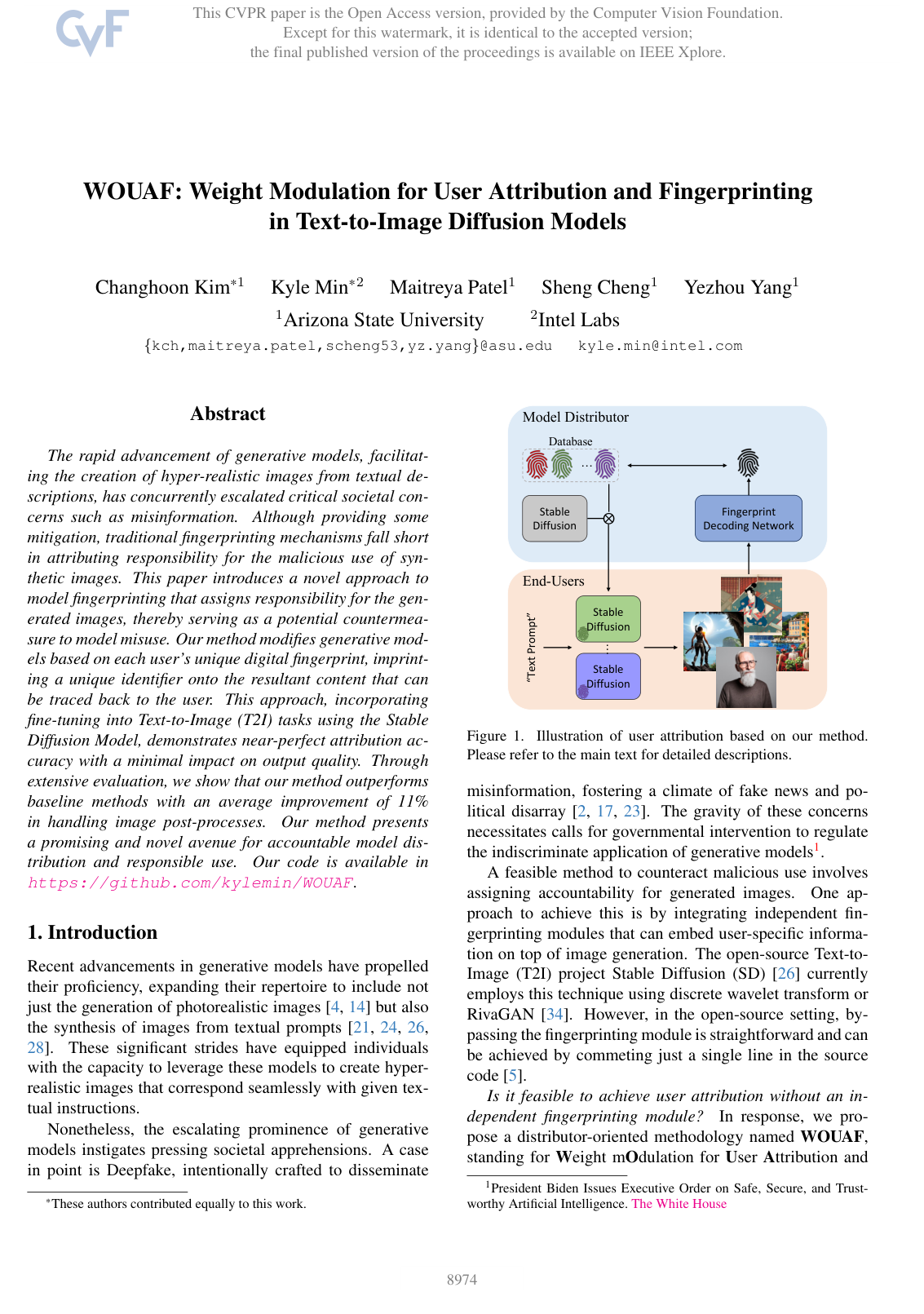
To achieve this, the authors developed a fine-tuning technique applied specifically to the image decoder component of the popular Stable Diffusion model. When an authorized user requests a model from an open-source hub or distributor, the system applies a distinct mathematical modulation to the decoder weights and registers the corresponding identifier in a central database. When an image is generated, it inherently carries an invisible identifier that a dedicated decoding network can extract. The authors evaluated this approach against standard image datasets (MS-COCO and LAION-Aesthetics) across diverse image modifications and adversarial attempts to remove the fingerprint.
The findings show that this weight-modulation technique achieves near-perfect user attribution accuracy of 98% to 99% while causing negligible degradation to image visual quality or text alignment. Using a 32-bit identifier, the system can distinguish over four billion unique users without interference. Generating a customized, fingerprinted model requires less than one second—a major computational advantage over prior fine-tuning baselines that require minutes or hours per user. Furthermore, the embedded identifiers proved robust against common transformations such as cropping, rotation, blurring, and compression, outperforming alternative approaches by an average of 11% in post-processing resilience. When tested against deliberate removal attempts via image compression or model fine-tuning, the identifier could only be obscured by severely degrading the visual quality of the output.
These results demonstrate that model distributors can effectively enforce accountability without sacrificing model performance or incurring heavy computational expenses. By embedding user attribution directly into the model weights rather than in optional modular code, distributors can reliably trace malicious content and deter harmful misuse. Organizations distributing open-source generative models should consider integrating weight-modulation fingerprinting as a scalable compliance and safety measure. Decision-makers should note that while the current evaluation provides high confidence for image-generation frameworks, further validation is necessary before applying these techniques across other media modalities such as audio, text, and video.
- Paper: Multi-Concept Customization of Text-to-Image Diffusion, Nupur Kumari et al. (2022). Provides fundamental techniques for parameter-efficient fine-tuning and weight adaptation in text-to-image diffusion models upon which weight-modulation mechanisms rely.
- Paper: DreamBooth: Fine Tuning Text-to-Image Diffusion Models for Subject-Driven Generation, Nataniel Ruiz et al. (2023). Introduces key principles of fine-tuning text-to-image diffusion models with subject-driven identifiers while preserving prior generative distributions.
- Paper: Fingerprinting Deep Neural Networks Globally via Universal Adversarial Perturbations, Zirui Peng et al. (2022). Establishes foundational concepts in deep neural network fingerprinting for model verification and ownership attribution.
- Paper: T2I-Adapter: Learning Adapters to Dig out More Controllable Ability for Text-to-Image Diffusion Models, Chong Mou et al. (2023). Demonstrates how lightweight modular adapters can modulate frozen text-to-image diffusion models without degrading baseline image generation quality.
- Paper: On Provable Copyright Protection for Generative Models, Nikhil Vyas et al. (2023). Explores the legal, ethical, and algorithmic requirements of provenance tracking and copyright protection in generative models.
- Paper: Instructional Fingerprinting of Large Language Models, Jiashu Xu et al. (2024). Extends the concept of embedding attributable fingerprints via weight modulation and adapter tuning to generative large language models.
- Paper: Robustness of AI-Image Detectors: Fundamental Limits and Practical Attacks, Mehrdad Saberi et al. (2024). Analyzes the theoretical limits and adversarial robustness of synthetic image identification and watermarking mechanisms under diffusion-based purification attacks.
- Paper: Rethinking the Up-Sampling Operations in CNN-Based Generative Network for Generalizable Deepfake Detection, Chuangchuang Tan et al. (2024). Investigates generalizable detection of synthetic generator artifacts left by upsampling operations across diverse diffusion and GAN architectures.
- Paper: Frequency-Aware Deepfake Detection: Improving Generalizability through Frequency Space Domain Learning, Chuangchuang Tan et al. (2024). Examines complementary frequency-domain detection mechanisms for identifying synthetic visual content across unseen generative models.