Multi-Concept Customization of Text-to-Image Diffusion
Nupur KumariBingliang ZhangRichard ZhangEli ShechtmanJun-Yan Zhu
Introduces Custom Diffusion, an efficient fine-tuning approach that updates key cross-attention weights in minutes to learn, merge, and compose multiple user-specified concepts in generative text-to-image models.
Text-to-image artificial intelligence models can generate diverse, high-quality visuals from natural language prompts, yet they struggle to represent specific, personal subjects—such as individual pets, proprietary items, or unique artistic styles. While retraining large models from scratch is cost-prohibitive and standard fine-tuning often causes catastrophic forgetting of existing knowledge, organizations require efficient, customizable image synthesis that can rapidly adopt new concepts without losing broad generative capabilities.
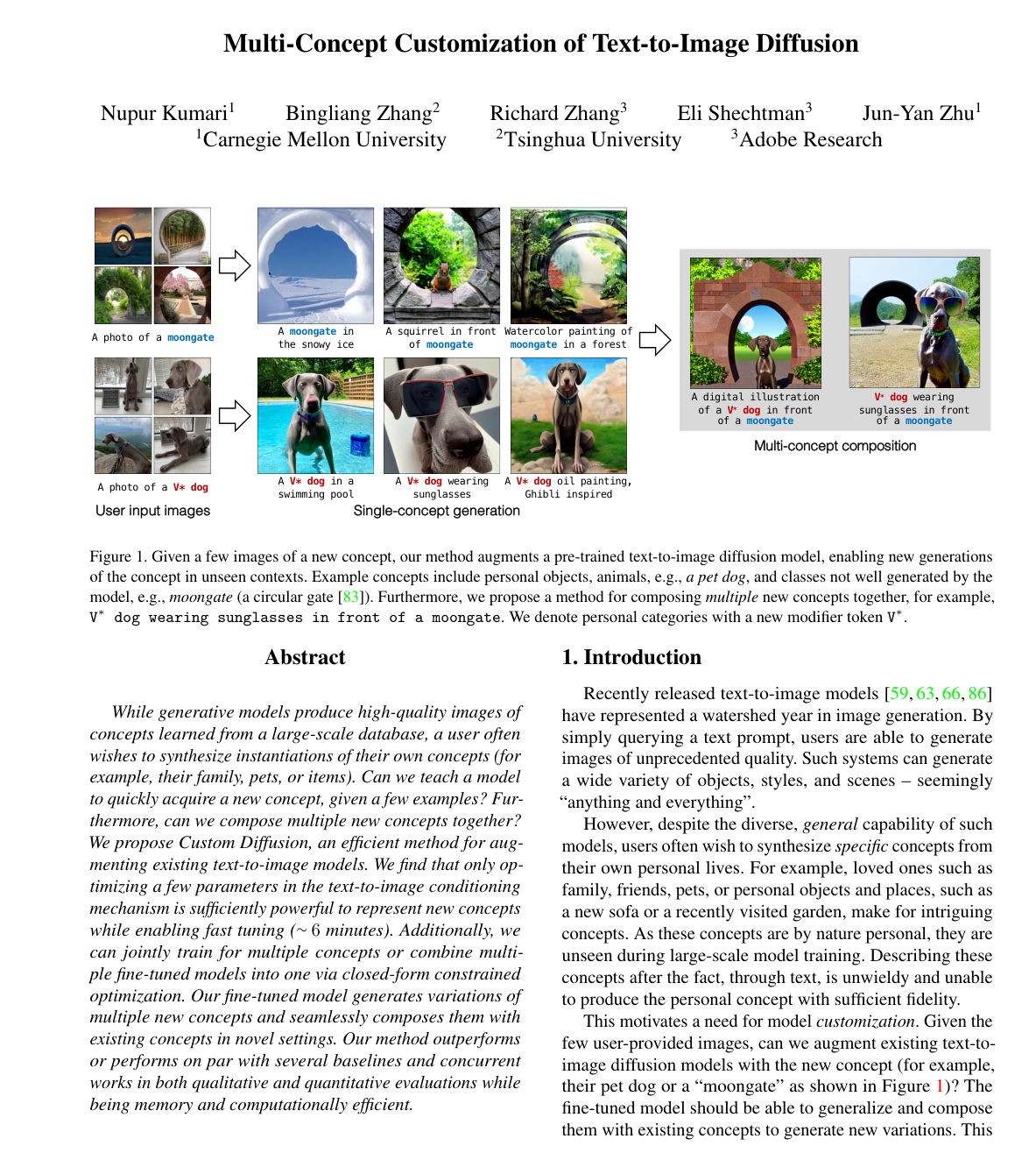
The article introduces and evaluates Custom Diffusion, a computationally efficient fine-tuning method that adapts text-to-image diffusion models to generate novel concepts and combine multiple new subjects within a single synthetic scene using as few as four sample images.
The researchers analyzed parameter shifts during fine-tuning across network layers and established that updating only the cross-attention key and value projection matrices—the layers mapping text input to visual features—is sufficient to acquire new concepts. They evaluated this approach on multiple datasets spanning pets, personal objects, and rare categories, including the newly introduced 101-concept dataset, CustomConcept101. To prevent the model from distorting related existing words, the framework incorporates a regularization dataset of approximately 200 real images retrieved using text similarity. The team also formulated a closed-form, constrained optimization algorithm allowing multiple independently fine-tuned concepts to be merged into a single model in roughly two seconds, alongside a standard joint training option. Performance was measured against leading baselines via visual similarity, text alignment, image quality metrics, and paired human evaluation studies.
The analysis produced several critical findings. First, Custom Diffusion achieves equal or superior visual fidelity and prompt alignment compared to existing methods while updating only about 3% of the total network parameters (75 MB of storage compared to 3 GB for full-model tuning). Second, it accelerates fine-tuning speeds substantially, completing adaptation in approximately 6 minutes on two A100 GPUs, which is 2 to 4 times faster than concurrent approaches. Third, in multi-concept compositional tasks, the method effectively avoids omitting subjects, earning a strong human preference of 81% to 87% over alternatives like Textual Inversion and 56% to 62% over DreamBooth. Fourth, the updated parameter weights can be compressed further via low-rank matrix approximation by up to five times without significant performance degradation.
These results demonstrate that targeted parameter updates drastically reduce the computational overhead and storage costs required to operationalize customized generative AI. For enterprise applications, this efficiency enables scalable personalization pipelines where thousands of individual concept models can be trained, stored, and combined dynamically without the infrastructure expense of full model replication. Furthermore, utilizing real retrieved images for regularization mitigates language drift, ensuring high output quality and preserving general pretraining capabilities.
Organizations implementing generative media should consider adopting selective attention-layer fine-tuning to minimize infrastructure expenditure and accelerate iteration cycles. For multi-concept workflows, teams should balance the trade-offs: joint training yields the highest visual consistency across complex compositions, while the closed-form merging method offers near-instantaneous integration for existing separate models. At the same time, teams must maintain awareness of limitations. Custom Diffusion inherits underlying base model weaknesses and faces degraded fidelity during challenging compositions involving similar semantic categories (such as multiple pets in the same frame) or when attempting to compose three or more distinct concepts simultaneously. Reliable synthetic media detection protocols should also be integrated to mitigate the governance and safety risks associated with realistic image personalization.
- Paper: An Image is Worth One Word: Personalizing Text-to-Image Generation using Textual Inversion, Rinon Gal et al. (2022). Introduces Textual Inversion for personalizing text-to-image diffusion via learned prompt embeddings, providing the foundational baseline that Custom Diffusion optimizes and compares against.
- Paper: High-Resolution Image Synthesis with Latent Diffusion Models, Robin Rombach et al. (2022). Establishes Latent Diffusion Models and cross-attention conditioning mechanisms, which form the exact base architecture Custom Diffusion fine-tunes for multi-concept customization.
- Paper: Prompt-to-Prompt Image Editing with Cross Attention Control, Amir Hertz et al. (2022). Demonstrates the role of cross-attention layers in binding text tokens to spatial regions in diffusion models, motivating Custom Diffusion's focus on key-value cross-attention weight optimization.
- Paper: Classifier-Free Diffusion Guidance, Jonathan Ho et al. (2022). Formulates classifier-free guidance for text-conditional diffusion models, a fundamental technique relied upon during Custom Diffusion's training and sampling pipelines.
- Paper: Denoising Diffusion Probabilistic Models, Jonathan Ho et al. (2020). Establishes the standard denoising diffusion probabilistic formulation and training objectives underlying all modern diffusion customization frameworks.
- Paper: IP-Adapter: Text Compatible Image Prompt Adapter for Text-to-Image Diffusion Models, Hu Ye et al. (2023). Introduces decoupled cross-attention adapter modules for image-prompt conditioning, extending lightweight parameter-efficient conditioning strategies beyond few-shot fine-tuning.
- Paper: Adding Conditional Control to Text-to-Image Diffusion Models, Lvmin Zhang et al. (2023). Builds on parameter-efficient conditioning of diffusion models by adding zero-convolution adapters to inject structured spatial guidance alongside customized text prompts.
- Paper: T2I-Adapter: Learning Adapters to Dig out More Controllable Ability for Text-to-Image Diffusion Models, Chong Mou et al. (2023). Presents lightweight plug-and-play adapter networks to guide pre-trained diffusion models with structural inputs without altering base generative weights.
- Paper: AnimateDiff: Animate Your Personalized Text-to-Image Diffusion Models without Specific Tuning, Yuwei Guo et al. (2024). Applies plug-and-play motion modules to personalized text-to-image diffusion models, enabling dynamic animation without altering the personalized concepts.
- Paper: InstructPix2Pix: Learning to Follow Image Editing Instructions, Tim Brooks et al. (2023). Leverages fine-tuned diffusion models and cross-attention manipulations to build an instruction-guided image editing system without requiring per-concept optimization.