
keyword
text-to-image diffusion models
Text-to-image diffusion models are generative artificial intelligence systems that synthesize high-fidelity visual images from descriptive natural language text prompts. These models operate using a diffusion framework, beginning with random noise and iteratively removing that noise across successive steps to construct a clear, coherent image. During the iterative denoising procedure, textual prompts are processed by language encoders to provide conditioning guidance, commonly integrated through cross-attention mechanisms that steer visual features to match the provided text semantics. By learning the underlying probability distributions of visual data from large-scale paired image-text datasets, text-to-image diffusion models can generate diverse artistic styles and photorealistic scenes, while also serving as foundational architectures for advanced tasks such as structural control, subject personalization, and multimodal generation.
6 items
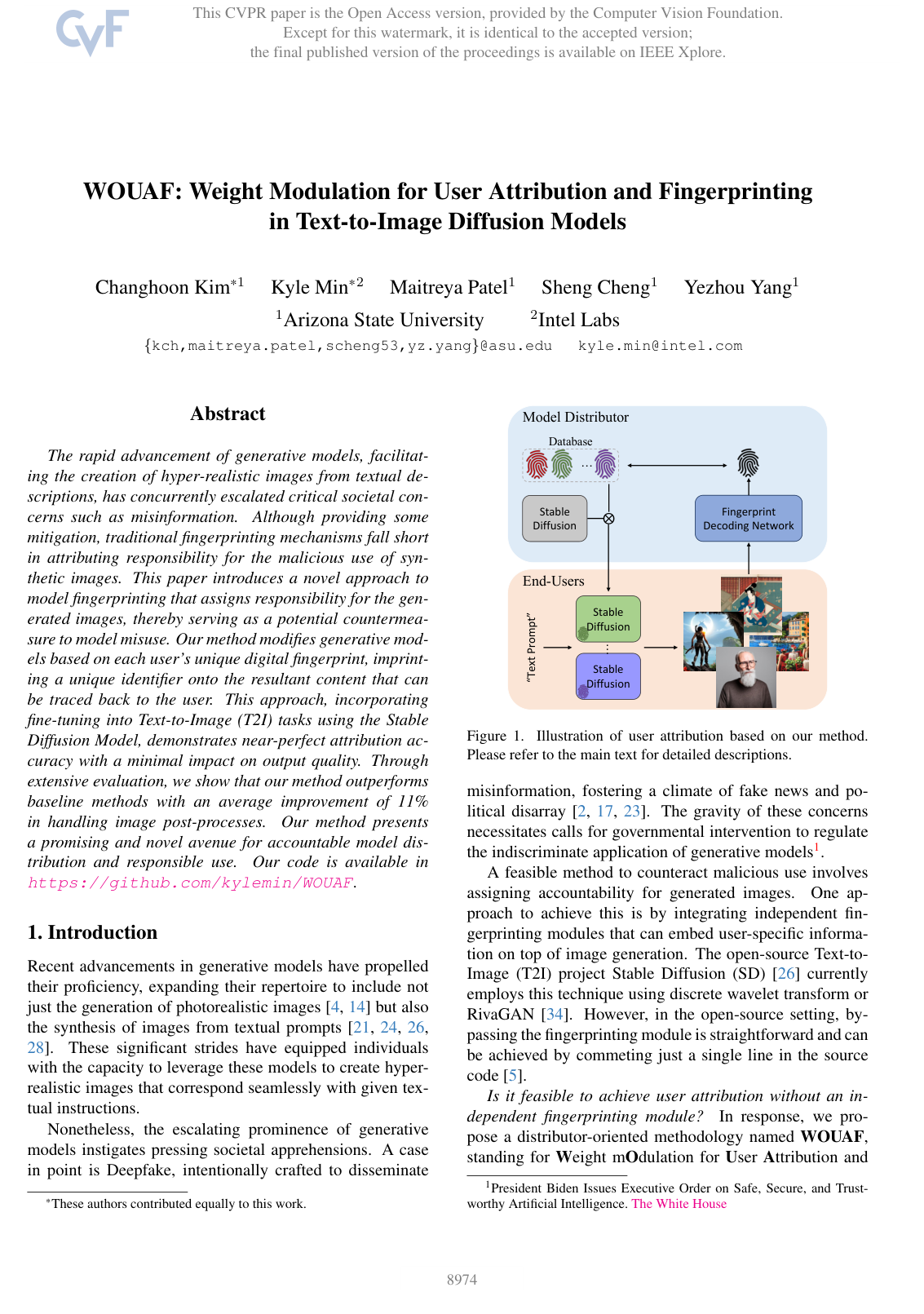
WOUAF: Weight Modulation for User Attribution and Fingerprinting in Text-to-Image Diffusion Models
Changhoon Kim, Kyle Min, Maitreya Patel, Sheng Cheng, Yezhou Yang
Why you should read this
Proposes a distributor-oriented framework that embeds user-specific identifiers directly into the weights of text-to-image diffusion models via weight modulation, enabling reliable user attribution and resistance against post-processing manipulations without sacrificing image quality.
The rapid advancement of generative models, facilitating the creation of hyper-realistic images from textual descriptions, has concurrently escalated critical societal concerns such as misinformation. Although providing some mitigation, traditional fingerprinting mechanisms fall short in attributing responsibility for the malicious use of synthetic images. This paper introduces a novel approach to model fingerprinting that assigns responsibility for the generated images, thereby serving as a potential countermeasure to model misuse. Our method modifies generative models based on each user's unique digital fingerprint, imprinting a unique identifier onto the resultant content that can be traced back to the user. This approach, incorporating fine-tuning into Text-to-Image (T2I) tasks using the Stable Diffusion Model, demonstrates near-perfect attribution accuracy with a minimal impact on output quality. Through extensive evaluation, we show that our method outperforms baseline methods with an average improvement of 11% in handling image post-processes. Our method presents a promising and novel avenue for accountable model distribution and responsible use. Our code is available in https://github.com/kylemin/WOUAF.
Added
2026-09-26
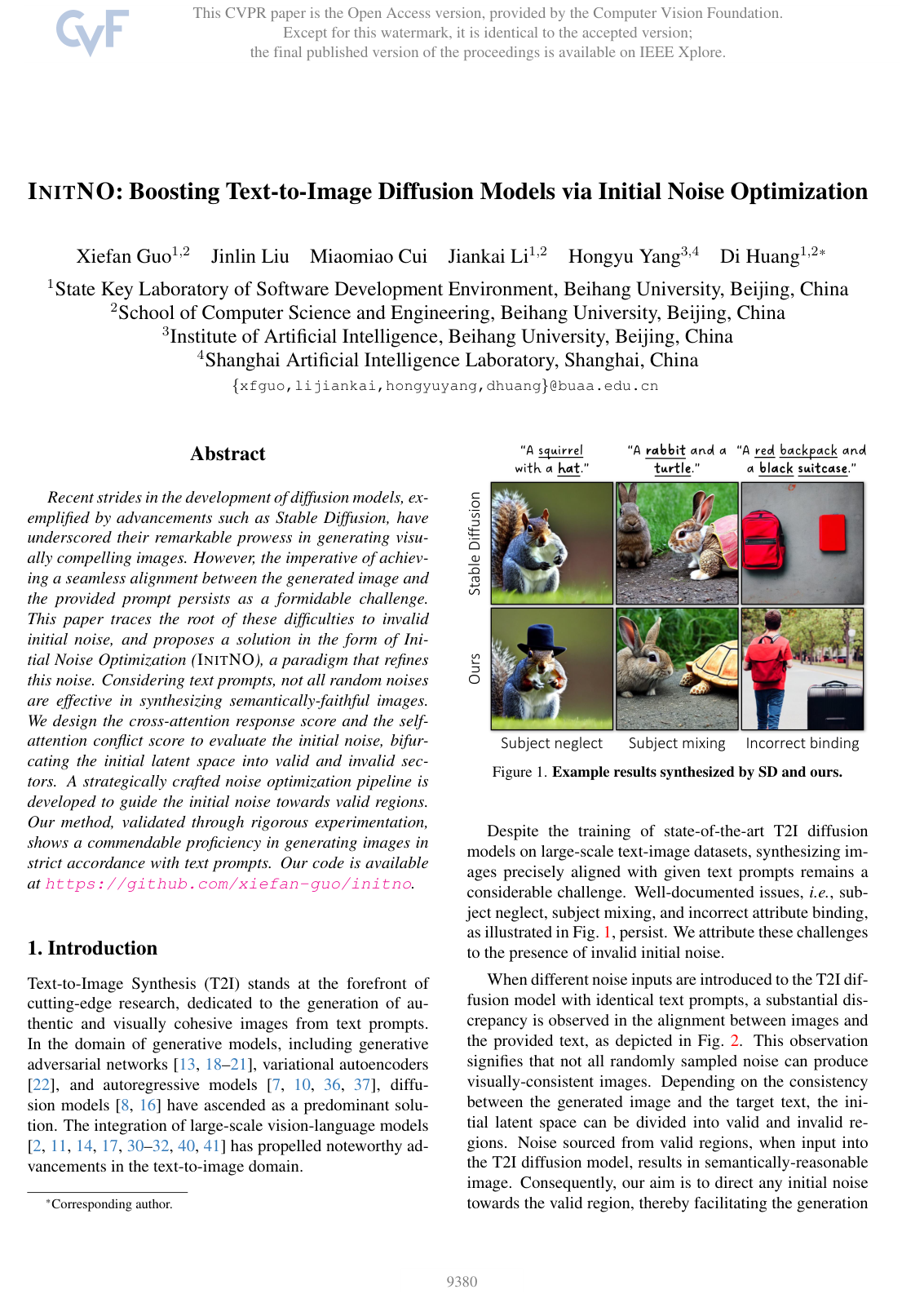
Initno: Boosting Text-to-Image Diffusion Models via Initial Noise Optimization
Xiefan Guo, Jinlin Liu, Miaomiao Cui, Jiankai Li, Hongyu Yang, Di Huang
Why you should read this
Proposes a training-free optimization method that evaluates attention scores to steer initial noise into semantically valid latent regions, preventing common text-to-image synthesis failures such as subject neglect, mixing, and incorrect attribute binding.
Recent strides in the development of diffusion models, exemplified by advancements such as Stable Diffusion, have underscored their remarkable prowess in generating visually compelling images. However, the imperative of achieving a seamless alignment between the generated image and the provided prompt persists as a formidable challenge. This paper traces the root of these difficulties to invalid initial noise, and proposes a solution in the form of Initial Noise Optimization (INITNO), a paradigm that refines this noise. Considering text prompts, not all random noises are effective in synthesizing semantically-faithful images. We design the cross-attention response score and the self-attention conflict score to evaluate the initial noise, bifurcating the initial latent space into valid and invalid sectors. A strategically crafted noise optimization pipeline is developed to guide the initial noise towards valid regions. Our method, validated through rigorous experimentation, shows a commendable proficiency in generating images in strict accordance with text prompts. Our code is available at https://github.com/xiefan-guo/initno.
Added
2026-09-26
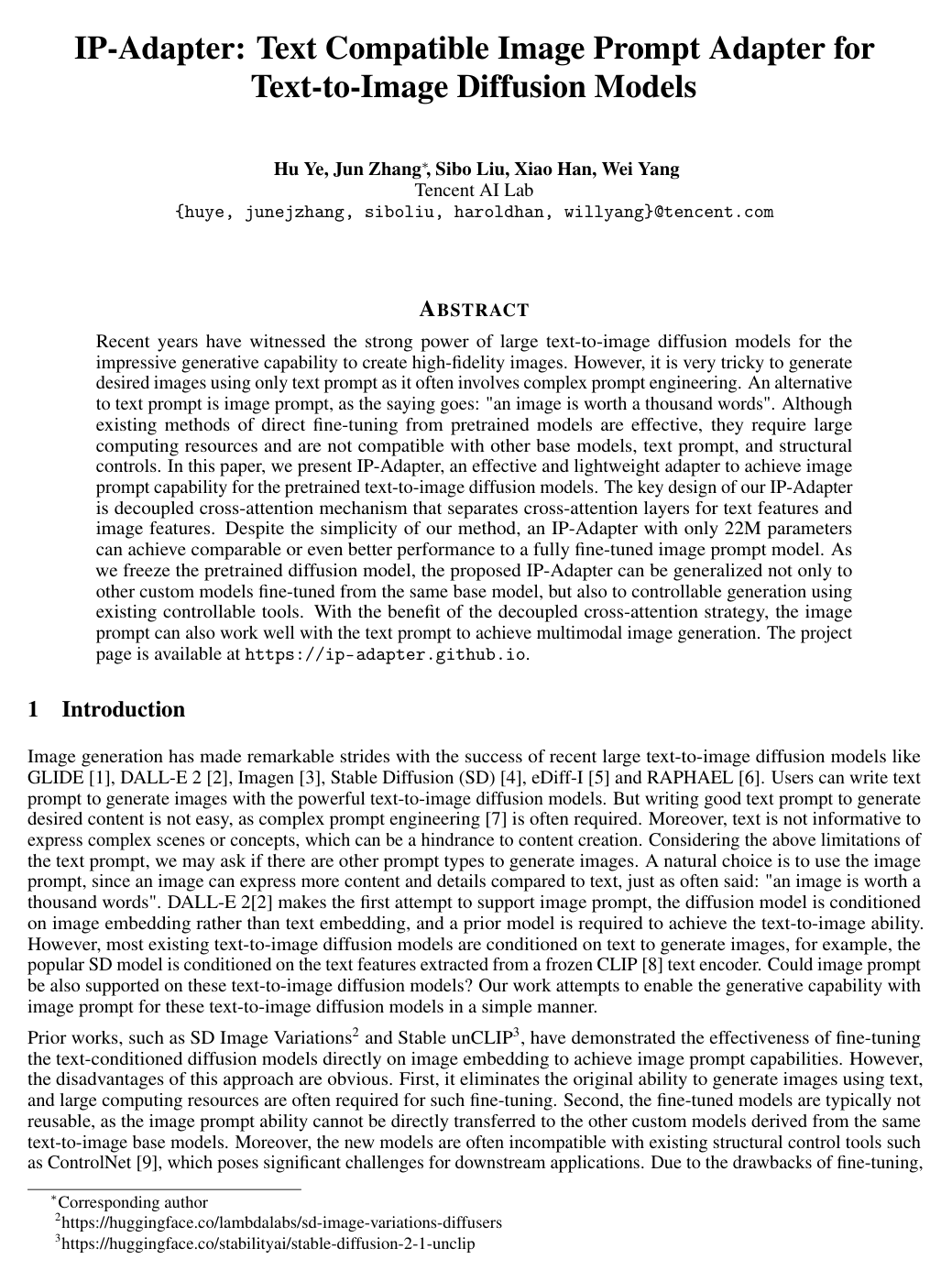
IP-Adapter: Text Compatible Image Prompt Adapter for Text-to-Image Diffusion Models
Hu Ye, Jun Zhang, Siyi Liu, Xiao Han, Wei Yang
Why you should read this
Introduces a lightweight, decoupled cross-attention adapter that equips pretrained text-to-image diffusion models with image prompting capabilities while maintaining full compatibility with text prompts and structural controls without retraining the base model.
Recent years have witnessed the strong power of large text-to-image diffusion models for the impressive generative capability to create high-fidelity images. However, it is very tricky to generate desired images using only text prompt as it often involves complex prompt engineering. An alternative to text prompt is image prompt, as the saying goes: "an image is worth a thousand words". Although existing methods of direct fine-tuning from pretrained models are effective, they require large computing resources and are not compatible with other base models, text prompt, and structural controls. In this paper, we present IP-Adapter, an effective and lightweight adapter to achieve image prompt capability for the pretrained text-to-image diffusion models. The key design of our IP-Adapter is decoupled cross-attention mechanism that separates cross-attention layers for text features and image features. Despite the simplicity of our method, an IP-Adapter with only 22M parameters can achieve comparable or even better performance to a fully fine-tuned image prompt model. As we freeze the pretrained diffusion model, the proposed IP-Adapter can be generalized not only to other custom models fine-tuned from the same base model, but also to controllable generation using existing controllable tools. With the benefit of the decoupled cross-attention strategy, the image prompt can also work well with the text prompt to achieve multimodal image generation. The project page is available at \url{this https URL}.
Added
2026-09-24
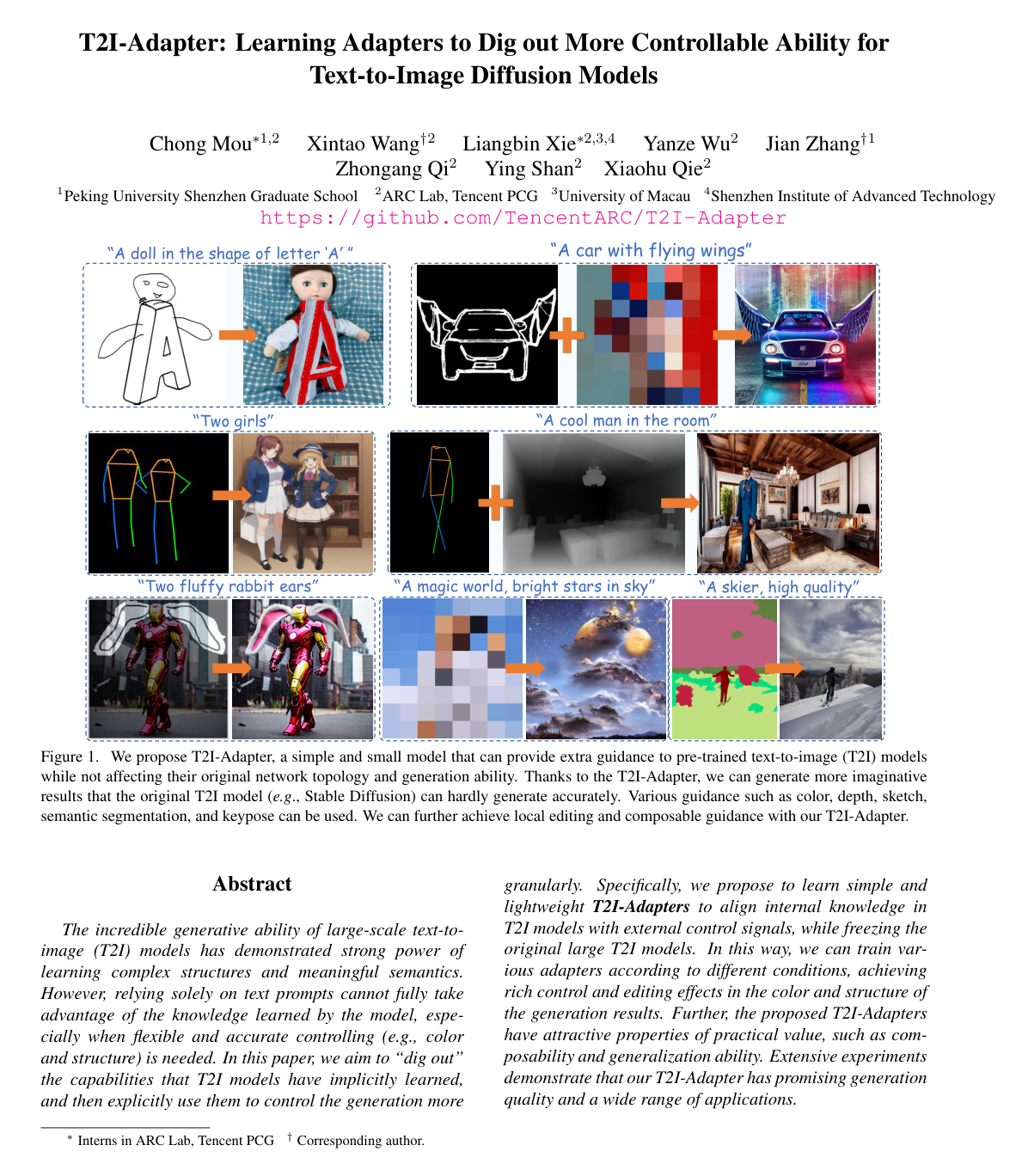
T2I-Adapter: Learning Adapters to Dig Out More Controllable Ability for Text-to-Image Diffusion Models
Chong Mou, Xintao Wang, Liangbin Xie, Yanze Wu, Jian Zhang, Zhongang Qi, Ying Shan
Why you should read this
Introduces lightweight, composable adapter modules that enable precise structural and color control in pretrained text-to-image diffusion models while keeping the base network frozen.
The incredible generative ability of large-scale text-to-image (T2I) models has demonstrated strong power of learning complex structures and meaningful semantics. However, relying solely on text prompts cannot fully take advantage of the knowledge learned by the model, especially when flexible and accurate controlling (e.g., color and structure) is needed. In this paper, we aim to ``dig out" the capabilities that T2I models have implicitly learned, and then explicitly use them to control the generation more granularly. Specifically, we propose to learn simple and lightweight T2I-Adapters to align internal knowledge in T2I models with external control signals, while freezing the original large T2I models. In this way, we can train various adapters according to different conditions, achieving rich control and editing effects in the color and structure of the generation results. Further, the proposed T2I-Adapters have attractive properties of practical value, such as composability and generalization ability. Extensive experiments demonstrate that our T2I-Adapter has promising generation quality and a wide range of applications.
Added
2026-09-18
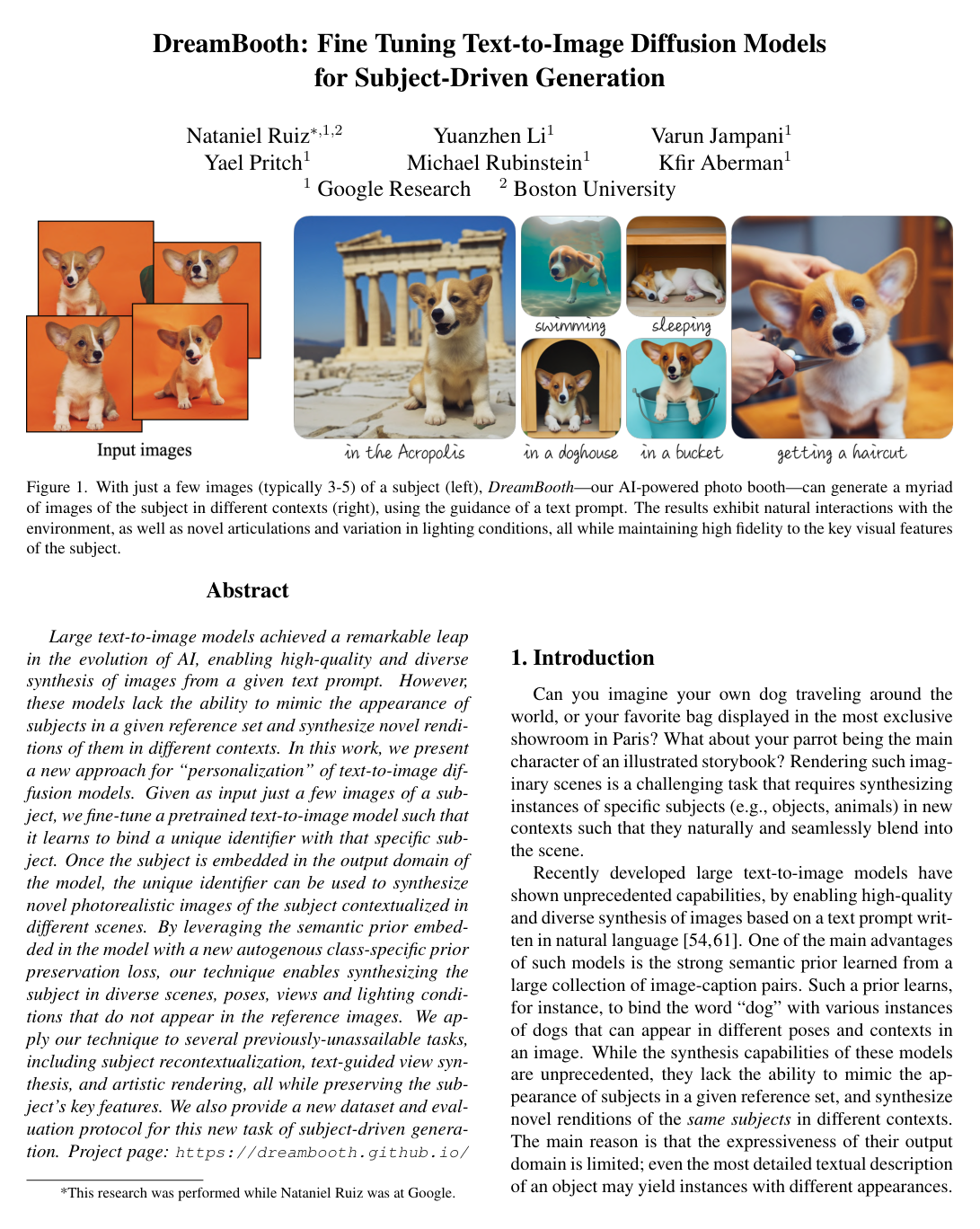
DreamBooth: Fine Tuning Text-to-Image Diffusion Models for Subject-Driven Generation
Nataniel Ruiz, Yuanzhen Li, Varun Jampani, Yael Pritch, Michael Rubinstein, Kfir Aberman
Why you should read this
Presents a groundbreaking method to personalize text-to-image AI, allowing users to generate specific subjects in diverse scenes with photorealistic accuracy from just a few reference images.
Large text-to-image models achieved a remarkable leap in the evolution of AI, enabling high-quality and diverse synthesis of images from a given text prompt. However, these models lack the ability to mimic the appearance of subjects in a given reference set and synthesize novel renditions of them in different contexts. In this work, we present a new approach for "personalization" of text-to-image diffusion models. Given as input just a few images of a subject, we fine-tune a pretrained text-to-image model such that it learns to bind a unique identifier with that specific subject. Once the subject is embedded in the output domain of the model, the unique identifier can be used to synthesize novel photorealistic images of the subject contextualized in different scenes. By leveraging the semantic prior embedded in the model with a new autogenous class-specific prior preservation loss, our technique enables synthesizing the subject in diverse scenes, poses, views and lighting conditions that do not appear in the reference images. We apply our technique to several previously-unassailable tasks, including subject recontextualization, text-guided view synthesis, and artistic rendering, all while preserving the subject's key features. We also provide a new dataset and evaluation protocol for this new task of subject-driven generation. Project page: this https URL
Added
2026-02-25

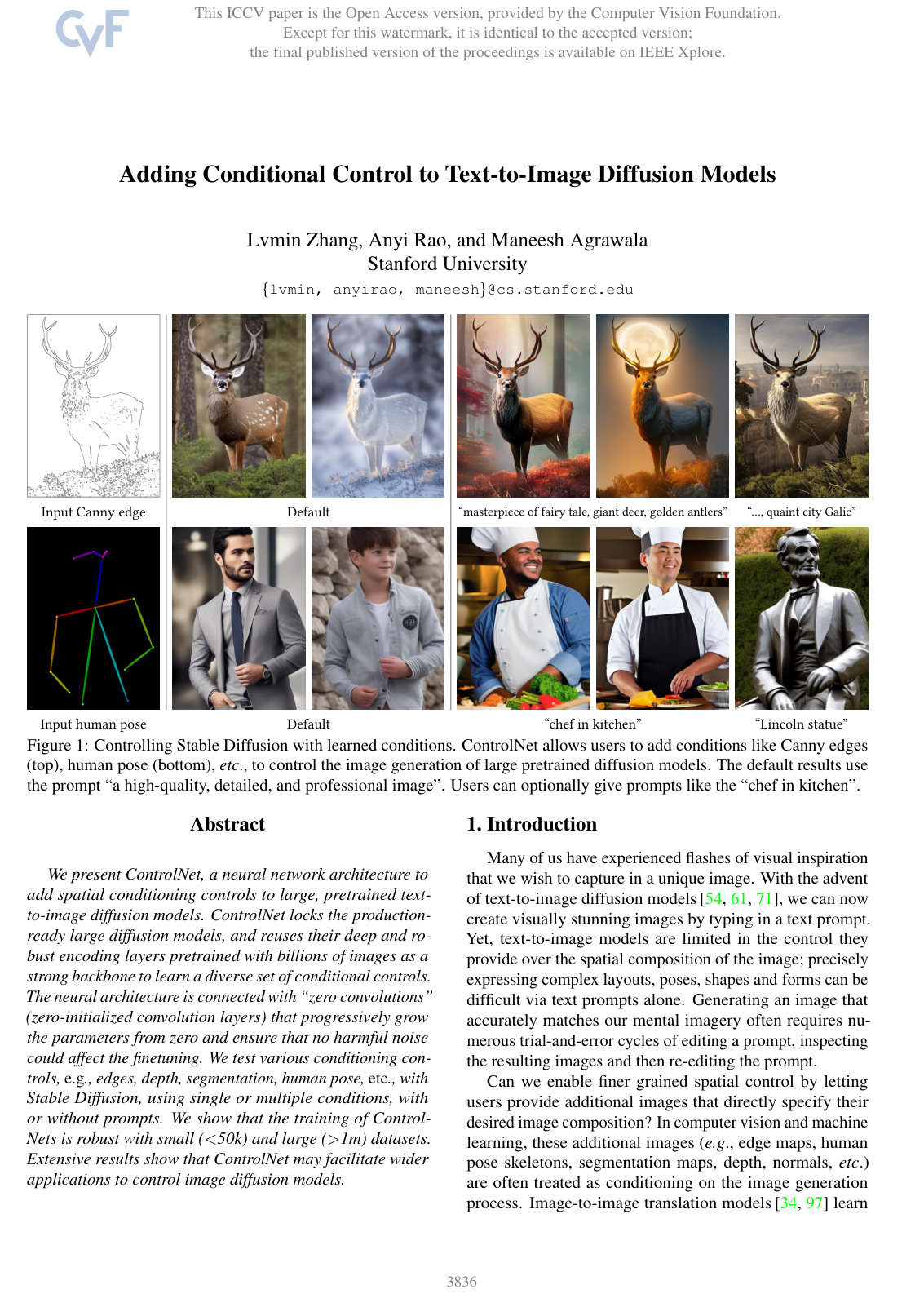
Adding Conditional Control to Text-to-Image Diffusion Models
Lvmin Zhang, Anyi Rao, Maneesh Agrawala
Why you should read this
Introduces ControlNet, a method to lock the structure of a diffusion model while allowing precise spatial guidance (edges, poses) for generation.
We present ControlNet, a neural network architecture to add spatial conditioning controls to large, pretrained text-to-image diffusion models. ControlNet locks the production-ready large diffusion models, and reuses their deep and robust encoding layers pretrained with billions of images as a strong backbone to learn a diverse set of conditional controls. The neural architecture is connected with "zero convolutions"(zero-initialized convolution layers) that progressively grow the parameters from zero and ensure that no harmful noise could affect the finetuning. We test various conditioning controls, e.g., edges, depth, segmentation, human pose, etc., with Stable Diffusion, using single or multiple conditions, with or without prompts. We show that the training of ControlNets is robust with small (<50k) and large (>1m) datasets. Extensive results show that ControlNet may facilitate wider applications to control image diffusion models.
Added
2026-01-28