Frequency-Aware Deepfake Detection: Improving Generalizability through Frequency Space Domain Learning
Chuangchuang TanYao ZhaoShikui WeiGuanghua GuPing LiuYunchao Wei
Presents FreqNet, a compact deepfake detector that learns source-agnostic representations by applying convolutions to both phase and amplitude spectra in the frequency domain, achieving a 9.8% improvement across 17 unseen generation models with only 1.9 million parameters.
Rapid advances in generative artificial intelligence have made synthetic images, commonly known as deepfakes, increasingly realistic and difficult for humans to detect. While early detection tools identified frequency artifacts produced by image synthesis, newer generative architectures create unique patterns that cause existing detectors to fail on unfamiliar sources. Most state-of-the-art systems overfit to the specific models they were trained on, creating severe security and trust vulnerabilities across media, corporate, and public sectors.
The article demonstrates that shifting detector training directly into the frequency domain significantly improves the generalizability of deepfake detection. The authors introduce FreqNet, a lightweight framework designed to identify forgeries across unseen generative models even when trained on very limited data.
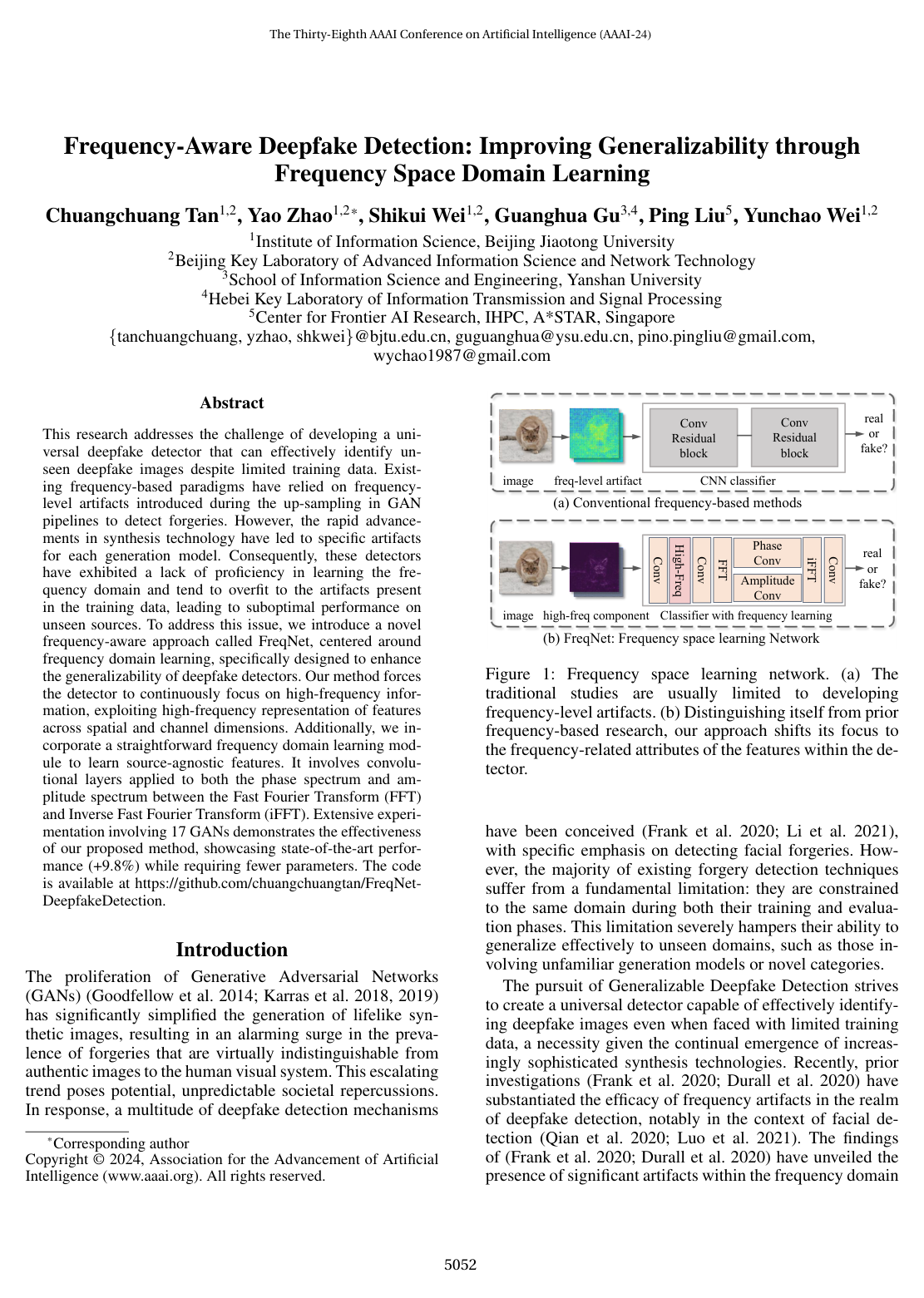
The researchers evaluated their approach through extensive cross-model experiments. The detector was trained on constrained image categories from a single generator and then tested against a comprehensive benchmark of 17 distinct generative models, comprising over 36,000 real-world scene test images and 80,000 face images. FreqNet achieves domain-agnostic detection by combining two high-level mechanisms: extracting high-frequency components from images and internal feature representations across spatial and channel dimensions, and applying specialized frequency convolutional layers to phase and amplitude spectra within the network.
The experimental findings show substantial improvements in both detection accuracy and computational efficiency. Across the 17 tested generative models, FreqNet achieved an overall mean accuracy of 92.8%, outperforming the prior state-of-the-art benchmark by 9.8 percentage points. On self-synthesized test sets from nine distinct models, FreqNet achieved a 94.0% mean accuracy, surpassing the leading baseline by 16.4 percentage points. When applied to high-resolution face images from unseen generators, it maintained high accuracy rates between 98.7% and 99.5%. Crucially, FreqNet achieved these results using only 1.9 million parameters, compared to 304 million parameters required by the top competing baseline.
These results demonstrate that deepfake detectors do not need massive parameter scales or exhaustive multi-generator training to achieve strong cross-model generalization. Operating directly within the frequency spectrum allows detectors to isolate structural forgery indicators rather than model-specific visual artifacts. This approach substantially reduces the compute costs and deployment footprints required for deepfake defense while improving resilience against newly emerging synthesis methods.
Organizations seeking to implement synthetic media moderation should consider lightweight frequency-domain architectures as cost-effective, high-performing options for real-time verification pipelines. Decision-makers should validate FreqNet in pilot deployments on target data streams and explore combining frequency-based plugins with existing enterprise monitoring tools. Further evaluations on heavily compressed or post-processed digital media will help establish operational boundaries before broad deployment.
- Paper: CNN-Generated Images Are Surprisingly Easy to Spot… for Now, Sheng-Yu Wang et al. (2019). This benchmark study demonstrated that universal artifacts exist across CNN generative models and established standard cross-generator generalization evaluation protocols for deepfake detectors.
- Paper: FaceForensics++: Learning to Detect Manipulated Facial Images, Andreas Rössler et al. (2019). This foundational paper introduced standard benchmarks and deep forensic pipelines for detecting facial manipulations that modern deepfake detectors build upon.
- Paper: Celeb-DF: A Large-Scale Challenging Dataset for DeepFake Forensics, Yuezun Li et al. (2019). This work established the Celeb-DF benchmark dataset to expose the poor generalizability of existing forensic detection algorithms on high-quality synthetic videos.
- Paper: MesoNet: a Compact Facial Video Forgery Detection Network, Darius Afchar et al. (2018). This study introduced lightweight deep learning architectures specifically targeted at intermediate mesoscopic forensic artifacts in facial video manipulation.
- Paper: Alias-Free Generative Adversarial Networks, Tero Karras et al. (2021). This work analyzes how standard upsampling and convolutional operations cause aliasing artifacts in GANs, providing the architectural rationale for frequency-domain forensic cues.
- Paper: Analyzing and Improving the Image Quality of StyleGAN, Tero Karras et al. (2020). This paper analyzes structural and phase artifacts in GAN-generated images, which motivate frequency-space representation learning to detect synthetic media.
- Paper: Rethinking the Up-Sampling Operations in CNN-Based Generative Network for Generalizable Deepfake Detection, Chuangchuang Tan et al. (2024). This work rethinks generator up-sampling artifacts by modeling local neighboring pixel relationships to achieve generalizable detection across diverse GAN and diffusion architectures.