Directed Diffusion: Direct Control of Object Placement through Attention Guidance
Wan-Duo Kurt MaAvisek LahiriJohn P. LewisThomas LeungW. Bastiaan Kleijn
Introduces a training-free technique for text-to-image diffusion models that directly guides cross-attention maps during early denoising steps to accurately place multiple specified objects within user-defined bounding boxes.
Modern text-to-image artificial intelligence systems can generate high-quality visual content from descriptive prompts, but they routinely struggle to compose complex scenes involving multiple objects in precise arrangements. Because simple text descriptions cannot reliably specify spatial layouts, creators face tedious and costly trial-and-error cycles. This limitation presents a major barrier for practical storytelling applications, such as illustrated books and storyboards, where characters and objects must maintain intentional positional relationships.
The article introduces and evaluates Directed Diffusion, a lightweight method designed to give creators intuitive, high-level control over where multiple objects appear in synthesized images. The technique works on existing, pre-trained image generation systems without requiring expensive model retraining or fine-tuning.
The researchers developed an approach that operates during the early stages of the image generation process, when general layouts are established. By adjusting internal cross-attention maps—the representations that connect specific words in a prompt to corresponding image regions—the system steers object generation toward user-defined bounding boxes. To evaluate the method, the authors conducted comparative experiments against standard Stable Diffusion and existing state-of-the-art layout control methods, measuring prompt fidelity using standardized text-image similarity scores across single-object and complex multi-object scenes.
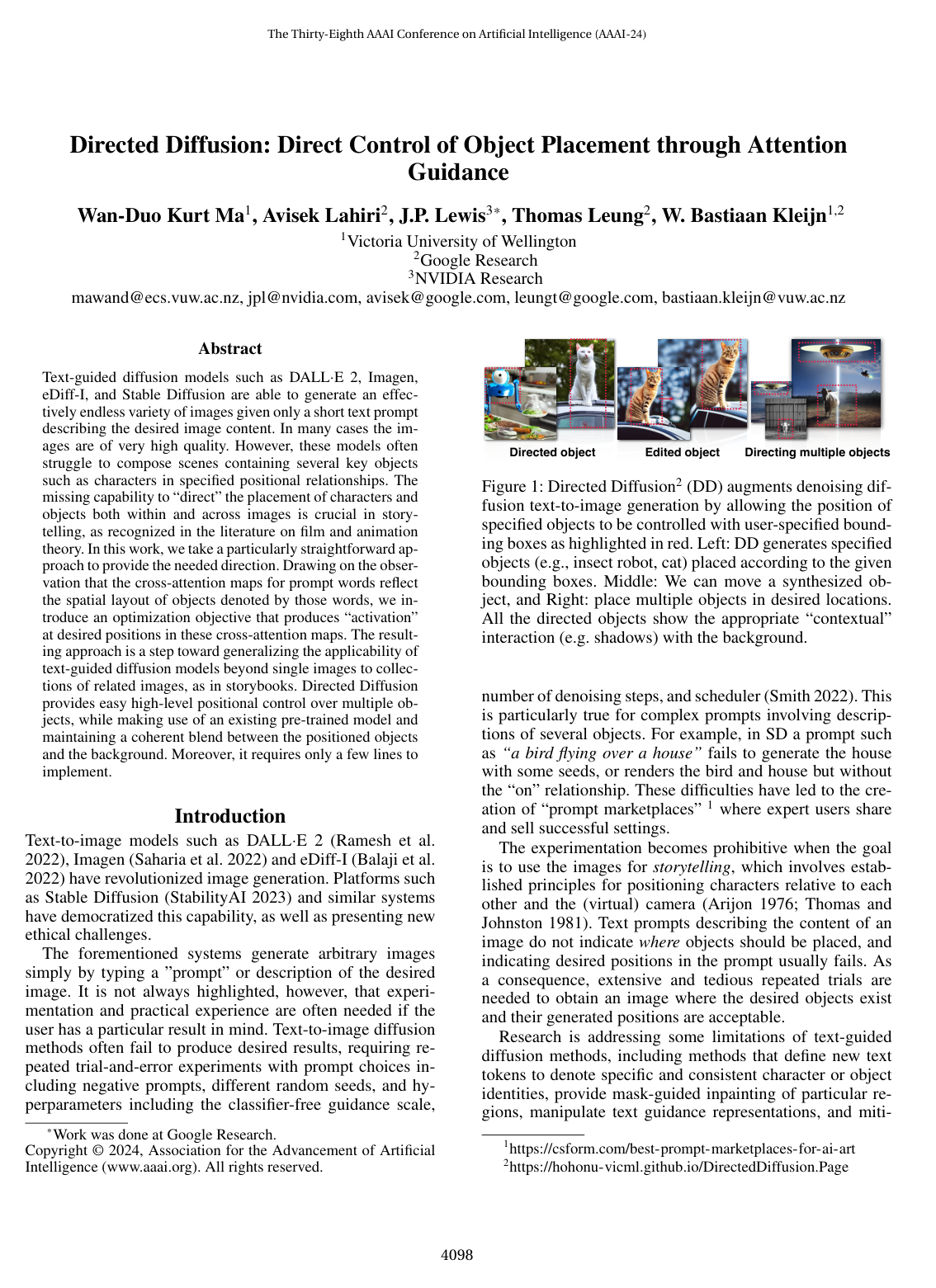
The evaluation revealed several key findings. First, Directed Diffusion successfully places specified objects within user-defined bounding boxes while producing natural contextual interactions, such as realistic shadows, lighting, and occlusions with the background. Second, the method achieved quantitative prompt-alignment scores (CLIP similarity) on par with or exceeding competing approaches, reaching 0.824 in complex scene composition compared to 0.821 for baseline Stable Diffusion and 0.791 for Composable Diffusion. Third, the authors demonstrated a companion technique, Placement Finetuning, which enables users to reposition an object within an existing scene while preserving the object's identity and background consistency without retraining.
These findings demonstrate that high-level spatial control can be achieved with minimal computational overhead, requiring only a few lines of code added to standard image generation pipelines. For organizations and creative teams, this significantly reduces the time and computing costs associated with repeated prompt engineering and eliminates the heavy infrastructure requirements of training specialized models from scratch.
The authors recommend integrating Directed Diffusion into creative production workflows for static visual storytelling formats, such as comic books and illustrated literature. Practitioners should pair this positional framework with complementary identity-preservation tools to maintain consistent character appearances across multiple narrative scenes.
The method inherits certain baseline limitations from underlying diffusion models, including occasional generation failures that still require seed exploration, as well as grammatical parsing limitations in language understanding models. Confidence in the reported results is high for static, multi-object image composition, though the authors caution that substantial technical advances remain necessary before these capabilities can be extended to video production.
- Paper: Prompt-to-Prompt Image Editing with Cross Attention Control, Amir Hertz et al. (2022). This foundational work establishes how manipulating cross-attention maps in diffusion models enables spatial and semantic control over generated visual elements, providing the underlying mechanism adapted by Directed Diffusion.
- Paper: What the DAAM: Interpreting Stable Diffusion Using Cross Attention, Raphael Tang et al. (2023). This paper demonstrates how cross-attention heat maps bind specific prompt tokens to spatial regions in Stable Diffusion, providing the core interpretability insight that enables bounding-box attention steering.
- Paper: Adding Conditional Control to Text-to-Image Diffusion Models, Lvmin Zhang et al. (2023). Understanding ControlNet's learned structural conditioning highlights the motivation for training-free, lightweight spatial steering alternatives like Directed Diffusion.
- Paper: T2I-Adapter: Learning Adapters to Dig out More Controllable Ability for Text-to-Image Diffusion Models, Chong Mou et al. (2023). This study demonstrates that spatial layout guidance is most critical in early diffusion steps, a principle directly utilized by Directed Diffusion's early-stage cross-attention guidance.
- Paper: T2I-CompBench: A Comprehensive Benchmark for Open-world Compositional Text-to-image Generation, Kaiyi Huang et al. (2023). This benchmark details the specific failure modes of text-to-image models in spatial positioning and multi-object binding that Directed Diffusion explicitly targets.
- Paper: MIGC: Multi-Instance Generation Controller for Text-to-Image Synthesis, Dewei Zhou et al. (2024). Extending bounding-box spatial guidance, MIGC introduces instance-level attention controllers and shading aggregation to prevent attribute leakage in complex multi-object layouts.
- Paper: Towards Understanding Cross and Self-Attention in Stable Diffusion for Text-Guided Image Editing, Bingyan Liu et al. (2024). This work deepens the theoretical understanding of what cross-attention layers encode and demonstrates how to refine attention manipulation for tuning-free localized editing.
- Paper: Intelligent Grimm - Open-ended Visual Storytelling via Latent Diffusion Models, Chang Liu et al. (2024). Building upon spatial object steering and identity preservation for storytelling, StoryGen applies context modules to maintain multi-frame character and scene consistency across narrative sequences.
- Paper: Initno: Boosting Text-to-Image Diffusion Models via Initial Noise Optimization, Xiefan Guo et al. (2024). Complementing attention guidance during denoising, INITNO addresses multi-subject omission and blending by optimizing initial noise distributions prior to generation.
- Paper: Everything in Its Place: Benchmarking Spatial Intelligence of Text-to-Image Models, Zengbin Wang et al. (2026). This benchmark provides a comprehensive framework to evaluate spatial intelligence and multi-object reasoning across generative models, evaluating the capabilities Directed Diffusion seeks to improve.