What the DAAM: Interpreting Stable Diffusion Using Cross Attention
Raphael TangLinqing LiuAkshat PandeyZhiying JiangGefei YangKarun KumarPontus StenetorpJimmy LinFerhan Ture
Introduces DAAM, a method that aggregates cross-attention maps in Stable Diffusion to interpret how individual prompt words influence generated pixels and uncover visual-linguistic failure modes such as feature entanglement.
Modern text-to-image generative systems, such as diffusion models, can synthesize high-fidelity and photorealistic images from textual prompts. Despite their widespread adoption and commercial relevance, the internal mechanics driving how specific words shape visual outputs remain poorly understood. Because these models function as black boxes, practitioners face challenges diagnosing generation errors, controlling layout precision, and understanding semantic failures.
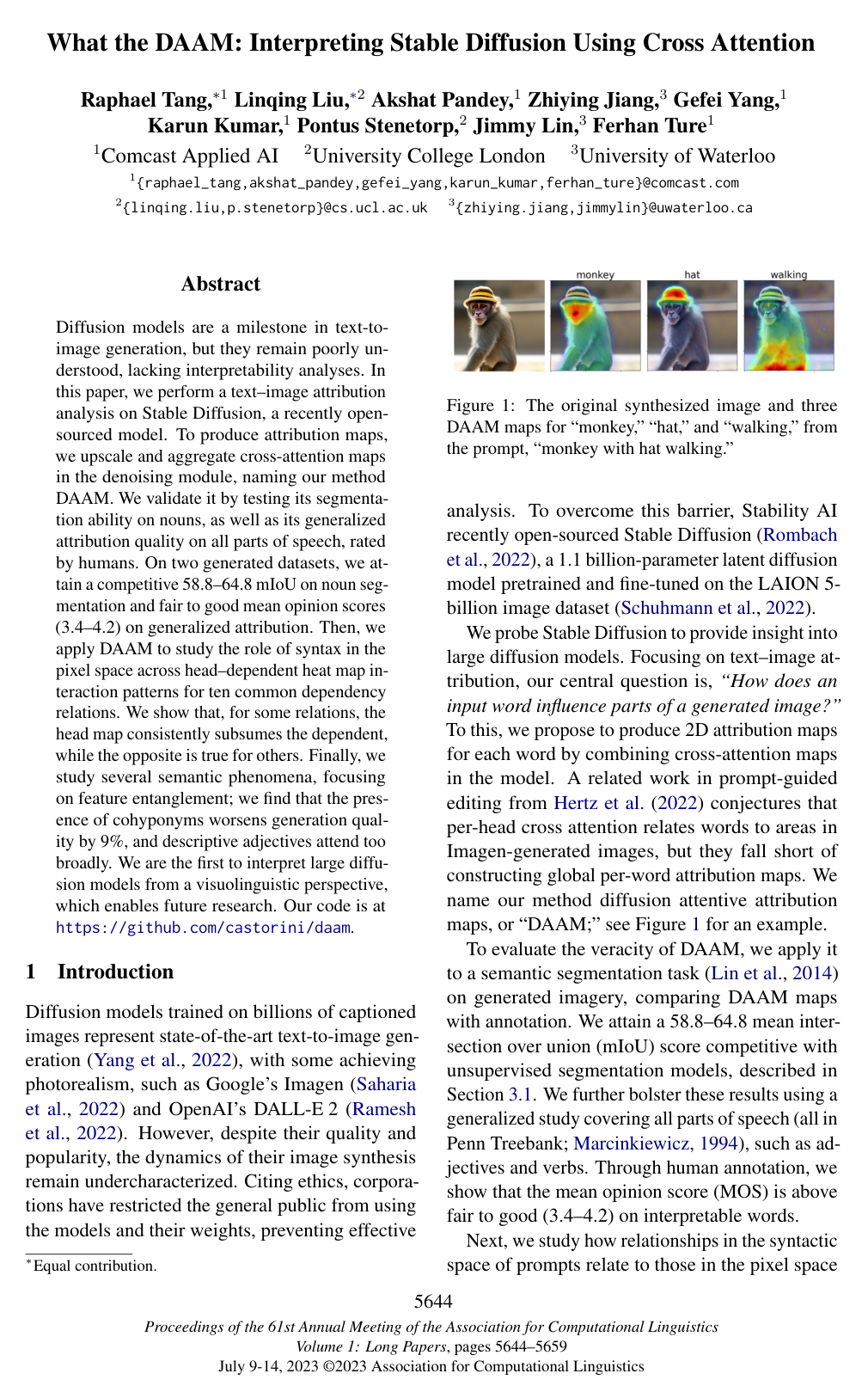
The article demonstrates a novel interpretability method called Diffusion Attentive Attribution Maps (DAAM) to evaluate how individual input words directly influence specific regions of generated images in Stable Diffusion. It investigates the visual realization of linguistic syntax and analyzes the core semantic failure modes that degrade image quality.
To conduct this evaluation, the researchers aggregated and upscaled cross-attention scores across all network layers and denoising time steps, producing two-dimensional attribution heat maps without requiring computationally intractable gradient calculations. The approach was evaluated on two synthetic benchmarks derived from standard image caption datasets (COCO-Gen and Unreal-Gen) for object segmentation, followed by crowdsourced human evaluations covering multiple parts of speech. The researchers also parsed 8,000 syntactic head–dependent relationships across 1,000 prompts to measure visual overlap and tested semantic prompts containing pairs of cohyponyms (words sharing a broader category, such as "giraffe" and "zebra") and varying descriptive adjectives.
The analysis produced three primary findings. First, the attribution method achieves competitive unsupervised noun segmentation performance (58.8 to 64.8 mean intersection-over-union) and generates reliable visual maps across diverse grammatical categories, with over 80% to 90% of human ratings scored as fair to excellent. Second, visual interactions between words often reflect syntactic dependencies, showing that verbs spatially encompass their subject and object nouns, whereas descriptive adjectives unexpectedly attend more broadly across the image than the specific nouns they modify. Third, semantically related words suffer from severe feature entanglement: prompts featuring cohyponyms suffer a 9% absolute reduction in generation accuracy compared to unrelated noun pairs (52% versus 61%), frequently generating only one intended entity while their attribution maps heavily overlap.
These findings indicate that current diffusion models struggle with compositional disentanglement. When models process visually related concepts or modifying adjectives, features bleed across the image rather than binding cleanly to specific objects, leading to missing subjects, corrupted backgrounds, and inconsistent prompt fidelity. This behavioral analysis explains why prompt engineering often yields unpredictable results and provides a diagnostic basis for improving generative control and compliance in real-world deployment.
To improve generative performance, future engineering and model development should leverage cross-attention maps as internal feature representations to explicitly disentangle concept attributes and object boundaries. Organizations deploying generative pipelines should implement pre-generation prompt screening or post-generation attention monitoring to detect cohyponym overlap and prevent rendering errors. Further research is necessary to design training techniques or architectural constraints that actively decouple entangled semantic features.
These conclusions are bounded by automated dependency parsing quality and an evaluation benchmark focused primarily on concrete, visual entities derived from caption datasets rather than highly abstract concepts. Additionally, while the attribution maps offer high-confidence diagnostic value, attention scores serve as an empirical proxy for model behavior rather than an exact causal guarantee of model outputs.
- Paper: High-Resolution Image Synthesis with Latent Diffusion Models, Robin Rombach et al. (2022). Introduces Latent Diffusion Models and the cross-attention architecture underpinning Stable Diffusion, which DAAM analyzes and interprets.
- Paper: Prompt-to-Prompt Image Editing with Cross Attention Control, Amir Hertz et al. (2022). Establishes that cross-attention maps in text-to-image diffusion models reflect spatial token grounding, motivating DAAM's cross-attention attribution approach.
- Paper: Denoising Diffusion Probabilistic Models, Jonathan Ho et al. (2020). Provides the foundational denoising diffusion probabilistic model formulation upon which modern latent diffusion architectures and their iterative processes rely.
- Paper: Grad-CAM: Visual Explanations from Deep Networks via Gradient-Based Localization, Ramprasaath R. Selvaraju et al. (2016). Introduces foundational visual attribution and localization concepts from neural network feature maps that inspire subsequent visuolinguistic interpretability methods.
- Paper: Adding Conditional Control to Text-to-Image Diffusion Models, Lvmin Zhang et al. (2023). Builds on spatial grounding in diffusion models by adding explicit structural and conditional guidance beyond cross-attention prompting.
- Paper: T2I-Adapter: Learning Adapters to Dig out More Controllable Ability for Text-to-Image Diffusion Models, Chong Mou et al. (2023). Extends controllable generation in latent diffusion models using lightweight adapters that steer structural and semantic alignment.
- Paper: IP-Adapter: Text Compatible Image Prompt Adapter for Text-to-Image Diffusion Models, Hu Ye et al. (2023). Decouples cross-attention pathways to enable multimodal image prompting alongside text guidance in pretrained diffusion networks.
- Paper: TextDiffuser: Diffusion Models as Text Painters, Jingye Chen et al. (2023). Applies explicit layout planning and character segmentation masks to overcome diffusion models' known visuolinguistic text-rendering limitations.
- Paper: SDXL: Improving Latent Diffusion Models for High-Resolution Image Synthesis, Dustin Podell et al. (2024). Scales and refines latent diffusion architectures with larger cross-attention backbones and multi-stage pipelines to improve prompt fidelity.
- Paper: Scaling Rectified Flow Transformers for High-Resolution Image Synthesis, Patrick Esser et al. (2024). Advances text-to-image synthesis beyond standard diffusion by scaling rectified flow transformers with joint multimodal attention.