
keyword
image editing
Image editing is the process of altering, manipulating, or enhancing an existing digital image to modify its visual content, appearance, or structure according to specific user guidance. In modern computational and generative frameworks, this encompasses tasks such as inpainting, localized object addition or removal, color and lighting adjustment, attribute alteration, and semantic translation, frequently directed by multimodal conditioning inputs such as natural language descriptions, spatial masks, sketches, or structural feature maps. A central objective of image editing is to faithfully realize the intended modifications while preserving unedited regions, structural layout, semantic coherence, and overall visual realism.
10 items
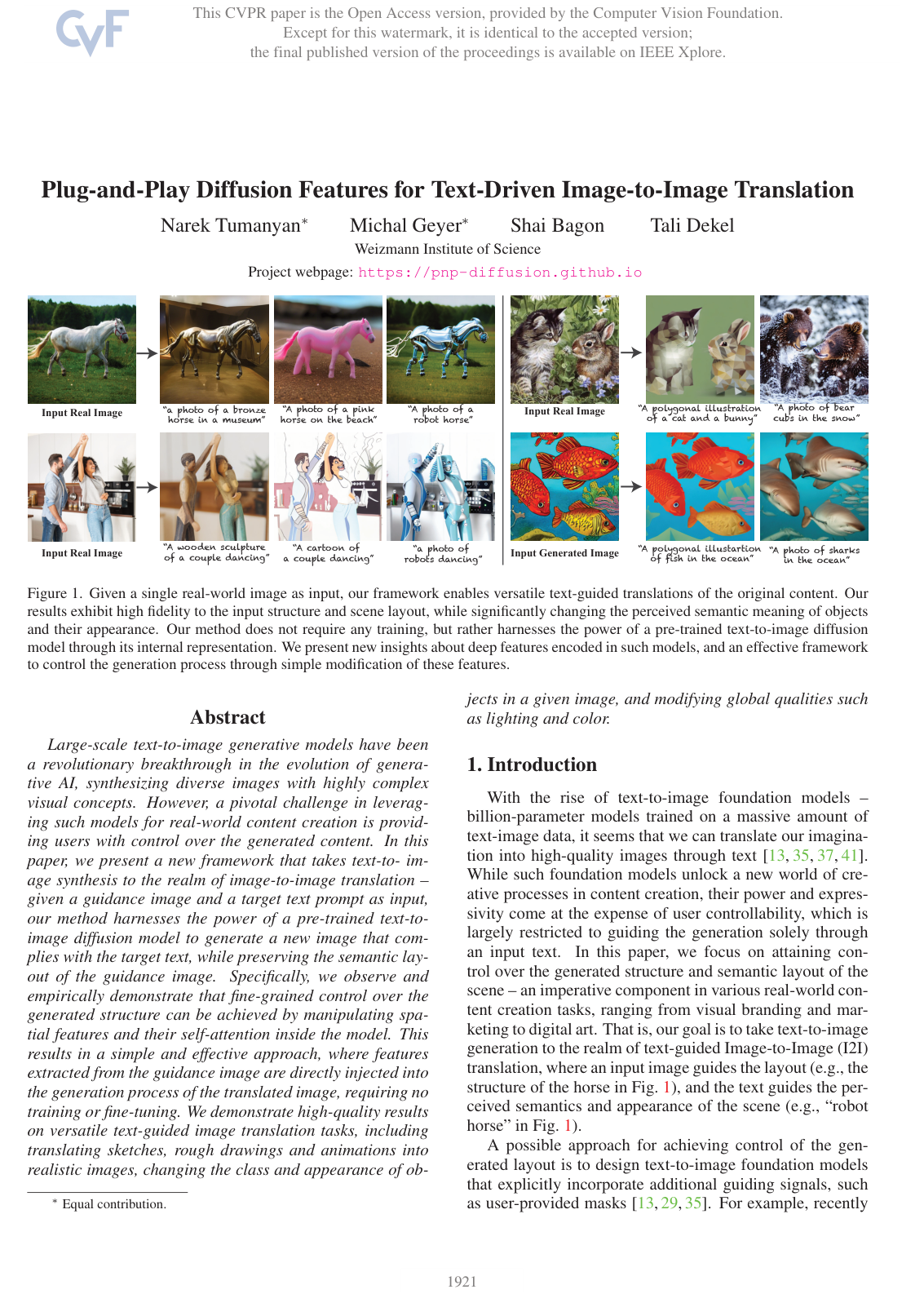
Plug-and-Play Diffusion Features for Text-Driven Image-to-Image Translation
Narek Tumanyan, Michal Geyer, Shai Bagon, Tali Dekel
Why you should read this
Introduces a training-free framework that enables precise text-guided image-to-image translation by directly injecting spatial features and self-attention maps from a source image into a pre-trained diffusion model to preserve visual layout and structure.
Large-scale text-to-image generative models have been a revolutionary breakthrough in the evolution of generative AI, synthesizing diverse images with highly complex visual concepts. However, a pivotal challenge in leveraging such models for real-world content creation is providing users with control over the generated content. In this paper, we present a new framework that takes text-to-image synthesis to the realm of image-to-image translation – given a guidance image and a target text prompt as input, our method harnesses the power of a pre-trained text-to-image diffusion model to generate a new image that complies with the target text, while preserving the semantic layout of the guidance image. Specifically, we observe and empirically demonstrate that fine-grained control over the generated structure can be achieved by manipulating spatial features and their self-attention inside the model. This results in a simple and effective approach, where features extracted from the guidance image are directly injected into the generation process of the translated image, requiring no training or fine-tuning. We demonstrate high-quality results on versatile text-guided image translation tasks, including translating sketches, rough drawings and animations into realistic images, changing the class and appearance of objects in a given image, and modifying global qualities such as lighting and color.
Added
2026-10-04
Composer: Creative and Controllable Image Synthesis with Composable Conditions
Lianghua Huang, Di Chen, Yu Liu, Yujun Shen, Deli Zhao, Jingren Zhou
Why you should read this
Develops Composer, a controllable diffusion framework that conditions image synthesis on decomposed representations like text descriptions, spatial layouts, and color histograms to enable flexible visual creation and multi-task image editing without retraining.
Recent large-scale generative models learned on big data are capable of synthesizing incredible images yet suffer from limited controllability. This work offers a new generation paradigm that allows flexible control of the output image, such as spatial layout and palette, while maintaining the synthesis quality and model creativity. With compositionality as the core idea, we first decompose an image into representative factors, and then train a diffusion model with all these factors as the conditions to recompose the input. At the inference stage, the rich intermediate representations work as composable elements, leading to a huge design space (i.e., exponentially proportional to the number of decomposed factors) for customizable content creation. It is noteworthy that our approach, which we call Composer, supports various levels of conditions, such as text description as the global information, depth map and sketch as the local guidance, color histogram for low-level details, etc. Besides improving controllability, we confirm that Composer serves as a general framework and facilitates a wide range of classical generative tasks without retraining. Code and models will be made available.
Added
2026-09-28
Kosmos-G: Generating Images in Context with Multimodal Large Language Models
Xichen Pan, Li Dong, Shaohan Huang, Zhiliang Peng, Wenhu Chen, Furu Wei
Why you should read this
Presents Kosmos-G, a framework that aligns multimodal large language models with CLIP to achieve zero-shot subject-driven image generation from interleaved text and image inputs without requiring test-time tuning or image decoder modifications.
Recent advancements in subject-driven image generation have made significant strides. However, current methods still fall short in diverse application scenarios, as they require test-time tuning and cannot accept interleaved multi-image and text input. These limitations keep them far from the ultimate goal of "image as a foreign language in image generation." This paper presents Kosmos-G, a model that leverages the advanced multimodal perception capabilities of Multimodal Large Language Models (MLLMs) to tackle the aforementioned challenge. Our approach aligns the output space of MLLM with CLIP using the textual modality as an anchor and performs compositional instruction tuning on curated data. Kosmos-G demonstrates an impressive capability of zero-shot subject-driven generation with interleaved multi-image and text input. Notably, the score distillation instruction tuning requires no modifications to the image decoder. This allows for a seamless substitution of CLIP and effortless integration with a myriad of U-Net techniques ranging from fine-grained controls to personalized image decoder variants. We posit Kosmos-G as an initial attempt towards the goal of "image as a foreign language in image generation." The code can be found at this https URL
Added
2026-09-26
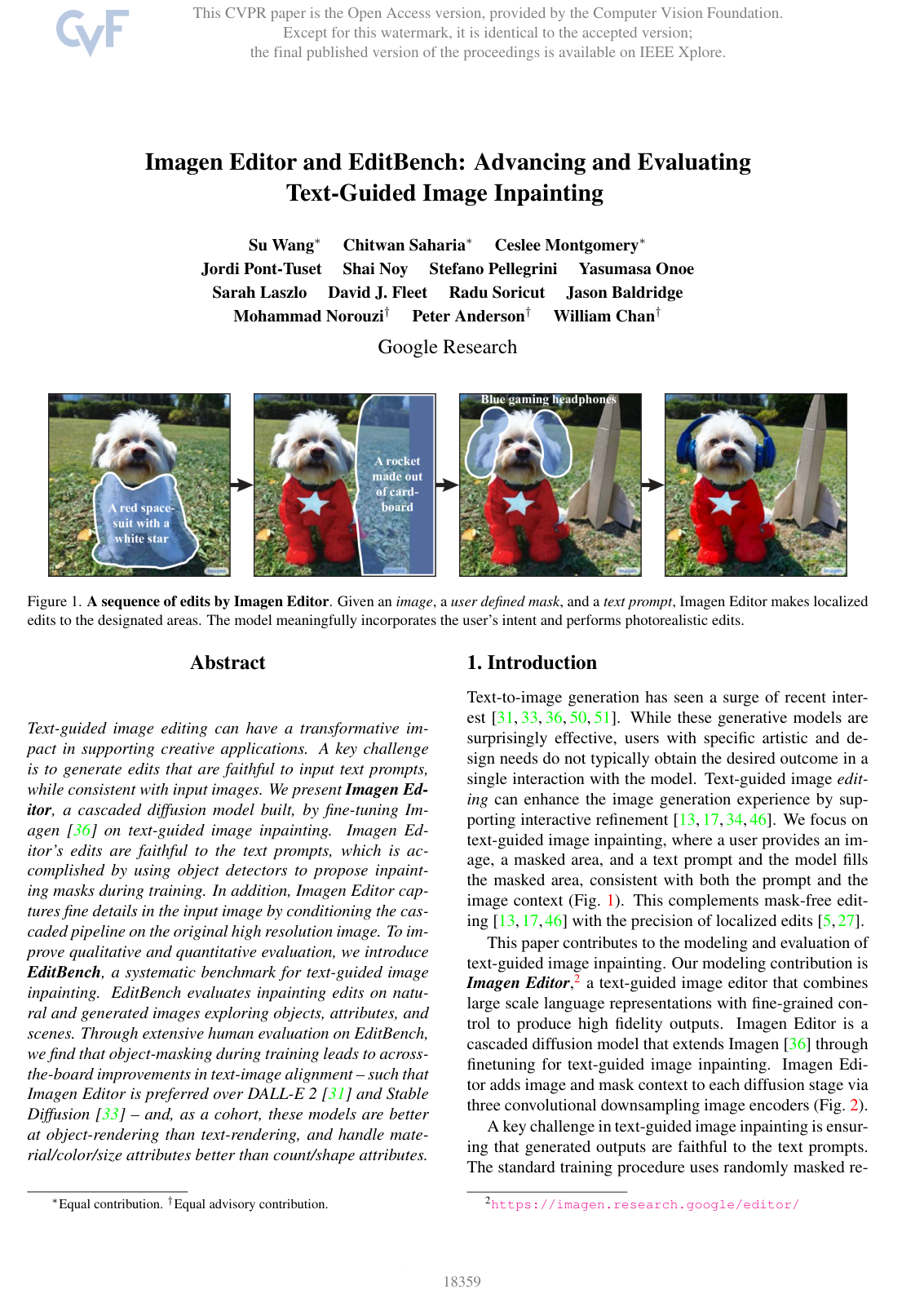
Imagen Editor and EditBench: Advancing and Evaluating Text-Guided Image Inpainting
Su Wang, Chitwan Saharia, Ceslee Montgomery, Jordi Pont-Tuset, Shai Noy, Stefano Pellegrini, Yasumasa Onoe, Sarah Laszlo, David J. Fleet, Radu Soricut, Jason Baldridge, Mohammad Norouzi, Peter Anderson, William Chan
Why you should read this
Presents Imagen Editor, a high-resolution diffusion model that improves prompt-aligned image inpainting via object-detector masking during training, alongside EditBench, a systematic benchmark that reveals fine-grained strengths and limitations across leading text-guided editing models.
Text-guided image editing can have a transformative impact in supporting creative applications. A key challenge is to generate edits that are faithful to input text prompts, while consistent with input images. We present Imagen Editor, a cascaded diffusion model built, by fine-tuning Imagen [36] on text-guided image inpainting. Imagen Editor’s edits are faithful to the text prompts, which is accomplished by using object detectors to propose inpainting masks during training. In addition, Imagen Editor captures fine details in the input image by conditioning the cascaded pipeline on the original high resolution image. To improve qualitative and quantitative evaluation, we introduce EditBench, a systematic benchmark for text-guided image inpainting. EditBench evaluates inpainting edits on natural and generated images exploring objects, attributes, and scenes. Through extensive human evaluation on EditBench, we find that object-masking during training leads to across-the-board improvements in text-image alignment – such that Imagen Editor is preferred over DALL-E 2 [31] and Stable Diffusion [33] – and, as a cohort, these models are better at object-rendering than text-rendering, and handle material/color/size attributes better than count/shape attributes.
Added
2026-09-26
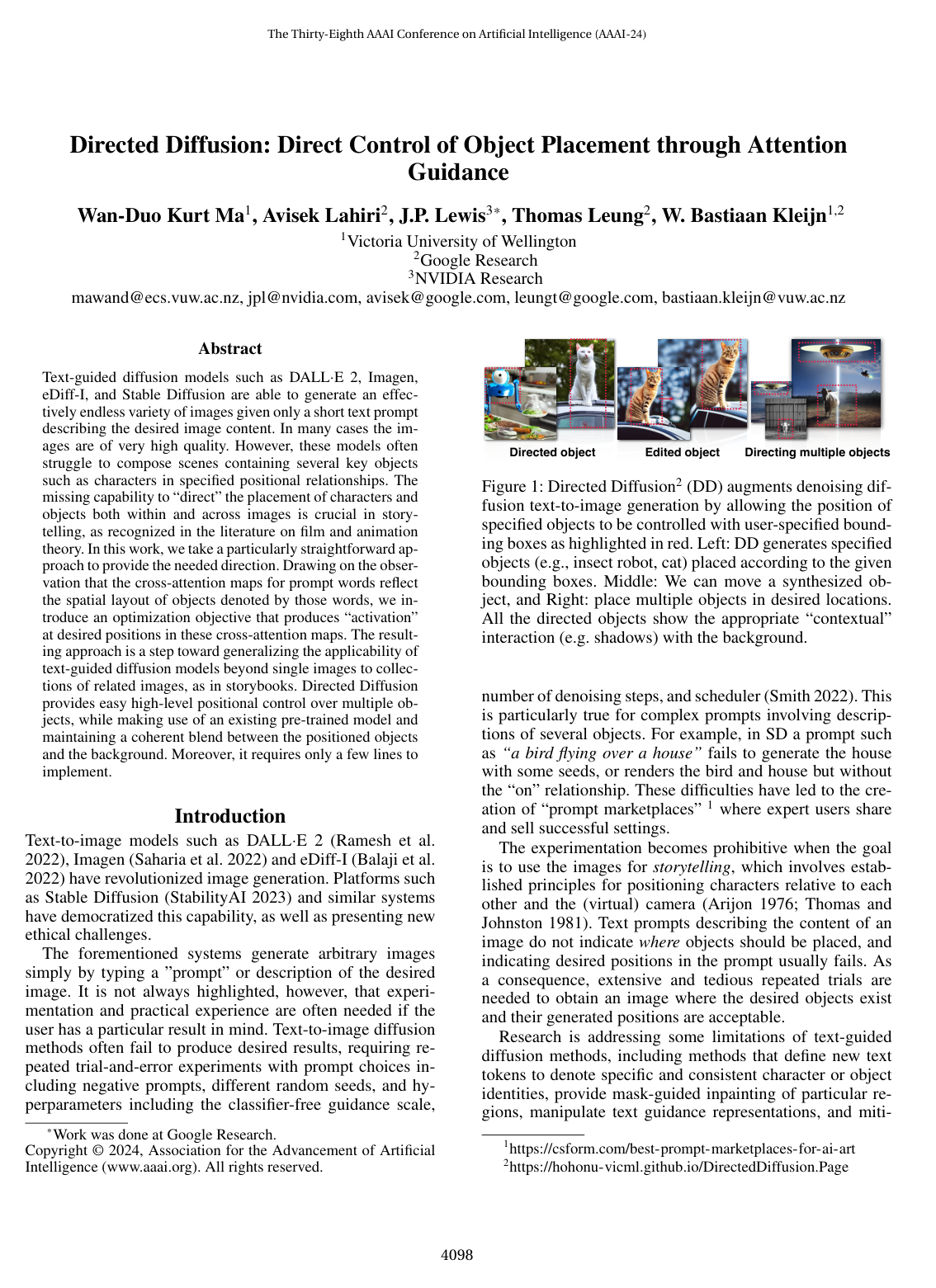
Directed Diffusion: Direct Control of Object Placement through Attention Guidance
Wan-Duo Kurt Ma, Avisek Lahiri, John P. Lewis, Thomas Leung, W. Bastiaan Kleijn
Why you should read this
Introduces a training-free technique for text-to-image diffusion models that directly guides cross-attention maps during early denoising steps to accurately place multiple specified objects within user-defined bounding boxes.
Text-guided diffusion models such as DALL-E 2, Imagen, eDiff-I, and Stable Diffusion are able to generate an effectively endless variety of images given only a short text prompt describing the desired image content. In many cases the images are of very high quality. However, these models often struggle to compose scenes containing several key objects such as characters in specified positional relationships. The missing capability to “direct” the placement of characters and objects both within and across images is crucial in storytelling, as recognized in the literature on film and animation theory. In this work, we take a particularly straightforward approach to provide the needed direction. Drawing on the observation that the cross-attention maps for prompt words reflect the spatial layout of objects denoted by those words, we introduce an optimization objective that produces “activation” at desired positions in these cross-attention maps. The resulting approach is a step toward generalizing the applicability of text-guided diffusion models beyond single images to collections of related images, as in storybooks. Directed Diffusion provides easy high-level positional control over multiple objects, while making use of an existing pre-trained model and maintaining a coherent blend between the positioned objects and the background. Moreover, it requires only a few lines to implement.
Added
2026-09-26
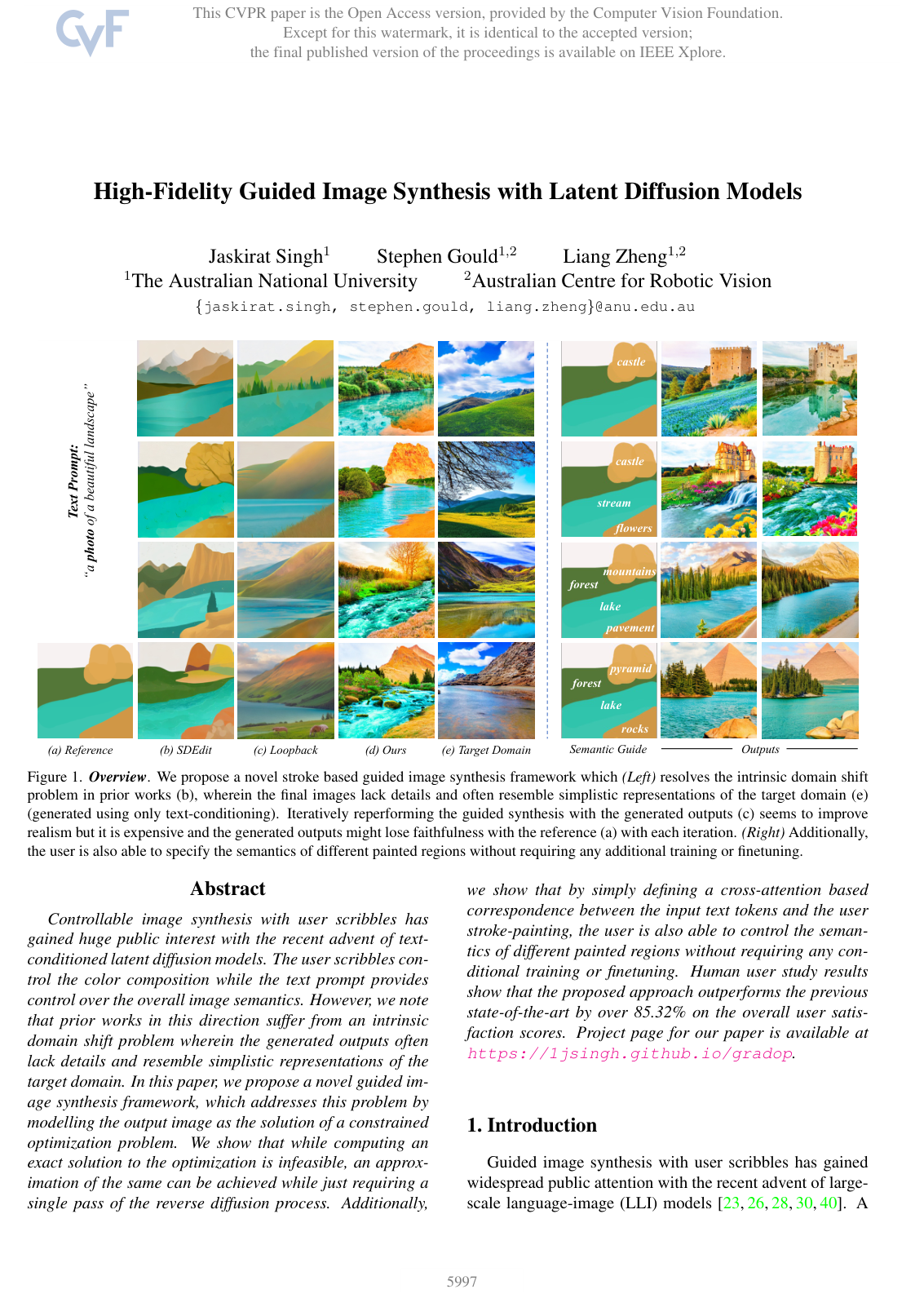
High-Fidelity Guided Image Synthesis with Latent Diffusion Models
Jaskirat Singh, Stephen Gould, Liang Zheng
Why you should read this
Proposes an optimization framework and cross-attention mechanism that enable precise, region-specific semantic control and photorealistic image synthesis from coarse user scribbles without requiring additional model training or fine-tuning.
Controllable image synthesis with user scribbles has gained huge public interest with the recent advent of text-conditioned latent diffusion models. The user scribbles control the color composition while the text prompt provides control over the overall image semantics. However, we note that prior works in this direction suffer from an intrinsic domain shift problem wherein the generated outputs often lack details and resemble simplistic representations of the target domain. In this paper, we propose a novel guided image synthesis framework, which addresses this problem by modelling the output image as the solution of a constrained optimization problem. We show that while computing an exact solution to the optimization is infeasible, an approximation of the same can be achieved while just requiring a single pass of the reverse diffusion process. Additionally, we show that by simply defining a cross-attention based correspondence between the input text tokens and the user stroke-painting, the user is also able to control the semantics of different painted regions without requiring any conditional training or finetuning. Human user study results show that the proposed approach outperforms the previous state-of-the-art by over 85.32% on the overall user satisfaction scores. Project page for our paper is available at https://ljsingh.github.io/gradop.
Added
2026-09-26
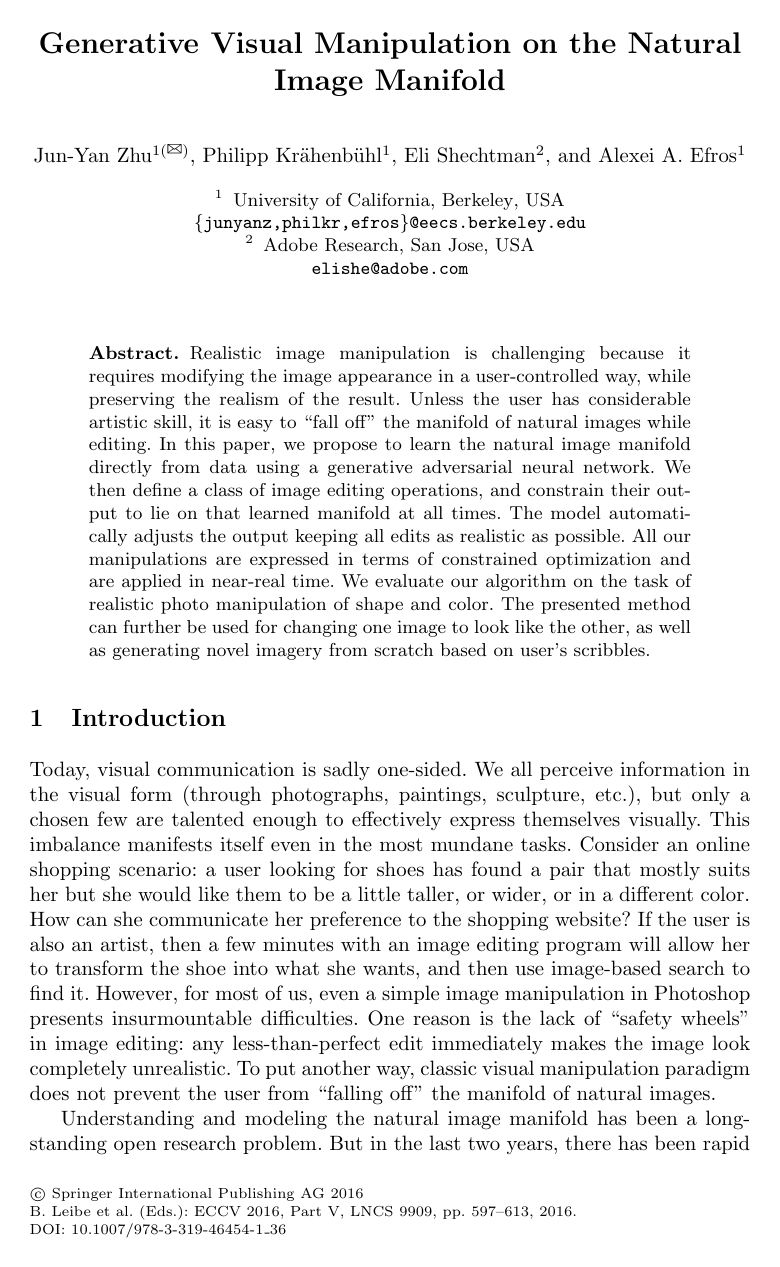
Generative Visual Manipulation on the Natural Image Manifold
Jun-Yan Zhu, Philipp Krähenbühl, Eli Shechtman, Alexei A. Efros
Why you should read this
Introduces a generative adversarial framework that constrains interactive image editing to learned natural image distributions, enabling users to realistically modify photo shape, color, and content in near-real time using simple brush strokes.
Realistic image manipulation is challenging because it requires modifying the image appearance in a user-controlled way, while preserving the realism of the result. Unless the user has considerable artistic skill, it is easy to "fall off" the manifold of natural images while editing. In this paper, we propose to learn the natural image manifold directly from data using a generative adversarial neural network. We then define a class of image editing operations, and constrain their output to lie on that learned manifold at all times. The model automatically adjusts the output keeping all edits as realistic as possible. All our manipulations are expressed in terms of constrained optimization and are applied in near-real time. We evaluate our algorithm on the task of realistic photo manipulation of shape and color. The presented method can further be used for changing one image to look like the other, as well as generating novel imagery from scratch based on user's scribbles.
Added
2026-09-25
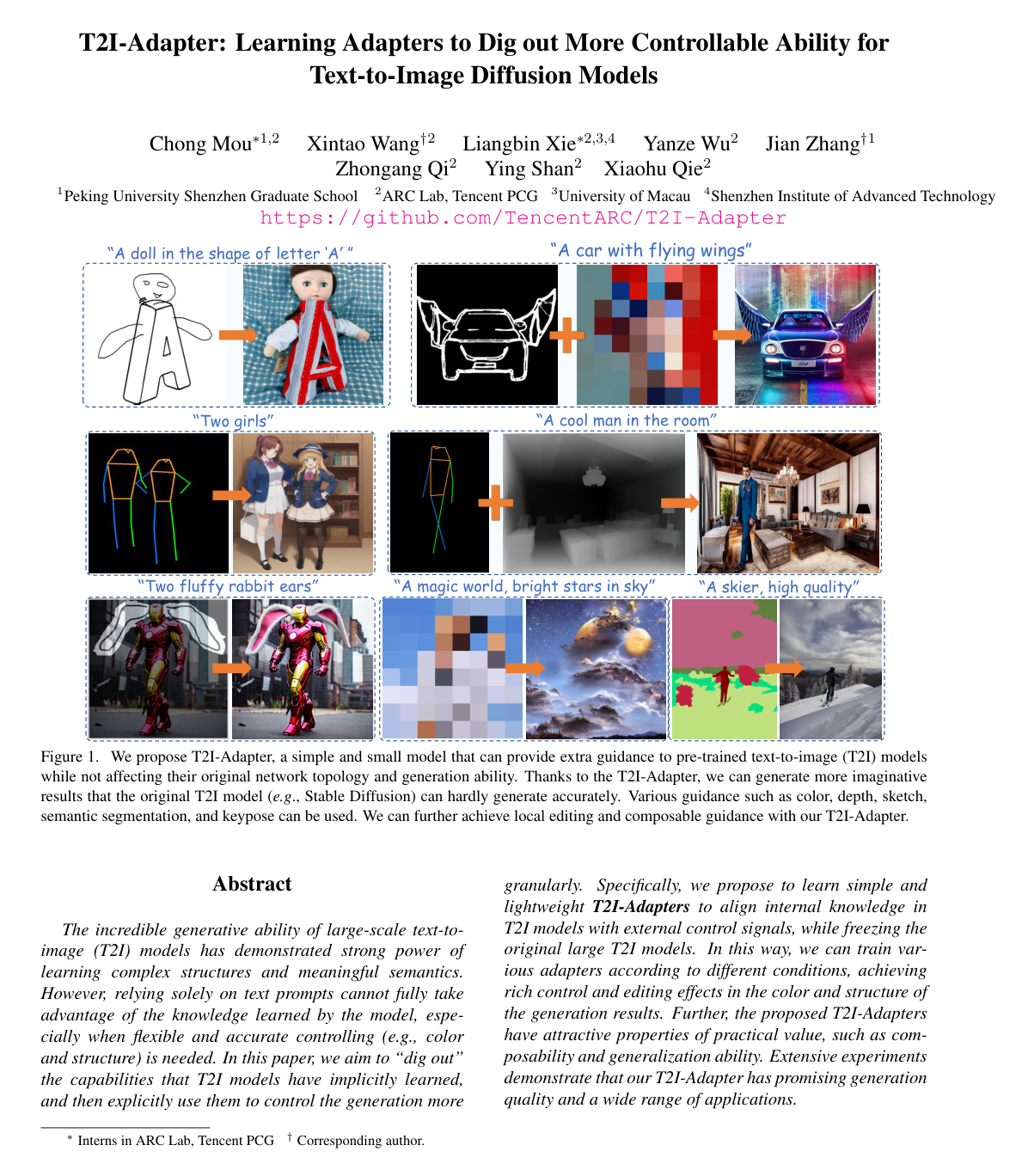
T2I-Adapter: Learning Adapters to Dig Out More Controllable Ability for Text-to-Image Diffusion Models
Chong Mou, Xintao Wang, Liangbin Xie, Yanze Wu, Jian Zhang, Zhongang Qi, Ying Shan
Why you should read this
Introduces lightweight, composable adapter modules that enable precise structural and color control in pretrained text-to-image diffusion models while keeping the base network frozen.
The incredible generative ability of large-scale text-to-image (T2I) models has demonstrated strong power of learning complex structures and meaningful semantics. However, relying solely on text prompts cannot fully take advantage of the knowledge learned by the model, especially when flexible and accurate controlling (e.g., color and structure) is needed. In this paper, we aim to ``dig out" the capabilities that T2I models have implicitly learned, and then explicitly use them to control the generation more granularly. Specifically, we propose to learn simple and lightweight T2I-Adapters to align internal knowledge in T2I models with external control signals, while freezing the original large T2I models. In this way, we can train various adapters according to different conditions, achieving rich control and editing effects in the color and structure of the generation results. Further, the proposed T2I-Adapters have attractive properties of practical value, such as composability and generalization ability. Extensive experiments demonstrate that our T2I-Adapter has promising generation quality and a wide range of applications.
Added
2026-09-18
GLIDE: Towards Photorealistic Image Generation and Editing with Text-Guided Diffusion Models
Alexander Quinn Nichol, Prafulla Dhariwal, Aditya Ramesh, Pranav Shyam, Pamela Mishkin, Bob McGrew, Ilya Sutskever, Mark Chen
Why you should read this
Demonstrates that classifier-free guidance significantly enhances the photorealism and textual alignment of diffusion-based image synthesis, offering a superior alternative to CLIP-guided methods for both high-fidelity generation and text-conditional image editing.
Diffusion models have recently been shown to generate high-quality synthetic images, especially when paired with a guidance technique to trade off diversity for fidelity. We explore diffusion models for the problem of text-conditional image synthesis and compare two different guidance strategies: CLIP guidance and classifier-free guidance. We find that the latter is preferred by human evaluators for both photorealism and caption similarity, and often produces photorealistic samples. Samples from a 3.5 billion parameter text-conditional diffusion model using classifier-free guidance are favored by human evaluators to those from DALL-E, even when the latter uses expensive CLIP reranking. Additionally, we find that our models can be fine-tuned to perform image inpainting, enabling powerful text-driven image editing. We train a smaller model on a filtered dataset and release the code and weights at https://github.com/openai/glide-text2im.
Added
2026-05-17

Transfusion: Predict the Next Token and Diffuse Images with One Multi-Modal Model
Chunting Zhou, Lili Yu, Arun Babu, Kushal Tirumala, Michihiro Yasunaga, Leonid Shamis, Jacob Kahn, Xuezhe Ma, Luke Zettlemoyer, Omer Levy
Why you should read this
Presents Transfusion, a novel multi-modal model that effectively integrates next-token prediction for text and diffusion for images within a single transformer, demonstrating superior scalability and efficiency over current methods for generating both discrete and continuous data.
We introduce Transfusion, a recipe for training a multi-modal model over discrete and continuous data. Transfusion combines the language modeling loss function (next token prediction) with diffusion to train a single transformer over mixed-modality sequences. We pretrain multiple Transfusion models up to 7B parameters from scratch on a mixture of text and image data, establishing scaling laws with respect to a variety of uni- and cross-modal benchmarks. Our experiments show that Transfusion scales significantly better than quantizing images and training a language model over discrete image tokens. By introducing modality-specific encoding and decoding layers, we can further improve the performance of Transfusion models, and even compress each image to just 16 patches. We further demonstrate that scaling our Transfusion recipe to 7B parameters and 2T multi-modal tokens produces a model that can generate images and text on a par with similar scale diffusion models and language models, reaping the benefits of both worlds.
Added
2026-01-06