End-to-End Recovery of Human Shape and Pose
Angjoo KanazawaMichael J. BlackDavid W. JacobsJitendra Malik
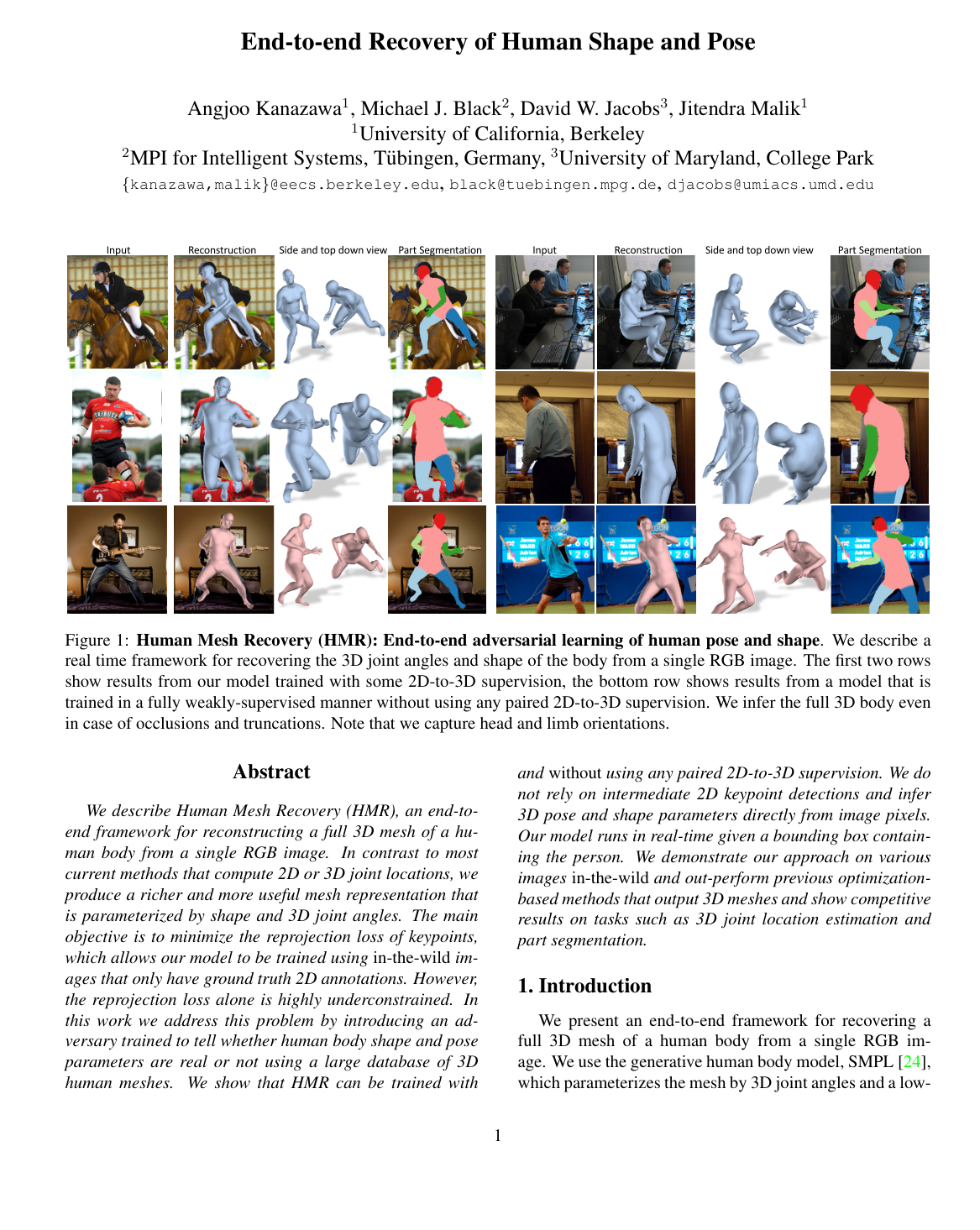
Introduces an end-to-end deep learning framework that reconstructs full 3D human body meshes directly from single RGB images in real time, using adversarial training to learn valid body shapes and poses without requiring paired 3D annotations.
Reconstructing full three-dimensional (3D) human body meshes from single two-dimensional (2D) images is a crucial capability for animation, virtual reality, and computer vision. However, standard methods primarily predict sparse 3D joint skeletons rather than full surfaces, or they rely on multi-stage optimization pipelines that require up to a minute per image and struggle to generalize to natural, unconstrained environments where ground-truth 3D data is scarce.
The article demonstrates an end-to-end framework, called Human Mesh Recovery (HMR), that directly infers full 3D human pose, body shape, and camera parameters in real time from a single RGB image. It aims to eliminate multi-step pipelines and enable accurate 3D mesh reconstruction even when trained without paired 3D annotations.
To accomplish this, the authors designed a deep learning system that directly maps image pixels to parameters of a standard generative human body model (SMPL) using an iterative feedback loop. The framework is trained to ensure the projected 3D keypoints match annotated 2D image keypoints. To prevent the model from generating anatomically impossible bodies that happen to fit 2D projections, the architecture integrates a factorized adversarial discriminator. This discriminator is trained on an unpaired dataset of 3D motion-capture body scans (over 700,000 samples) to ensure the inferred joint angles and body shapes conform to real human anatomy without requiring hand-crafted geometric constraints.
Key findings show that HMR substantially outperforms prior mesh-recovery methods while running in real time at approximately 0.04 seconds per image—roughly 1,500 times faster than earlier optimization methods that took 20 to 60 seconds. On standard benchmark datasets such as Human3.6M, HMR achieved a reconstruction error of 56.8 mm, outperforming previous mesh estimation approaches (which had errors around 80.7 to 93.9 mm) and competing closely with specialized 3D skeleton-only models. Crucially, when trained entirely without paired 3D supervision, the system still achieved strong performance (66.5 mm reconstruction error) and produced plausible body shapes, whereas removing the adversarial component produced severely distorted, unnatural shapes. The model also matched top-performing benchmarks on auxiliary tasks like body part segmentation.
These results show that high-fidelity 3D human analysis can be scaled efficiently using readily available 2D in-the-wild images alongside unpaired 3D scan data. This lowers the operational and data collection costs associated with expensive motion-capture labs and unlocks practical, low-latency deployment for real-time video analytics and interactive graphics.
Organizations developing 3D human capture applications should adopt direct feedforward regression models rather than slow multi-stage optimization pipelines. Stakeholders should also consider expanding training datasets with in-the-wild 2D labeled images to further refine real-world robustness. Future work should focus on testing whether scaling up 2D data alone can fully close the accuracy gap with supervised models, as well as evaluating performance across wider demographics and video-based temporal sequences.
The findings carry high confidence for monocular images within standard bounding boxes, though some caution is warranted regarding extreme occlusions, boundary ambiguities, and noisy ground-truth labels in existing evaluation benchmarks.
- Paper: SMPL, M. Loper et al. (2015). Introduces the SMPL parametric body model that provides the core shape and pose parameterization directly regressed and constrained in HMR.
- Paper: Human3.6M: Large Scale Datasets and Predictive Methods for 3D Human Sensing in Natural Environments, Catalin Ionescu et al. (2014). Establishes the large-scale 3D human pose benchmark and evaluation protocols used to supervise and evaluate 3D mesh and joint recovery methods.
- Paper: Realtime Multi-person 2D Pose Estimation Using Part Affinity Fields, Zhe Cao et al. (2016). Pioneers real-time 2D human pose estimation via Part Affinity Fields, enabling the 2D keypoint annotations and detections that guide 3D reprojection losses.
- Paper: Stacked Hourglass Networks for Human Pose Estimation, Alejandro Newell et al. (2016). Introduces stacked hourglass networks for precise 2D keypoint heatmap prediction, establishing foundational representations for intermediate 2D pose reasoning.
- Paper: Convolutional Pose Machines, Shih-En Wei et al. (2016). Demonstrates sequential deep convolutional prediction for articulated 2D keypoint estimation, laying groundwork for deep learning-based human pose extraction.
- Paper: DeepPose: Human Pose Estimation via Deep Neural Networks, Alexander Toshev et al. (2014). Frames human pose estimation as direct end-to-end coordinate regression from raw images using deep neural networks.
- Paper: Learning a Probabilistic Latent Space of Object Shapes via 3D Generative-Adversarial Modeling, Jiajun Wu et al. (2016). Applies generative adversarial networks to 3D geometry representation learning, prefiguring HMR's adversarial prior on 3D human mesh parameters.
- Paper: Expressive Body Capture: 3D Hands, Face, and Body From a Single Image, Georgios Pavlakos et al. (2019). Extends single-image parametric body reconstruction beyond SMPL to SMPL-X by jointly capturing expressive face, hand, and body mesh details.
- Paper: AMASS: Archive of Motion Capture As Surface Shapes, Naureen Mahmood et al. (2019). Unifies diverse motion capture datasets into a standardized SMPL-based representation (AMASS), substantially expanding the 3D mesh priors and training data available for methods like HMR.
- Paper: Deep High-Resolution Representation Learning for Human Pose Estimation, Ke Sun et al. (2019). Provides high-resolution representation learning (HRNet) that dramatically improves the 2D keypoint precision crucial for downstream 3D mesh recovery.
- Paper: OpenPose: Realtime Multi-Person 2D Pose Estimation Using Part Affinity Fields, Zhe Cao et al. (2018). Extends real-time multi-person keypoint extraction to include foot, hand, and facial keypoints, enriching 2D supervisory signals for 3D body fitting.