Convolutional Pose Machines
Shih-En WeiVarun RamakrishnaTakeo KanadeYaser Sheikh
Proposes Convolutional Pose Machines, an end-to-end multi-stage architecture that captures long-range spatial context for articulated human pose estimation by iteratively refining part belief maps using intermediate supervision without requiring explicit graphical models.
Convolutional Pose Machines introduce a sequential prediction architecture that integrates convolutional networks to estimate the locations of human body joints from single images. The work targets the long-standing challenge of articulated pose estimation, where parts exhibit large appearance variation, occlusions, and complex spatial dependencies that defeat both simple local detectors and tree-structured graphical models. Accurate pose estimation matters now because it underpins applications in activity recognition, human–computer interaction, and video analysis, yet prior methods either required hand-designed spatial priors or suffered from training difficulties in deep networks.
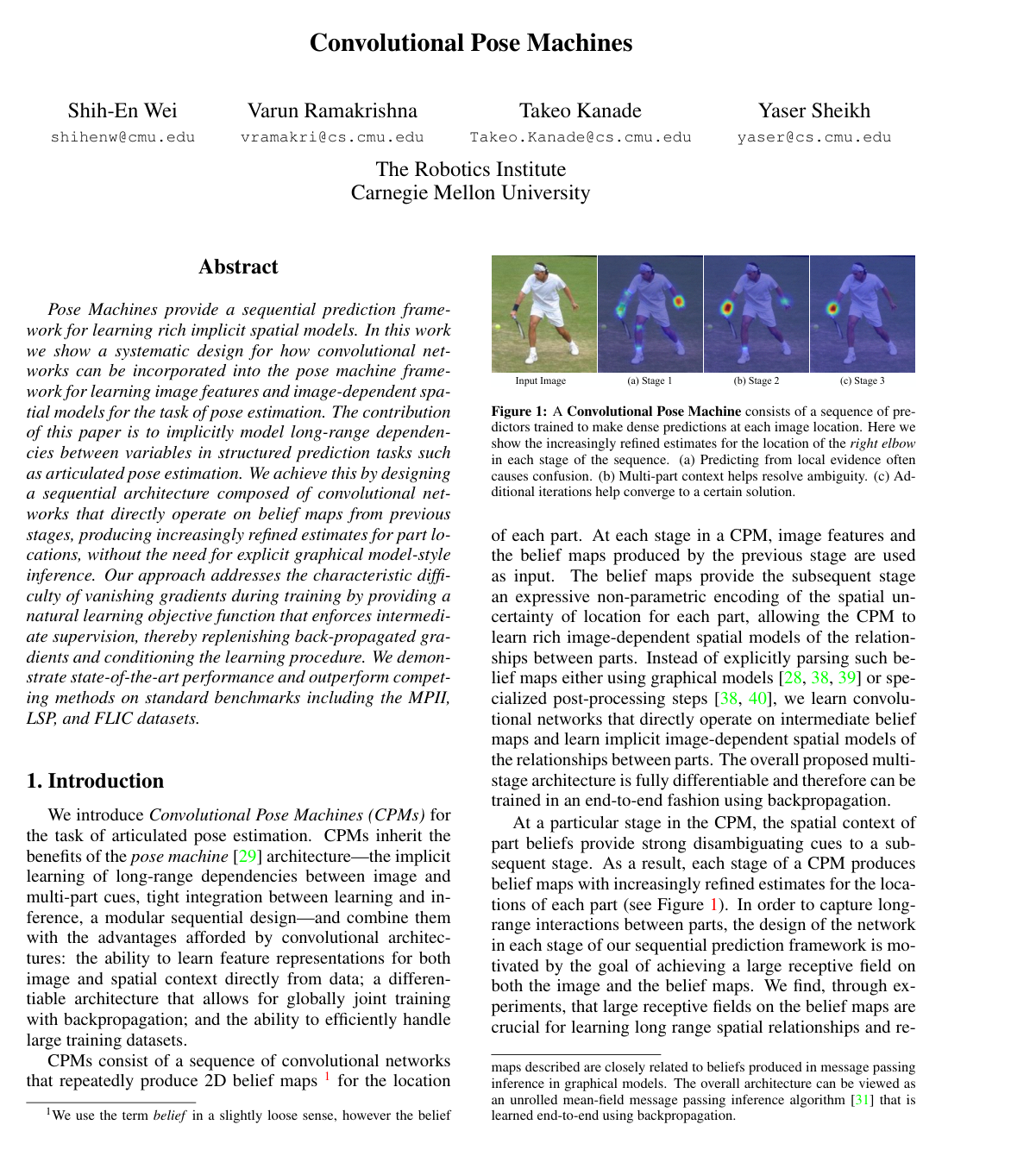
The paper set out to demonstrate that a fully differentiable sequence of convolutional stages can implicitly learn both image features and image-dependent spatial relationships, eliminating the need for explicit graphical-model inference while avoiding vanishing gradients during training. The approach replaces the predictors inside the original pose-machine framework with convolutional networks that operate directly on intermediate belief maps. Each stage receives image evidence plus the belief maps from the preceding stage, and the network is sized to produce a large receptive field that captures long-range part interactions. Intermediate loss layers enforce supervision after every stage, replenishing gradients and guiding successive refinements. The resulting multi-stage model was trained end-to-end on standard benchmarks and evaluated with the PCK and PCKh metrics on the MPII, LSP, and FLIC datasets.
The central finding is that the architecture reaches state-of-the-art accuracy: 87.95 % PCKh at the 0.5 threshold on MPII (rising to 88.52 % when LSP data are added) and 84.32 % PCK on LSP, with the largest gains on difficult extremities such as ankles (roughly 10 percentage points above prior best results). Accuracy improves monotonically with the number of stages and with receptive-field size up to approximately 400 pixels, confirming that long-range context is effectively encoded. Intermediate supervision measurably prevents gradient collapse across deep layers and yields higher final performance than stage-wise training or joint training without intermediate losses. The method also delivers consistent gains across all viewpoints, including challenging non-frontal poses, without pre-training on external data or post-processing with hand-crafted priors.
These results indicate that pose estimation can be treated as a learned, feed-forward structured-prediction task rather than one requiring separate inference machinery, thereby simplifying deployment and improving precision at both coarse and fine scales. The approach removes the accuracy–efficiency trade-off that previously forced designers to limit model expressiveness for tractable inference. Because the architecture is modular and fully differentiable, it can be extended to related spatial-prediction problems such as semantic labeling or depth estimation.
Further work is needed to handle scenes containing multiple overlapping people within a single end-to-end network; current failure cases occur mainly when individuals are in close proximity. Additional gains may also come from incorporating residual connections or testing on video sequences, yet the core design already provides a reproducible, high-accuracy baseline that future systems can build upon. The reported gains rest on standard academic benchmarks whose labeling quality varies; users should therefore validate performance on their own imagery before critical deployment.
- Paper: DeepPose: Human Pose Estimation via Deep Neural Networks, Alexander Toshev et al. (2014). DeepPose introduced the formulation of human pose estimation as a deep regression task solved by convolutional neural networks, establishing the foundational architecture that Convolutional Pose Machines directly build upon and refine.
- Paper: Realtime Multi-person 2D Pose Estimation Using Part Affinity Fields, Zhe Cao et al. (2016). This paper extends the sequential convolutional framework of Convolutional Pose Machines to solve real-time multi-person pose estimation by introducing Part Affinity Fields for bottom-up association.
- Paper: Stacked Hourglass Networks for Human Pose Estimation, Alejandro Newell et al. (2016). Building directly upon the sequential refinement and intermediate supervision concepts of Convolutional Pose Machines, this work introduces stacked hourglass networks for capturing multi-scale spatial dependencies in human pose estimation.
- Paper: OpenPose: Realtime Multi-Person 2D Pose Estimation Using Part Affinity Fields, Zhe Cao et al. (2018). This paper refines and speeds up the bottom-up pose estimation paradigm established by Convolutional Pose Machines and Part Affinity Fields, adding joint support for foot, hand, and face keypoints.