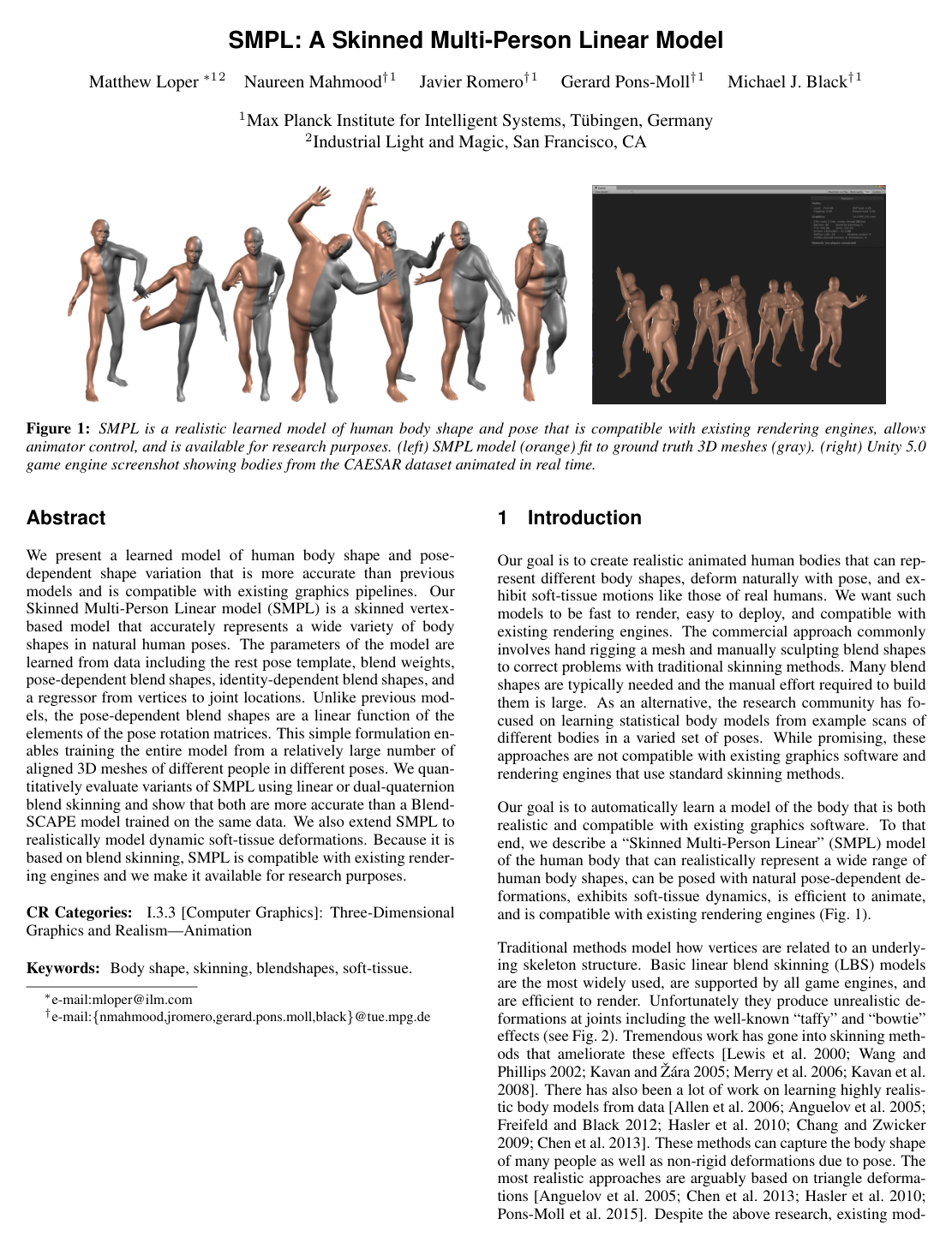
SMPL
Matthew LoperNaureen MahmoodJavier RomeroGerard Pons-MollMichael J. Black
Presents a learned, vertex-based 3D human body model that formulates pose-dependent deformations as a linear function of joint rotation matrices to achieve realistic shape variation while maintaining full compatibility with standard graphics engines.
The SMPL model addresses the long-standing challenge of generating realistic animated human bodies that accurately capture variation in shape across individuals, produce natural deformations with changing pose, and exhibit plausible soft-tissue motion while remaining efficient and compatible with existing rendering engines and animation tools. Prior approaches either required extensive manual sculpting of blend shapes or produced models incompatible with standard skinning methods used in game engines and production software, limiting their practical adoption.
This work set out to learn a single, vertex-based body model from data that combines the realism of statistical shape models with the speed and compatibility of linear blend skinning. The authors trained the model on thousands of high-resolution 3D registrations—1786 multi-pose scans from 40 subjects plus roughly 3,800 CAESAR scans for shape variation—optimizing a rest-pose template, blend weights, joint regressor, identity-dependent blend shapes, and pose-dependent blend shapes to minimize per-vertex reconstruction error. They also extended the approach to capture dynamic soft-tissue motion using an autoregressive model driven by pose velocities and accelerations.
Quantitative tests on held-out registrations show that both linear-blend-skinning and dual-quaternion variants of SMPL achieve lower average vertex error than a BlendSCAPE model trained on identical data, with differences on the order of half a millimeter; the two skinning versions perform nearly identically. The model generalizes well to new poses and shapes, produces visually natural deformations across a wide range of body types and motions, and runs significantly faster than deformation-based alternatives. The dynamic extension, DMPL, generates more lifelike soft-tissue motion than the prior Dyna model while remaining fully compatible with standard pipelines.
These results matter because they remove the previous trade-off between realism and deployability. SMPL can be exported as a standard rigged FBX asset, loaded directly into Maya, Unity, Blender, or Unreal, and animated at interactive rates on CPU without baking weights. This makes high-quality statistical body models immediately usable by animators, game developers, and researchers who previously had to choose between hand-crafted rigs or research-only deformation models.
The paper recommends adopting SMPL for any application needing fast, realistic human animation and makes the model, training registrations, and driving scripts publicly available for research. Further work could include making pose-dependent blend shapes depend on body shape and extending the model to breathing or facial motion. The main limitations are that some elements such as mesh topology and part segmentation were defined manually, and the current pose corrections do not yet vary with individual body shape; results are therefore most reliable within the range of adult body shapes and motions present in the training data. Overall confidence in the core accuracy and compatibility claims is high given the held-out quantitative evaluations and direct comparisons.
No sufficiently relevant recommendations were found.
- Paper: Analyzing and Improving the Image Quality of StyleGAN, Tero Karras et al. (2020). This paper extends the foundational modeling ideas of statistical shape and generative design to address artifacts in high-resolution synthesis.