YOLOv6: A Single-Stage Object Detection Framework for Industrial Applications

Chuyi LiLulu LiHongliang JiangKaiheng WengYifei GengLiang LiZaidan KeQingyuan LiMeng ChengWeiqiang Nie

article2022arXiv3,378 citations

Introduces YOLOv6, a deployment-oriented object detection framework that integrates advanced network design, training strategies, and quantization techniques to achieve superior speed-accuracy trade-offs over existing YOLO architectures across varied hardware scales.

Listen

Real-time computer vision systems in industrial applications require an optimal balance between visual detection accuracy and processing speed. Prior object detection frameworks frequently faced practical deployment bottlenecks, including performance degradation during model compression and computational inefficiencies on cost-effective serving hardware. The article introduces and evaluates YOLOv6, a single-stage object detection framework engineered to deliver high processing throughput and high precision across diverse real-world hardware environments.

The authors conducted a comprehensive empirical evaluation using the standard COCO 2017 benchmark dataset across multiple network scales, ranging from nano to large models. To bridge the gap between training performance and real-world deployment, the evaluation assessed model speed and accuracy on production hardware, specifically NVIDIA Tesla T4 GPUs using TensorRT acceleration, with additional validation across V100 GPUs and central processing units.

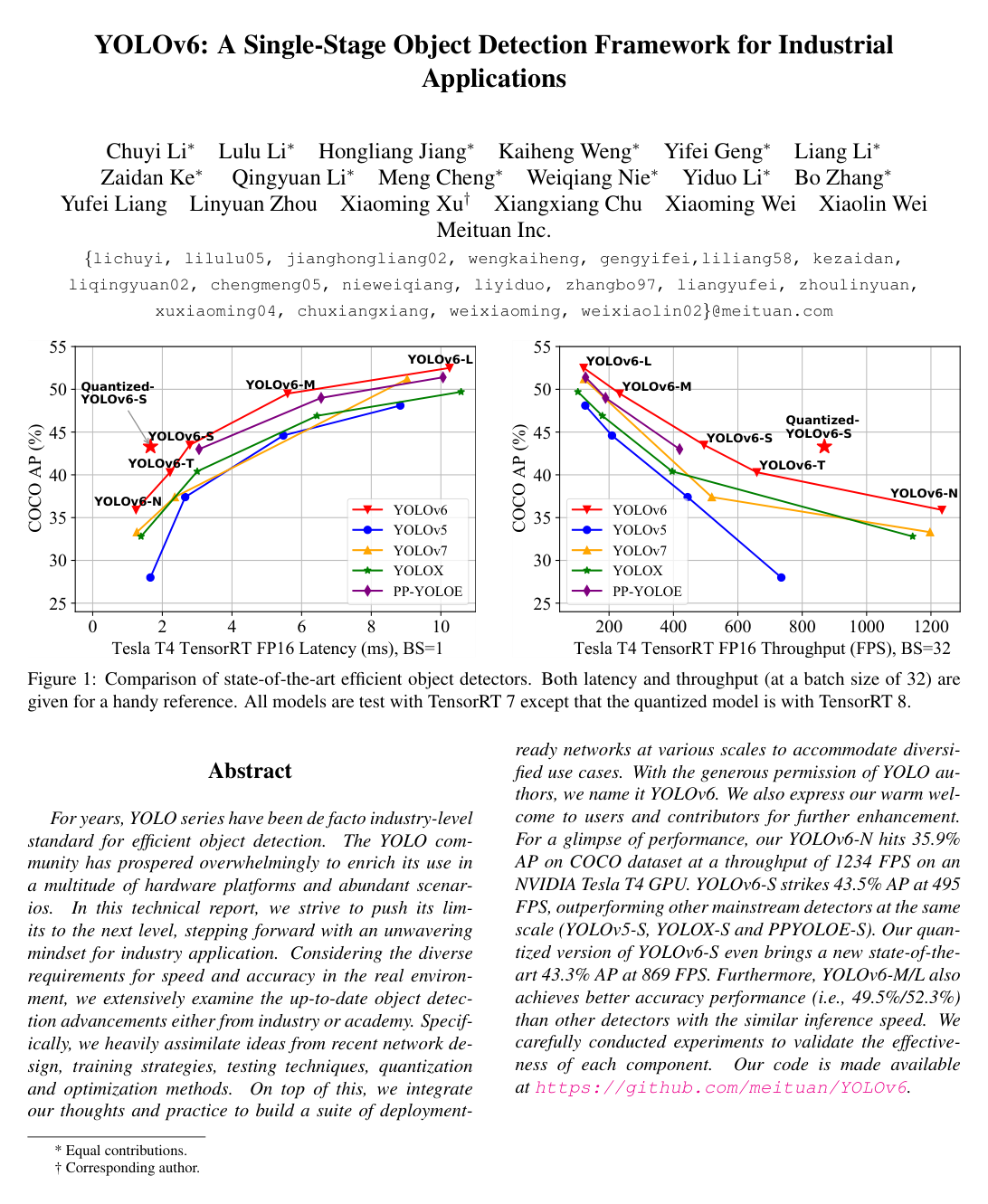
The findings show that YOLOv6 systematically outperforms prior industry-standard architectures. The smallest model, YOLOv6-N, achieved a 35.9% average precision at a throughput of 1,234 frames per second, improving accuracy by 7.9% over YOLOv5-N. The mid-sized YOLOv6-S achieved 43.5% precision at 495 frames per second, and its compressed, 8-bit quantized version reached 43.3% precision at an industry-leading 869 frames per second. Larger variants also demonstrated superior performance, with YOLOv6-M and YOLOv6-L reaching 49.5% and 52.5% precision, respectively. Ablation experiments revealed that structural reparameterization benefits smaller models, multi-branch designs best support larger models, and task-aligned learning significantly stabilizes training.

These results demonstrate that enterprises can achieve state-of-the-art computer vision accuracy without requiring expensive server hardware, thereby reducing infrastructure costs and lowering latency risks in time-critical systems. Organizations deploying real-time vision pipelines should adopt the YOLOv6 framework, utilizing RepConv-and-ReLU configurations for latency-sensitive edge systems and quantized models for high-throughput production environments. Although the reported benchmarks are confined to standard image datasets and standard hardware platforms, the high consistency of the empirical results provides strong confidence for production adoption.

Cover for YOLOv6: A Single-Stage Object Detection Framework for Industrial Applications

Abstract

For years, the YOLO series has been the de facto industry-level standard for efficient object detection. The YOLO community has prospered overwhelmingly to enrich its use in a multitude of hardware platforms and abundant scenarios. In this technical report, we strive to push its limits to the next level, stepping forward with an unwavering mindset for industry application.

Considering the diverse requirements for speed and accuracy in the real environment, we extensively examine the up-to-date object detection advancements either from industry or academia. Specifically, we heavily assimilate ideas from recent network design, training strategies, testing techniques, quantization, and optimization methods. On top of this, we integrate our thoughts and practice to build a suite of deployment-ready networks at various scales to accommodate diversified use cases. With the generous permission of YOLO authors, we name it YOLOv6. We also express our warm welcome to users and contributors for further enhancement. For a glimpse of performance, our YOLOv6-N hits 35.9% AP on the COCO dataset at a throughput of 1234 FPS on an NVIDIA Tesla T4 GPU. YOLOv6-S strikes 43.5% AP at 495 FPS, outperforming other mainstream detectors at the same scale~(YOLOv5-S, YOLOX-S, and PPYOLOE-S). Our quantized version of YOLOv6-S even brings a new state-of-the-art 43.3% AP at 869 FPS. Furthermore, YOLOv6-M/L also achieves better accuracy performance (i.e., 49.5%/52.3%) than other detectors with a similar inference speed. We carefully conducted experiments to validate the effectiveness of each component. Our code is made available at this https URL.

Table of Contents

  • 1 Introduction
  • 2 Method
  • 2.1 Network Design
  • 2.1.1 Backbone
  • 2.1.2 Neck
  • 2.1.3 Head
  • 2.2 Label Assignment
  • 2.3 Loss Functions
  • 2.3.1 Classification Loss
  • 2.3.2 Box Regression Loss
  • 2.3.3 Object Loss
  • 2.4 Industry-handy improvements
  • 2.4.1 More training epochs
  • 2.4.2 Self-distillation
  • 2.4.3 Gray border of images
  • 2.5 Quantization and Deployment
  • 2.5.1 Reparameterizing Optimizer
  • 2.5.2 Sensitivity Analysis
  • 2.5.3 Quantization-aware Training with Channel-wise Distillation
  • 3 Experiments
  • 3.1 Implementation Details
  • 3.2 Comparisons
  • 3.3 Ablation Study
  • 3.3.1 Network
  • 3.3.2 Label Assignment
  • 3.3.3 Loss functions
  • 3.4 Industry-handy improvements
  • 3.5 Quantization Results
  • 3.5.1 PTQ
  • 3.5.2 QAT
  • 4 Conclusion
  • References
  • A Detailed Latency and Throughput Benchmark
  • A.1 Setup
  • A.2 T4 GPU Latency Table with TensorRT 8
  • A.3 V100 GPU Latency Table
  • A.4 CPU Latency
  • B Quantization Details
  • B.1 Feature Distribution Comparison
  • B.2 Sensitivity Analysis Results
  • C Analysis of Gray Border

Knowls

  1. Knowl 1 — YOLOv6 Detection Framework Architecture

    model/method

    YOLOv6 is an anchor-free single-stage object detector designed for industrial deployment, comprising three specialized components:

    1. EfficientRep Backbone: For small networks (YOLOv6-N, YOLOv6-T, YOLOv6-S), the backbone is composed of stacked RepBlocks. During training, each RepBlock consists of multi-branch RepVGG blocks with ReLU activations. During inference, each RepBlock is structurally re-parameterized into a sequence of 3×33 \times 3 standard convolutional layers (RepConv). For medium and large networks (YOLOv6-M, YOLOv6-L), the backbone uses multi-branch CSPStackRep blocks to prevent excessive parameter and computational scaling.
    2. Rep-PAN Neck: Based on the Path Aggregation Network (PAN) topology, Rep-PAN aggregates low-level spatial features and high-level semantic features across pyramid levels. Connections within the PAN structure use RepBlocks for small models and CSPStackRep blocks for larger models.
    3. Efficient Decoupled Head: Unlike conventional decoupled detection heads that stack two 3×33 \times 3 convolutions per branch, YOLOv6 adopts a hybrid-channel strategy that employs only a single 3×33 \times 3 convolutional layer per branch (classification and regression). The head width is jointly scaled by the width multiplier of the backbone and neck.

    The framework adopts an anchor point-based anchor-free paradigm, where the bounding box regression branch directly predicts the orthogonal distances from the anchor point to the four boundaries of the ground-truth box.

  2. Knowl 2 — CSPStackRep Block for Large-Scale Reparameterized Networks

    model/method

    To mitigate the exponential increase in parameter count and floating-point operations (FLOPs) that occurs when scaling plain single-path RepVGG architectures to larger models, YOLOv6 introduces the CSPStackRep Block for medium and large network scales (YOLOv6-M and YOLOv6-L).

    A CSPStackRep Block consists of:

    • Three 1×11 \times 1 convolutional layers.
    • A stack of sub-blocks containing two RepVGG blocks during training (reparameterized to RepConv during inference) followed by ReLU activations with a residual connection.
    • A Cross Stage Partial (CSP) connection that splits the channel dimension into two paths, routing one path through the RepConv sub-blocks and concatenating it with the identity path before passing through a final 1×11 \times 1 convolution.

    The channel coefficient (CCCC), defining the proportion of channels processed through the residual branch, is set to 2/32/3 for YOLOv6-M and 1/21/2 for YOLOv6-L.

  3. Knowl 3 — Self-Distillation Objective with Cosine Weight Decay

    equation

    In YOLOv6, self-distillation transfers knowledge from a pre-trained instance of the identical model architecture (acting as the teacher) to the student model across both classification and bounding box regression tasks.

    The distillation loss LKDL_{KD} is defined as the sum of Kullback-Leibler (KL) divergences over class predictions and bounding box regression probability distributions:

    LKD=KL(ptcls∥pscls)+KL(ptreg∥psreg)L_{KD} = KL(p_t^{cls} \parallel p_s^{cls}) + KL(p_t^{reg} \parallel p_s^{reg})

    where ptclsp_t^{cls} and psclsp_s^{cls} denote the class probability distributions output by the teacher and student models respectively, and ptregp_t^{reg} and psregp_s^{reg} denote the bounding box regression probability distributions generated via Distribution Focal Loss (DFL).

    The total training objective LtotalL_{total} is:

    Ltotal=Ldet+αLKDL_{total} = L_{det} + \alpha L_{KD}

    where LdetL_{det} represents the supervised detection loss evaluated against ground-truth labels, and α\alpha is a dynamic balancing hyperparameter regulated by a cosine decay schedule over training epochs. Cosine weight decay prioritizes softer teacher labels in earlier training phases and gradually shifts optimization toward hard ground-truth labels in later phases.

  4. Knowl 4 — Quantization Pipeline with RepOptimizer and Channel-Wise Distillation

    model/method

    Structural re-parameterization models typically suffer from substantial quantization performance degradation during Post-Training Quantization (PTQ) due to disparate activation dynamics. YOLOv6 resolves this via a specialized quantization pipeline:

    1. RepOptimizer Training: Re-parameterization blocks are trained with gradient re-parameterization at each optimization step. This directly yields plain inference-time weights with narrow activation distributions without requiring offline multi-branch fusion, producing PTQ-friendly weights.
    2. Sensitivity Analysis: Layer-wise sensitivity to INT8 quantization is evaluated using metrics including Mean Squared Error (MSE), Signal-to-Noise Ratio (SNR), Cosine Similarity, and validation AP drops. The most sensitive layers are retained in FP32 precision during partial post-training quantization.
    3. Quantization-Aware Training (QAT) with Channel-Wise Distillation: When PTQ is insufficient, QAT is initialized from RepOptimizer-trained weights. A channel-wise distillation loss supervises the INT8 student network using the FP32 network as the teacher. Graph optimization is applied to prune redundant quantizer nodes and merge batch normalization and activation operations prior to deployment under TensorRT.
  5. Knowl 5 — Loss Function and Label Assignment Selection in YOLOv6

    model/method

    YOLOv6 employs task-specific loss functions and dynamic label assignment selected through systematic ablation:

    • Label Assignment: Task Alignment Learning (TAL) from TOOD is used as the default label assignment strategy. TAL uses a unified metric combining classification score and predicted bounding box IoU to dynamically allocate positive samples, alleviating task misalignment and stabilizing training compared to SimOTA, ATSS, DW, and ObjectBox.
    • Classification Loss: VariFocal Loss (VFL) is adopted. VFL treats positive and negative samples asymmetrically, weighting positive samples by their continuous IoU scores and down-weighting easy negative samples.
    • Bounding Box Regression Loss: Small models (YOLOv6-N, YOLOv6-T) use SIoU Loss, while larger models (YOLOv6-S, YOLOv6-M, YOLOv6-L) use GIoU Loss.
    • Probability Loss: Distribution Focal Loss (DFL) is incorporated exclusively for medium and large models (YOLOv6-M and YOLOv6-L) to model box coordinate distributions without sharp priors. DFL is excluded from small models (N, T, S) due to its 17×17\times increase in regression output channels, which introduces unacceptable computational overhead on edge devices.
  6. Knowl 6 — COCO 2017 Object Detection Benchmark Comparison

    data/table

    Performance comparison of YOLOv6 models against real-time detectors on the MS COCO 2017 validation dataset (640×640640 \times 640 resolution, FP16 precision on an NVIDIA Tesla T4 GPU with TensorRT 7.2, trained for 300 epochs without pre-training or external data):

    Method Input Size APval\text{AP}^{\text{val}} AP50val\text{AP}_{50}^{\text{val}} FPSbs=1\text{FPS}_{\text{bs}=1} FPSbs=32\text{FPS}_{\text{bs}=32} Latency Params FLOPs
    YOLOv5-N 640 28.0% 45.7% 602 735 1.7 ms 1.9 M 4.5 G
    YOLOv5-S 640 37.4% 56.8% 376 444 2.7 ms 7.2 M 16.5 G
    YOLOv5-M 640 45.4% 64.1% 182 209 5.5 ms 21.2 M 49.0 G
    YOLOv5-L 640 49.0% 67.3% 113 126 8.8 ms 46.5 M 109.1 G
    YOLOX-Tiny 416 32.8% 50.3% 717 1143 1.4 ms 5.1 M 6.5 G
    YOLOX-S 640 40.5% 59.3% 333 396 3.0 ms 9.0 M 26.8 G
    YOLOX-M 640 46.9% 65.6% 155 179 6.4 ms 25.3 M 73.8 G
    YOLOX-L 640 49.7% 68.0% 94 103 10.6 ms 54.2 M 155.6 G
    PPYOLOE-S 640 43.1% 59.6% 327 419 3.1 ms 7.9 M 17.4 G
    PPYOLOE-M 640 49.0% 65.9% 152 189 6.6 ms 23.4 M 49.9 G
    PPYOLOE-L 640 51.4% 68.6% 101 127 10.1 ms 52.2 M 110.1 G
    YOLOv7-Tiny 416 33.3% 49.9% 787 1196 1.3 ms 6.2 M 5.8 G
    YOLOv7-Tiny 640 37.4% 55.2% 424 519 2.4 ms 6.2 M 13.7 G
    YOLOv7 640 51.2% 69.7% 110 122 9.0 ms 36.9 M 104.7 G
    YOLOv6-N 640 35.9% 51.2% 802 1234 1.2 ms 4.3 M 11.1 G
    YOLOv6-T 640 40.3% 56.6% 449 659 2.2 ms 15.0 M 36.7 G
    YOLOv6-S 640 43.5% 60.4% 358 495 2.8 ms 17.2 M 44.2 G
    YOLOv6-M 640 49.5% 66.8% 179 233 5.6 ms 34.3 M 82.2 G
    YOLOv6-L-ReLU 640 51.7% 69.2% 113 149 8.8 ms 58.5 M 144.0 G
    YOLOv6-L 640 52.5% 70.0% 98 121 10.2 ms 58.5 M 144.0 G

    Self-distillation is applied to YOLOv6-M, YOLOv6-L-ReLU, and YOLOv6-L. Latencies and FPS are measured at batch size 1 (bs=1) and batch size 32 (bs=32).

  7. Knowl 7 — Detrimental Interaction between Objectness Loss and Task Alignment Learning

    empirical result

    In anchor-free architectures such as FCOS and YOLOX, an auxiliary objectness branch and loss (LobjL_{obj}) are conventionally introduced to suppress low-quality bounding boxes and accelerate convergence. However, when integrated into YOLOv6 with Task Alignment Learning (TAL), the objectness loss consistently degrades detection accuracy across network scales:

    • On YOLOv6-N, introducing object loss drops APval\text{AP}^{\text{val}} from 35.0%35.0\% to 33.9%33.9\% (a decline of 1.1% AP1.1\% \text{ AP}).
    • On YOLOv6-S, introducing object loss drops APval\text{AP}^{\text{val}} from 42.9%42.9\% to 41.4%41.4\% (a decline of 1.5% AP1.5\% \text{ AP}).
    • On YOLOv6-M, introducing object loss drops APval\text{AP}^{\text{val}} from 48.0%48.0\% to 46.5%46.5\% (a decline of 1.5% AP1.5\% \text{ AP}).

    This negative effect arises because TAL aligns predictions across two tasks (classification and bounding box regression) using a joint quality metric. Incorporating an independent object branch expands the alignment requirement from two to three tasks, introducing gradient conflict during sample assignment and optimization. Consequently, the objectness loss is discarded in YOLOv6.

  8. Knowl 8 — Mitigation of Gray Border Performance Degradation via Mosaic Fading

    model/method

    Standard evaluation pipelines in YOLOv5 and YOLOv7 pad a 16-pixel half-stride gray border around each test image (expanding input dimensions from 640×640640 \times 640 to 672×672672 \times 672), which aids detection of boundary objects but slows inference speed. Directly removing this padding reduces detection performance by 0.4%–0.7% AP0.4\%\text{--}0.7\% \text{ AP} due to domain shifts induced by gray border padding in Mosaic data augmentation.

    YOLOv6 resolves this trade-off using a two-part remedy:

    1. Mosaic Fading: Disabling Mosaic augmentation during the final training epochs (fade strategy) reduces the performance gap when removing the gray border from 0.4%–0.7%0.4\%\text{--}0.7\% down to 0.2%–0.5%0.2\%\text{--}0.5\%.
    2. Direct Image Scaling with Thin Border: Test images are resized to 634×634634 \times 634 and padded with a 3-pixel gray border to reach exactly 640×640640 \times 640.

    This combined approach matches or exceeds the accuracy of using 16-pixel gray borders (e.g., YOLOv6-M achieves 48.5% AP48.5\% \text{ AP} at 640×640640 \times 640 versus 48.4% AP48.4\% \text{ AP} at 672×672672 \times 672) while eliminating inference latency overhead.

  9. Knowl 9 — Quantization Performance of YOLOv6-S under PTQ and QAT

    data/table

    Evaluation of Post-Training Quantization (PTQ) and Quantization-Aware Training (QAT) on YOLOv6-S on COCO 2017 val:

    Model Precision APval\text{AP}^{\text{val}} FPSbs=32\text{FPS}_{\text{bs}=32} (TRT 8)
    YOLOv6-S (v1.0 baseline) FP32 42.4% –
    YOLOv6-S (v1.0) PTQ INT8 35.0% 556 (TRT 7)
    YOLOv6-S (v1.0) w/ RepOptimizer PTQ INT8 40.9% –
    YOLOv6-S (v1.0) + RepOpt + Partial QAT + CW Distill INT8 42.3% 503 (TRT 7)
    YOLOv6-S (v1.0) + RepOpt + Full QAT + CW Distill INT8 42.1% 528 (TRT 7)
    YOLOv6-S (v2.0 baseline) FP32 / FP16 43.4% 541
    YOLOv6-S (v2.0) PTQ INT8 41.3% –
    YOLOv6-S (v2.0) w/ RepOptimizer PTQ INT8 42.6% –
    YOLOv6-S (v2.0) (Our QAT strategy) INT8 43.3% 869

    When deployed on Tesla T4 with TensorRT 8, YOLOv6-S under QAT achieves 43.3% AP43.3\% \text{ AP} at 869 FPS869 \text{ FPS} (batch size 32) and 596 FPS596 \text{ FPS} (batch size 1), outperforming quantized YOLOv5-S (36.9% AP36.9\% \text{ AP}, 502 FPS502 \text{ FPS}) and YOLOv7-Tiny (37.0% AP37.0\% \text{ AP}, 512 FPS512 \text{ FPS}).

  10. Knowl 10 — Hardware Efficiency Trade-Offs of RepConv and Activation Functions

    empirical result

    Comparing ordinary convolution (Conv) versus reparameterized convolution (RepConv) paired with different activation functions (ReLU, SiLU, LeakyReLU) demonstrates a trade-off between floating-point representational power and hardware latency under TensorRT:

    • Accuracy: Conv with SiLU attains the highest raw accuracy (36.6% AP36.6\% \text{ AP} on YOLOv6-N, 48.9% AP48.9\% \text{ AP} on YOLOv6-M at batch size 32).
    • Inference Speed: RepConv with ReLU provides substantial inference acceleration due to operator fusion in TensorRT engines. On YOLOv6-N, RepConv + ReLU achieves 35.2% AP35.2\% \text{ AP} at 1233 FPS1233 \text{ FPS} compared to 963 FPS963 \text{ FPS} for Conv + SiLU (+28.0%+28.0\% higher throughput). On YOLOv6-M, RepConv + ReLU achieves 48.1% AP48.1\% \text{ AP} at 236 FPS236 \text{ FPS} compared to 180 FPS180 \text{ FPS} for Conv + SiLU (+31.1%+31.1\% higher throughput).

    Based on these characteristics, YOLOv6 employs RepConv with ReLU across small and medium networks (YOLOv6-N, YOLOv6-T, YOLOv6-S, YOLOv6-M) to prioritize throughput, while offering YOLOv6-L with Conv and SiLU to maximize detection accuracy.

Coverage note — Ablations on neck channel configurations for YOLOv6-L (Table 3), warmup label assignment variants (Table 7), and latency numbers on V100/CPU (Tables 19-20) were omitted as minor hyperparameter variations or supplementary device benchmarks that are secondary to the primary Tesla T4 industrial comparisons.

References

  1. 1.Alexey Bochkovskiy, Chien-Yao Wang, and Hong-Yuan Mark Liao. Yolov4: Optimal speed and accuracy of object detection. arXiv preprint arXiv:2004.10934, 2020. 2, 4, 6, 7
  2. 2.Xiaohan Ding, Honghao Chen, Xiangyu Zhang, Kaiqi Huang, Jungong Han, and Guiguang Ding. Re-parameterizing your optimizers rather than architectures. arXiv preprint arXiv:2205.15242, 2022. 2, 3, 6
  3. 3.Xiaohan Ding, Xiangyu Zhang, Ningning Ma, Jungong Han, Guiguang Ding, and Jian Sun. Repvgg: Making vgg-style convnets great again. In Proceedings of the IEEE/CVF Conference on Computer Vision and Pattern Recognition, pages 13733–13742, 2021. 2, 3, 4
  4. 4.Stefan Elfwing, Eiji Uchibe, and Kenji Doya. Sigmoid-weighted linear units for neural network function approximation in reinforcement learning. Neural Networks, 107:3–11, 2018. 8
  5. 5.Chengjian Feng, Yujie Zhong, Yu Gao, Matthew R Scott, and Weilin Huang. Tood: Task-aligned one-stage object detection. In ICCV, 2021. 2, 4, 9
  6. 6.Zheng Ge, Songtao Liu, Zeming Li, Osamu Yoshie, and Jian Sun. Ota: Optimal transport assignment for object detection. 2021 IEEE/CVF Conference on Computer Vision and Pattern Recognition (CVPR), pages 303–312, 2021. 4
  7. 7.Zheng Ge, Songtao Liu, Feng Wang, Zeming Li, and Jian Sun. Yolox: Exceeding yolo series in 2021. arXiv preprint arXiv:2107.08430, 2021. 2, 4, 5, 6, 7, 8, 9, 15
  8. 8.Zhora Gevorgyan. Siou loss: More powerful learning for bounding box regression. arXiv preprint arXiv:2205.12740, 2022. 3, 5, 10
  9. 9.Golnaz Ghiasi, Tsung-Yi Lin, and Quoc V Le. Nas-fpn: Learning scalable feature pyramid architecture for object detection. In Proceedings of the IEEE/CVF conference on computer vision and pattern recognition, pages 7036–7045, 2019. 4
  10. 10.Jocher Glenn. YOLOv5 release v6.1. https://github.com/ultralytics/yolov5/releases/tag/v6.1, 2022. 2, 4, 6, 7, 8, 15
  11. 11.Jiabo He, Sarah Erfani, Xingjun Ma, James Bailey, Ying Chi, and Xian-Sheng Hua. α\alpha-iou: A family of power intersection over union losses for bounding box regression. Advances in Neural Information Processing Systems, 34:20230–20242, 2021. 5
  12. 12.Kaiming He, Xiangyu Zhang, Shaoqing Ren, and Jian Sun. Deep residual learning for image recognition. In Proceedings of the IEEE conference on computer vision and pattern recognition, pages 770–778, 2016.
  13. 13.Kaiming He, Xiangyu Zhang, Shaoqing Ren, and Jian Sun. Identity mappings in deep residual networks. In European conference on computer vision, pages 630–645. Springer, 2016. 3
  14. 14.Gao Huang, Zhuang Liu, Laurens Van Der Maaten, and Kilian Q Weinberger. Densely connected convolutional networks. In Proceedings of the IEEE conference on computer vision and pattern recognition, pages 4700–4708, 2017. 3
  15. 15.Alex Krizhevsky, Ilya Sutskever, and Geoffrey E Hinton. Imagenet classification with deep convolutional neural networks. Advances in neural information processing systems, 25, 2012. 3
  16. 16.Hei Law and Jia Deng. Cornernet: Detecting objects as paired keypoints. In Proceedings of the European conference on computer vision (ECCV), pages 734–750, 2018. 4
  17. 17.Zhaoqi Leng, Mingxing Tan, Chenxi Liu, Ekin Dogus Cubuk, Xiaojie Shi, Shuyang Cheng, and Dragomir Anguelov. Polyloss: A polynomial expansion perspective of classification loss functions. arXiv preprint arXiv:2204.12511, 2022. 5, 10
  18. 18.Shuai Li, Chenhang He, Ruihuang Li, and Lei Zhang. A dual weighting label assignment scheme for object detection. In Proceedings of the IEEE/CVF Conference on Computer Vision and Pattern Recognition (CVPR), pages 9387–9396, June 2022. 2, 4, 9
  19. 19.Xiang Li, Wenhai Wang, Xiaolin Hu, Jun Li, Jinhui Tang, and Jian Yang. Generalized focal loss v2: Learning reliable localization quality estimation for dense object detection. In Proceedings of the IEEE/CVF Conference on Computer Vision and Pattern Recognition, pages 11632–11641, 2021. 5, 10
  20. 20.Xiang Li, Wenhai Wang, Lijun Wu, Shuo Chen, Xiaolin Hu, Jun Li, Jinhui Tang, and Jian Yang. Generalized focal loss: Learning qualified and distributed bounding boxes for dense object detection. Advances in Neural Information Processing Systems, 33:21002–21012, 2020. 3, 5, 6, 10
  21. 21.Tsung-Yi Lin, Piotr Dollár, Ross Girshick, Kaiming He, Bharath Hariharan, and Serge Belongie. Feature pyramid networks for object detection. In Proceedings of the IEEE conference on computer vision and pattern recognition, pages 2117–2125, 2017. 4
  22. 22.Tsung-Yi Lin, Priya Goyal, Ross Girshick, Kaiming He, and Piotr Dollár. Focal loss for dense object detection. In Proceedings of the IEEE international conference on computer vision, pages 2980–2988, 2017. 5, 10
  23. 23.Tsung-Yi Lin, Michael Maire, Serge Belongie, James Hays, Pietro Perona, Deva Ramanan, Piotr Dollár, and C Lawrence Zitnick. Microsoft coco: Common objects in context. In European conference on computer vision, pages 740–755. Springer, 2014. 7
  24. 24.Shu Liu, Lu Qi, Haifang Qin, Jianping Shi, and Jiaya Jia. Path aggregation network for instance segmentation. In Proceedings of the IEEE conference on computer vision and pattern recognition, pages 8759–8768, 2018. 2, 4
  25. 25.Andrew L Maas, Awni Y Hannun, Andrew Y Ng, et al. Rectifier nonlinearities improve neural network acoustic models. In Proc. icml, volume 30, page 3. Citeseer, 2013. 8
  26. 26.Diganta Misra. Mish: A self regularized non-monotonic neural activation function. arXiv preprint arXiv:1908.08681, 4(2):10–48550, 2019. 8
  27. 27.Vinod Nair and Geoffrey E Hinton. Rectified linear units improve restricted boltzmann machines. In Icml, 2010. 8
  28. 28.NVIDIA. TensorRT. https://developer.nvidia.com/tensorrt, 2018. 7, 8
  29. 29.NVIDIA. pytorch-quantization’s documentation. https://docs.nvidia.com/deeplearning/tensorrt/pytorch-quantization-toolkit/docs/index.html, 2021. 7
  30. 30.PaddleSlim. PaddleSlim documentation. https://github.com/PaddlePaddle/PaddleSlim/tree/develop/example/auto_compression/pytorch_yolo_series, 2022. 12
  31. 31.Prajit Ramachandran, Barret Zoph, and Quoc V Le. Searching for activation functions. arXiv preprint arXiv:1710.05941, 2017. 8
  32. 32.Joseph Redmon, Santosh Divvala, Ross Girshick, and Ali Farhadi. You only look once: Unified, real-time object detection. In Proceedings of the IEEE conference on computer vision and pattern recognition, pages 779–788, 2016. 2
  33. 33.Joseph Redmon and Ali Farhadi. Yolo9000: better, faster, stronger. In Proceedings of the IEEE conference on computer vision and pattern recognition, pages 7263–7271, 2017. 2
  34. 34.Joseph Redmon and Ali Farhadi. Yolov3: An incremental improvement. arXiv preprint arXiv:1804.02767, 2018. 2
  35. 35.Hamid Rezatofighi, Nathan Tsoi, JunYoung Gwak, Amir Sadeghian, Ian Reid, and Silvio Savarese. Generalized intersection over union: A metric and a loss for bounding box regression. In Proceedings of the IEEE/CVF conference on computer vision and pattern recognition, pages 658–666, 2019. 3, 5, 10
  36. 36.Changyong Shu, Yifan Liu, Jianfei Gao, Zheng Yan, and Chunhua Shen. Channel-wise knowledge distillation for dense prediction. In Proceedings of the IEEE/CVF International Conference on Computer Vision, pages 5311–5320, 2021. 2, 3, 7
  37. 37.Karen Simonyan and Andrew Zisserman. Very deep convolutional networks for large-scale image recognition. arXiv preprint arXiv:1409.1556, 2014. 3
  38. 38.Christian Szegedy, Wei Liu, Yangqing Jia, Pierre Sermanet, Scott Reed, Dragomir Anguelov, Dumitru Erhan, Vincent Vanhoucke, and Andrew Rabinovich. Going deeper with convolutions. In Proceedings of the IEEE conference on computer vision and pattern recognition, pages 1–9, 2015. 3
  39. 39.Christian Szegedy, Vincent Vanhoucke, Sergey Ioffe, Jon Shlens, and Zbigniew Wojna. Rethinking the inception architecture for computer vision. In Proceedings of the IEEE conference on computer vision and pattern recognition, pages 2818–2826, 2016. 3
  40. 40.Mingxing Tan, Ruoming Pang, and Quoc V Le. Efficientdet: Scalable and efficient object detection. In Proceedings of the IEEE/CVF conference on computer vision and pattern recognition, pages 10781–10790, 2020. 4
  41. 41.Zhi Tian, Chunhua Shen, Hao Chen, and Tong He. FCOS: Fully convolutional one-stage object detection. In Proc. Int. Conf. Computer Vision (ICCV), 2019. 4, 5
  42. 42.Chien-Yao Wang, Alexey Bochkovskiy, and Hong-Yuan Mark Liao. Yolov7: Trainable bag-of-freebies sets new state-of-the-art for real-time object detectors. arXiv preprint arXiv:2207.02696, 2022. 2, 6, 7, 8, 15
  43. 43.Chien-Yao Wang, Hong-Yuan Mark Liao, Yueh-Hua Wu, Ping-Yang Chen, Jun-Wei Hsieh, and I-Hau Yeh. Cspnet: A new backbone that can enhance learning capability of cnn. In Proceedings of the IEEE/CVF conference on computer vision and pattern recognition workshops, pages 390–391, 2020. 2
  44. 44.Shangliang Xu, Xinxin Wang, Wenyu Lv, Qinyao Chang, Cheng Cui, Kaipeng Deng, Guanzhong Wang, Qingqing Dang, Shengyu Wei, Yuning Du, et al. Pp-yoloe: An evolved version of yolo. arXiv preprint arXiv:2203.16250, 2022. 2
  45. 45.Shangliang Xu, Xinxin Wang, Wenyu Lv, Qinyao Chang, Cheng Cui, Kaipeng Deng, Guanzhong Wang, Qingqing Dang, Shengyu Wei, Yuning Du, et al. Pp-yoloe: An evolved version of yolo. arXiv preprint arXiv:2203.16250, 2022. 4, 7, 8, 15
  46. 46.Ze Yang, Shaohui Liu, Han Hu, Liwei Wang, and Stephen Lin. Reppoints: Point set representation for object detection. In Proceedings of the IEEE/CVF International Conference on Computer Vision, pages 9657–9666, 2019. 4
  47. 47.Jiahui Yu, Yuning Jiang, Zhangyang Wang, Zhimin Cao, and Thomas Huang. Unitbox: An advanced object detection network. In Proceedings of the 24th ACM international conference on Multimedia, pages 516–520, 2016. 5
  48. 48.Mohsen Zand, Ali Etemad, and Michael A. Greenspan. Objectbox: From centers to boxes for anchor-free object detection. ArXiv, abs/2207.06985, 2022. 2, 4, 9
  49. 49.Hongyi Zhang, Moustapha Cisse, Yann N Dauphin, and David Lopez-Paz. mixup: Beyond empirical risk minimization. arXiv preprint arXiv:1710.09412, 2017. 7
  50. 50.Haoyang Zhang, Ying Wang, Feras Dayoub, and Niko Sunderhauf. Varifocalnet: An iou-aware dense object detector. In Proceedings of the IEEE/CVF Conference on Computer Vision and Pattern Recognition, pages 8514–8523, 2021. 3, 5, 10
  51. 51.Shifeng Zhang, Cheng Chi, Yongqiang Yao, Zhen Lei, and Stan Z. Li. Bridging the gap between anchor-based and anchor-free detection via adaptive training sample selection. In CVPR, 2020. 2, 4, 9
  52. 52.Zhaohui Zheng, Ping Wang, Wei Liu, Jinze Li, Rongguang Ye, and Dongwei Ren. Distance-iou loss: Faster and better learning for bounding box regression. In Proceedings of the AAAI conference on artificial intelligence, volume 34, pages 12993–13000, 2020. 5, 10
  53. 53.Xingyi Zhou, Dequan Wang, and Philipp Krähenbóhl. Objects as points. arXiv preprint arXiv:1904.07850, 2019. 4

Citation

MLA
Li, C., et al. “YOLOv6: A Single-Stage Object Detection Framework for Industrial Applications”. arXiv, 2022, http://arxiv.org/abs/2209.02976v1.
APA
Li, C., Li, L., Jiang, H., Weng, K., Geng, Y., Li, L., Ke, Z., Li, Q., Cheng, M., Nie, W., Li, Y., Zhang, B., Liang, Y., Zhou, L., Xu, X., Chu, X., Wei, X., & Wei, X. (2022). YOLOv6: A Single-Stage Object Detection Framework for Industrial Applications. arXiv. http://arxiv.org/abs/2209.02976v1
Chicago
Li, C., L. Li, H. Jiang, et al. 2022. “YOLOv6: A Single-Stage Object Detection Framework for Industrial Applications”. arXiv. http://arxiv.org/abs/2209.02976v1.
Harvard
Li, C. et al. (2022) “YOLOv6: A Single-Stage Object Detection Framework for Industrial Applications”, arXiv [Preprint]. Available at: http://arxiv.org/abs/2209.02976v1.
Vancouver
1. Li C, Li L, Jiang H, et al (2022) YOLOv6: A Single-Stage Object Detection Framework for Industrial Applications. arXiv

BibTeX

@article{li2022yolov6,
  title = {YOLOv6: A Single-Stage Object Detection Framework for Industrial Applications},
  author = {Li, Chuyi and Li, Lulu and Jiang, Hongliang and Weng, Kaiheng and Geng, Yifei and Li, Liang and Ke, Zaidan and Li, Qingyuan and Cheng, Meng and Nie, Weiqiang and Li, Yiduo and Zhang, Bo and Liang, Yufei and Zhou, Linyuan and Xu, Xiaoming and Chu, Xiangxiang and Wei, Xiaoming and Wei, Xiaolin},
  year = {2022},
  journal = {arXiv},
  url = {http://arxiv.org/abs/2209.02976v1},
  eprint = {2209.02976}
}
Metadata:arXiv

Source Code

This paper has an official code repository available. Click below to access the source code.

View Repository

Access the Paper

This paper is available from its original source. Click below to access the PDF.

Open PDF

License: Authors