YOLOv3: An Incremental Improvement
Joseph RedmonAli Farhadi
Presents an updated real-time object detection model that matches the accuracy of leading detectors while operating more than three times faster across multiple spatial scales.
YOLOv3 introduces a series of targeted updates to the earlier YOLO object detectors, primarily by adopting proven components from other systems and training a new feature-extraction network. The work addresses the ongoing need for object detectors that deliver both high accuracy and real-time speed on standard hardware, a requirement that has grown with expanding use of vision systems in surveillance, autonomous systems, and content analysis.
The authors set out to document incremental refinements that raise detection quality while preserving the original emphasis on fast inference. They evaluated the resulting model on the COCO benchmark using both the conventional AP50 metric and the stricter COCO-style average precision across IoU thresholds, then compared runtimes against contemporary one-stage and two-stage detectors on the same Titan X or M40 GPUs.
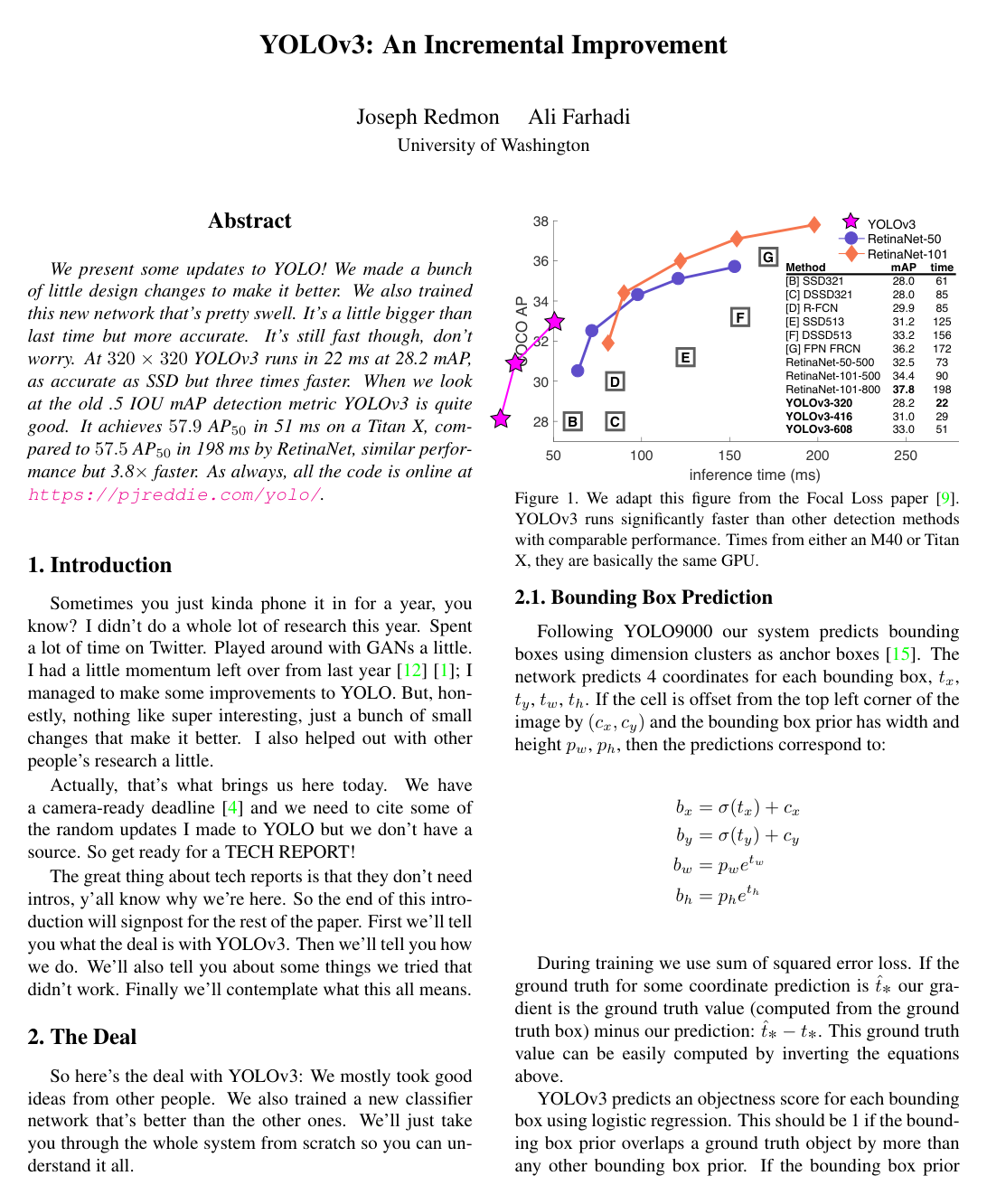
The new Darknet-53 backbone, combined with multi-scale feature prediction and logistic objectness scoring, produces competitive results at substantially lower latency. At 320 × 320 resolution the detector reaches 28.2 mAP in 22 ms, matching SSD accuracy while running three times faster; on the AP50 metric it attains 57.9 in 51 ms, nearly identical to RetinaNet yet 3.8 times quicker. Small-object performance improved markedly relative to prior YOLO versions, although precision on medium and large objects declined and overall COCO AP remained below the best two-stage systems.
These outcomes indicate that YOLOv3 supplies a practical operating point for applications where throughput matters more than marginal gains on strict localization metrics. The speed advantage reduces hardware costs and power draw for edge or high-volume deployments, yet the model’s weaker performance at higher IoU thresholds suggests it may require post-processing or complementary methods when precise bounding-box alignment is essential. The authors also note that widespread adoption of such detectors carries societal risks if the technology is applied without regard for privacy or misuse.
Further work should focus on closing the remaining gap on strict localization, testing the detector on additional datasets that contain heavy label overlap, and exploring whether alternative evaluation protocols better reflect real-world utility. Results rest on a single benchmark and a limited set of ablation trials; broader validation across domains and hardware would increase confidence before large-scale deployment.
- Paper: You Only Look Once: Unified, Real-Time Object Detection, Joseph Redmon et al. (2016). Reading the original YOLO paper provides the foundational single-stage regression architecture and grid prediction concepts directly built upon and updated in YOLOv3.
- Paper: YOLO9000: Better, Faster, Stronger, J. Redmon et al. (2016). YOLOv2 introduces crucial improvements like anchor boxes, batch normalization, and multi-scale training that serve as direct technical prerequisites for the architectural refinements in YOLOv3.
- Paper: Feature Pyramid Networks for Object Detection, Tsung-Yi Lin et al. (2017). Feature Pyramid Networks establish the multi-scale feature fusion and skip-connection methodology that YOLOv3 adapts across its three output scales to dramatically improve small-object detection.
- Paper: Generalized Intersection Over Union: A Metric and a Loss for Bounding Box Regression, Hamid Rezatofighi et al. (2019). This paper extends YOLOv3 by introducing Generalized Intersection over Union as a direct drop-in loss function to overcome the limitations of standard bounding box regression.
- Paper: Distance-IoU Loss: Faster and Better Learning for Bounding Box Regression, Zhaohui Zheng et al. (2019). This work directly builds upon YOLOv3 by replacing its bounding box regression loss with Distance-IoU and Complete-IoU objectives to accelerate convergence and improve localization.
- Paper: YOLOv7: Trainable Bag-of-Freebies Sets New State-of-the-Art for Real-Time Object Detectors, Chien-Yao Wang et al. (2023). YOLOv7 continues the incremental lineage established by YOLOv3, introducing advanced training optimizations and extended layer aggregation to push real-time object detection performance further.
- Paper: YOLOv9: Learning What You Want to Learn Using Programmable Gradient Information, Chien-Yao Wang et al. (2024). YOLOv9 extends the YOLO architectural evolution by introducing programmable gradient information to mitigate information bottleneck issues during training.
- Paper: YOLOv10: Real-Time End-to-End Object Detection, Ao Wang et al. (2024). YOLOv10 continues the YOLO series by removing non-maximum suppression entirely and redesigning core components for true end-to-end real-time detection.