YOLOX: Exceeding YOLO Series in 2021
Zheng GeSongtao LiuFeng WangZeming LiJian Sun
Introduces an anchor-free redesign of the YOLO object detection architecture featuring a decoupled head and SimOTA dynamic label assignment, surpassing existing benchmarks in accuracy and inference speed across lightweight and large-scale models.
Real-time computer vision systems require a balance between detection accuracy and execution speed. Although recent academic advances introduced anchor-free architectures and advanced label assignment strategies to enhance performance, mainstream industrial detectors such as the YOLO family remained reliant on anchor-based pipelines with hand-crafted training rules. The article set out to modernize these widely deployed detectors by incorporating anchor-free mechanisms, decoupled detection heads, and dynamic label assignment into a new high-performance system named YOLOX.
The developers evaluated this framework across multiple model sizes using standard benchmark datasets. They modernized the base architecture by separating the classification and localization branches, removing predefined anchor boxes in favor of direct coordinate prediction, and implementing a simplified dynamic label assignment method called SimOTA. The system was validated against baseline architectures across various hardware platforms and edge-device constraints, maintaining standardized training schedules and evaluation protocols.
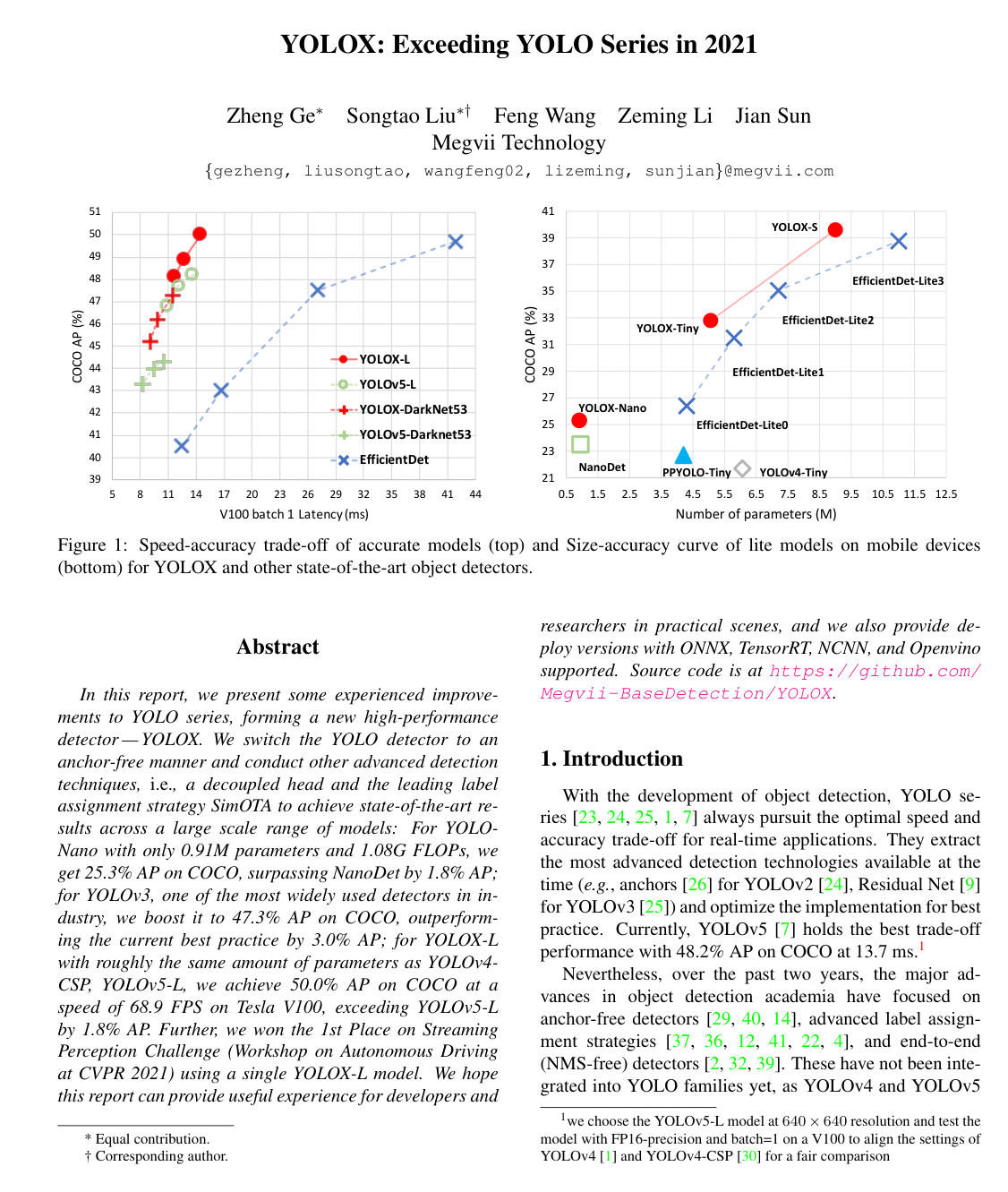
The findings show substantial improvements in both accuracy and efficiency across all model scales. Upgrading the baseline architecture boosted standard benchmark accuracy from 38.5% to 47.3%, outperforming previous best practices by 3.0 percentage points. For high-capacity models, the design achieved 50.0% accuracy at 68.9 frames per second, exceeding comparable state-of-the-art baselines by 1.8 percentage points. In lightweight and mobile configurations, the ultra-compact version achieved 25.3% accuracy with only 0.91 million parameters, surpassing alternative lightweight detectors while reducing computational requirements.
These results demonstrate that anchor-free designs and advanced assignment strategies can improve accuracy without incurring meaningful latency penalties. Removing anchor mechanisms significantly reduces heuristic tuning and cross-device transmission bottlenecks, making the models cheaper to deploy and easier to maintain across production environments ranging from edge devices to enterprise servers.
Organizations deploying computer vision should consider adopting this modernized architecture, selecting the model scale that fits their specific hardware constraints. Data augmentation should be calibrated carefully, using strong image mixing for large models and reduced distortion for compact networks. Future work should evaluate these techniques on larger transformer-based architectures and emerging multi-scale frameworks.
- Paper: YOLOv4: Optimal Speed and Accuracy of Object Detection, Alexey Bochkovskiy et al. (2020). YOLOv4 establishes the foundational architecture and training optimizations that YOLOX builds upon and refines.
- Paper: YOLOv3: An Incremental Improvement, Joseph Redmon et al. (2018). YOLOv3 provides the specific baseline network structure that YOLOX significantly updates and accelerates.
- Paper: FCOS: Fully Convolutional One-Stage Object Detection, Zhi Tian et al. (2019). FCOS introduces the anchor-free detection paradigm and center-ness concepts directly adopted by YOLOX.
- Paper: Focal Loss for Dense Object Detection, Tsung-Yi Lin et al. (2017). Focal Loss and modern dense detection training strategies inform the advanced supervision techniques leveraged in YOLOX.
- Paper: YOLOv7: Trainable Bag-of-Freebies Sets New State-of-the-Art for Real-Time Object Detectors, Chien-Yao Wang et al. (2023). YOLOv7 extends the real-time detection advances of YOLOX with further trainable bag-of-freebies and advanced architectural aggregation.
- Paper: YOLOv10: Real-Time End-to-End Object Detection, Ao Wang et al. (2024). YOLOv10 continues the evolution of real-time object detection by eliminating post-processing bottlenecks introduced after YOLOX.