Enhancing Geometric Factors in Model Learning and Inference for Object Detection and Instance Segmentation
Zhaohui ZhengPing WangDongwei RenWei LiuRongguang YeQinghua HuWangmeng Zuo
Proposes Complete-IoU loss and Cluster-NMS to integrate key geometric factors into bounding box regression and suppression, boosting object detection and instance segmentation accuracy across popular architectures without sacrificing real-time inference speed.
Modern computer vision systems rely heavily on object detection and instance segmentation for applications ranging from autonomous navigation to video surveillance. These systems locate targets using predicted bounding boxes, but traditional methods struggle in two key stages: model training often uses loss functions that fail to distinguish complex spatial alignments or converge too slowly, and model inference relies on post-processing techniques, known as non-maximum suppression, that create computational bottlenecks or mistakenly remove overlapping objects.
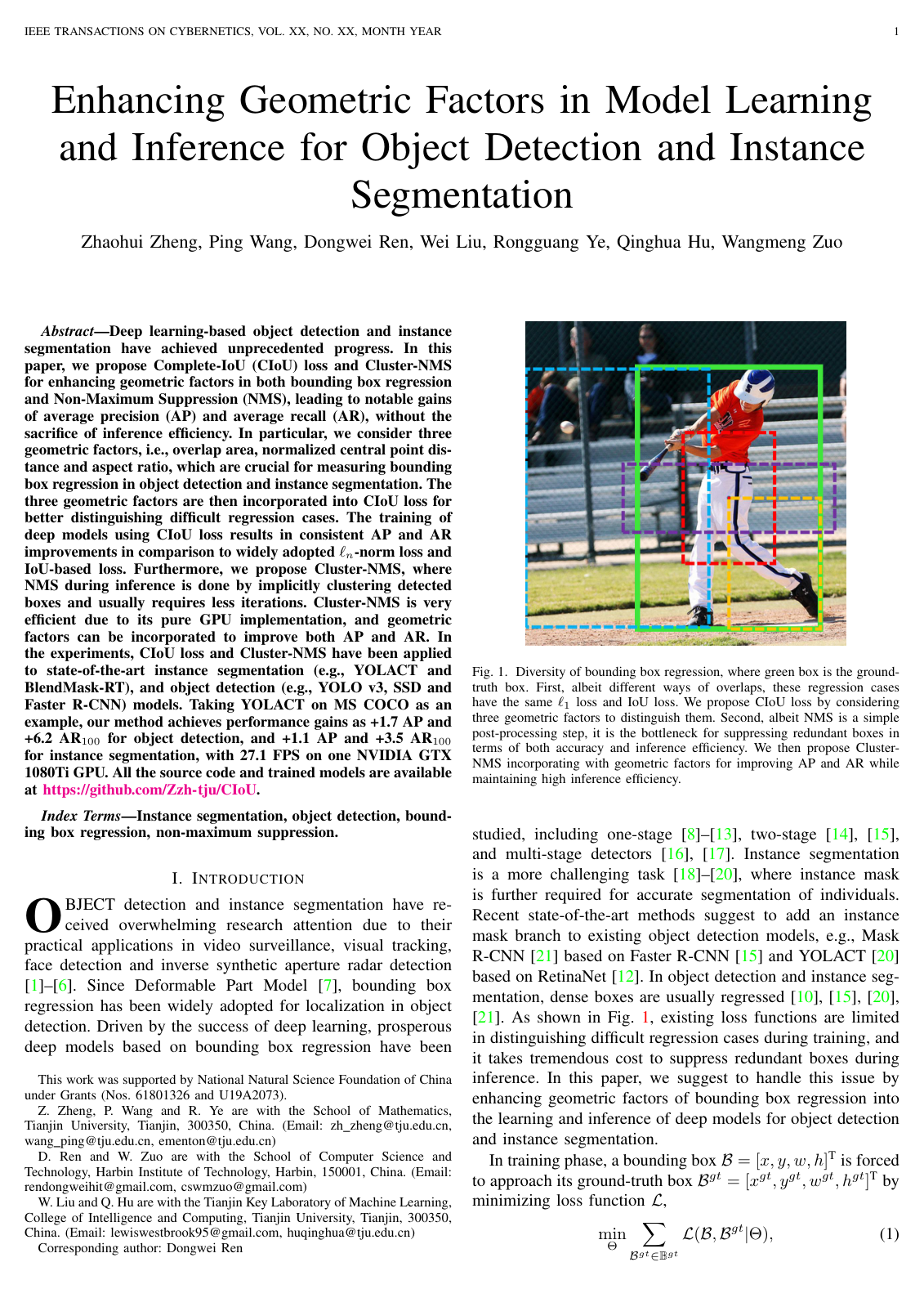
The main objective of the article is to demonstrate that incorporating three fundamental geometric factors—overlap area, normalized central point distance, and aspect ratio—into both model training and post-processing significantly improves accuracy and recall without sacrificing real-time inference speed.
To achieve this, the authors developed Complete Intersection over Union (CIoU) loss for model training and Cluster-NMS for fast inference. The approach was evaluated through extensive numerical simulations covering over 1.7 million spatial configurations, followed by empirical validation across benchmark datasets (MS COCO and PASCAL VOC) using widely adopted deep learning architectures, including YOLACT, BlendMask-RT, YOLO v3, SSD, and Faster R-CNN.
The investigation produced several key findings. First, CIoU loss significantly speeds up model convergence and achieves superior accuracy compared to standard norm-based and prior overlap-based losses, yielding gains such as a 5.67% increase in average precision on YOLO v3 over baseline methods. Second, Cluster-NMS operates via implicit box clustering executed entirely on graphics processing units (GPUs), matching the exact suppression output of original sequential methods while requiring fewer iterations. Third, combining Cluster-NMS with geometric enhancements (such as score penalties and coordinate weighting) produced substantial accuracy improvements—for example, boosting YOLACT's detection average precision by +1.7 and average recall by +6.2 on the MS COCO benchmark while sustaining a real-time speed of 27.1 frames per second. Finally, the analysis showed that Cluster-NMS variants deliver weighted-combination accuracy at more than six times the computational speed of previous weighted methods.
These findings imply that vision pipelines can achieve notable accuracy and safety improvements in crowded or occluded environments without requiring costly hardware upgrades or slower processing times. Because CIoU loss and Cluster-NMS act as plug-and-play components, organizations can upgrade existing vision systems with minimal engineering friction.
Engineering teams should deploy CIoU loss during model training and adopt Cluster-NMS variants during deployment to maximize both precision and recall. Depending on specific operational needs, practitioners can tune the trade-off parameter to prioritize precision or recall, using score-penalty variants for dense segmentation tasks and weighted-coordinate variants for rapid object detection.
The primary limitation identified is that incorporating aspect ratio can slightly reduce performance on small or medium objects, where center-point distance dominates spatial alignment. Future research should refine aspect ratio penalties for smaller targets and explore further low-level CUDA optimizations for Cluster-NMS implementations.
- Paper: Distance-IoU Loss: Faster and Better Learning for Bounding Box Regression, Zhaohui Zheng et al. (2019). Introduces the Distance-IoU (DIoU) and Complete-IoU (CIoU) formulations for bounding box regression, establishing the fundamental geometric penalty terms directly extended and analyzed in this work.
- Paper: Generalized Intersection Over Union: A Metric and a Loss for Bounding Box Regression, Hamid Rezatofighi et al. (2019). Derives Generalized IoU (GIoU) loss to handle non-overlapping bounding boxes, laying the essential groundwork for geometric IoU-based loss functions.
- Paper: UnitBox: An Advanced Object Detection Network, Jiahui Yu et al. (2016). Proposes the foundational IoU loss for bounding box regression, motivating direct overlap optimization over traditional coordinate-wise Ln-norm losses.
- Paper: YOLACT: Real-Time Instance Segmentation, Daniel Bolya et al. (2019). Presents real-time instance segmentation with Fast NMS, serving as a primary target architecture and post-processing benchmark improved by Cluster-NMS and CIoU.
- Paper: Soft-NMS — Improving Object Detection with One Line of Code, Navaneeth Bodla et al. (2017). Addresses the limitations of standard greedy NMS in dense scenes via continuous score decay, motivating the design of faster and more geometric post-processing suppression algorithms.
- Paper: Mask R-CNN, Kaiming He et al. (2017). Establishes the standard baseline framework for simultaneous object detection and instance segmentation evaluated throughout the paper.
- Paper: YOLOv3: An Incremental Improvement, Joseph Redmon et al. (2018). Provides a prominent one-stage real-time object detection architecture used as an experimental benchmark to demonstrate the efficacy of CIoU and Cluster-NMS.
- Paper: Faster R-CNN: Towards Real-Time Object Detection with Region Proposal Networks, Shaoqing Ren et al. (2015). Introduces the canonical two-stage anchor-based object detection pipeline and standard bounding-box regression formulation.
- Paper: Focal and Efficient IOU Loss for Accurate Bounding Box Regression, Yi-Fan Zhang et al. (2021). Builds directly on CIoU by explicitly decoupling aspect ratio into width and height error terms (EIoU) and adding focal sample reweighting to resolve gradient conflict issues.
- Paper: YOLOv4: Optimal Speed and Accuracy of Object Detection, Alexey Bochkovskiy et al. (2020). Adopts CIoU loss as a core 'bag-of-freebies' component to significantly boost training convergence and localization accuracy in real-time detectors.
- Paper: Scaled-YOLOv4: Scaling Cross Stage Partial Network, Chien-Yao Wang et al. (2020). Scales the YOLOv4 architecture across multiple hardware platforms while leveraging CIoU loss and enhanced NMS techniques for improved real-time performance.
- Paper: Generalized Focal Loss: Learning Qualified and Distributed Bounding Boxes for Dense Object Detection, Xiang Li et al. (2020). Extends geometric bounding box regression by formulating box offsets as continuous probability distributions to capture boundary ambiguity.
- Paper: TOOD: Task-aligned One-stage Object Detection, Chengjian Feng et al. (2021). Aligns classification and IoU-based localization objectives during training and inference to reduce the post-processing suppression errors analyzed in Cluster-NMS.
- Paper: YOLOv6: A Single-Stage Object Detection Framework for Industrial Applications, Chuyi Li et al. (2022). Incorporates modern geometric regression losses and post-processing strategies into a production-focused real-time detection framework.
- Paper: YOLOv7: Trainable Bag-of-Freebies Sets New State-of-the-Art for Real-Time Object Detectors, Chien-Yao Wang et al. (2023). Integrates trainable optimization techniques and advanced regression objectives to advance real-time object detection accuracy.
- Paper: A Comprehensive Review of YOLO Architectures in Computer Vision: From YOLOv1 to YOLOv8 and YOLO-NAS, Juan R. Terven et al. (2023). Provides a comprehensive historical overview tracking how geometric IoU losses and NMS refinements became standardized across the YOLO family.