WILDS: A Benchmark of in-the-Wild Distribution Shifts
Pang Wei KohShiori SagawaHenrik MarklundSang Michael XieMarvin ZhangAkshay BalsubramaniWeihua HuMichihiro YasunagaRichard Lanas PhillipsIrena Gao
article2020ICML2,007 citations
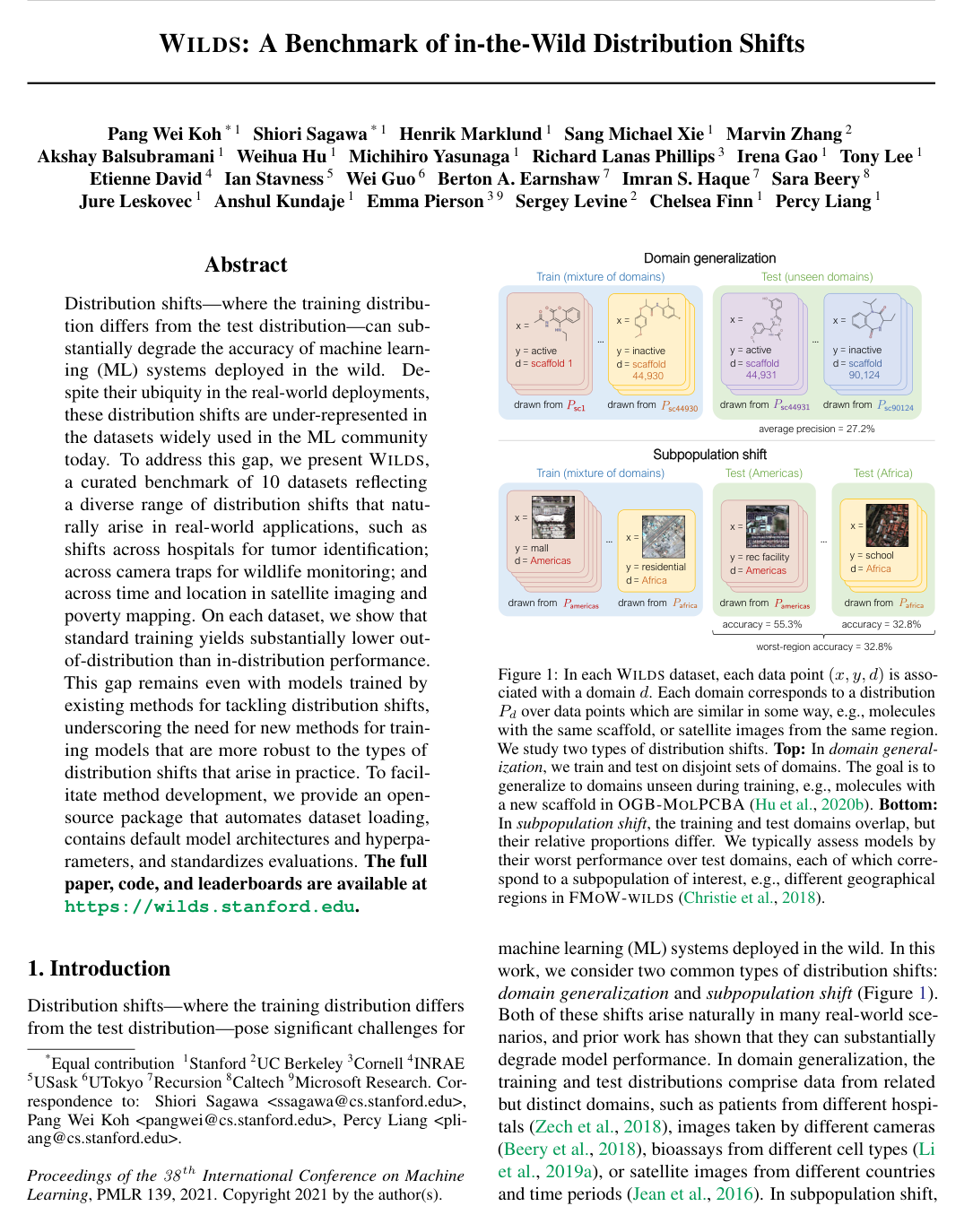
Introduces WILDS, a benchmark of ten real-world datasets across diverse applications, demonstrating that standard algorithms fail under naturally occurring distribution shifts and providing standardized evaluations to develop models with better out-of-distribution generalization.
- Paper: Invariant Risk Minimization, Martin Arjovsky et al. (2019). Introduces Invariant Risk Minimization (IRM), a foundational multi-environment distribution shift method whose real-world efficacy WILDS explicitly evaluates and challenges.
- Paper: Fairness Without Demographics in Repeated Loss Minimization, Tatsunori B. Hashimoto et al. (2018). Establishes distributionally robust optimization (DRO) principles for mitigating subpopulation shifts that form the baseline methodologies analyzed across WILDS datasets.
- Paper: Benchmarking Neural Network Robustness to Common Corruptions and Perturbations, Dan Hendrycks et al. (2019). Pioneers standardized evaluation protocols and synthetic corruptions for machine learning robustness benchmarks, setting the stage for WILDS to focus on naturally occurring in-the-wild shifts.
- Paper: Unbiased look at dataset bias, A. Torralba et al. (2011). Provides the classic foundational analysis of cross-dataset generalization failures and dataset bias that motivates benchmarking real-world distribution shifts.
- Paper: A theory of learning from different domains, Shai Ben-David et al. (2010). Develops the core theoretical learning bounds for generalization across distinct domains that underpin empirical out-of-distribution evaluation suites.
- Book: Domain-Adversarial Training of Neural Networks, Yaroslav Ganin et al. (2016). Introduces domain-adversarial neural networks (DANN), one of the standard baseline domain adaptation algorithms evaluated on the WILDS benchmark.
- Paper: Deep CORAL: Correlation Alignment for Deep Domain Adaptation, Baochen Sun et al. (2016). Proposes correlation alignment (CORAL) for deep domain adaptation, providing an essential baseline algorithm benchmarked throughout the WILDS package.
- Paper: Do ImageNet Classifiers Generalize to ImageNet?, Benjamin Recht et al. (2019). Demonstrates empirical generalization drops on replicated test sets, motivating the need for comprehensive benchmarks that test models beyond standard i.i.d. splits.
- Paper: Natural Adversarial Examples, Dan Hendrycks et al. (2019). Highlights the vulnerability of neural networks to natural out-of-distribution examples, serving as a direct precursor to curated real-world shift benchmarks.
- Paper: Open Graph Benchmark: Datasets for Machine Learning on Graphs, Weihua Hu et al. (2020). Presents the Open Graph Benchmark methodology of application-driven, non-random splits and unified toolkits that strongly influenced WILDS' design philosophy.
- Paper: The Many Faces of Robustness: A Critical Analysis of Out-of-Distribution Generalization, Dan Hendrycks et al. (2021). Extends the empirical study of out-of-distribution generalization by curating additional natural shift benchmarks and evaluating modern mitigation techniques.
- Paper: Datasheets for datasets, Timnit Gebru et al. (2021). Provides a comprehensive documentation framework that standardizes dataset creation and distribution shift characteristics following the transparency goals of benchmark suites.