ComENet: Towards Complete and Efficient Message Passing for 3D Molecular Graphs

Limei WangYi LiuYuchao LinHaoran LiuShuiwang Ji

article2022NeurIPS120 citations

Proposes ComENet, a graph neural network that achieves provably complete 3D molecular representations via rotation angles within 1-hop neighborhoods, reducing time complexity to linear and speeding up computation by up to ten times over existing methods.

Listen

Accurately modeling three-dimensional (3D) molecular graphs is essential for high-impact fields such as drug discovery, materials science, and catalyst design. Traditional approaches often rely on two-dimensional representations that discard critical spatial geometries, such as bond lengths and dihedral angles. While modern 3D graph neural networks aim to incorporate spatial geometry, existing models face a critical dilemma: they either incorporate incomplete geometric information, failing to distinguish complex molecular structures, or they incur prohibitively high computational costs that prevent scaling to massive real-world datasets.

The article evaluates and demonstrates ComENet (Complete and Efficient Network), a novel machine learning framework designed to achieve full 3D geometric completeness while dramatically reducing computational overhead. The primary objective is to prove theoretical completeness in distinguishing any distinct 3D molecular structures, including conformers, and to validate that this design provides state-of-the-art predictive accuracy with significantly faster training and inference runtimes.

The authors established their framework by designing a 1-hop message passing scheme that computes a four-part geometric representation for each edge: distance, two local spherical angles, and a newly introduced edge rotation angle that enforces global geometric alignment across connected structures. The approach combines theoretical mathematical induction to prove geometric uniqueness with extensive empirical evaluations across three benchmark datasets: the Open Catalyst 2020 dataset (over 660,000 catalyst-adsorbate graphs), the Molecule3D dataset (nearly 4 million graphs), and the standard QM9 quantum property benchmark (over 130,000 molecules).

The empirical and theoretical findings highlight three major outcomes. First, ComENet achieves theoretical completeness with a linear time complexity relative to neighboring node connections, drastically reducing computational scaling compared to the quadratic or cubic scaling of leading alternatives like SphereNet and GemNet. Second, across large benchmarks, ComENet accelerates model training and inference runtimes by approximately 6 to 10 times; for instance, on Open Catalyst 2020, per-epoch training dropped from 290 minutes (SphereNet) to just 20 minutes while outperforming all baselines on out-of-domain energy prediction error. Third, ablation testing confirmed that incorporating the rotation angle is critical, directly improving predictive accuracy on diverse conformers where molecular graphs share identical connectivity but differ in spatial bond rotations.

These findings demonstrate that organizations utilizing computational chemistry and molecular machine learning no longer need to compromise between physical modeling accuracy and computing costs. By resolving the efficiency bottleneck, ComENet substantially reduces the hardware time, cloud computing expenses, and turnaround cycles required to train and evaluate large-scale molecular models, directly enhancing discovery timelines in materials engineering and pharmaceutical research.

Organizations evaluating large-scale molecular screening pipelines should consider adopting this 1-hop invariant message passing architecture to optimize throughput and cost efficiency. For production deployment, research teams should validate ComENet within domain-specific workflows and explore generative or contrastive learning techniques to mitigate the primary remaining limitation: the practical cost and difficulty of acquiring accurate ground-truth 3D atomic coordinates from slow quantum simulations.

arXiv: 2206.08515
  • Paper: Neural Message Passing for Quantum Chemistry, Justin Gilmer et al. (2017). Introduces the foundational message passing neural network (MPNN) framework for predicting quantum chemical properties on molecular graphs that ComENet directly builds upon and enhances.
  • Paper: SchNet: A continuous-filter convolutional neural network for modeling quantum interactions, Kristof Schütt et al. (2017). Pioneers continuous-filter convolutions for 3D atomic coordinates and rotationally invariant energy prediction, establishing the geometric deep learning paradigm for molecular graphs.
  • Paper: E(n) Equivariant Graph Neural Networks, Victor Garcia Satorras et al. (2021). Formulates E(n)-equivariant graph neural networks for 3D coordinate processing, providing the foundational symmetry principles and spatial message passing context necessary to understand ComENet's complete invariant representations.
  • Paper: E(3)-equivariant graph neural networks for data-efficient and accurate interatomic potentials, Simon Batzner et al. (2021). Demonstrates equivariant tensor convolutions for modeling interatomic potentials, exemplifying the high-fidelity 3D modeling baselines that ComENet aims to match in expressiveness while improving computational scaling.
  • Paper: Machine Learning Force Fields, Oliver T. Unke et al. (2020). Provides a comprehensive review of machine learning force fields, physical symmetries, and 3D molecular representations that motivate the accuracy-efficiency trade-offs addressed by ComENet.
  • Paper: How Powerful are Graph Neural Networks?, Keyulu Xu et al. (2019). Establishes the theoretical framework for analyzing the expressiveness and structural completeness of graph neural networks using the Weisfeiler-Lehman hierarchy.
  • Paper: MoleculeNet: a benchmark for molecular machine learning, Zhenqin Wu et al. (2017). Establishes standard benchmark datasets and evaluation protocols for molecular machine learning, including quantum property prediction tasks used throughout ComENet's evaluation.
Cover for ComENet: Towards Complete and Efficient Message Passing for 3D Molecular Graphs

Abstract

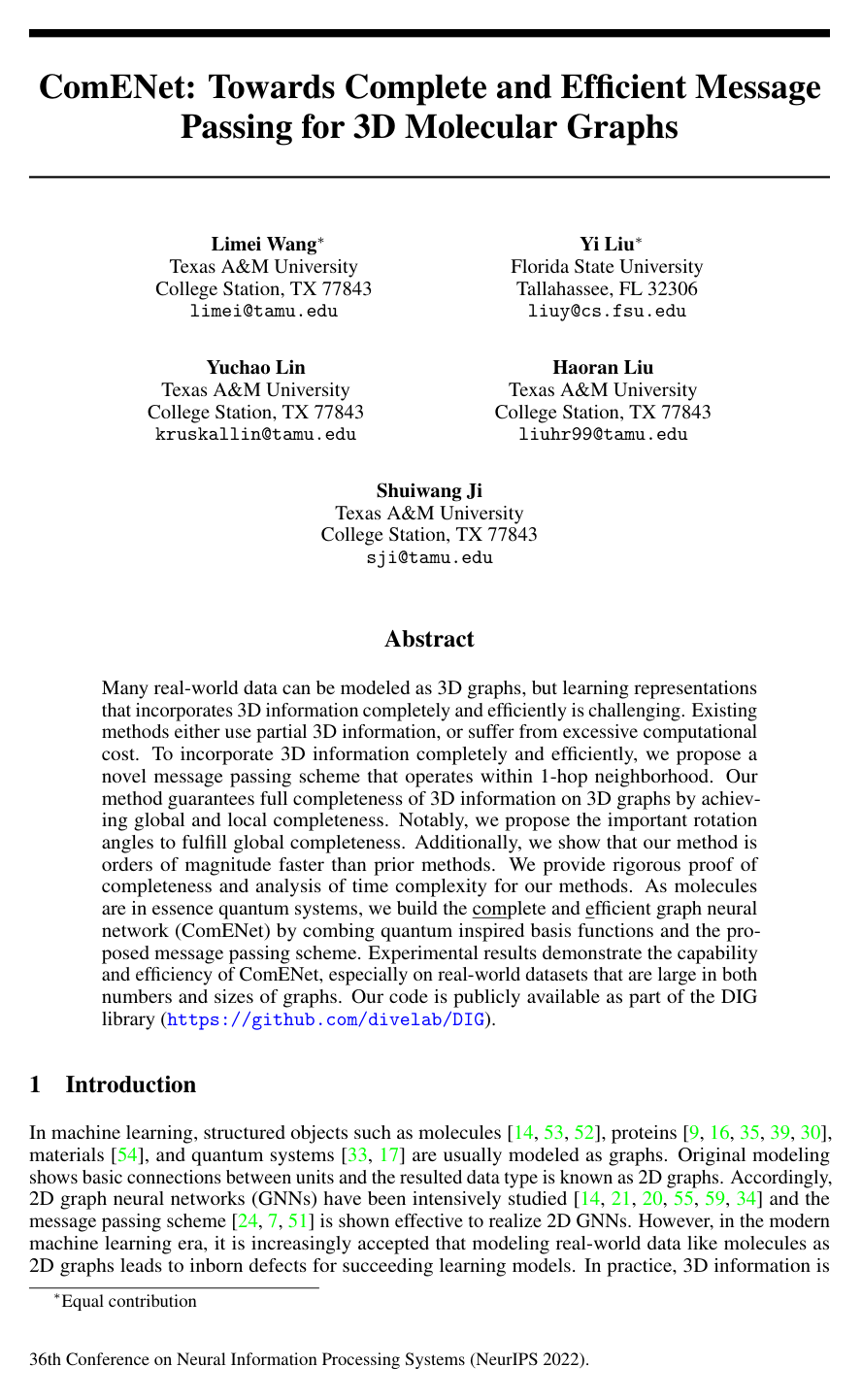
Many real-world data can be modeled as 3D graphs, but learning representations that incorporates 3D information completely and efficiently is challenging. Existing methods either use partial 3D information, or suffer from excessive computational cost. To incorporate 3D information completely and efficiently, we propose a novel message passing scheme that operates within 1-hop neighborhood. Our method guarantees full completeness of 3D information on 3D graphs by achieving global and local completeness. Notably, we propose the important rotation angles to fulfill global completeness. Additionally, we show that our method is orders of magnitude faster than prior methods. We provide rigorous proof of completeness and analysis of time complexity for our methods. As molecules are in essence quantum systems, we build the complete and efficient graph neural network (ComENet) by combing quantum inspired basis functions and the proposed message passing scheme. Experimental results demonstrate the capability and efficiency of ComENet, especially on real-world datasets that are large in both numbers and sizes of graphs. Our code is publicly available as part of the DIG library (https://github.com/divelab/DIG).

Table of Contents

  • 1 Introduction
  • 2 The Proposed Message Passing Scheme
  • 2.1 Notations & Definitions
  • 2.2 Global Completeness via Rotation Angles
  • 2.3 Rotation Angles for Conformer Identification
  • 2.4 Local Completeness with Improved Efficiency
  • 2.5 Message Passing Scheme
  • 3 Merits of Our Methods
  • 3.1 Geometric Completeness
  • 3.2 Efficiency
  • 4 ComENet
  • 5 Related Work
  • 6 Experiments
  • 6.1 OC20
  • 6.2 Molecule3D
  • 6.3 QM9
  • 6.4 Ablation Study for Identifying Conformers
  • 7 Conclusions, Limitations, Outlook, and Societal Impacts
  • Acknowledgments and Disclosure of Funding
  • References

Knowls

  1. Knowl 1 — Geometric Completeness for 3D Graphs

    definition

    Let G1=(V,A,P1)G_1 = (V, A, P_1) and G2=(V,A,P2)G_2 = (V, A, P_2) be two 3D graphs sharing the same node feature matrix V∈Rn×dvV \in \mathbb{R}^{n \times d_v} and adjacency matrix A∈Rn×nA \in \mathbb{R}^{n \times n}, with 3D Cartesian position matrices P1,P2∈Rn×3P_1, P_2 \in \mathbb{R}^{n \times 3}, where nn is the number of nodes and dvd_v is the node feature dimension. A geometric transformation T:(Rn×dv,Rn×n,Rn×3)→Rm×d\mathcal{T}: (\mathbb{R}^{n \times d_v}, \mathbb{R}^{n \times n}, \mathbb{R}^{n \times 3}) \to \mathbb{R}^{m \times d} (where mm is the number of transformed geometric features and dd is the feature size) is defined as geometrically complete if and only if:

    T(G1)=T(G2)  ⟺  ∃R∈SE(3),  P1=R(P2)\mathcal{T}(G_1) = \mathcal{T}(G_2) \iff \exists R \in \mathrm{SE}(3), \; P_1 = R(P_2)

    Here SE(3)\mathrm{SE}(3) denotes the Special Euclidean group in 3 dimensions, consisting of all 3D rotations and translations. Under this definition, a complete transformation produces identical outputs if and only if two 3D graphs are equivalent up to rigid rotation and translation, allowing the model to distinguish any two distinct 3D conformations.

  2. Knowl 2 — Geometric Completeness of the 4-Tuple Transformation

    theoretical result

    For any strongly connected 3D molecular graph G=(V,E,P)G = (V, E, P), the geometric transformation:

    T(G)=[(dij,θij,ϕij,τij)]i=1,…,n; j∈Ni∈Rm×4\mathcal{T}(G) = [(d_{ij}, \theta_{ij}, \phi_{ij}, \tau_{ij})]_{i=1,\dots,n;\, j \in \mathcal{N}_i} \in \mathbb{R}^{m \times 4}

    is geometrically complete in the sense of the Special Euclidean group SE(3)\mathrm{SE}(3), where nn is the number of nodes, mm is the number of directed edges, Ni\mathcal{N}_i denotes the 1-hop neighborhood of node ii, dijd_{ij} is the Euclidean distance between nodes ii and jj, θij\theta_{ij} and ϕij\phi_{ij} are the spherical coordinate angles of node jj in the canonical local frame of node ii, and τij\tau_{ij} is the rotation angle (dihedral angle) associated with edge eije_{ij} across adjacent local frames. This guarantees that no 3D geometric information is lost across the entire graph.

  3. Knowl 3 — Complete 1-Hop Message Passing Scheme for 3D Graphs

    equation

    ComENet updates node feature vectors via a message passing scheme operating within the 1-hop local neighborhood combined with inter-frame rotation angles:

    vi′=g(vi,∑j∈Nif(vj,dij,θij,ϕij,τij))v'_i = g\left(v_i, \sum_{j \in \mathcal{N}_i} f(v_j, d_{ij}, \theta_{ij}, \phi_{ij}, \tau_{ij})\right)

    where vi,vi′∈Rdvv_i, v'_i \in \mathbb{R}^{d_v} are the input and updated node representation vectors of node ii, Ni\mathcal{N}_i is the set of 1-hop neighbor indices of node ii, ff is a message function mapping neighbor features and geometric attributes to messages, and gg is an update function. The geometric inputs for each edge eije_{ij} form a 4-tuple (dij,θij,ϕij,τij)(d_{ij}, \theta_{ij}, \phi_{ij}, \tau_{ij}), where (dij,θij,ϕij)(d_{ij}, \theta_{ij}, \phi_{ij}) specify the spherical coordinates of node jj in ii's local frame, and τij\tau_{ij} is the rotation angle describing the relative orientation between the local frame of node ii and that of node jj.

  4. Knowl 4 — Local and Global Invariant Coordinate Computation in ComENet

    model/method

    ComENet extracts SE(3)-invariant geometric features for each directed edge eije_{ij} with an overall time complexity of O(nk)\mathcal{O}(nk), where nn is the number of nodes and kk is the average node degree:

    1. Local Spherical Coordinates (dij,θij,ϕij)(d_{ij}, \theta_{ij}, \phi_{ij}): For each node ii, a local coordinate system is defined with node ii at the origin. The zz-axis is set along the unit vector from node ii to its nearest neighbor fif_i. The xzxz-plane is defined by the zz-axis and the vector pointing to ii's second nearest neighbor sis_i. For each neighboring node j∈Nij \in \mathcal{N}_i, distance dij=∥pj−pi∥2d_{ij} = \|p_j - p_i\|_2, polar angle θij∈[0,π]\theta_{ij} \in [0, \pi], and azimuthal angle ϕij∈[0,2π)\phi_{ij} \in [0, 2\pi) are computed in this canonical frame.

    2. Rotation Angle τij\tau_{ij}: For each edge eije_{ij}, let fi∖jf_{i \setminus j} denote the nearest neighbor of node ii excluding jj, and fj∖if_{j \setminus i} denote the nearest neighbor of node jj excluding ii. The rotation angle τij\tau_{ij} is computed as the dihedral angle between the plane formed by (fi∖j,i,j)(f_{i \setminus j}, i, j) and the plane formed by (i,j,fj∖i)(i, j, f_{j \setminus i}).

  5. Knowl 5 — ComENet Architecture

    model/method

    The Complete and Efficient Graph Neural Network (ComENet) processes 3D molecular graphs through four sequential modules:

    1. Embedding Layer: Transforms atomic numbers ziz_i into initial node feature vectors vi∈Rdvv_i \in \mathbb{R}^{d_v} via learnable embedding lookup.
    2. Interaction Blocks: Stacked layers that update node representations. Each interaction block contains two parallel convolution branches:
      • LocalConv: Maps local spherical geometric features (dij,θij,ϕij)(d_{ij}, \theta_{ij}, \phi_{ij}) expanded using 3D Triplet Bessel/Basis Functions (TBF) together with neighbor node features vjv_j.
      • GlobalConv: Maps edge distance and rotation angle (dij,τij)(d_{ij}, \tau_{ij}) expanded using 2D Spherical Bessel/Basis Functions (SBF) together with neighbor features vjv_j. The outputs of LocalConv and GlobalConv are concatenated, projected back to the hidden dimension using a linear down-projection layer, added to an MLP transformation of viv_i, and finally passed through another MLP with a residual skip connection.
    3. Self-Atom Layer: Applies an atom-wise MLP to update each node representation and project its channel dimension to 1.
    4. Pooling Layer: Applies global sum pooling over all node scalar outputs to yield the final molecular property prediction.
  6. Knowl 6 — Performance and Efficiency on Open Catalyst 2020 (OC20) IS2RE Task

    data/table

    ComENet was evaluated on the Initial Structure to Relaxed Energy (IS2RE) task of the Open Catalyst 2020 dataset, trained on the All training split and evaluated on the validation set across four sub-splits: In-Domain (ID), Out-of-Domain Adsorbate (OOD Ads), Out-of-Domain Catalyst (OOD Cat), and Out-of-Domain Both (OOD Both). Metrics include Energy Mean Absolute Error (MAE in eV, lower is better) and percentage of Energies within Threshold (EwT in %, higher is better).

    Time Energy MAE [eV] ↓\downarrow EwT [%] ↑\uparrow
    Model Train Infer ID OOD Ads OOD Cat OOD Both ID OOD Ads OOD Cat OOD Both
    CGCNN 18min 1min 0.6203 0.7426 0.6001 0.6708 3.36% 2.11% 3.53% 2.29%
    SchNet 10min 1min 0.6465 0.7074 0.6475 0.6626 2.96% 2.22% 3.03% 2.38%
    DimeNet++ 230min 4min 0.5636 0.7127 0.5612 0.6492 4.25% 2.48% 4.40% 2.56%
    GemNet-T 200min 4min 0.5561 0.7342 0.5659 0.6964 4.51% 2.24% 4.37% 2.38%
    SphereNet 290min 5min 0.5632 0.6682 0.5590 0.6190 4.56% 2.70% 4.59% 2.70%
    ComENet 20min 1min 0.5558 0.6602 0.5491 0.5901 4.17% 2.71% 4.53% 2.83%

    ComENet achieves the lowest average Energy MAE of 0.5888 eV (compared to 0.6023 eV for SphereNet and 0.6217 eV for DimeNet++) while training in 20 minutes per epoch on an NVIDIA RTX A6000 GPU, offering over 14x training speedup compared to SphereNet (290 min/epoch).

  7. Knowl 7 — Performance and Efficiency on Molecule3D Benchmark

    data/table

    ComENet was evaluated on the Molecule3D dataset (~3.9 million molecules) for predicting the quantum chemical HOMO-LUMO energy gap under random and scaffold splits. Training and inference runtimes were measured per epoch on an NVIDIA GeForce RTX 2080 Ti GPU (11GB).

    Time MAE [eV] ↓\downarrow
    Model Train Inference Random Split Scaffold Split
    GIN-Virtual 15min 2min 0.1036 0.2371
    SchNet 14min 3min 0.0428 0.1511
    DimeNet++ 133min 16min 0.0306 0.1214
    SphereNet 182min 28min 0.0301 0.1182
    ComENet 22min 3min 0.0326 0.1273

    ComENet achieves error rates comparable to 2-hop directional message passing architectures (DimeNet++ and SphereNet) while reducing training time by 6x to 8x (22 minutes vs. 133 and 182 minutes per epoch).

  8. Knowl 8 — Molecular Property Prediction on QM9 Benchmark

    data/table

    ComENet was evaluated on the 12 quantum chemical properties of the QM9 dataset using a standard 84:8:8 train/validation/test split. Evaluation is reported as MAE for each property and overall mean standardized MAE (std. MAE in %).

    Property Unit SchNet PhysNet MGCN DimeNet DimeNet++ PaiNN SphereNet ComENet
    μ\mu D\text{D} 0.033 0.0529 0.0560 0.0286 0.0297 0.012 0.0245 0.0245
    α\alpha a03a_0^3 0.235 0.0615 0.0300 0.0469 0.0435 0.045 0.0449 0.0452
    ϵHOMO\epsilon_{\text{HOMO}} meV\text{meV} 41 32.9 42.1 27.8 24.6 27.6 22.8 23.1
    ϵLUMO\epsilon_{\text{LUMO}} meV\text{meV} 34 24.7 57.4 19.7 19.5 20.4 18.9 19.8
    Δϵ\Delta\epsilon meV\text{meV} 63 42.5 64.2 34.8 32.6 45.7 31.1 32.4
    ⟨R2⟩\langle R^2 \rangle a02a_0^2 0.073 0.765 0.110 0.331 0.331 0.066 0.268 0.259
    ZPVE\text{ZPVE} meV\text{meV} 1.7 1.39 1.12 1.29 1.21 1.28 1.12 1.20
    U0U_0 meV\text{meV} 14 8.15 12.9 8.02 6.32 5.85 6.26 6.59
    UU meV\text{meV} 19 8.34 14.4 7.89 6.28 5.83 6.36 6.82
    HH meV\text{meV} 14 8.42 14.6 8.11 6.53 5.98 6.33 6.86
    GG meV\text{meV} 14 9.4 16.2 8.98 7.56 7.35 7.78 7.98
    cvc_v calmol K\frac{\text{cal}}{\text{mol K}} 0.033 0.028 0.038 0.025 0.023 0.024 0.022 0.024
    std. MAE % 1.76 1.37 1.86 1.05 0.98 1.01 0.91 0.93

    ComENet achieves an overall std. MAE of 0.93%, significantly outperforming previous 1-hop methods (SchNet 1.76%, MGCN 1.86%, PhysNet 1.37%) and remaining competitive with 2-hop directional models (DimeNet++ 0.98%, SphereNet 0.91%) while operating with strictly 1-hop O(nk)\mathcal{O}(nk) computational complexity.

  9. Knowl 9 — Ablation Study on Rotation Angles for Conformer Disambiguation

    data/table

    An ablation study on the Open Catalyst 2020 (OC20) IS2RE dataset was conducted to assess the necessity of inter-frame rotation angles τ\tau for distinguishing molecular conformers.

    Energy MAE [eV] ↓\downarrow EwT [%] ↑\uparrow
    Model ID OOD Ads OOD Cat OOD Both Average ID OOD Ads OOD Cat OOD Both Average
    ComENet 0.5558 0.6602 0.5491 0.5901 0.5888 4.17% 2.71% 4.53% 2.83% 3.56%
    ComENet w/o τ\tau 0.5585 0.6851 0.5574 0.6186 0.6049 4.13% 2.65% 4.13% 2.75% 3.42%

    Removing the rotation angle parameter τ\tau degrades the average Energy MAE from 0.5888 eV to 0.6049 eV and decreases the EwT metric from 3.56% to 3.42%, confirming that global completeness via rotation angles is essential for resolving structural differences across molecular conformers.

  10. Knowl 10 — Dependency of 3D Invariant GNNs on Pre-Acquired 3D Conformations

    limitation

    ComENet and related invariant 3D graph neural networks assume that accurate 3D Cartesian coordinates are provided as input data. In many practical applications (e.g., de novo drug discovery), 3D molecular conformations are not readily available and are computationally demanding or expensive to acquire via experimental crystallographic methods or Density Functional Theory (DFT) calculations.

Coverage note — None was omitted; all contributed definitions, theorems, model designs, empirical evaluations across OC20, Molecule3D, QM9, conformer ablation studies, and limitations are fully covered.

References

  1. 1.Keir Adams, Lagnajit Pattanaik, and Connor W. Coley. Learning 3D representations of molecular chirality with invariance to bond rotations. In International Conference on Learning Representations, 2022. URL https://openreview.net/forum?id=hm2tNDdgaFK.
  2. 2.Brandon Anderson, Truong-Son Hy, and Risi Kondor. Cormorant: Covariant molecular neural networks. In Proceedings of the 33st International Conference on Neural Information Processing Systems, pages 14537–14546, 2019.
  3. 3.Kenneth Atz, Francesca Grisoni, and Gisbert Schneider. Geometric deep learning on molecular representations. Nature Machine Intelligence, pages 1–10, 2021.
  4. 4.Simon Axelrod and Rafael Gomez-Bombarelli. Molecular machine learning with conformer ensembles. arXiv preprint arXiv:2012.08452, 2020.
  5. 5.Simon Axelrod and Rafael Gomez-Bombarelli. GEOM, energy-annotated molecular conformations for property prediction and molecular generation. Scientific Data, 9(1):1–14, 2022.
  6. 6.Minkyung Baek, Frank DiMaio, Ivan Anishchenko, Justas Dauparas, Sergey Ovchinnikov, Gyu Rie Lee, Jue Wang, Qian Cong, Lisa N Kinch, R Dustin Schaeffer, et al. Accurate prediction of protein structures and interactions using a three-track neural network. Science, 373(6557):871–876, 2021.
  7. 7.Peter W Battaglia, Jessica B Hamrick, Victor Bapst, Alvaro Sanchez-Gonzalez, Vinicius Zambaldi, Mateusz Malinowski, Andrea Tacchetti, David Raposo, Adam Santoro, Ryan Faulkner, et al. Relational inductive biases, deep learning, and graph networks. arXiv preprint arXiv:1806.01261, 2018.
  8. 8.Simon Batzner, Albert Musaelian, Lixin Sun, Mario Geiger, Jonathan P Mailoa, Mordechai Kornbluth, Nicola Molinari, Tess E Smidt, and Boris Kozinsky. E(3)-equivariant graph neural networks for data-efficient and accurate interatomic potentials. Nature communications, 13(1): 1–11, 2022.
  9. 9.Karsten M Borgwardt, Cheng Soon Ong, Stefan Schönauer, SVN Vishwanathan, Alex J Smola, and Hans-Peter Kriegel. Protein function prediction via graph kernels. Bioinformatics, 21 (suppl_1):i47–i56, 2005.
  10. 10.Michael M Bronstein, Joan Bruna, Taco Cohen, and Petar Velickovi č c. Geometric deep learning: ´ Grids, groups, graphs, geodesics, and gauges. arXiv preprint arXiv:2104.13478, 2021.
  11. 11.Lowik Chanussot, Abhishek Das, Siddharth Goyal, Thibaut Lavril, Muhammed Shuaibi, Morgane Riviere, Kevin Tran, Javier Heras-Domingo, Caleb Ho, Weihua Hu, et al. Correction to “the open catalyst 2020 (oc20) dataset and community challenges”. ACS Catalysis, 11(21): 13062–13065, 2021.
  12. 12.Lowik Chanussot, Abhishek Das, Siddharth Goyal, Thibaut Lavril, Muhammed Shuaibi, Morgane Riviere, Kevin Tran, Javier Heras-Domingo, Caleb Ho, Weihua Hu, et al. Open catalyst 2020 (OC20) dataset and community challenges. ACS Catalysis, 11(10):6059–6072, 2021.
  13. 13.Lowik Chanussot, Abhishek Das, Siddharth Goyal, Thibaut Lavril, Muhammed Shuaibi, Morgane Riviere, Kevin Tran, et al. Open Catalyst Challenge. https://opencatalystproject. org/challenge.html, 2021.
  14. 14.David K Duvenaud, Dougal Maclaurin, Jorge Iparraguirre, Rafael Bombarell, Timothy Hirzel, Alán Aspuru-Guzik, and Ryan P Adams. Convolutional networks on graphs for learning molecular fingerprints. Advances in Neural Information Processing Systems, 28:2224–2232, 2015.
  15. 15.Matthias Fey and Jan E. Lenssen. Fast graph representation learning with PyTorch Geometric. In ICLR Workshop on Representation Learning on Graphs and Manifolds, 2019.
  16. 16.Alex Fout, Jonathon Byrd, Basir Shariat, and Asa Ben-Hur. Protein interface prediction using graph convolutional networks. In Proceedings of the 31st International Conference on Neural Information Processing Systems, pages 6533–6542, 2017.
  17. 17.Cong Fu, Xuan Zhang, Huixin Zhang, Hongyi Ling, Shenglong Xu, and Shuiwang Ji. Lattice convolutional networks for learning ground states of quantum many-body systems. arXiv preprint arXiv:2206.07370, 2022.
  18. 18.Fabian Fuchs, Daniel Worrall, Volker Fischer, and Max Welling. SE(3)-Transformers: 3D roto-translation equivariant attention networks. Advances in Neural Information Processing Systems, 33, 2020.
  19. 19.Octavian-Eugen Ganea, Lagnajit Pattanaik, Connor W Coley, Regina Barzilay, Klavs F Jensen, William H Green, and Tommi S Jaakkola. GeoMol: Torsional geometric generation of molecular 3D conformer ensembles. Advances in Neural Information Processing Systems, 2021.
  20. 20.Hongyang Gao and Shuiwang Ji. Graph U-Nets. In International Conference on Machine Learning, pages 2083–2092. PMLR, 2019.
  21. 21.Hongyang Gao, Yi Liu, and Shuiwang Ji. Topology-aware graph pooling networks. IEEE Transactions on Pattern Analysis and Machine Intelligence, 43(12):4512–4518, 2021.
  22. 22.Johannes Gasteiger, Janek Groß, and Stephan Günnemann. Directional message passing for molecular graphs. In International Conference on Learning Representations, 2020. URL https://openreview.net/forum?id=B1eWbxStPH.
  23. 23.Johannes Gasteiger, Florian Becker, and Stephan Günnemann. Gemnet: Universal directional graph neural networks for molecules. Advances in Neural Information Processing Systems, 34: 6790–6802, 2021.
  24. 24.Justin Gilmer, Samuel S Schoenholz, Patrick F Riley, Oriol Vinyals, and George E Dahl. Neural message passing for quantum chemistry. In Proceedings of the 34th International Conference on Machine Learning-Volume 70, pages 1263–1272. JMLR. org, 2017.
  25. 25.Jonathan Godwin, Michael Schaarschmidt, Alexander L Gaunt, Alvaro Sanchez-Gonzalez, Yulia Rubanova, Petar Velickovi č c, James Kirkpatrick, and Peter Battaglia. Simple GNN regularisation ´ for 3D molecular property prediction and beyond. In International Conference on Learning Representations, 2022. URL https://openreview.net/forum?id=1wVvweK3oIb.
  26. 26.Emiel Hoogeboom, Victor Garcia Satorras, Clément Vignac, and Max Welling. Equivariant diffusion for molecule generation in 3D. In International Conference on Machine Learning, pages 8867–8887. PMLR, 2022.
  27. 27.Weihua Hu, Matthias Fey, Hongyu Ren, Maho Nakata, Yuxiao Dong, and Jure Leskovec. OGB-LSC: A large-scale challenge for machine learning on graphs. In Thirty-fifth Conference on Neural Information Processing Systems Datasets and Benchmarks Track (Round 2), 2021. URL https://openreview.net/forum?id=qkcLxoC52kL.
  28. 28.Weihua Hu, Muhammed Shuaibi, Abhishek Das, Siddharth Goyal, Anuroop Sriram, Jure Leskovec, Devi Parikh, and C Lawrence Zitnick. ForceNet: A graph neural network for large-scale quantum calculations. arXiv preprint arXiv:2103.01436, 2021.
  29. 29.Bowen Jing, Gabriele Corso, Regina Barzilay, and Tommi S. Jaakkola. Torsional diffusion for molecular conformer generation. In ICLR Workshop on Deep Generative Models for Highly Structured Data, 2022. URL https://openreview.net/forum?id=SBgNnnVuwbc.
  30. 30.John Jumper, Richard Evans, Alexander Pritzel, Tim Green, Michael Figurnov, Olaf Ronneberger, Kathryn Tunyasuvunakool, Russ Bates, Augustin Žídek, Anna Potapenko, et al. Highly accurate protein structure prediction with AlphaFold. Nature, 596(7873):583–589, 2021.
  31. 31.Diederik Kingma and Jimmy Ba. Adam: A method for stochastic optimization. The International Conference on Learning Representations, 2015.
  32. 32.Johannes Klicpera, Shankari Giri, Johannes T Margraf, and Stephan Günnemann. Fast and uncertainty-aware directional message passing for non-equilibrium molecules. In NeurIPS-W, 2020.
  33. 33.Dmitrii Kochkov, Tobias Pfaff, Alvaro Sanchez-Gonzalez, Peter Battaglia, and Bryan K Clark. Learning ground states of quantum hamiltonians with graph networks. arXiv preprint arXiv:2110.06390, 2021.
  34. 34.Meng Liu, Youzhi Luo, Limei Wang, Yaochen Xie, Hao Yuan, Shurui Gui, Haiyang Yu, Zhao Xu, Jingtun Zhang, Yi Liu, Keqiang Yan, Haoran Liu, Cong Fu, Bora M Oztekin, Xuan Zhang, and Shuiwang Ji. DIG: A turnkey library for diving into graph deep learning research. Journal of Machine Learning Research, 22(240):1–9, 2021. URL http://jmlr.org/papers/v22/ 21-0343.html.
  35. 35.Yi Liu, Hao Yuan, Lei Cai, and Shuiwang Ji. Deep learning of high-order interactions for protein interface prediction. In Proceedings of the 26th ACM SIGKDD International Conference on Knowledge Discovery & Data Mining, pages 679–687, 2020.
  36. 36.Yi Liu, Limei Wang, Meng Liu, Yuchao Lin, Xuan Zhang, Bora Oztekin, and Shuiwang Ji. Spherical message passing for 3D molecular graphs. In International Conference on Learning Representations, 2022. URL https://openreview.net/forum?id=givsRXsOt9r.
  37. 37.Chengqiang Lu, Qi Liu, Chao Wang, Zhenya Huang, Peize Lin, and Lixin He. Molecular property prediction: A multilevel quantum interactions modeling perspective. In Proceedings of the AAAI Conference on Artificial Intelligence, volume 33, pages 1052–1060, 2019.
  38. 38.Haggai Maron, Heli Ben-Hamu, Hadar Serviansky, and Yaron Lipman. Provably powerful graph networks. Advances in Neural Information Processing Systems, 32:2153–2164, 2019.
  39. 39.Alex Morehead, Chen Chen, and Jianlin Cheng. Geometric transformers for protein interface contact prediction. In International Conference on Learning Representations, 2022. URL https://openreview.net/forum?id=CS4463zx6Hi.
  40. 40.Raghunathan Ramakrishnan, Pavlo O Dral, Matthias Rupp, and O Anatole Von Lilienfeld. Quantum chemistry structures and properties of 134 kilo molecules. Scientific data, 1(1):1–7, 2014.
  41. 41.Vıctor Garcia Satorras, Emiel Hoogeboom, and Max Welling. E (n) equivariant graph neural networks. In International conference on machine learning, pages 9323–9332. PMLR, 2021.
  42. 42.Jürgen Schmidhuber. Deep learning in neural networks: An overview. Neural Networks, 61: 85–117, 2015.
  43. 43.Kristof Schütt, Pieter-Jan Kindermans, Huziel Enoc Sauceda Felix, Stefan Chmiela, Alexandre Tkatchenko, and Klaus-Robert Müller. SchNet: A continuous-filter convolutional neural network for modeling quantum interactions. In Advances in Neural Information Processing Systems, pages 991–1001, 2017.
  44. 44.Kristof Schütt, Oliver Unke, and Michael Gastegger. Equivariant message passing for the prediction of tensorial properties and molecular spectra. In International Conference on Machine Learning, pages 9377–9388. PMLR, 2021.
  45. 45.Muhammed Shuaibi, Adeesh Kolluru, Abhishek Das, Aditya Grover, Anuroop Sriram, Zachary Ulissi, and C Lawrence Zitnick. Rotation invariant graph neural networks using spin convolutions. arXiv preprint arXiv:2106.09575, 2021.
  46. 46.Gregor N. C. Simm, Robert Pinsler, and José Miguel Hernández-Lobato. Reinforcement learning for molecular design guided by quantum mechanics. In Hal Daumé III and Aarti Singh, editors, Proceedings of the 37th International Conference on Machine Learning, volume 119 of Proceedings of Machine Learning Research, pages 8959–8969. PMLR, 2020. URL http://proceedings.mlr.press/v119/simm20b.html.
  47. 47.Gregor N. C. Simm, Robert Pinsler, Gábor Csányi, and José Miguel Hernández-Lobato. Symmetry-aware actor-critic for 3D molecular design. In International Conference on Learning Representations, 2021. URL https://openreview.net/forum?id=jEYKjPE1xYN.
  48. 48.Jonathan M Stokes, Kevin Yang, Kyle Swanson, Wengong Jin, Andres Cubillos-Ruiz, Nina M Donghia, Craig R MacNair, Shawn French, Lindsey A Carfrae, Zohar Bloom-Ackermann, et al. A deep learning approach to antibiotic discovery. Cell, 180(4):688–702, 2020.
  49. 49.Nathaniel Thomas, Tess Smidt, Steven Kearnes, Lusann Yang, Li Li, Kai Kohlhoff, and Patrick Riley. Tensor field networks: Rotation-and translation-equivariant neural networks for 3D point clouds. arXiv preprint arXiv:1802.08219, 2018.
  50. 50.Oliver T Unke and Markus Meuwly. PhysNet: A neural network for predicting energies, forces, dipole moments, and partial charges. Journal of chemical theory and computation, 15(6): 3678–3693, 2019.
  51. 51.Clement Vignac, Andreas Loukas, and Pascal Frossard. Building powerful and equivariant graph neural networks with structural message-passing. Advances in Neural Information Processing Systems, 33:14143–14155, 2020.
  52. 52.Zhengyang Wang, Meng Liu, Youzhi Luo, Zhao Xu, Yaochen Xie, Limei Wang, Lei Cai, Qi Qi, Zhuoning Yuan, Tianbao Yang, et al. Advanced graph and sequence neural networks for molecular property prediction and drug discovery. Bioinformatics, 38(9):2579–2586, 2022.
  53. 53.Zhenqin Wu, Bharath Ramsundar, Evan N Feinberg, Joseph Gomes, Caleb Geniesse, Aneesh S Pappu, Karl Leswing, and Vijay Pande. MoleculeNet: a benchmark for molecular machine learning. Chemical science, 9(2):513–530, 2018.
  54. 54.Tian Xie and Jeffrey C Grossman. Crystal graph convolutional neural networks for an accurate and interpretable prediction of material properties. Physical review letters, 120(14):145301, 2018.
  55. 55.Keyulu Xu, Weihua Hu, Jure Leskovec, and Stefanie Jegelka. How powerful are graph neural networks? In International Conference on Learning Representations, 2019.
  56. 56.Zhao Xu, Youzhi Luo, Xuan Zhang, Xinyi Xu, Yaochen Xie, Meng Liu, Kaleb Dickerson, Cheng Deng, Maho Nakata, and Shuiwang Ji. Molecule3D: A benchmark for predicting 3D geometries from molecular graphs. arXiv preprint arXiv:2110.01717, 2021.
  57. 57.Kevin Yang, Kyle Swanson, Wengong Jin, Connor Coley, Philipp Eiden, Hua Gao, Angel Guzman-Perez, Timothy Hopper, Brian Kelley, Miriam Mathea, et al. Analyzing learned molecular representations for property prediction. Journal of chemical information and modeling, 59 (8):3370–3388, 2019.
  58. 58.Chengxuan Ying, Tianle Cai, Shengjie Luo, Shuxin Zheng, Guolin Ke, Di He, Yanming Shen, and Tie-Yan Liu. Do transformers really perform badly for graph representation? In Thirty-Fifth Conference on Neural Information Processing Systems, 2021. URL https://openreview.net/forum?id=OeWooOxFwDa.
  59. 59.Muhan Zhang, Zhicheng Cui, Marion Neumann, and Yixin Chen. An end-to-end deep learning architecture for graph classification. In Proceedings of the AAAI Conference on Artificial Intelligence, volume 32, 2018.

Citation

MLA
Wang, L., et al. “ComENet: Towards Complete and Efficient Message Passing for 3D Molecular Graphs”. Advances in Neural Information Processing Systems, vol. 35, 2022, pp. 650–64, https://proceedings.neurips.cc/paper_files/paper/2022/file/0418973e545b932939302cb605d06f43-Paper-Conference.pdf.
APA
Wang, L., Liu, Y., Lin, Y., Liu, H., & Ji, S. (2022). ComENet: Towards Complete and Efficient Message Passing for 3D Molecular Graphs. Advances in Neural Information Processing Systems, 35, 650–664. https://proceedings.neurips.cc/paper_files/paper/2022/file/0418973e545b932939302cb605d06f43-Paper-Conference.pdf
Chicago
Wang, L., Y. Liu, Y. Lin, H. Liu, and S. Ji. 2022. “ComENet: Towards Complete and Efficient Message Passing for 3D Molecular Graphs”. Advances in Neural Information Processing Systems 35: 650–64. https://proceedings.neurips.cc/paper_files/paper/2022/file/0418973e545b932939302cb605d06f43-Paper-Conference.pdf.
Harvard
Wang, L. et al. (2022) “ComENet: Towards Complete and Efficient Message Passing for 3D Molecular Graphs”, Advances in Neural Information Processing Systems. Curran Associates, Inc., pp. 650–664. Available at: https://proceedings.neurips.cc/paper_files/paper/2022/file/0418973e545b932939302cb605d06f43-Paper-Conference.pdf.
Vancouver
1. Wang L, Liu Y, Lin Y, Liu H, Ji S (2022) ComENet: Towards Complete and Efficient Message Passing for 3D Molecular Graphs. In: Advances in Neural Information Processing Systems. Curran Associates, Inc., pp 650–664

BibTeX

@inproceedings{wang2022comenet,
  title = {ComENet: Towards Complete and Efficient Message Passing for 3D Molecular Graphs},
  author = {Wang, Limei and Liu, Yi and Lin, Yuchao and Liu, Haoran and Ji, Shuiwang},
  year = {2022},
  booktitle = {Advances in Neural Information Processing Systems},
  publisher = {Curran Associates, Inc.},
  volume = {35},
  pages = {650-664},
  url = {https://proceedings.neurips.cc/paper_files/paper/2022/file/0418973e545b932939302cb605d06f43-Paper-Conference.pdf}
}
Metadata:DOI registry

Access the Paper

This paper is available from its original source. Click below to access the PDF.

Open PDF
License: Authors