Deep Color Consistent Network for Low-Light Image Enhancement
Zhao ZhangHuan ZhengRichang HongMingliang XuShuicheng YanMeng Wang
Proposes DCC-Net, a low-light image restoration framework that decouples images into structural gray components and color histograms to eliminate color distortion through pyramid feature embedding.
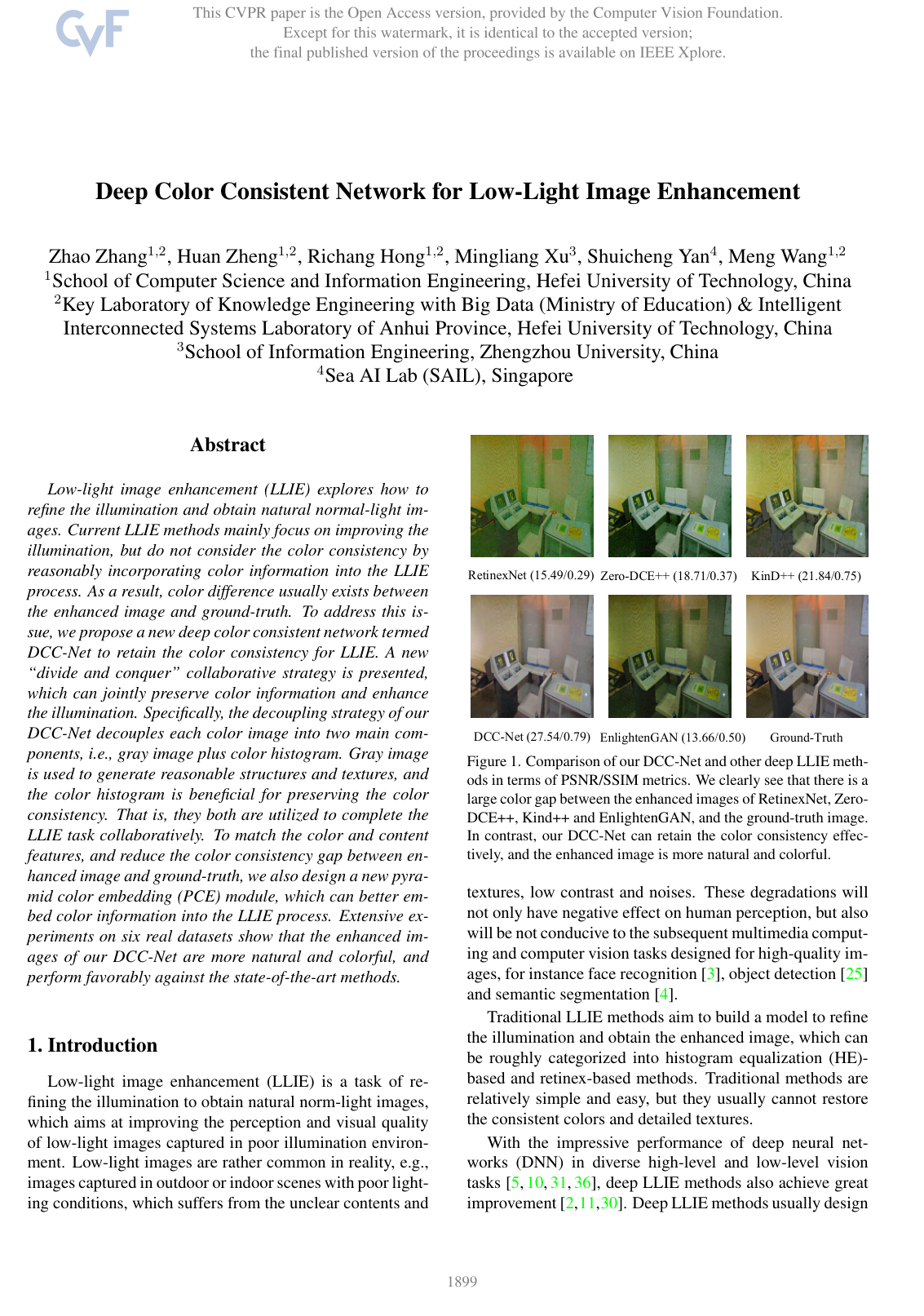
Low-light image enhancement is essential for improving visual quality and supporting downstream computer vision applications, such as object detection, face recognition, and semantic segmentation. While deep learning methods have significantly advanced image brightening, existing approaches predominantly focus on adjusting illumination. Consequently, they often overlook color fidelity, producing unnatural images with severe color distortion and noticeable gaps compared to ground-truth normal-light scenes.
The article evaluates a new deep neural network architecture called the Deep Color Consistent Network (DCC-Net). The primary objective is to demonstrate that directly incorporating color preservation alongside illumination enhancement can eliminate color discrepancies and generate more natural, visually coherent results.
To achieve this, the authors introduce a collaborative strategy that separates the enhancement task into distinct components. One sub-network reconstructs a grayscale image to capture scene structure and texture, while a second sub-network learns global color distributions via color histograms. A third sub-network integrates these two elements using a multi-level Pyramid Color Embedding module, which applies a dual affinity matrix to dynamically match color features with spatial content. The authors evaluated DCC-Net against six leading deep enhancement models across six standard public datasets, using both paired reference data and real-world unpaired imagery under diverse lighting conditions.
The key findings demonstrate significant performance gains over current state-of-the-art techniques. DCC-Net achieved the lowest color distortion on standard benchmark testing, reducing color error substantially compared to competing methods, some of which exhibited up to nine times higher error rates. The model achieved superior image fidelity and structural clarity metrics, recording the lowest reconstruction error and highest overall signal quality. Visual assessments confirmed that DCC-Net effectively avoids the common over-enhancement, washed-out whites, and unnatural color casts typical of competing models. Furthermore, DCC-Net maintained practical computational efficiency, processing images in approximately 0.026 seconds per frame, making it faster than several supervised baselines.
These results demonstrate that separating structural recovery from color estimation successfully overcomes the information mismatch that degrades traditional enhancement methods. For decision-makers and engineering teams, this approach offers a dependable foundation for vision systems operating in low-light conditions, mitigating the risk of downstream processing failures caused by distorted visual inputs.
For future implementation and research, the authors recommend exploring further architectural refinements to boost naturalness and developing standardized, quantitative assessment metrics specifically tailored to content naturalness and color discrepancy. A current limitation is that testing relied on established academic benchmark datasets, and quantitatively measuring perceptual naturalness remains an evolving research challenge. Nevertheless, confidence in the findings is high, strongly supported by consistent quantitative advantages across multiple datasets and distinct ablation studies confirming the impact of each network module.
- Paper: Deep Retinex Decomposition for Low-Light Enhancement, Chen Wei et al. (2018). Retinex-Net establishes the learned illumination–reflectance decomposition that helps frame DCC-Net’s move beyond illumination adjustment toward preserving color.
- Paper: Zero-Reference Deep Curve Estimation for Low-Light Image Enhancement, Chunle Guo et al. (2020). Zero-DCE’s curve-based enhancement and color-constancy objective provide a useful prior for understanding DCC-Net’s contrasting effort to preserve color through learned color features.
- Paper: EnlightenGAN: Deep Light Enhancement Without Paired Supervision, Yifan Jiang et al. (2019). EnlightenGAN shows how unpaired enhancement addresses scarce reference data, clarifying the different training and color-preservation choices made by DCC-Net.
- Paper: LLNet: A deep autoencoder approach to natural low-light image enhancement, Kin Gwn Lore et al. (2015). LLNet is an early deep-learning approach to brightening low-light images while suppressing noise, setting context for the later shift toward explicit color fidelity.
- Paper: Learning to See in the Dark, Chen Chen et al. (2018). Learning to See in the Dark illustrates end-to-end recovery of color from severely underexposed raw data, providing an earlier reference point for DCC-Net’s color-focused restoration.
- Paper: HVI: A New Color Space for Low-light Image Enhancement, Qingsen Yan et al. (2025). HVI carries forward the challenge of color distortion in low-light enhancement by proposing a color-space representation designed to separate chromatic information from brightness.