
keyword
deep autoencoder
A deep autoencoder is an artificial neural network with multiple hidden layers designed to learn compact, low-dimensional representations of input data in an unsupervised manner. It comprises two primary components: an encoder, which progressively compresses high-dimensional input through successive non-linear layers into a bottleneck latent representation, and a decoder, which reconstructs the original input from that compressed code. By optimizing the network to minimize reconstruction error between the original data and the output, a deep autoencoder captures complex, non-linear structures and salient features of the data. This multi-layered architecture enables superior representation learning compared to shallow models, making it widely useful for non-linear dimensionality reduction, feature extraction, data denoising, anomaly detection, and clustering.
7 items
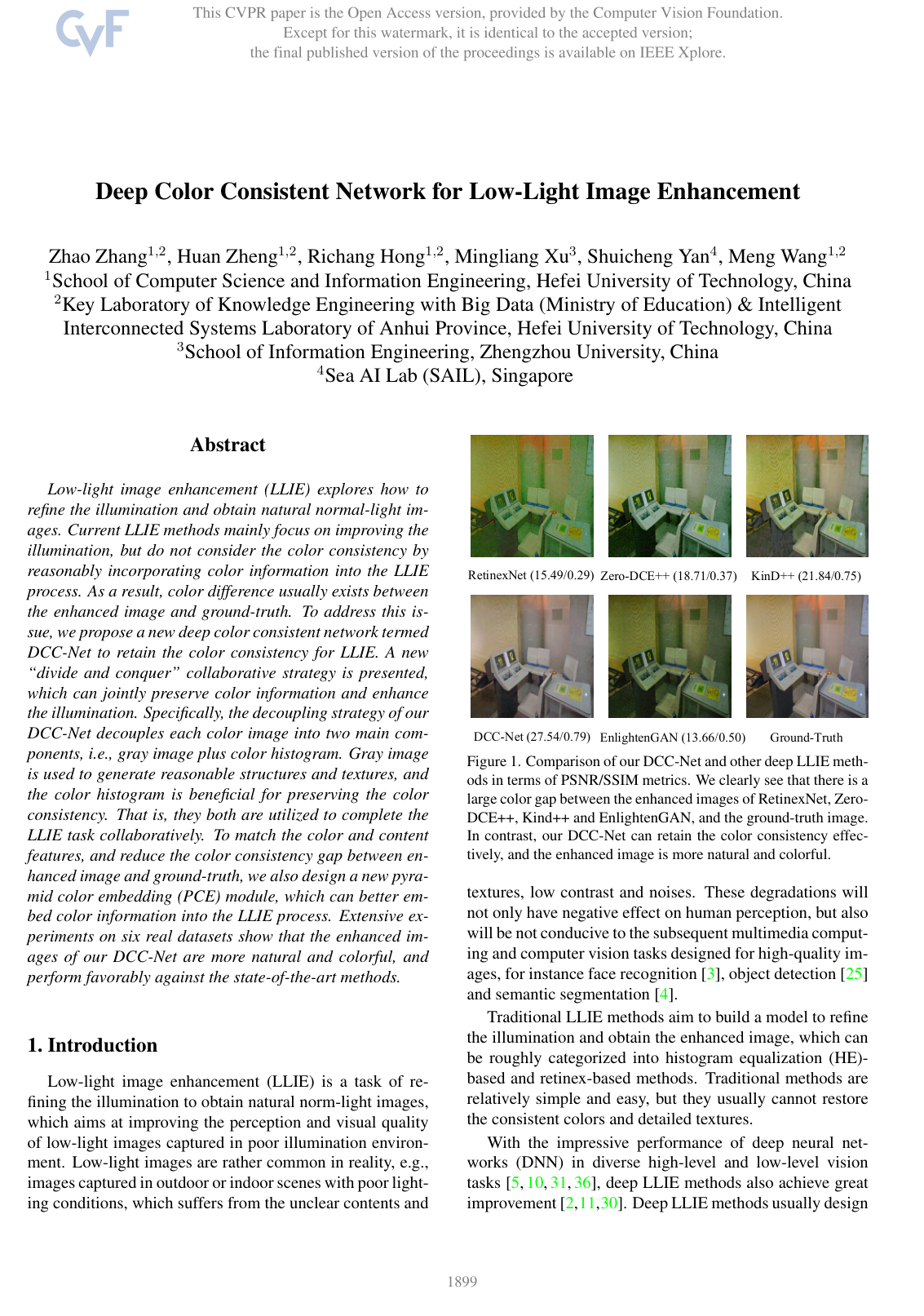
Deep Color Consistent Network for Low-Light Image Enhancement
Zhao Zhang, Huan Zheng, Richang Hong, Mingliang Xu, Shuicheng Yan, Meng Wang
Why you should read this
Proposes DCC-Net, a low-light image restoration framework that decouples images into structural gray components and color histograms to eliminate color distortion through pyramid feature embedding.
Low-light image enhancement (LLIE) explores how to refine the illumination and obtain natural normal-light images. Current LLIE methods mainly focus on improving the illumination, but do not consider the color consistency by reasonably incorporating color information into the LLIE process. As a result, color difference usually exists between the enhanced image and ground-truth. To address this issue, we propose a new deep color consistent network termed DCC-Net to retain the color consistency for LLIE. A new “divide and conquer” collaborative strategy is presented, which can jointly preserve color information and enhance the illumination. Specifically, the decoupling strategy of our DCC-Net decouples each color image into two main components, i.e., gray image plus color histogram. Gray image is used to generate reasonable structures and textures, and the color histogram is beneficial for preserving the color consistency. That is, they both are utilized to complete the LLIE task collaboratively. To match the color and content features, and reduce the color consistency gap between enhanced image and ground-truth, we also design a new pyramid color embedding (PCE) module, which can better embed color information into the LLIE process. Extensive experiments on six real datasets show that the enhanced images of our DCC-Net are more natural and colorful, and perform favorably against the state-of-the-art methods.
Added
2026-10-05
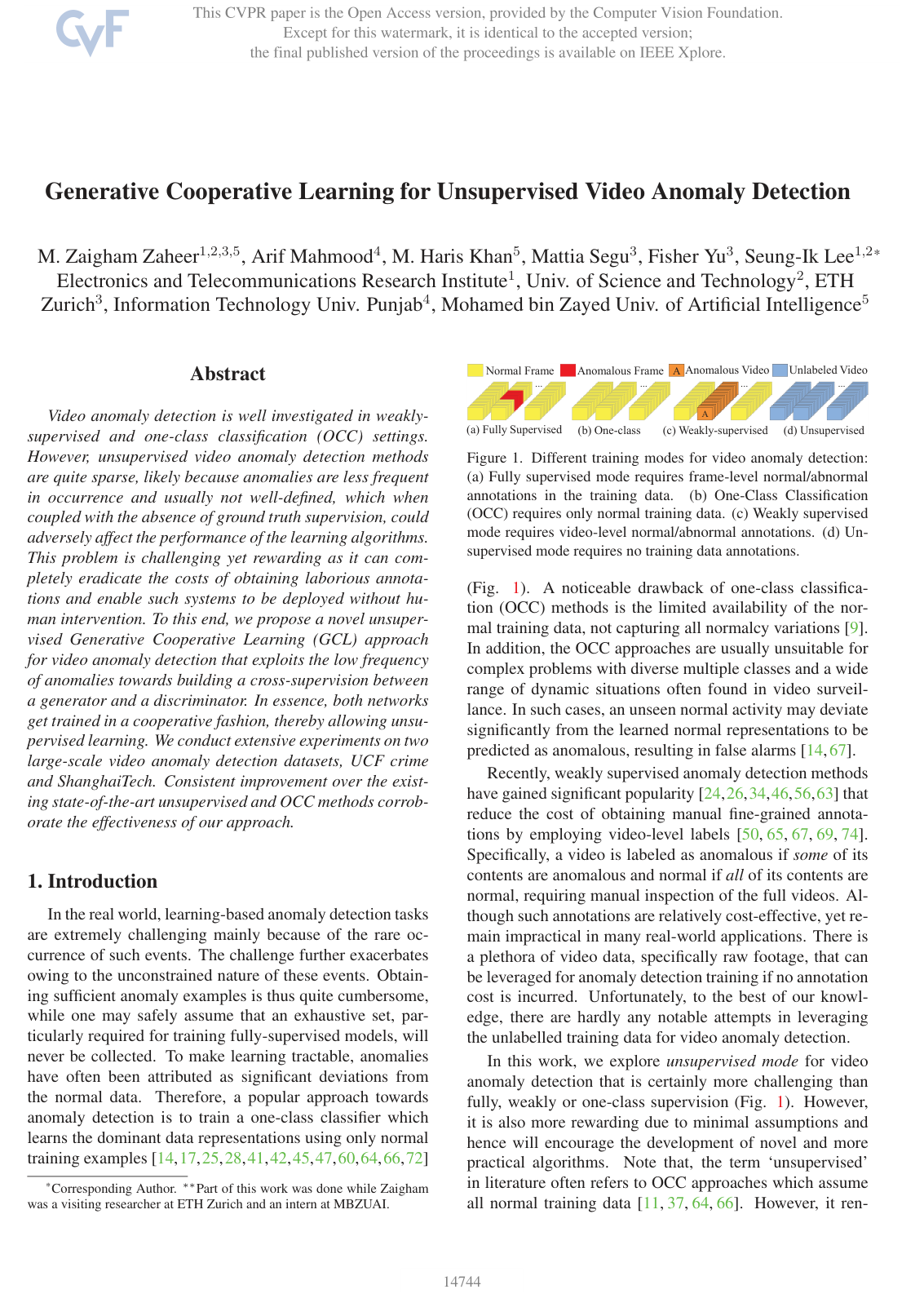
Generative Cooperative Learning for Unsupervised Video Anomaly Detection
Muhammad Zaigham Zaheer, Arif Mahmood, Muhammad Haris Khan, Mattia Segù, Fisher Yu, Seung-Ik Lee
Why you should read this
Proposes a fully unsupervised video anomaly detection framework that trains a generator and a discriminator via iterative cross-supervision and negative learning on unlabelled data, eliminating the need for normal-only or frame-level annotations while outperforming existing one-class classification baselines on UCF-Crime and ShanghaiTech.
Video anomaly detection is well investigated in weakly-supervised and one-class classification (OCC) settings. However, unsupervised video anomaly detection methods are quite sparse, likely because anomalies are less frequent in occurrence and usually not well-defined, which when coupled with the absence of ground truth supervision, could adversely affect the performance of the learning algorithms. This problem is challenging yet rewarding as it can completely eradicate the costs of obtaining laborious annotations and enable such systems to be deployed without human intervention. To this end, we propose a novel unsupervised Generative Cooperative Learning (GCL) approach for video anomaly detection that exploits the low frequency of anomalies towards building a cross-supervision between a generator and a discriminator. In essence, both networks get trained in a cooperative fashion, thereby allowing unsupervised learning. We conduct extensive experiments on two large-scale video anomaly detection datasets, UCF crime and ShanghaiTech. Consistent improvement over the existing state-of-the-art unsupervised and OCC methods corroborate the effectiveness of our approach.
Added
2026-10-05
Deep Learning in Mobile and Wireless Networking: A Survey
Chaoyun Zhang, Paul Patras, Hamed Haddadi
Why you should read this
Provides a comprehensive taxonomy and critical review of how deep learning architectures are applied across mobile and wireless networking domains, offering practical guidance on deploying neural models onto resource-constrained mobile systems.
The rapid uptake of mobile devices and the rising popularity of mobile applications and services pose unprecedented demands on mobile and wireless networking infrastructure. Upcoming 5G systems are evolving to support exploding mobile traffic volumes, agile management of network resource to maximize user experience, and extraction of fine-grained real-time analytics. Fulfilling these tasks is challenging, as mobile environments are increasingly complex, heterogeneous, and evolving. One potential solution is to resort to advanced machine learning techniques to help managing the rise in data volumes and algorithm-driven applications. The recent success of deep learning underpins new and powerful tools that tackle problems in this space. In this paper we bridge the gap between deep learning and mobile and wireless networking research, by presenting a comprehensive survey of the crossovers between the two areas. We first briefly introduce essential background and state-of-the-art in deep learning techniques with potential applications to networking. We then discuss several techniques and platforms that facilitate the efficient deployment of deep learning onto mobile systems. Subsequently, we provide an encyclopedic review of mobile and wireless networking research based on deep learning, which we categorize by different domains. Drawing from our experience, we discuss how to tailor deep learning to mobile environments. We complete this survey by pinpointing current challenges and open future directions for research.
Added
2026-09-24
Multimodal learning with deep Boltzmann machines
Nitish Srivastava, Ruslan Salakhutdinov
Why you should read this
Proposes a Multimodal Deep Boltzmann Machine that learns a joint generative model across disparate modalities like images and text, enabling effective classification, cross-modal retrieval, and the reconstruction of missing inputs.
A Deep Boltzmann Machine is described for learning a generative model of data that consists of multiple and diverse input modalities. The model can be used to extract a unified representation that fuses modalities together. We find that this representation is useful for classification and information retrieval tasks. The model works by learning a probability density over the space of multimodal inputs. It uses states of latent variables as representations of the input. The model can extract this representation even when some modalities are absent by sampling from the conditional distribution over them and filling them in. Our experimental results on bi-modal data consisting of images and text show that the Multimodal DBM can learn a good generative model of the joint space of image and text inputs that is useful for information retrieval from both unimodal and multimodal queries. We further demonstrate that this model significantly outperforms SVMs and LDA on discriminative tasks. Finally, we compare our model to other deep learning methods, including autoencoders and deep belief networks, and show that it achieves noticeable gains.
Added
2026-09-18
LLNet: A deep autoencoder approach to natural low-light image enhancement
Kin Gwn Lore, Adedotun Akintayo, Soumik Sarkar
Why you should read this
Introduces LLNet, a deep autoencoder architecture that simultaneously brightens low-light images and removes noise without over-saturating highlights, demonstrating that networks trained on synthetic degradations can effectively restore natural dark scenes.
In surveillance, monitoring and tactical reconnaissance, gathering the right visual information from a dynamic environment and accurately processing such data are essential ingredients to making informed decisions which determines the success of an operation. Camera sensors are often cost-limited in ability to clearly capture objects without defects from images or videos taken in a poorly-lit environment. The goal in many applications is to enhance the brightness, contrast and reduce noise content of such images in an on-board real-time manner. We propose a deep autoencoder-based approach to identify signal features from low-light images handcrafting and adaptively brighten images without over-amplifying the lighter parts in images (i.e., without saturation of image pixels) in high dynamic range. We show that a variant of the recently proposed stacked-sparse denoising autoencoder can learn to adaptively enhance and denoise from synthetically darkened and noisy training examples. The network can then be successfully applied to naturally low-light environment and/or hardware degraded images. Results show significant credibility of deep learning based approaches both visually and by quantitative comparison with various popular enhancing, state-of-the-art denoising and hybrid enhancing-denoising techniques.
Added
2026-09-18
Structural Deep Network Embedding
Daixin Wang, Peng Cui, Wenwu Zhu
Why you should read this
Proposes a semi-supervised deep autoencoder architecture that jointly preserves first-order and second-order proximities, capturing highly non-linear local and global graph structures for effective representation learning on sparse networks.
Network embedding is an important method to learn low-dimensional representations of vertexes in networks, aiming to capture and preserve the network structure. Almost all the existing network embedding methods adopt shallow models. However, since the underlying network structure is complex, shallow models cannot capture the highly non-linear network structure, resulting in sub-optimal network representations. Therefore, how to find a method that is able to effectively capture the highly non-linear network structure and preserve the global and local structure is an open yet important problem. To solve this problem, in this paper we propose a Structural Deep Network Embedding method, namely SDNE. More specifically, we first propose a semi-supervised deep model, which has multiple layers of non-linear functions, thereby being able to capture the highly non-linear network structure. Then we propose to exploit the first-order and second-order proximity jointly to preserve the network structure. The second-order proximity is used by the unsupervised component to capture the global network structure. While the first-order proximity is used as the supervised information in the supervised component to preserve the local network structure. By jointly optimizing them in the semi-supervised deep model, our method can preserve both the local and global network structure and is robust to sparse networks. Empirically, we conduct the experiments on five real-world networks, including a language network, a citation network and three social networks. The results show that compared to the baselines, our method can reconstruct the original network significantly better and achieves substantial gains in three applications, i.e. multi-label classification, link prediction and visualization.
Added
2026-09-14
Unsupervised Deep Embedding for Clustering Analysis
Junyuan Xie, Ross B. Girshick, Ali Farhadi
Why you should read this
Proposes Deep Embedded Clustering (DEC), an unsupervised method that simultaneously learns low-dimensional feature representations and cluster assignments within deep neural networks to outperform traditional clustering pipelines on image and text benchmarks.
Clustering is central to many data-driven application domains and has been studied extensively in terms of distance functions and grouping algorithms. Relatively little work has focused on learning representations for clustering. In this paper, we propose Deep Embedded Clustering (DEC), a method that simultaneously learns feature representations and cluster assignments using deep neural networks. DEC learns a mapping from the data space to a lower-dimensional feature space in which it iteratively optimizes a clustering objective. Our experimental evaluations on image and text corpora show significant improvement over state-of-the-art methods.
Added
2026-09-11