Plug-In Diffusion Model for Sequential Recommendation
Haokai MaRuobing XieLei MengXin ChenXu ZhangLeyu LinZhanhui Kang
Proposes a model-agnostic plug-in framework that leverages time-interval diffusion models to generate preference distributions across all items, mitigating data sparsity and noisy interactions in sequential recommenders through behavior reweighting, positive augmentation, and noise-free negative sampling.
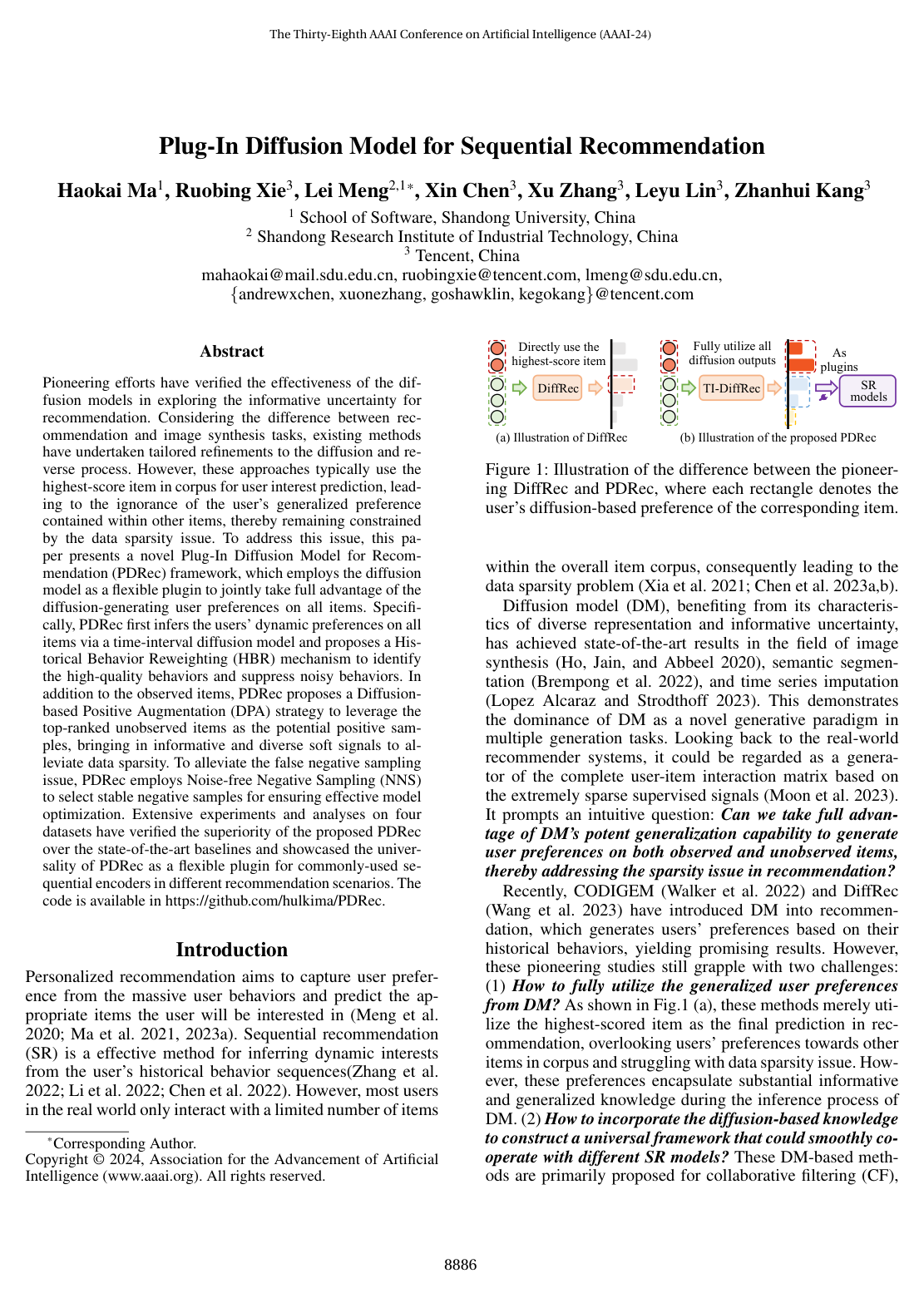
Modern online platforms rely heavily on sequential recommendation systems to anticipate user needs by analyzing past behavior sequences. However, because most users interact with only a tiny fraction of available items, these systems suffer from severe data sparsity. While generative diffusion models—widely recognized for their success in image generation—have recently been applied to recommendations to model uncertainty, existing approaches only use the single highest-scoring generated item. This narrow focus discards valuable preference information across the rest of the catalog and fails to address temporal dynamics.
The article develops and evaluates the Plug-In Diffusion Model for Recommendation (PDRec), a flexible framework designed to improve sequential recommenders by leveraging diffusion-generated user preferences across all catalog items.
The authors designed a time-interval diffusion model that accounts for the timing between user actions and integrates three modular mechanisms into existing recommendation architectures. First, it reweights historical user actions to filter out noise and emphasize critical interactions. Second, it identifies high-scoring unobserved items to serve as positive training signals, expanding user interests and addressing data sparsity. Third, it selects reliable negative samples from low-scoring unobserved items to prevent incorrect negative labeling. The evaluation tested PDRec across four real-world datasets spanning e-commerce, gaming, books, and music, pairing it with three standard sequential recommendation backbones and assessing performance in single-domain and cross-domain settings.
The evaluation yielded three key findings. First, integrating PDRec produced statistically significant accuracy improvements across all baseline models and datasets, showing gains of up to 13.88% in ranking quality metrics such as Normalized Discounted Cumulative Gain. Second, the performance benefits were especially pronounced on sparser datasets, where data limitations are most severe. Third, in cross-domain recommendation tasks, PDRec achieved improvements of up to 38.3% over standalone diffusion models, demonstrating that its modular components effectively curb negative transfer when merging behavioral streams across domains.
These findings indicate that diffusion models are most valuable when utilized as flexible, pre-trained plugins rather than standalone recommenders. By mining preference signals across the entire item catalog to denoise history and augment training data, organizations can significantly enhance recommendation precision without replacing their existing underlying recommendation architectures. Furthermore, using a pre-trained diffusion model for inference rather than end-to-end retraining helps control computational overhead.
Engineering and data teams should consider adopting this plug-in approach to enhance current sequential recommendation pipelines, particularly for product categories with sparse user interaction. For immediate exploration, organizations can pilot the framework in cross-domain or cold-start scenarios using the authors' publicly available codebase, evaluating the trade-off between offline pre-computation costs and online accuracy gains. Future work should focus on developing advanced hard-negative sampling strategies and testing the framework across broader industry operational environments.
Confidence in these findings is supported by rigorous multi-dataset benchmarking and consistent improvements across different model architectures. However, decision-makers should note that optimal performance requires tuning dataset-specific thresholds (such as truncation bounds and negative sampling proportions), and production deployment will depend on managing the computational resources required for diffusion model inference across very large product catalogs.
- Paper: Self-Attentive Sequential Recommendation, Wang-Cheng Kang et al. (2018). SASRec establishes the self-attentive foundation for sequential recommendation that serves as a primary baseline architecture and backbone enhanced by PDRec's plug-in diffusion framework.
- Paper: Uniform Sequence Better: Time Interval Aware Data Augmentation for Sequential Recommendation, Yizhou Dang et al. (2023). This paper establishes the importance of modeling irregular time intervals and sequence dynamics in recommender systems, directly motivating PDRec's time-interval diffusion mechanism.
- Paper: BERT4Rec: Sequential Recommendation with Bidirectional Encoder Representations from Transformer, Fei Sun et al. (2019). BERT4Rec introduces bidirectional self-attention architectures for sequential recommendation that form one of the standard sequential backbones evaluated with PDRec.
- Paper: Denoising Diffusion Probabilistic Models, Jonathan Ho et al. (2020). This foundational paper outlines the mathematical formulation and denoising principles of diffusion probabilistic models that PDRec adapts into a plug-in preference generation model.
- Paper: Diffusion Models: A Comprehensive Survey of Methods and Applications, Ling Yang et al. (2022). This comprehensive survey details theoretical foundations and optimization methods of diffusion models, providing essential background on generative diffusion mechanics utilized in PDRec.
- Paper: Session-based Recommendations with Recurrent Neural Networks, Balázs Hidasi et al. (2016). GRU4Rec pioneered neural sequence modeling for recommendation, establishing the core problem formulation of sequential item prediction that PDRec builds upon.
- Paper: BPR: Bayesian Personalized Ranking from Implicit Feedback, Steffen Rendle et al. (2009). BPR establishes the standard Bayesian personalized ranking optimization framework and implicit feedback sampling paradigm that PDRec refines using diffusion-guided positive and negative signals.
- Paper: An Embarrassingly Simple Graph Heuristic Reveals Shortcut-Solvable Benchmarks for Sequential Recommendation, Haoyu Han et al. (2026). This work critiques complex generative and sequential recommenders by showing how simple graph heuristics exploit benchmark shortcuts, offering a critical evaluation perspective following PDRec.
- Paper: An Attentive Inductive Bias for Sequential Recommendation beyond the Self-Attention, Yehjin Shin et al. (2024). This paper advances sequential recommendation backbones by addressing oversmoothing in self-attention with frequency-domain filtering, providing an alternative sequence modeling direction to explore after PDRec.