Uniform Sequence Better: Time Interval Aware Data Augmentation for Sequential Recommendation
Yizhou DangEnneng YangGuibing GuoLinying JiangXingwei WangXiaoxiao XuQinghui SunHong Liu
Proposes time-interval-aware data augmentation operators that transform irregular interaction sequences into uniform sequences to mitigate user preference drift and substantially improve sequential recommendation accuracy.
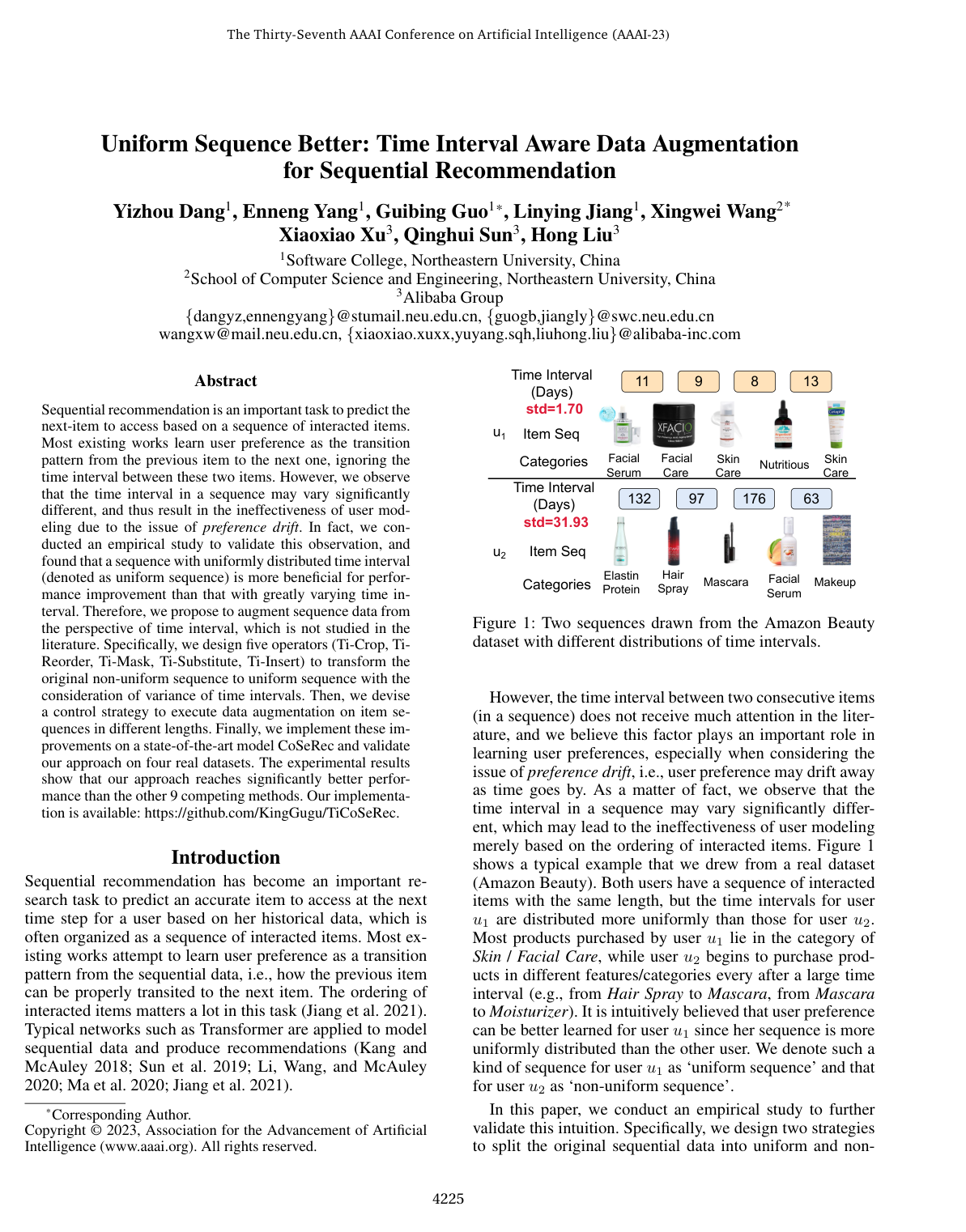
Modern online platforms rely heavily on sequential recommendation systems to predict what item a user will interact with next. Existing methods primarily focus on the ordering of interactions while ignoring the elapsed time between them. However, real-world user activity is often bursty or irregular, causing significant gaps in interaction histories. When long time gaps occur, user preferences frequently shift—a phenomenon known as preference drift—which degrades recommendation accuracy and diminishes user engagement.
The article evaluates the impact of time interval distributions on recommendation performance and introduces a novel framework that improves prediction accuracy by restructuring interaction histories through time-aware data augmentation.
To address this challenge, the authors first conducted an empirical benchmark showing that training models on sequences with uniformly spaced time intervals delivers substantial accuracy gains over sequences with irregular gaps. Building on this insight, they developed five targeted data modification techniques—insertion, cropping, masking, substitution, and reordering—specifically designed to regularize irregular time intervals or preserve core interaction patterns. These operators were integrated with contrastive learning, a self-supervised method that ensures modified data retains high similarity to the original behaviors, forming a comprehensive model termed TiCoSeRec. The approach was evaluated across four large real-world benchmarks encompassing e-commerce and consumer reviews.
The study yielded several key findings. First, existing recommendation algorithms achieved 15% to over 30% higher ranking accuracy when trained on uniform interaction sequences compared to irregular sequences. Second, across four diverse public datasets, the proposed TiCoSeRec framework consistently outperformed nine baseline recommendation models, yielding relative performance gains ranging from 5% to 18%. Third, ablation experiments revealed that the time-aware substitution operator had the most critical positive impact on accuracy. Finally, parameter sensitivity analysis demonstrated optimal results when leaving the top 20% most uniform user sequences intact while applying time-aware augmentation to the remaining 80%.
These findings demonstrate that improving data quality prior to model training is more effective than solely relying on complex temporal architectures. Rather than feeding noisy, irregular raw interaction histories directly into models, standardizing sequence timing reduces noise and prevents model disorientation caused by user preference drift. For organizations managing digital marketplaces or content platforms, adopting time-aware sequence refinement provides a practical, high-impact mechanism to enhance recommendation relevance and conversion metrics.
Organizations seeking to enhance their recommendation pipelines should implement time-interval-aware augmentation across irregular user histories, specifically targeting the least uniform 70% to 80% of sequence data. In terms of implementation options, teams should prioritize time-guided item substitution, insertion, and masking, while applying length-dependent rules to prevent over-modifying very short user histories. Next steps should explore incorporating product categories and contextual attributes directly into the augmentation logic.
The findings are supported by consistent results across four large real-world datasets spanning multiple product and service domains. However, certain limitations remain: the framework relies on tuned thresholds to classify uniform sequences, and evaluation was centered on standard e-commerce rating datasets. Overall, decision-makers can have high confidence in applying time-interval-aware augmentation to sequential recommendation workflows.
- Paper: Self-Attentive Sequential Recommendation, Wang-Cheng Kang et al. (2018). SASRec establishes the foundational self-attentive sequential recommendation architecture that contrastive and data-augmented sequential recommendation models build upon.
- Paper: BERT4Rec: Sequential Recommendation with Bidirectional Encoder Representations from Transformer, Fei Sun et al. (2019). BERT4Rec introduces bidirectional self-attention and sequence masking techniques to sequential recommendation that underpin modern sequence augmentation and transformation strategies.
- Paper: Personalized Top-N Sequential Recommendation via Convolutional Sequence Embedding, Jiaxi Tang et al. (2018). This work establishes core principles of modeling sequential transition patterns and skip behaviors in user interaction histories for sequential recommendation.
- Paper: Collaborative filtering with temporal dynamics, Yehuda Koren (2009). This seminal paper provides foundational insights into modeling temporal dynamics and user preference drift over time in recommender systems.
- Paper: Session-based Recommendations with Recurrent Neural Networks, Balázs Hidasi et al. (2016). This paper establishes sequence-based neural modeling for user interaction sessions that serves as the benchmark paradigm for modern sequential recommenders.
- Paper: Plug-In Diffusion Model for Sequential Recommendation, Haokai Ma et al. (2024). PDRec extends time-interval-aware sequential recommendation by employing a diffusion plugin framework to model dynamic user preferences across the entire item space.