
keyword
sequential recommendation
Sequential recommendation is a task in recommender systems that aims to predict a user's next interaction or interest based on the chronological sequence of their past behaviors. Unlike conventional recommendation methods that treat user feedback as static or order-independent sets, sequential recommendation explicitly models temporal dynamics, item-to-item transition patterns, and evolving preferences over time. By processing ordered interaction histories such as sequences of views, clicks, or purchases, these systems capture both immediate contextual intentions and long-term interest shifts to generate timely and personalized next-item suggestions.
10 items
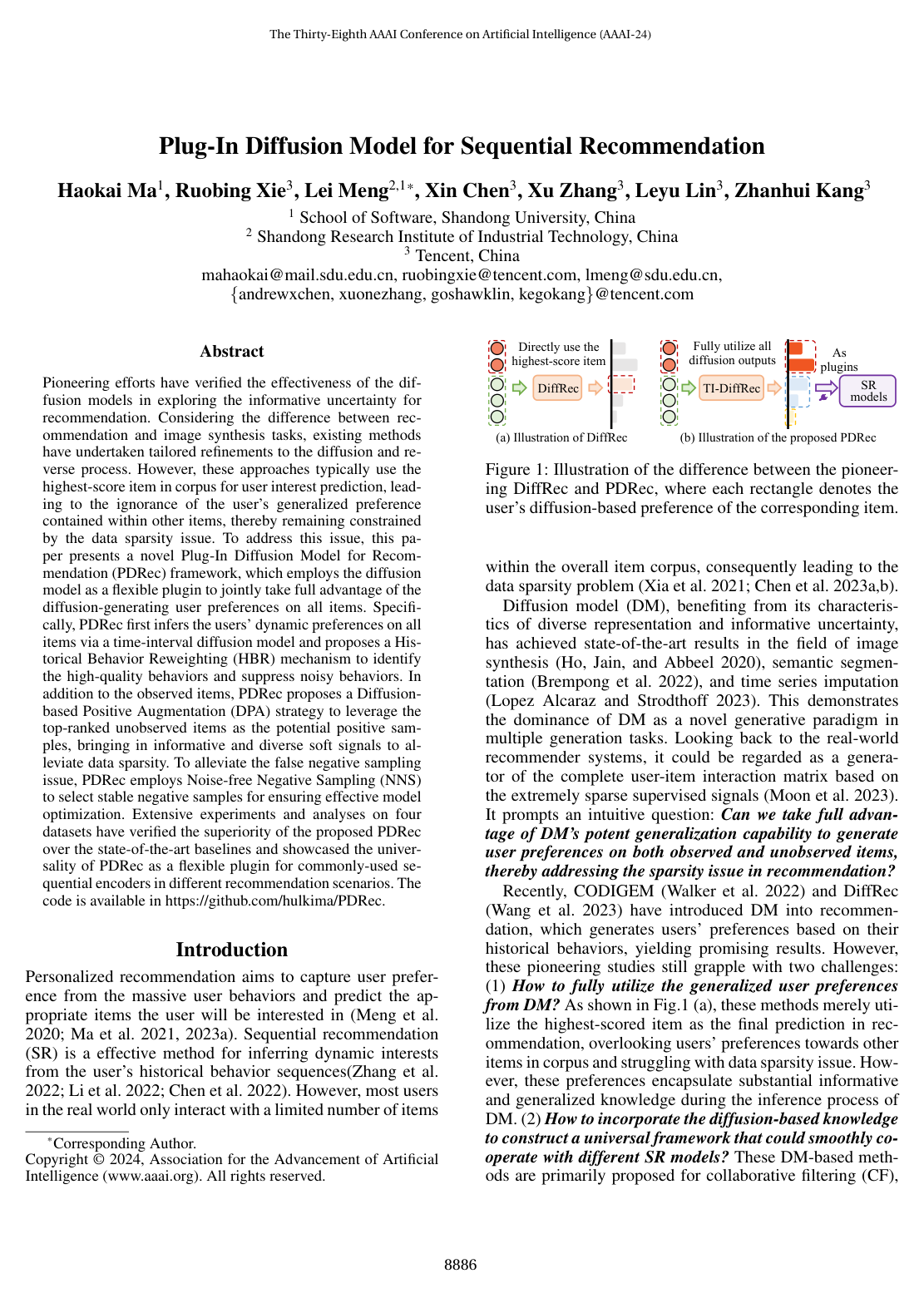
Plug-In Diffusion Model for Sequential Recommendation
Haokai Ma, Ruobing Xie, Lei Meng, Xin Chen, Xu Zhang, Leyu Lin, Zhanhui Kang
Why you should read this
Proposes a model-agnostic plug-in framework that leverages time-interval diffusion models to generate preference distributions across all items, mitigating data sparsity and noisy interactions in sequential recommenders through behavior reweighting, positive augmentation, and noise-free negative sampling.
Pioneering efforts have verified the effectiveness of the diffusion models in exploring the informative uncertainty for recommendation. Considering the difference between recommendation and image synthesis tasks, existing methods have undertaken tailored refinements to the diffusion and reverse process. However, these approaches typically use the highest-score item in corpus for user interest prediction, leading to the ignorance of the user's generalized preference contained within other items, thereby remaining constrained by the data sparsity issue. To address this issue, this paper presents a novel Plug-In Diffusion Model for Recommendation (PDRec) framework, which employs the diffusion model as a flexible plugin to jointly take full advantage of the diffusion-generating user preferences on all items. Specifically, PDRec first infers the users' dynamic preferences on all items via a time-interval diffusion model and proposes a Historical Behavior Reweighting (HBR) mechanism to identify the high-quality behaviors and suppress noisy behaviors. In addition to the observed items, PDRec proposes a Diffusion-based Positive Augmentation (DPA) strategy to leverage the top-ranked unobserved items as the potential positive samples, bringing in informative and diverse soft signals to alleviate data sparsity. To alleviate the false negative sampling issue, PDRec employs Noise-free Negative Sampling (NNS) to select stable negative samples for ensuring effective model optimization. Extensive experiments and analyses on four datasets have verified the superiority of the proposed PDRec over the state-of-the-art baselines and showcased the universality of PDRec as a flexible plugin for commonly-used sequential encoders in different recommendation scenarios. The code is available in https://github.com/hulkima/PDRec.
Added
2026-09-26
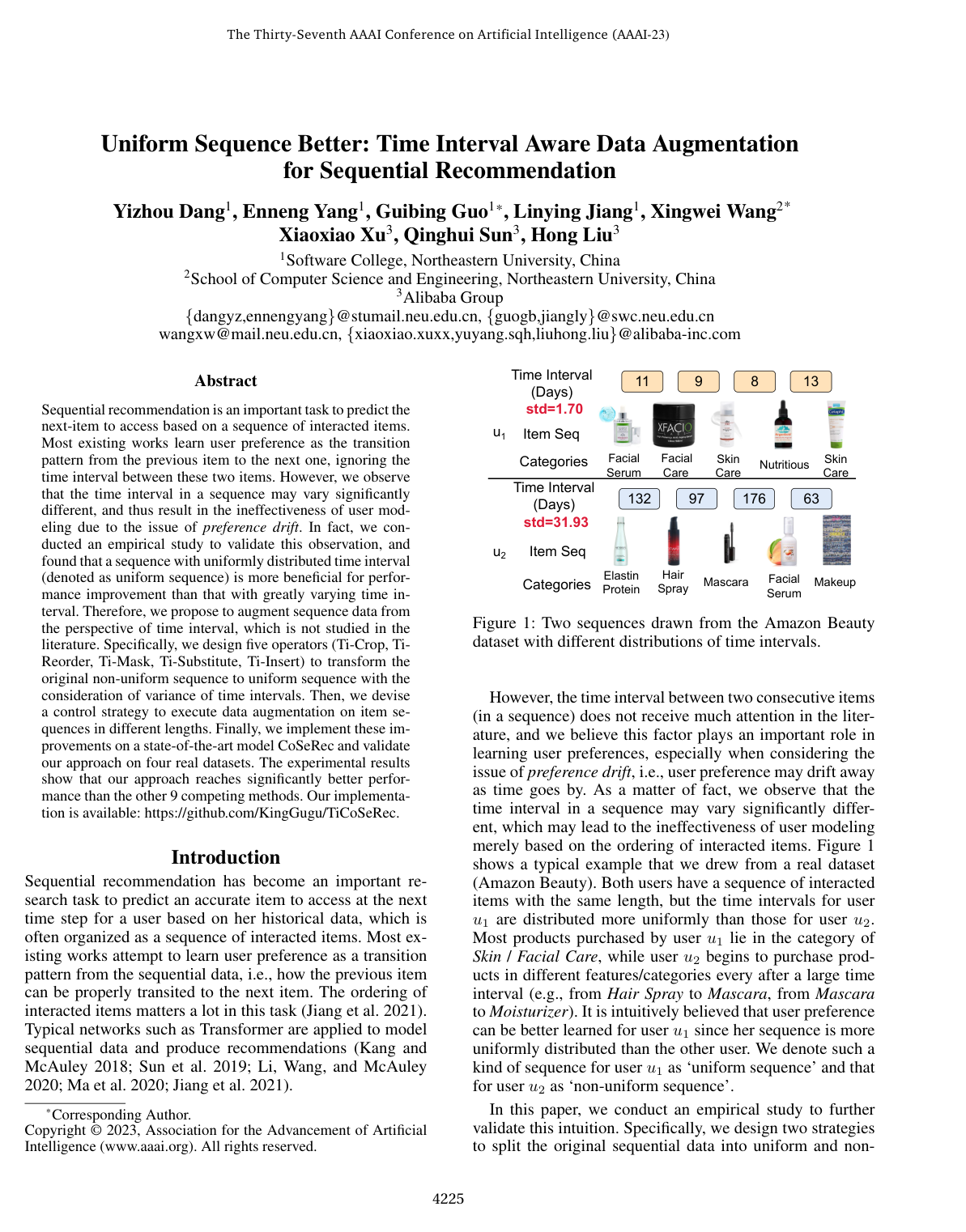
Uniform Sequence Better: Time Interval Aware Data Augmentation for Sequential Recommendation
Yizhou Dang, Enneng Yang, Guibing Guo, Linying Jiang, Xingwei Wang, Xiaoxiao Xu, Qinghui Sun, Hong Liu
Why you should read this
Proposes time-interval-aware data augmentation operators that transform irregular interaction sequences into uniform sequences to mitigate user preference drift and substantially improve sequential recommendation accuracy.
Sequential recommendation is an important task to predict the next-item to access based on a sequence of interacted items. Most existing works learn user preference as the transition pattern from the previous item to the next one, ignoring the time interval between these two items. However, we observe that the time interval in a sequence may vary significantly different, and thus result in the ineffectiveness of user modeling due to the issue of preference drift. In fact, we conducted an empirical study to validate this observation, and found that a sequence with uniformly distributed time interval (denoted as uniform sequence) is more beneficial for performance improvement than that with greatly varying time interval. Therefore, we propose to augment sequence data from the perspective of time interval, which is not studied in the literature. Specifically, we design five operators (Ti-Crop, Ti-Reorder, Ti-Mask, Ti-Substitute, Ti-Insert) to transform the original non-uniform sequence to uniform sequence with the consideration of variance of time intervals. Then, we devise a control strategy to execute data augmentation on item sequences in different lengths. Finally, we implement these improvements on a state-of-the-art model CoSeRec and validate our approach on four real datasets. The experimental results show that our approach reaches significantly better performance than the other 9 competing methods. Our implementation is available: https://github.com/KingGugu/TiCoSeRec.
Added
2026-09-26
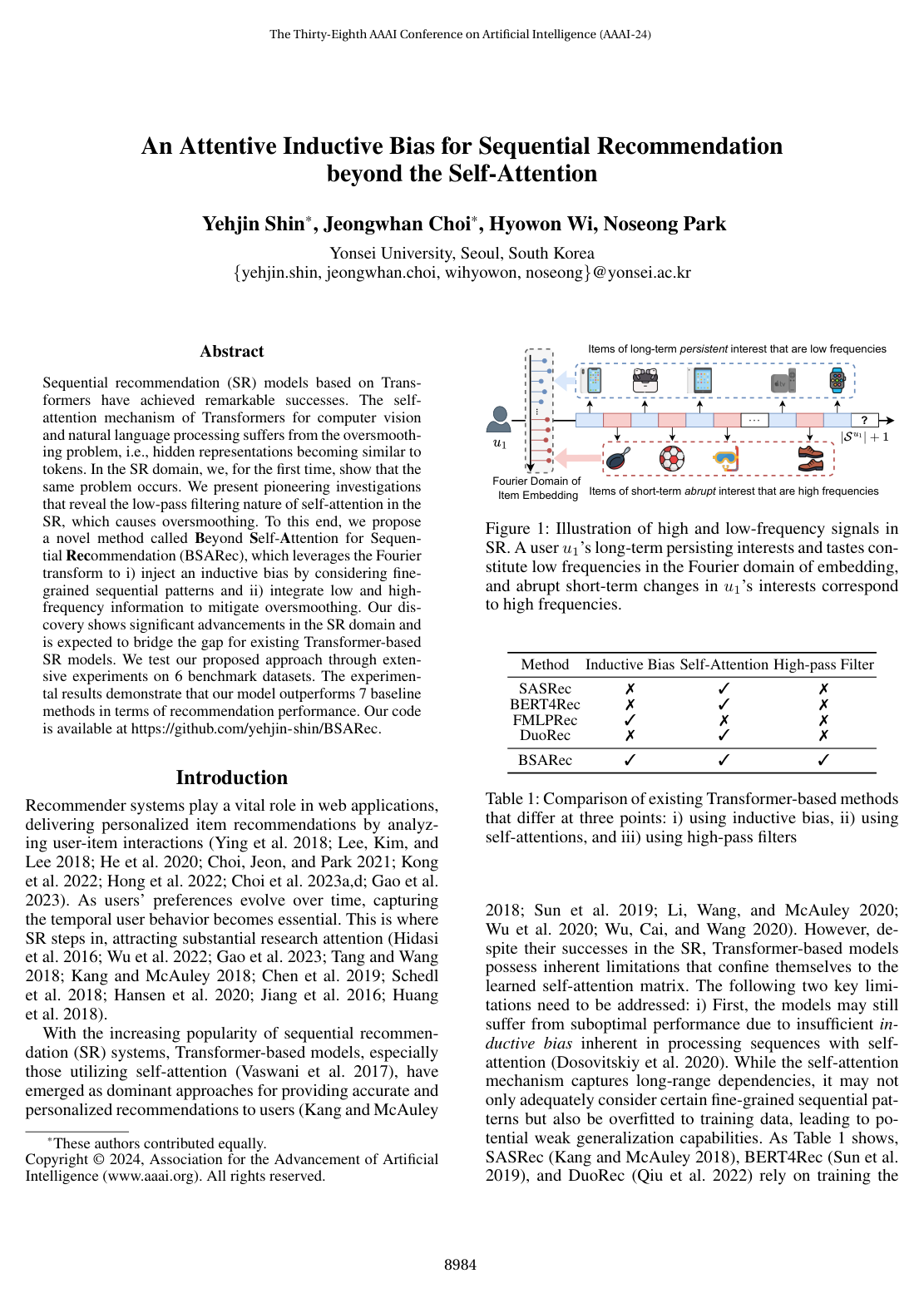
An Attentive Inductive Bias for Sequential Recommendation beyond the Self-Attention
Yehjin Shin, Jeongwhan Choi, Hyowon Wi, Noseong Park
Why you should read this
Reveals that self-attention in sequential recommendation behaves as a low-pass filter causing representation oversmoothing, and introduces BSARec, a Fourier transform-based architecture that integrates high-frequency signals to capture abrupt short-term user preferences alongside long-term interests.
Sequential recommendation (SR) models based on Transformers have achieved remarkable successes. The self-attention mechanism of Transformers for computer vision and natural language processing suffers from the oversmoothing problem, i.e., hidden representations becoming similar to tokens. In the SR domain, we, for the first time, show that the same problem occurs. We present pioneering investigations that reveal the low-pass filtering nature of self-attention in the SR, which causes oversmoothing. To this end, we propose a novel method called Beyond Self-Attention for Sequential Recommendation (BSARec), which leverages the Fourier transform to i) inject an inductive bias by considering fine-grained sequential patterns and ii) integrate low and high-frequency information to mitigate oversmoothing. Our discovery shows significant advancements in the SR domain and is expected to bridge the gap for existing Transformer-based SR models. We test our proposed approach through extensive experiments on 6 benchmark datasets. The experimental results demonstrate that our model outperforms 7 baseline methods in terms of recommendation performance. Our code is available at https://github.com/yehjin-shin/BSARec.
Added
2026-09-26
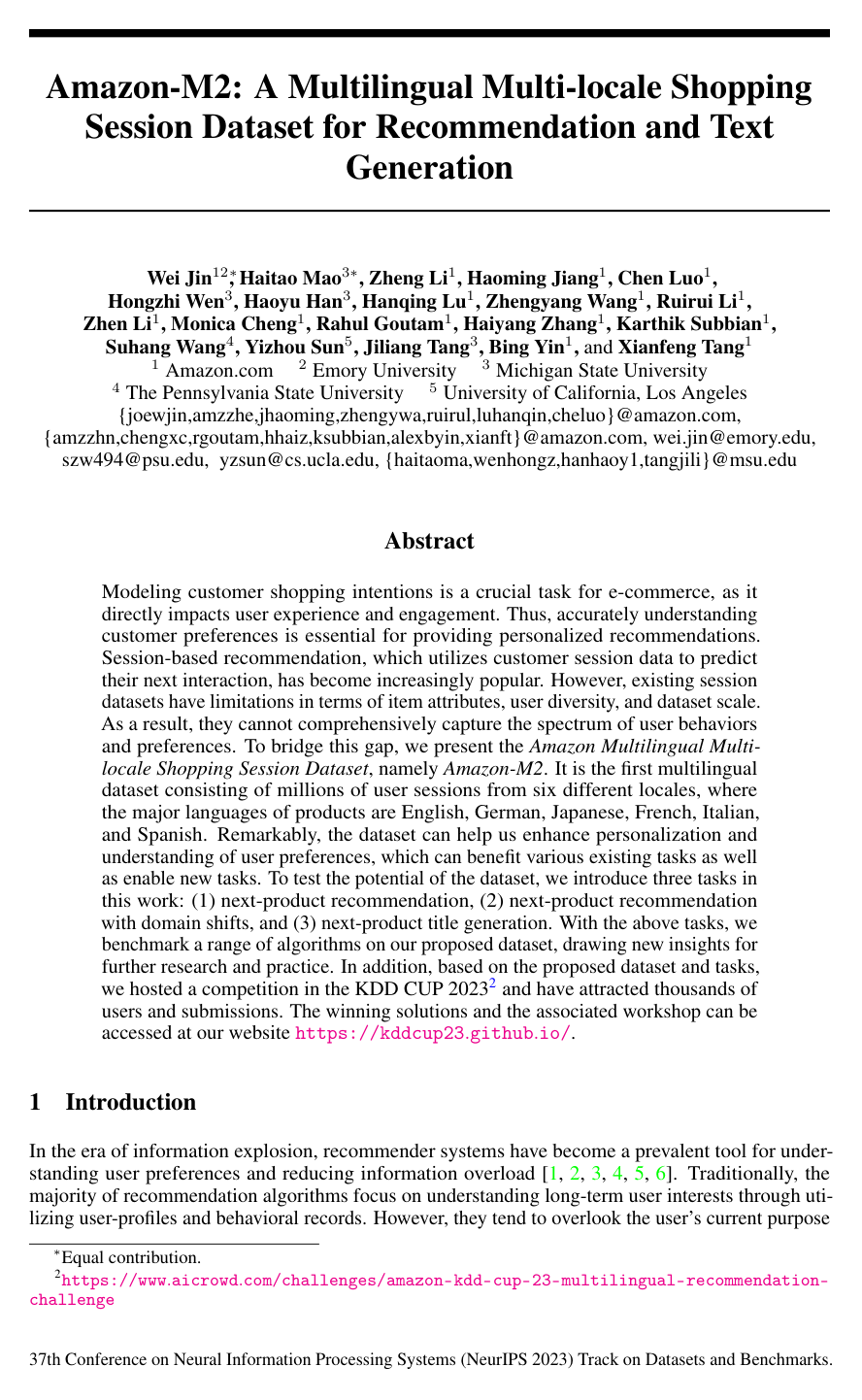
Amazon-M2: A Multilingual Multi-locale Shopping Session Dataset for Recommendation and Text Generation
Wei Jin, Haitao Mao, Zheng Li, Haoming Jiang, Chen Luo, Hongzhi Wen, Haoyu Han, Hanqing Lu, Zhengyang Wang, Ruirui Li, Zhen Li, Monica Xiao Cheng, Rahul Goutam, Haiyang Zhang, Karthik Subbian, Suhang Wang, Yizhou Sun, Jiliang Tang, Bing Yin, Xianfeng Tang
Why you should read this
Presents Amazon-M2, a large-scale shopping session dataset spanning millions of interactions across six languages and locales with rich text attributes, establishing new benchmarks for multilingual session-based recommendation, cross-market domain transfer, and product title generation.
Modeling customer shopping intentions is a crucial task for e-commerce, as it directly impacts user experience and engagement. Thus, accurately understanding customer preferences is essential for providing personalized recommendations. Session-based recommendation, which utilizes customer session data to predict their next interaction, has become increasingly popular. However, existing session datasets have limitations in terms of item attributes, user diversity, and dataset scale. As a result, they cannot comprehensively capture the spectrum of user behaviors and preferences. To bridge this gap, we present the Amazon Multilingual Multi-locale Shopping Session Dataset, namely Amazon-M2. It is the first multilingual dataset consisting of millions of user sessions from six different locales, where the major languages of products are English, German, Japanese, French, Italian, and Spanish. Remarkably, the dataset can help us enhance personalization and understanding of user preferences, which can benefit various existing tasks as well as enable new tasks. To test the potential of the dataset, we introduce three tasks in this work: (1) next-product recommendation, (2) next-product recommendation with domain shifts, and (3) next-product title generation. With the above tasks, we benchmark a range of algorithms on our proposed dataset, drawing new insights for further research and practice. In addition, based on the proposed dataset and tasks, we hosted a competition in the KDD CUP 2023² and have attracted thousands of users and submissions. The winning solutions and the associated workshop can be accessed at our website https://kddcup23.github.io/.
Added
2026-09-26
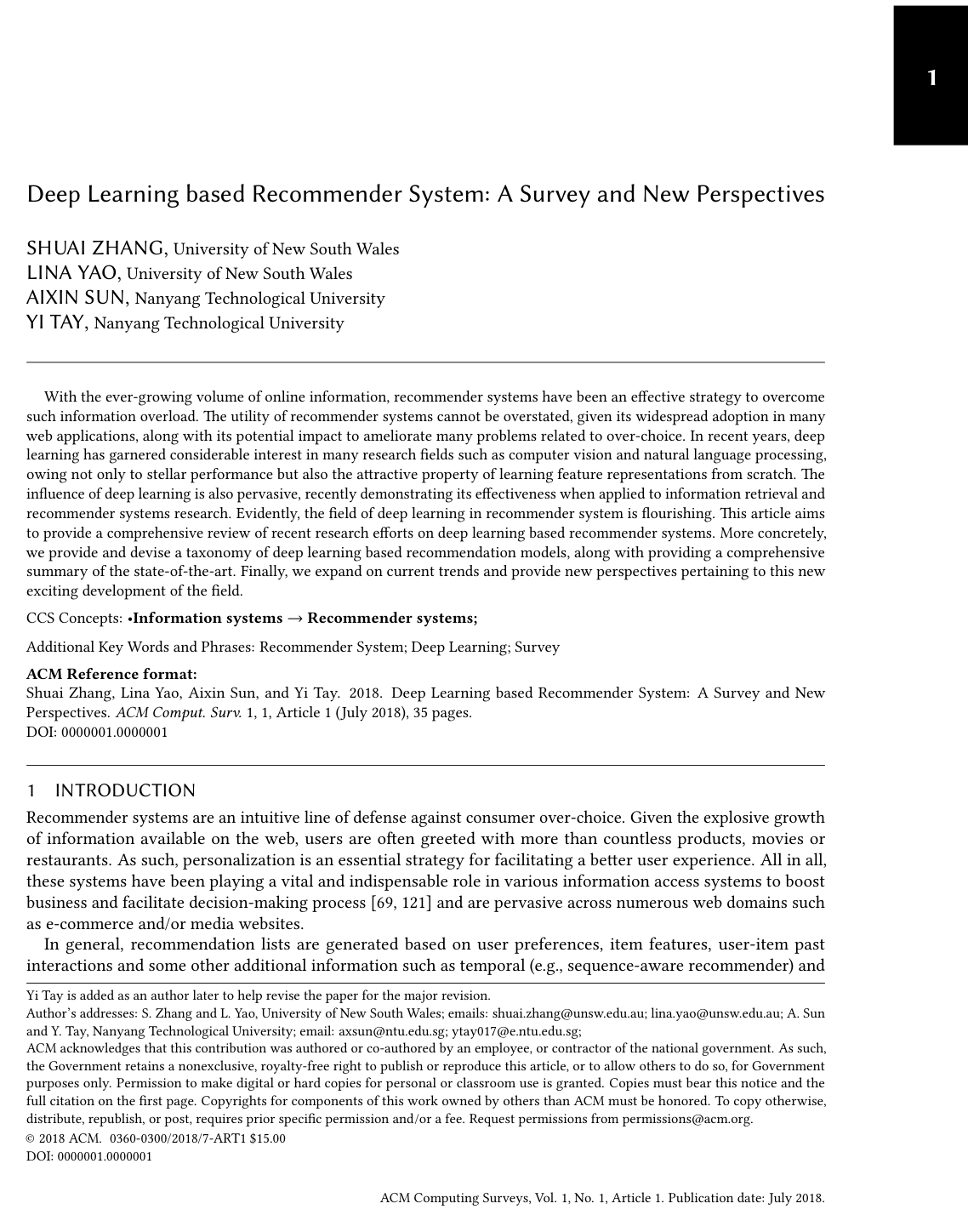
Deep Learning Based Recommender System
Shuai Zhang, Lina Yao, Aixin Sun, Yi Tay
Why you should read this
Provides a comprehensive taxonomy of deep learning recommender systems, synthesizing state-of-the-art architectures and outlining critical open directions for future research.
With the ever-growing volume of online information, recommender systems have been an effective strategy to overcome such information overload. The utility of recommender systems cannot be overstated, given its widespread adoption in many web applications, along with its potential impact to ameliorate many problems related to over-choice. In recent years, deep learning has garnered considerable interest in many research fields such as computer vision and natural language processing, owing not only to stellar performance but also the attractive property of learning feature representations from scratch. The influence of deep learning is also pervasive, recently demonstrating its effectiveness when applied to information retrieval and recommender systems research. Evidently, the field of deep learning in recommender system is flourishing. This article aims to provide a comprehensive review of recent research efforts on deep learning based recommender systems. More concretely, we provide and devise a taxonomy of deep learning based recommendation models, along with providing a comprehensive summary of the state-of-the-art. Finally, we expand on current trends and provide new perspectives pertaining to this new exciting development of the field.
Added
2026-09-25
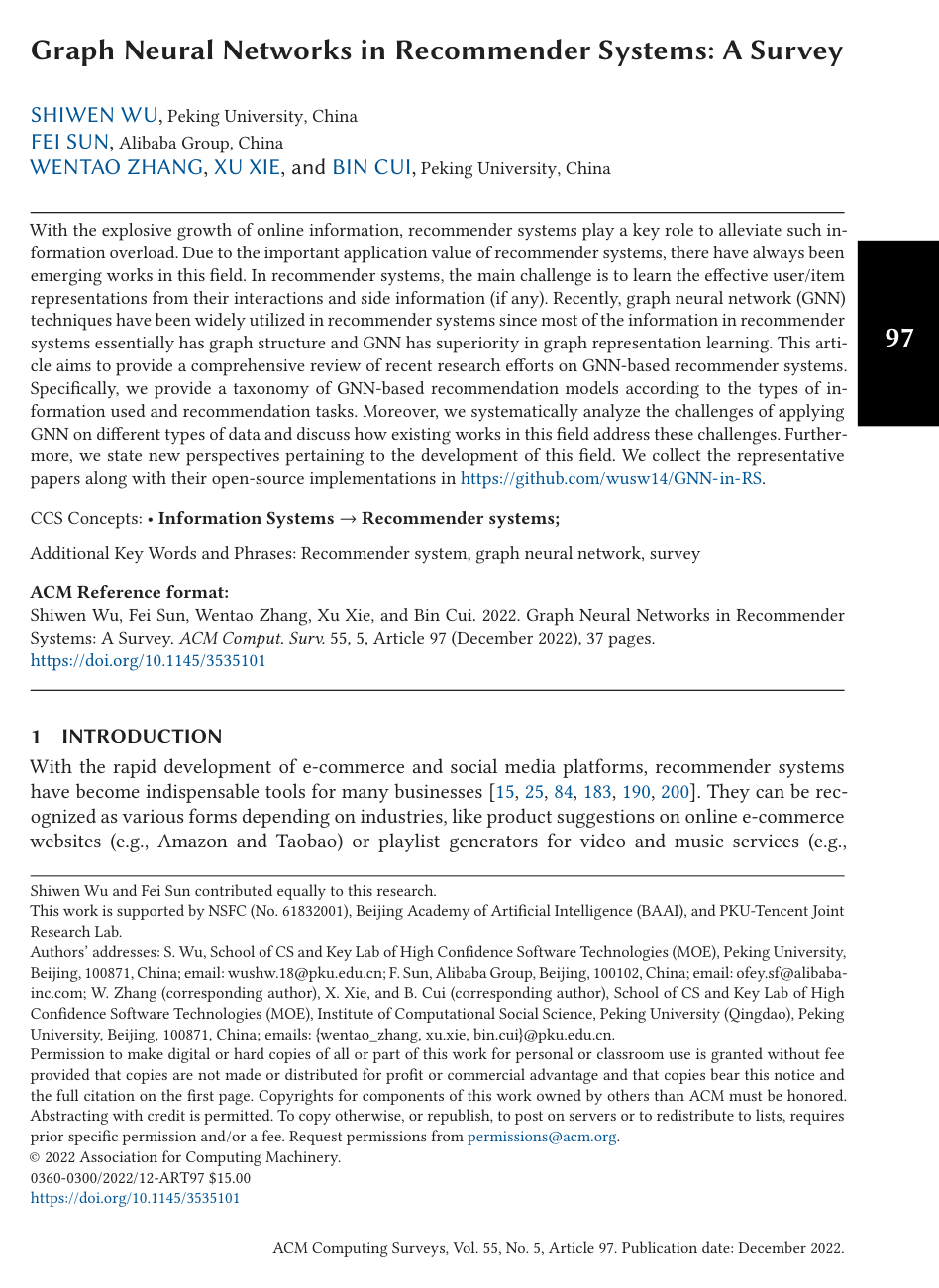
Graph Neural Networks in Recommender Systems: A Survey
Shiwen Wu, Fei Sun, Bin Cui
Why you should read this
Synthesizes graph neural network methods in recommender systems through a structured taxonomy of data types and tasks, detailing key technical challenges and cataloging open-source implementations to guide research and development.
With the explosive growth of online information, recommender systems play a key role to alleviate such information overload. Due to the important application value of recommender systems, there have always been emerging works in this field. In recommender systems, the main challenge is to learn the effective user/item representations from their interactions and side information (if any). Recently, graph neural network (GNN) techniques have been widely utilized in recommender systems since most of the information in recommender systems essentially has graph structure and GNN has superiority in graph representation learning. This article aims to provide a comprehensive review of recent research efforts on GNN-based recommender systems. Specifically, we provide a taxonomy of GNN-based recommendation models according to the types of information used and recommendation tasks. Moreover, we systematically analyze the challenges of applying GNN on different types of data and discuss how existing works in this field address these challenges. Furthermore, we state new perspectives pertaining to the development of this field. We collect the representative papers along with their open-source implementations in this https URL.
Added
2026-09-18
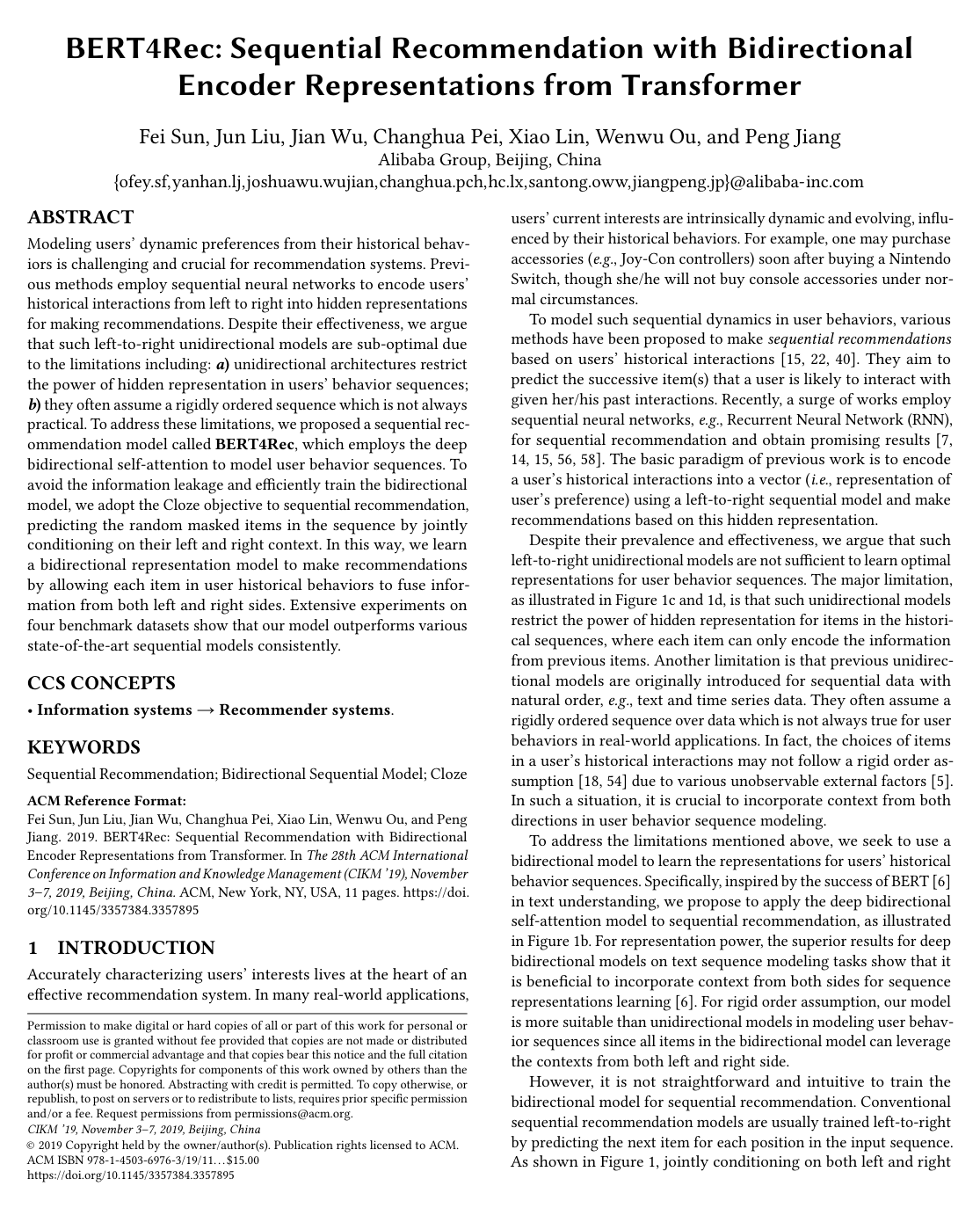
BERT4Rec: Sequential Recommendation with Bidirectional Encoder Representations from Transformer
Fei Sun, Jun Liu, Jian Wu, Changhua Pei, Xiao Lin, Wenwu Ou, Peng Jiang
Why you should read this
Proposes BERT4Rec, an architecture that uses bidirectional Transformers and a Cloze training objective to capture two-way context in user behavior histories, outperforming traditional unidirectional sequential recommendation models.
Modeling users' dynamic and evolving preferences from their historical behaviors is challenging and crucial for recommendation systems. Previous methods employ sequential neural networks (e.g., Recurrent Neural Network) to encode users' historical interactions from left to right into hidden representations for making recommendations. Although these methods achieve satisfactory results, they often assume a rigidly ordered sequence which is not always practical. We argue that such left-to-right unidirectional architectures restrict the power of the historical sequence representations. For this purpose, we introduce a Bidirectional Encoder Representations from Transformers for sequential Recommendation (BERT4Rec). However, jointly conditioning on both left and right context in deep bidirectional model would make the training become trivial since each item can indirectly "see the target item". To address this problem, we train the bidirectional model using the Cloze task, predicting the masked items in the sequence by jointly conditioning on their left and right context. Comparing with predicting the next item at each position in a sequence, the Cloze task can produce more samples to train a more powerful bidirectional model. Extensive experiments on four benchmark datasets show that our model outperforms various state-of-the-art sequential models consistently.
Added
2026-09-11
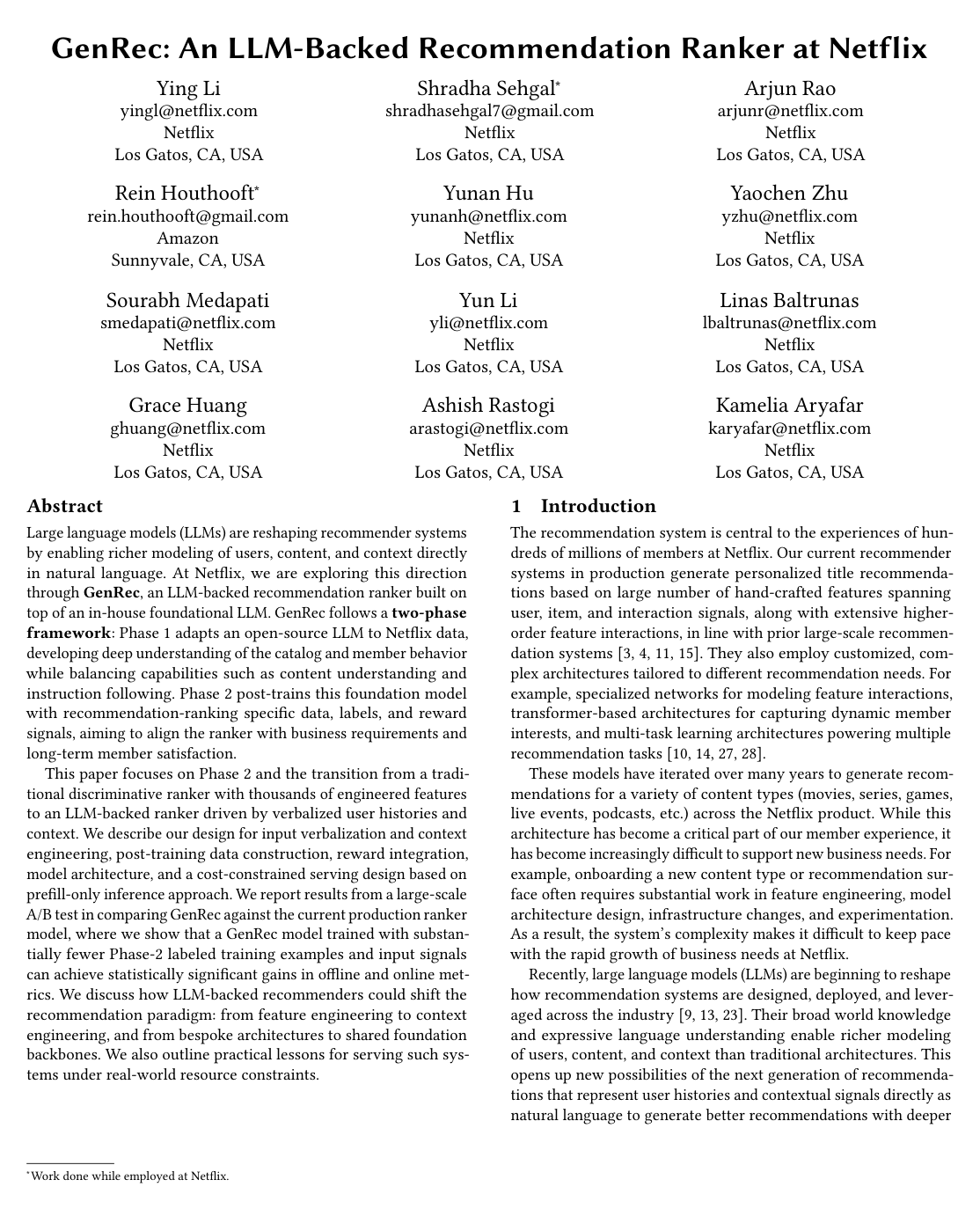
GenRec: An LLM-Backed Recommendation Ranker at Netflix
Ying Li, Shradha Sehgal, Arjun Rao, Rein Houthooft, Yunan Hu, Yaochen Zhu, Sourabh Medapati, Yun Li, Linas Baltrunas, Grace Huang, Ashish Rastogi, Kamelia Aryafar
Why you should read this
Demonstrates how Netflix deploys GenRec, an LLM-based recommendation ranker that uses natural language context engineering, reward-weighted tuning, and single-pass catalog scoring to outperform a mature production ranker in large-scale online A/B tests using significantly fewer labeled examples.
Large language models (LLMs) are reshaping recommender systems by enabling richer modeling of users, content, and context directly in natural language. At Netflix, we are exploring this direction through GenRec, an LLM-backed recommendation ranker built on top of an in-house foundational LLM. GenRec follows a two-phase framework: Phase 1 adapts an open-source LLM to Netflix data, developing deep understanding of the catalog and member behavior while balancing capabilities such as content understanding and instruction following. Phase 2 post-trains this foundation model with recommendation-ranking specific data, labels, and reward signals, aiming to align the ranker with business requirements and long-term member satisfaction. This paper focuses on Phase 2 and the transition from a traditional discriminative ranker with thousands of engineered features to an LLM-backed ranker driven by verbalized user histories and context. We describe our design for input verbalization and context engineering, post-training data construction, reward integration, model architecture, and a cost-constrained serving design based on a prefill-only inference approach. We report results from a large-scale A/B test comparing GenRec against the current production ranker model, where we show that a GenRec model trained with substantially fewer Phase-2 labeled training examples and input signals can achieve statistically significant gains in offline and online metrics. We discuss how LLM-backed recommenders could shift the recommendation paradigm: from feature engineering to context engineering, and from bespoke architectures to shared foundation backbones. We also outline practical lessons for serving such systems under real-world resource constraints.
Added
2026-09-03
Behavior sequence transformer for e-commerce recommendation in Alibaba
Qiwei Chen, Huan Zhao, Wei Li, Pipei Huang, Wenwu Ou
Why you should read this
Demonstrates how adapting the Transformer self-attention architecture to sequence-based user behaviors captures intricate long-range temporal dependencies in click histories.
Deep learning based methods have been widely used in industrial recommendation systems (RSs). Previous works adopt an Embedding&MLP paradigm: raw features are embedded into low-dimensional vectors, which are then fed on to MLP for final recommendations. However, most of these works just concatenate different features, ignoring the sequential nature of users' behaviors. In this paper, we propose to use the powerful Transformer model to capture the sequential signals underlying users' behavior sequences for recommendation in Alibaba. Experimental results demonstrate the superiority of the proposed model, which is then deployed online at Taobao and obtain significant improvements in online Click-Through-Rate (CTR) comparing to two baselines.
Added
2026-05-31
An Embarrassingly Simple Graph Heuristic Reveals Shortcut-Solvable Benchmarks for Sequential Recommendation
Haoyu Han, Li Ma, Hanbing Wang, Bingheng Li, Daochen Zha, Chun How Tan, Huiji Gao, Xin Liu, Stephanie Moyerman, Sanjeev Katariya, Hui Liu, Jiliang Tang
Why you should read this
Reveals that many sequential recommendation benchmarks are "shortcut-solvable" by a simple graph heuristic, challenging the perceived necessity of complex generative models and advocating for more rigorous benchmark analysis.
Sequential recommendation has increasingly shifted toward generative recommenders that combine sequential patterns with semantic item information. Yet these methods are often evaluated on a small set of widely used benchmarks, raising a key question: do these benchmarks actually require the advanced modeling capabilities that modern generative recommenders claim to provide? We conduct a benchmark audit with an intentionally simple graph heuristic. Starting from only the last one or two interacted items, it retrieves candidates from a few-hop item-transition graph and ranks them by item-feature similarity. Despite using no sequence encoder, generative objective, or training, this heuristic matches or outperforms many modern baselines, with relative NDCG@10 improvements of 38.10% and 44.18% over the best competing baseline on Amazon Review Sports and CDs. We show that this behavior reflects shortcut solvability rather than an artifact of one heuristic. We identify three shortcut structures that can make next-item prediction easier than expected: low-branching local transitions, feature-smooth transitions, and limited dependence on long user histories. These shortcuts need not appear together; even one or two strong signals can make simple local retrieval highly competitive, while weakening them makes the benefits of more sophisticated models clearer. Across 14 datasets, model rankings vary substantially with dataset properties, yet the heuristic remains competitive on 10 of them. Our findings suggest that strong performance on standard benchmarks does not always demonstrate advanced sequential, semantic, or generative modeling ability. We call for more careful dataset selection and dataset-level diagnostic analysis when using benchmarks to support claims about new recommendation models.
Added
2026-05-11
