
keyword
user-item interactions
User-item interactions refer to the observable actions, engagements, or relationships recorded between individual users and items or services within an information system. In machine learning and recommender systems, these interactions form the foundational behavioral data used to model user preferences, discover affinity patterns, and predict future choices. They encompass explicit feedback, where users intentionally express preferences through ratings, reviews, or direct evaluations, as well as implicit feedback, where preferences are inferred from activities such as clicks, views, search queries, and purchases. These interactions are commonly organized as sparse matrices, graph structures, or chronological sequences, allowing algorithms to capture user preferences along with contextual factors and temporal dynamics over time.
2 items
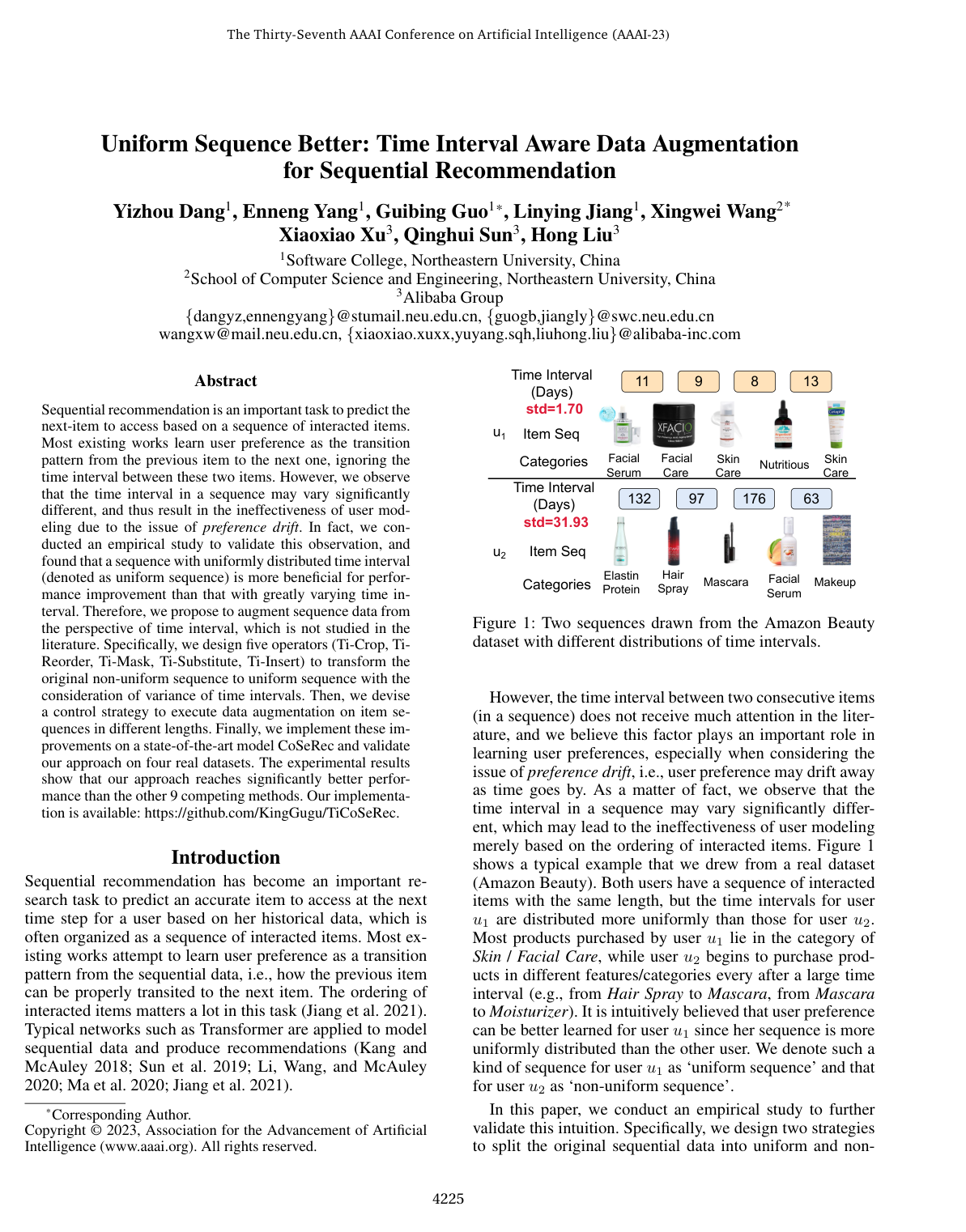
Uniform Sequence Better: Time Interval Aware Data Augmentation for Sequential Recommendation
Yizhou Dang, Enneng Yang, Guibing Guo, Linying Jiang, Xingwei Wang, Xiaoxiao Xu, Qinghui Sun, Hong Liu
Why you should read this
Proposes time-interval-aware data augmentation operators that transform irregular interaction sequences into uniform sequences to mitigate user preference drift and substantially improve sequential recommendation accuracy.
Sequential recommendation is an important task to predict the next-item to access based on a sequence of interacted items. Most existing works learn user preference as the transition pattern from the previous item to the next one, ignoring the time interval between these two items. However, we observe that the time interval in a sequence may vary significantly different, and thus result in the ineffectiveness of user modeling due to the issue of preference drift. In fact, we conducted an empirical study to validate this observation, and found that a sequence with uniformly distributed time interval (denoted as uniform sequence) is more beneficial for performance improvement than that with greatly varying time interval. Therefore, we propose to augment sequence data from the perspective of time interval, which is not studied in the literature. Specifically, we design five operators (Ti-Crop, Ti-Reorder, Ti-Mask, Ti-Substitute, Ti-Insert) to transform the original non-uniform sequence to uniform sequence with the consideration of variance of time intervals. Then, we devise a control strategy to execute data augmentation on item sequences in different lengths. Finally, we implement these improvements on a state-of-the-art model CoSeRec and validate our approach on four real datasets. The experimental results show that our approach reaches significantly better performance than the other 9 competing methods. Our implementation is available: https://github.com/KingGugu/TiCoSeRec.
Added
2026-09-26
Matrix Factorization Techniques for Recommender Systems
Yehuda Koren, Robert Bell, Chris Volinsky
Why you should read this
Establishes the definitive mathematical framework for collaborative filtering by demonstrating how latent matrix factorization handles data sparsity while seamlessly incorporating temporal dynamics.
As the Netflix Prize competition has demonstrated, matrix factorization models are superior to classic nearest neighbor techniques for producing product recommendations, allowing the incorporation of additional information such as implicit feedback, temporal effects, and confidence levels.
Added
2026-05-06