Additive Margin Softmax for Face Verification
Feng WangJian ChengWeiyang LiuHaijun Liu
Proposes an additive margin Softmax loss function with feature normalization that simplifies angular margin learning and improves deep face verification accuracy on standard benchmarks such as MegaFace and LFW.
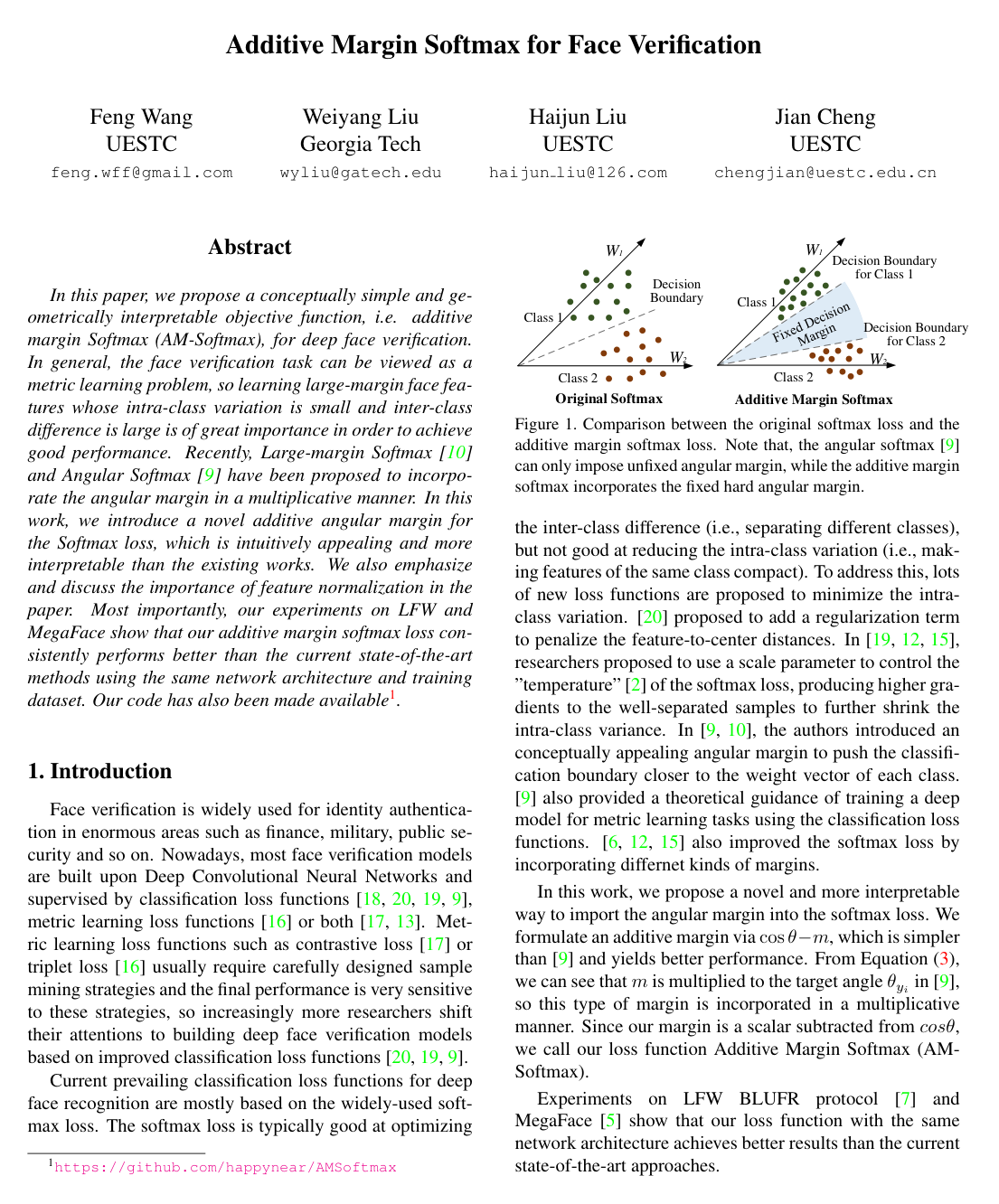
Automated face verification is essential for identity authentication across finance, defense, and public safety. Standard deep learning models rely on classification loss functions to distinguish individuals, but standard methods often struggle to create compact feature groupings for the same person while maintaining clear separation between different people. Existing approaches that enforce angular separation boundaries are computationally complex, difficult to train, and require cumbersome parameter tuning schedules.
The article demonstrates that introducing a direct additive margin to the classification loss function, combined with feature and weight normalization, creates a simpler, more interpretable, and higher-performing model for deep face verification.
The authors evaluated this additive margin approach by training deep neural networks from scratch on a standard dataset of roughly 494,000 face images across 10,575 identities. They rigorously removed overlapping identities between the training and testing sets to ensure realistic open-set evaluation. The models were tested against leading alternative loss functions across benchmark datasets, including Labeled Faces in the Wild and MegaFace, using identical network architectures.
The evaluation revealed several key findings. First, the additive margin method consistently outperformed existing state-of-the-art approaches across major benchmarks. On the challenging MegaFace identification benchmark with one million distractors, the proposed method achieved a 72.47% Rank-1 accuracy and an 84.44% verification rate, surpassing the previous leading angular method which achieved 67.41% and 78.19%, respectively. Second, performance peaked within a stable margin parameter range between 0.35 and 0.40. Third, the formulation removed the need for complex training annealing schedules, allowing models to converge stably from scratch. Finally, the analysis showed that feature normalization naturally acts as an automated hard-sample mining mechanism, assigning larger gradients to low-quality images to boost robustness.
These findings indicate that identity verification systems can achieve substantially higher accuracy under large-scale, real-world conditions without increasing architectural complexity or training instability. The additive formulation reduces the implementation and tuning overhead required to deploy robust biometric models, lowering development risk and engineering costs.
Organizations developing or upgrading facial recognition pipelines should adopt additive margin loss functions and audit their training pipelines to ensure strict overlap removal between training and testing data. Practitioners should apply feature normalization primarily when deploying models to environments characterized by low-quality imagery. Future work should focus on automatically determining optimal margin parameters and designing sample-specific or class-specific margins to further refine accuracy.
Confidence in these findings is high due to the controlled, fair comparisons across identical network backbones and benchmark datasets. However, decision-makers should note that optimal margin and normalization settings vary depending on target image quality, and extreme gradient adjustments on low-norm features present potential training risks if not properly scaled.
- Paper: SphereFace: Deep Hypersphere Embedding for Face Recognition, Weiyang Liu et al. (2017). SphereFace introduces Angular Softmax (A-Softmax) using multiplicative angular margins on a hypersphere, providing the direct baseline and foundational formulation that AM-Softmax simplifies into an additive margin.
- Paper: Large-Margin Softmax Loss for Convolutional Neural Networks, Weiyang Liu et al. (2016). This paper proposes Large-Margin Softmax (L-Softmax), which first embedded an angular margin into the standard cross-entropy loss and serves as the precursor to spherical margin losses.
- Paper: A Discriminative Feature Learning Approach for Deep Face Recognition, Yandong Wen et al. (2016). Center loss establishes the core paradigm of enforcing intra-class compactness in deep face recognition, motivating subsequent margin-based metric learning objectives in Softmax.
- Paper: FaceNet: A unified embedding for face recognition and clustering, Florian Schroff et al. (2015). FaceNet popularized hypersphere feature normalization and direct Euclidean margin optimization for open-set face verification, which AM-Softmax reformulates via classification-based angular margins.
- Paper: Learning Face Representation from Scratch, Dong Yi et al. (2014). This work establishes the standard CASIA-WebFace benchmark and evaluation methodology that AM-Softmax utilizes to validate face verification performance.
- Paper: ArcFace: Additive Angular Margin Loss for Deep Face Recognition, Jiankang Deng et al. (2018). ArcFace extends additive margin objectives by injecting the additive penalty directly into the geodesic angle itself rather than the cosine domain, building on the geometric insights of AM-Softmax.
- Paper: CosFace: Large Margin Cosine Loss for Deep Face Recognition, Hao Wang et al. (2018). CosFace explores a closely related Large Margin Cosine Loss framework and provides comprehensive comparative analysis with additive and multiplicative margin designs.
- Paper: Deep Face Recognition: A Survey, Mei Wang et al. (2018). This comprehensive survey contextualizes AM-Softmax within the broader evolution of angular, cosine, and modified margin loss functions in deep face recognition.
- Paper: Learning Imbalanced Datasets with Label-Distribution-Aware Margin Loss, Kaidi Cao et al. (2019). This work generalizes margin-based loss functions to address severe class imbalance by incorporating label-distribution-dependent adaptive margins.