
keyword
angular softmax
Angular softmax is a loss function in deep metric learning and neural network classification that modifies the standard softmax loss by enforcing a geometric, angular margin between class decision boundaries. Under this formulation, the model normalizes the weights of the final classification layer and maps learned feature embeddings onto a hypersphere manifold, transforming classification boundaries into angular constraints based on the angle between feature vectors and class weight vectors. By introducing an angular margin parameter that imposes stricter criteria for correctly classifying a sample, angular softmax forces the neural network to minimize intra-class variance while maximizing inter-class separation. This produces compact, highly discriminative feature representations that are especially effective for open-set verification and recognition tasks, such as automated face and speaker recognition.
2 items
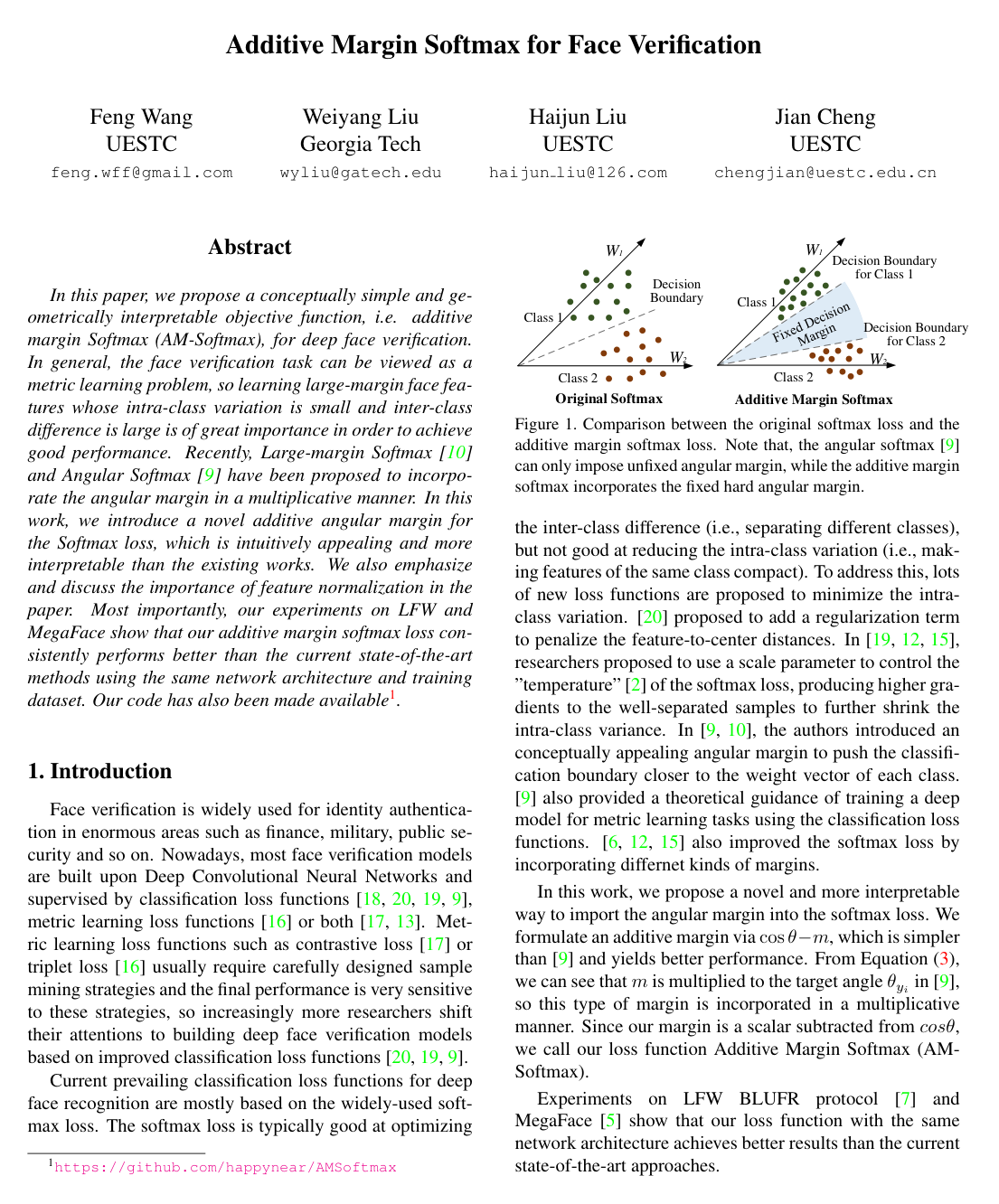
Additive Margin Softmax for Face Verification
Feng Wang, Jian Cheng, Weiyang Liu, Haijun Liu
Why you should read this
Proposes an additive margin Softmax loss function with feature normalization that simplifies angular margin learning and improves deep face verification accuracy on standard benchmarks such as MegaFace and LFW.
In this paper, we propose a conceptually simple and geometrically interpretable objective function, i.e. additive margin Softmax (AM-Softmax), for deep face verification. In general, the face verification task can be viewed as a metric learning problem, so learning large-margin face features whose intra-class variation is small and inter-class difference is large is of great importance in order to achieve good performance. Recently, Large-margin Softmax and Angular Softmax have been proposed to incorporate the angular margin in a multiplicative manner. In this work, we introduce a novel additive angular margin for the Softmax loss, which is intuitively appealing and more interpretable than the existing works. We also emphasize and discuss the importance of feature normalization in the paper. Most importantly, our experiments on LFW BLUFR and MegaFace show that our additive margin softmax loss consistently performs better than the current state-of-the-art methods using the same network architecture and training dataset. Our code has also been made available at this https URL
Added
2026-09-25
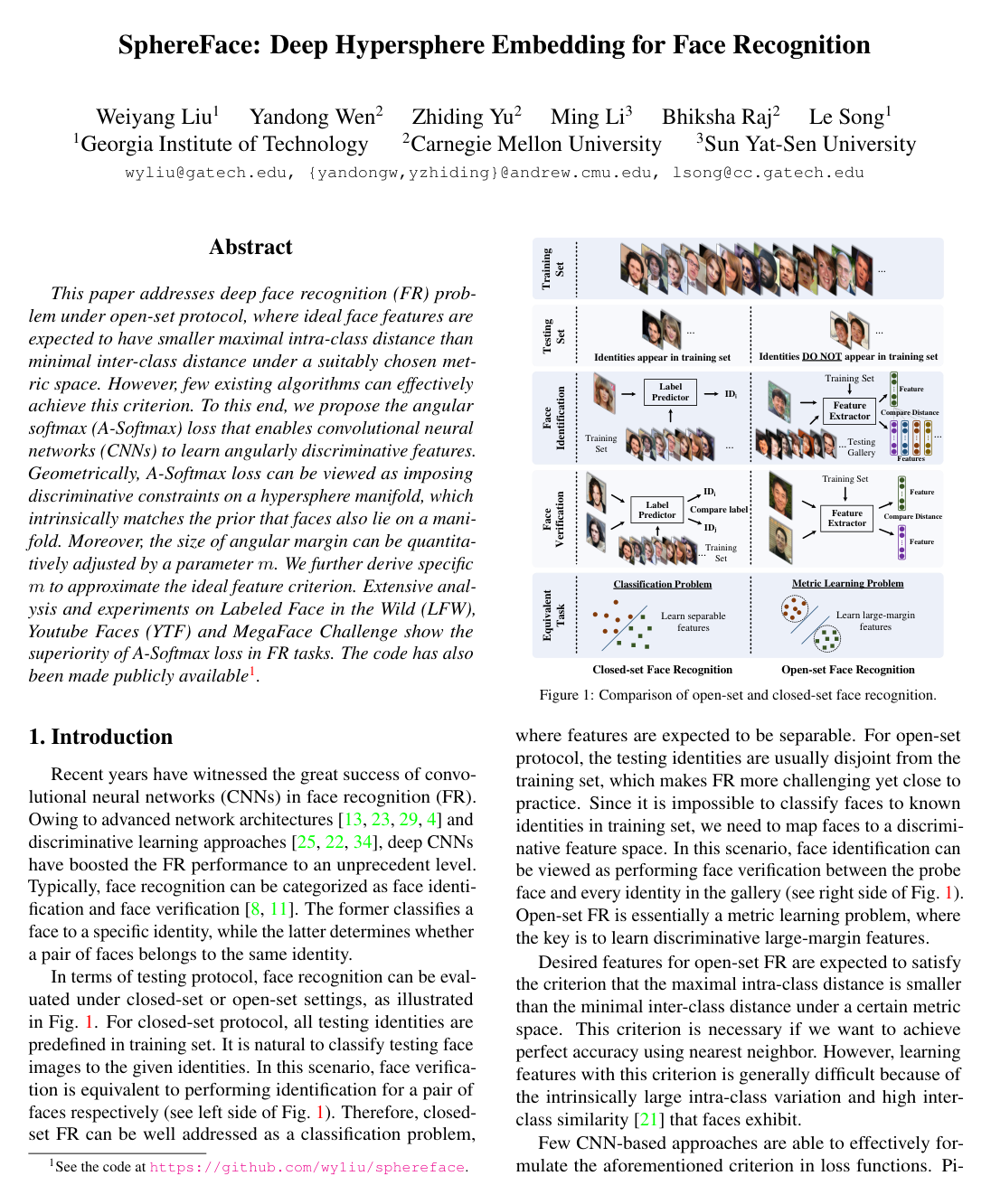
SphereFace: Deep Hypersphere Embedding for Face Recognition
Weiyang Liu, Yandong Wen, Zhiding Yu, Ming Li, Bhiksha Raj, Le Song
Why you should read this
Introduces the angular softmax loss to enforce adjustable angular margins on hypersphere embeddings, establishing a geometric formulation for learning highly discriminative features in open-set face recognition.
This paper addresses deep face recognition (FR) problem under open-set protocol, where ideal face features are expected to have smaller maximal intra-class distance than minimal inter-class distance under a suitably chosen metric space. However, few existing algorithms can effectively achieve this criterion. To this end, we propose the angular softmax (A-Softmax) loss that enables convolutional neural networks (CNNs) to learn angularly discriminative features. Geometrically, A-Softmax loss can be viewed as imposing discriminative constraints on a hypersphere manifold, which intrinsically matches the prior that faces also lie on a manifold. Moreover, the size of angular margin can be quantitatively adjusted by a parameter . We further derive specific to approximate the ideal feature criterion. Extensive analysis and experiments on Labeled Face in the Wild (LFW), Youtube Faces (YTF) and MegaFace Challenge show the superiority of A-Softmax loss in FR tasks. The code has also been made publicly available.
Added
2026-09-12