
keyword
deep face recognition
Deep face recognition is a computer vision and biometrics technology that uses deep artificial neural networks, primarily deep convolutional neural networks, to automatically verify or identify human faces from digital images or video. Unlike traditional face recognition methods that rely on handcrafted feature descriptors, deep face recognition learns hierarchical, highly discriminative representations directly from raw pixel data across large-scale training datasets. The process maps facial images into low-dimensional feature embeddings where distances correspond to identity similarity, typically optimized by specialized loss functions that minimize intra-class variation among images of the same individual while maximizing inter-class separation between different people. This enables accurate and robust facial identification and 1-to-1 verification across challenging real-world variations in pose, illumination, expression, and image quality.
12 items
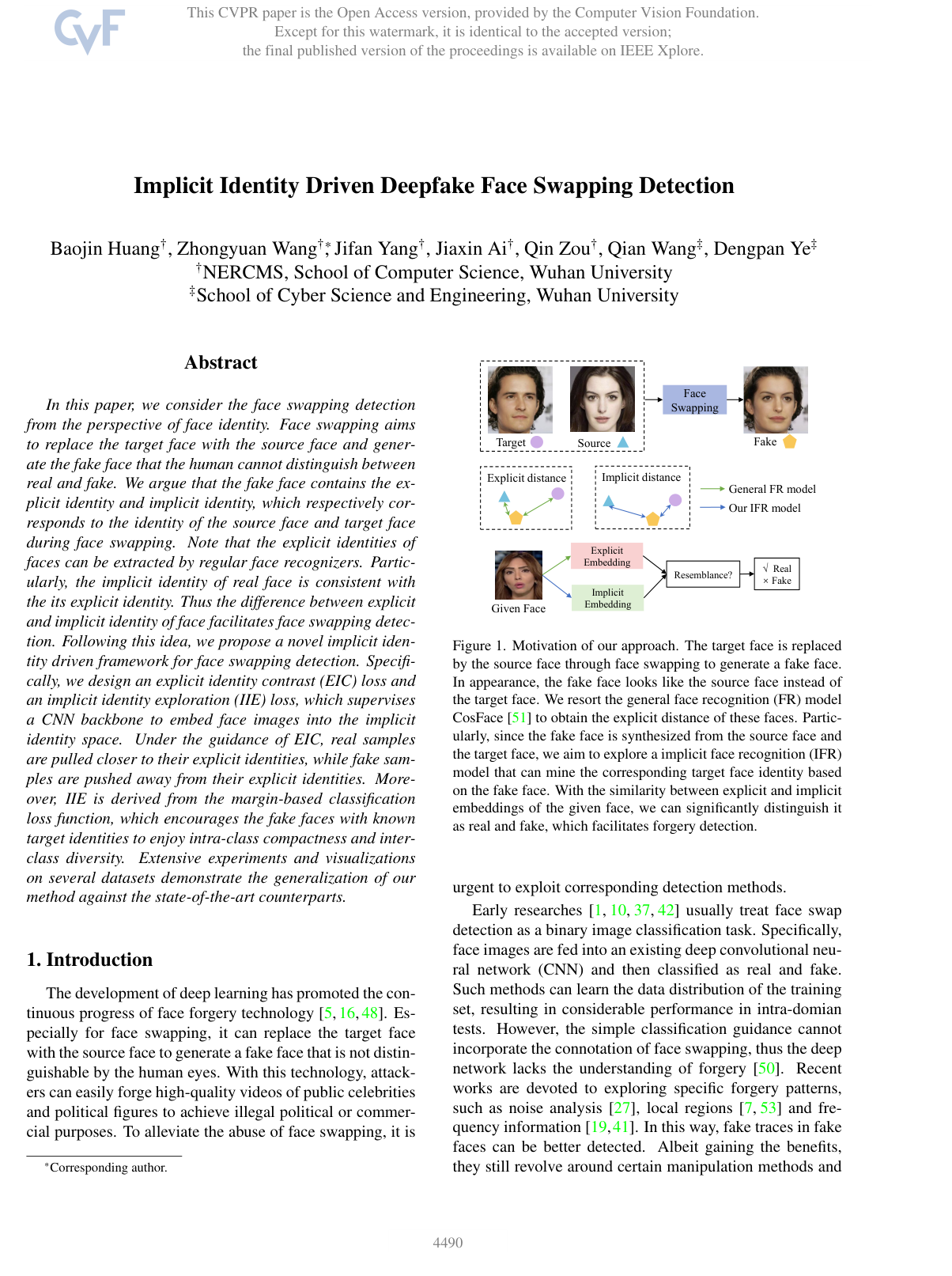
Implicit Identity Driven Deepfake Face Swapping Detection
Baojin Huang, Zhongyuan Wang, Jifan Yang, Jiaxin Ai, Qin Zou, Qian Wang, Dengpan Ye
Why you should read this
Proposes an implicit identity-driven framework that detects deepfake face swaps by identifying discrepancies between a face's explicit visual identity and its underlying target identity.
In this paper, we consider the face swapping detection from the perspective of face identity. Face swapping aims to replace the target face with the source face and generate the fake face that the human cannot distinguish between real and fake. We argue that the fake face contains the explicit identity and implicit identity, which respectively corresponds to the identity of the source face and target face during face swapping. Note that the explicit identities of faces can be extracted by regular face recognizers. Particularly, the implicit identity of real face is consistent with the its explicit identity. Thus the difference between explicit and implicit identity of face facilitates face swapping detection. Following this idea, we propose a novel implicit identity driven framework for face swapping detection. Specifically, we design an explicit identity contrast (EIC) loss and an implicit identity exploration (IIE) loss, which supervises a CNN backbone to embed face images into the implicit identity space. Under the guidance of EIC, real samples are pulled closer to their explicit identities, while fake samples are pushed away from their explicit identities. Moreover, IIE is derived from the margin-based classification loss function, which encourages the fake faces with known target identities to enjoy intra-class compactness and inter-class diversity. Extensive experiments and visualizations on several datasets demonstrate the generalization of our method against the state-of-the-art counterparts.
Added
2026-09-26
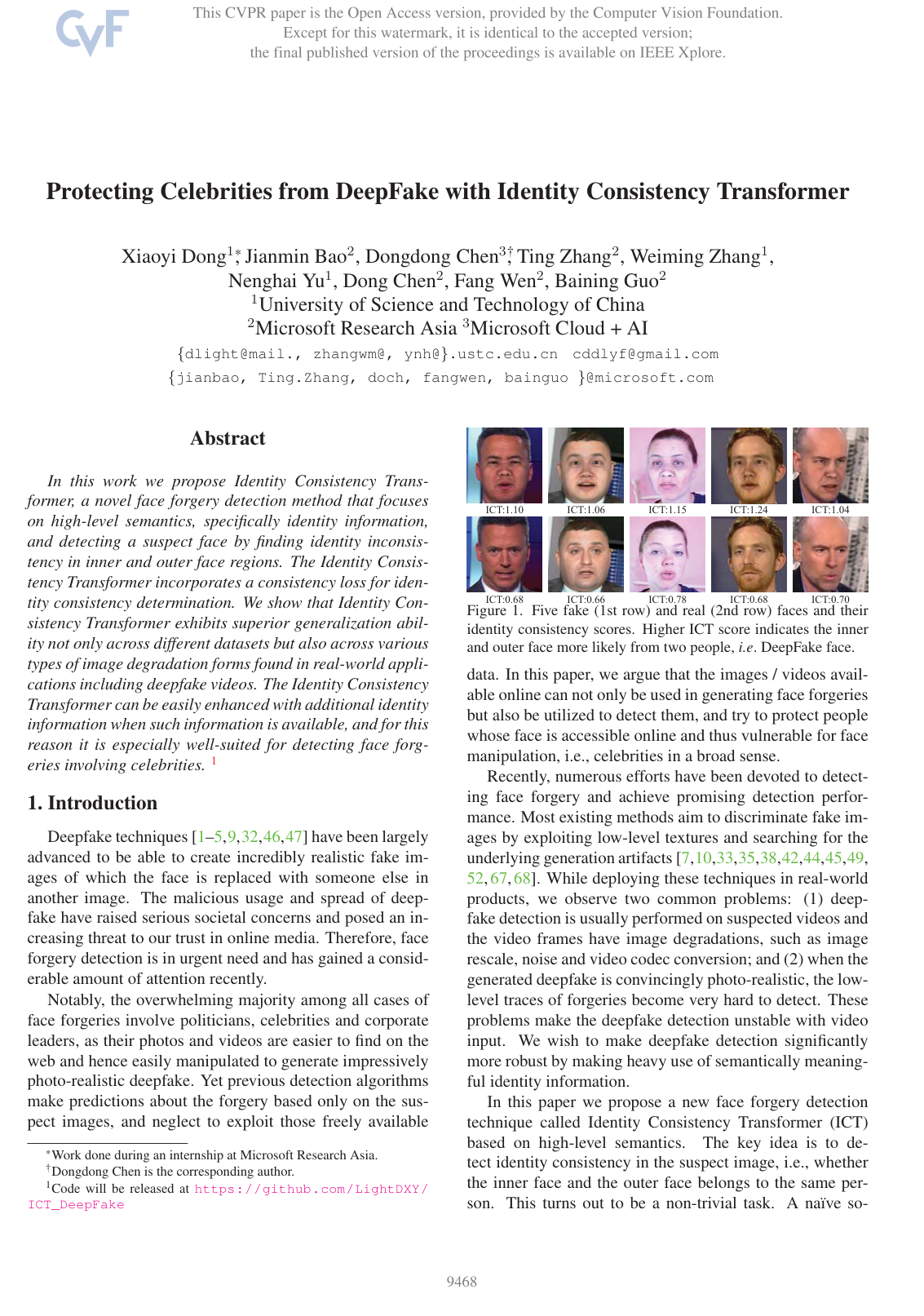
Protecting Celebrities from DeepFake with Identity Consistency Transformer
Xiaoyi Dong, Jianmin Bao, Dongdong Chen, Ting Zhang, Weiming Zhang, Nenghai Yu, Dong Chen, Fang Wen, Baining Guo
Why you should read this
Proposes an identity-consistency vision transformer that detects deepfakes by exposing semantic identity mismatches between inner and outer face regions, achieving high detection generalization under real-world video degradations without relying on fragile low-level texture artifacts.
In this work we propose Identity Consistency Transformer, a novel face forgery detection method that focuses on high-level semantics, specifically identity information, and detecting a suspect face by finding identity inconsistency in inner and outer face regions. The Identity Consistency Transformer incorporates a consistency loss for identity consistency determination. We show that Identity Consistency Transformer exhibits superior generalization ability not only across different datasets but also across various types of image degradation forms found in real-world applications including deepfake videos. The Identity Consistency Transformer can be easily enhanced with additional identity information when such information is available, and for this reason it is especially well-suited for detecting face forgeries involving celebrities.
Added
2026-09-26
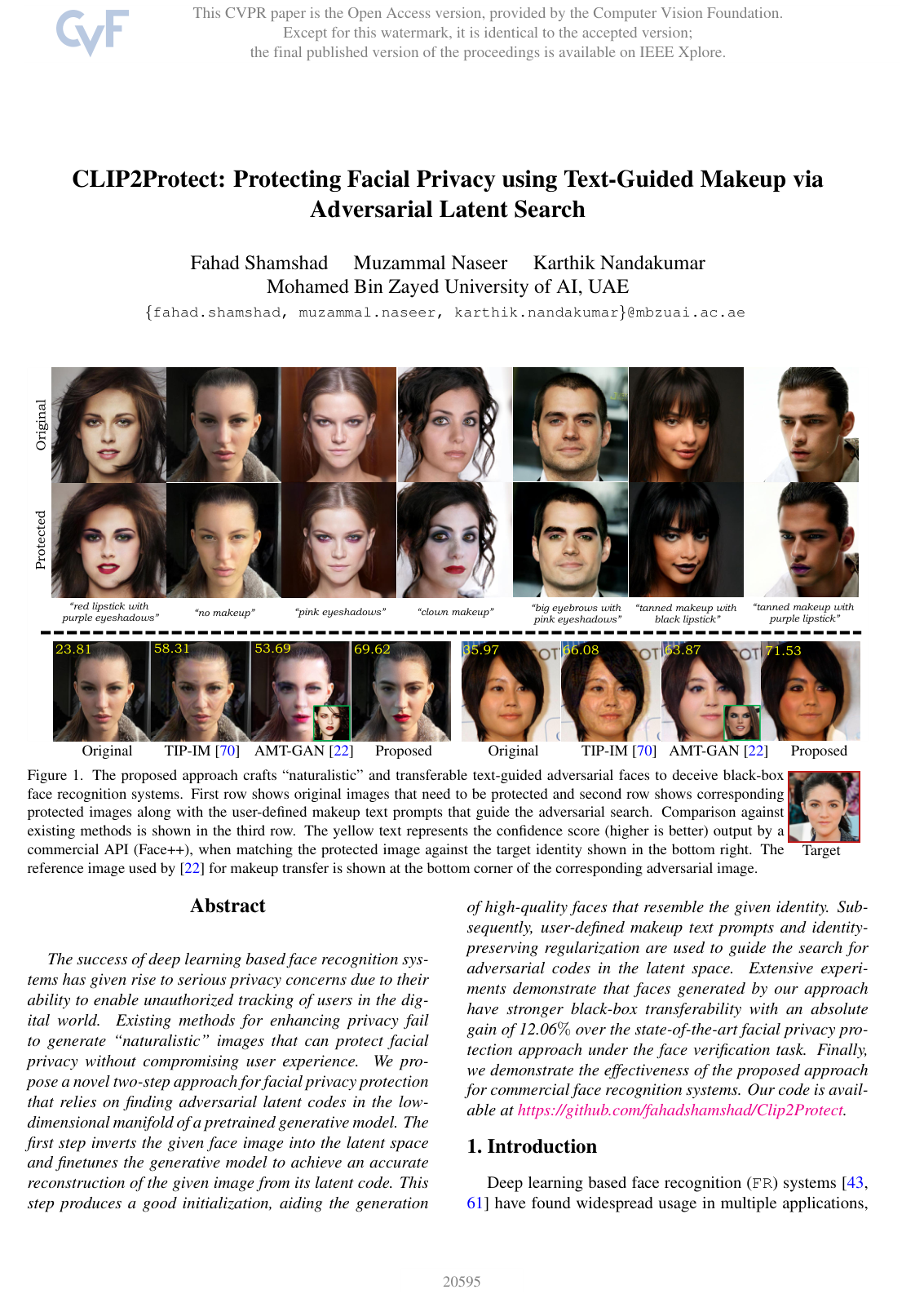
CLIP2Protect: Protecting Facial Privacy Using Text-Guided Makeup via Adversarial Latent Search
Fahad Shamshad, Muzammal Naseer, Karthik Nandakumar
Why you should read this
Proposes a text-guided generative framework that applies natural-looking adversarial makeup to face images, effectively deceiving commercial black-box face recognition systems while preserving human-perceived identity.
The success of deep learning based face recognition systems has given rise to serious privacy concerns due to their ability to enable unauthorized tracking of users in the digital world. Existing methods for enhancing privacy fail to generate “naturalistic” images that can protect facial privacy without compromising user experience. We propose a novel two-step approach for facial privacy protection that relies on finding adversarial latent codes in the low-dimensional manifold of a pretrained generative model. The first step inverts the given face image into the latent space and finetunes the generative model to achieve an accurate reconstruction of the given image from its latent code. This step produces a good initialization, aiding the generation of high-quality faces that resemble the given identity. Subsequently, user-defined makeup text prompts and identity-preserving regularization are used to guide the search for adversarial codes in the latent space. Extensive experiments demonstrate that faces generated by our approach have stronger black-box transferability with an absolute gain of 12.06% over the state-of-the-art facial privacy protection approach under the face verification task. Finally, we demonstrate the effectiveness of the proposed approach for commercial face recognition systems. Our code is available at https://github.com/fahadshamshad/Clip2Protect.
Added
2026-09-26
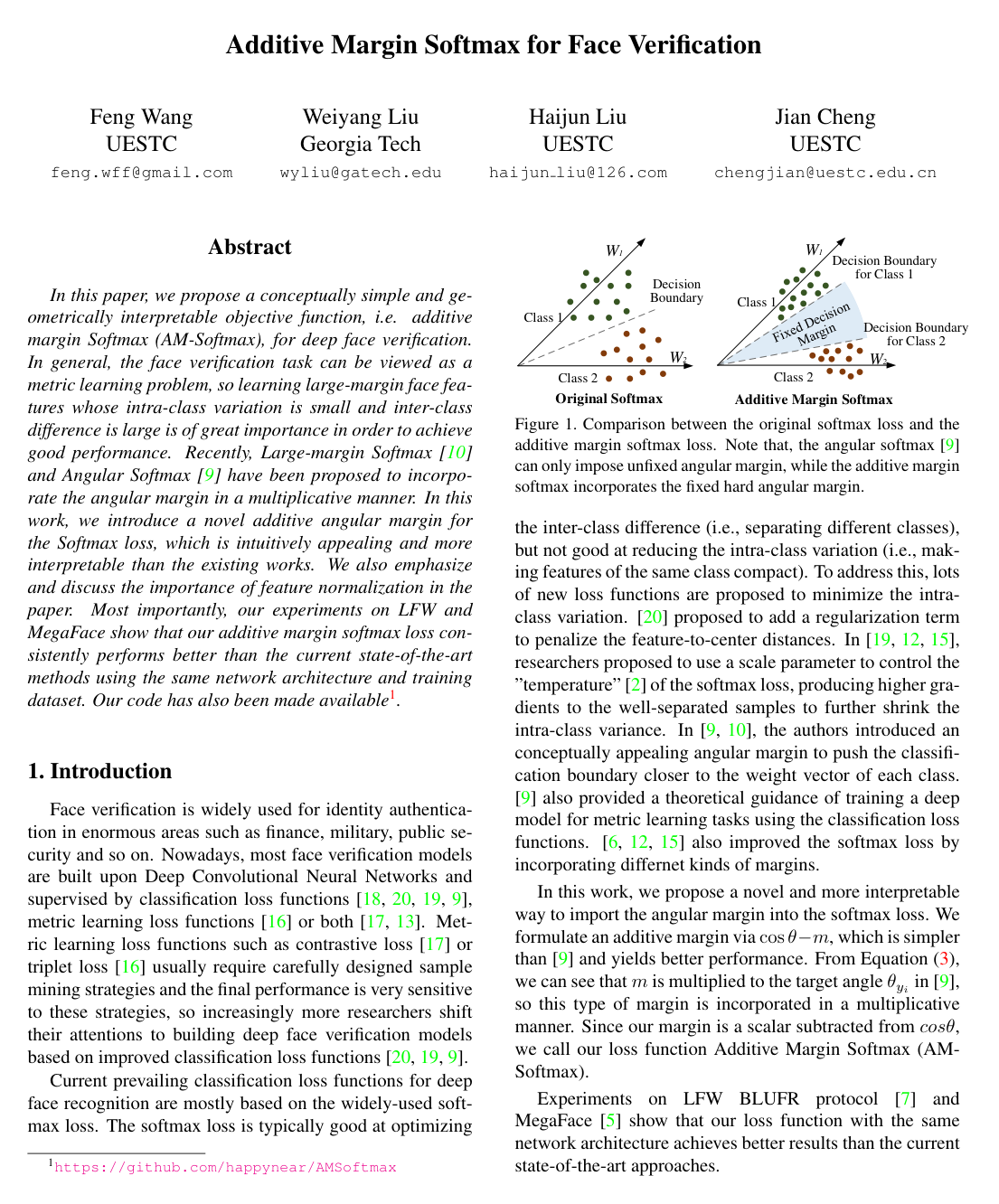
Additive Margin Softmax for Face Verification
Feng Wang, Jian Cheng, Weiyang Liu, Haijun Liu
Why you should read this
Proposes an additive margin Softmax loss function with feature normalization that simplifies angular margin learning and improves deep face verification accuracy on standard benchmarks such as MegaFace and LFW.
In this paper, we propose a conceptually simple and geometrically interpretable objective function, i.e. additive margin Softmax (AM-Softmax), for deep face verification. In general, the face verification task can be viewed as a metric learning problem, so learning large-margin face features whose intra-class variation is small and inter-class difference is large is of great importance in order to achieve good performance. Recently, Large-margin Softmax and Angular Softmax have been proposed to incorporate the angular margin in a multiplicative manner. In this work, we introduce a novel additive angular margin for the Softmax loss, which is intuitively appealing and more interpretable than the existing works. We also emphasize and discuss the importance of feature normalization in the paper. Most importantly, our experiments on LFW BLUFR and MegaFace show that our additive margin softmax loss consistently performs better than the current state-of-the-art methods using the same network architecture and training dataset. Our code has also been made available at this https URL
Added
2026-09-25
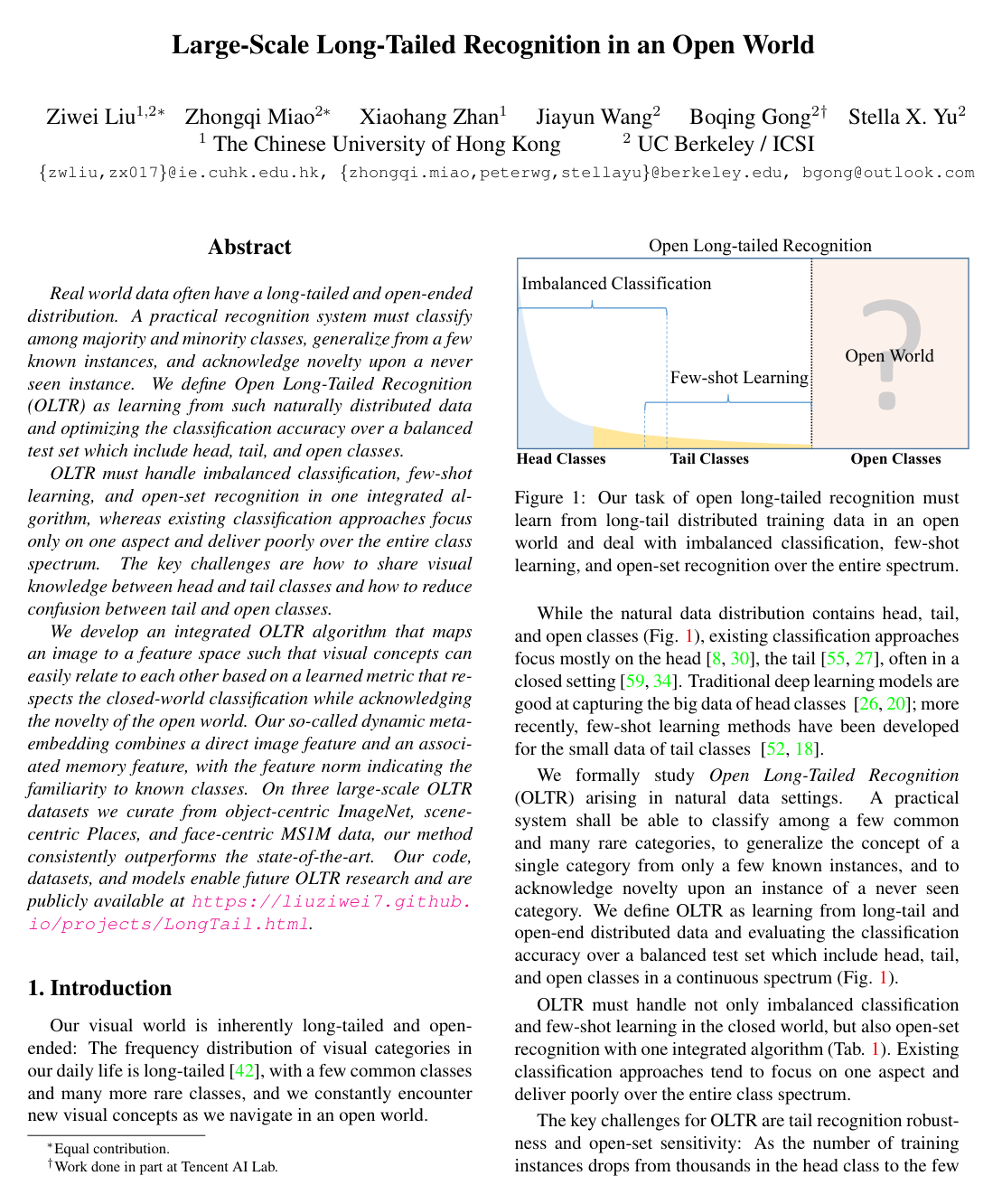
Large-Scale Long-Tailed Recognition in an Open World
Ziwei Liu, Zhongqi Miao, Xiaohang Zhan, Jiayun Wang, Boqing Gong, Stella X. Yu
Why you should read this
Develops a dynamic meta-embedding approach that unifies long-tailed classification, few-shot learning, and open-set recognition, allowing models to transfer visual knowledge to tail classes while detecting novel, unseen categories.
Real world data often have a long-tailed and open-ended distribution. A practical recognition system must classify among majority and minority classes, generalize from a few known instances, and acknowledge novelty upon a never seen instance. We define Open Long-Tailed Recognition (OLTR) as learning from such naturally distributed data and optimizing the classification accuracy over a balanced test set which include head, tail, and open classes. OLTR must handle imbalanced classification, few-shot learning, and open-set recognition in one integrated algorithm, whereas existing classification approaches focus only on one aspect and deliver poorly over the entire class spectrum. The key challenges are how to share visual knowledge between head and tail classes and how to reduce confusion between tail and open classes. We develop an integrated OLTR algorithm that maps an image to a feature space such that visual concepts can easily relate to each other based on a learned metric that respects the closed-world classification while acknowledging the novelty of the open world. Our so-called dynamic meta-embedding combines a direct image feature and an associated memory feature, with the feature norm indicating the familiarity to known classes. On three large-scale OLTR datasets we curate from object-centric ImageNet, scene-centric Places, and face-centric MS1M data, our method consistently outperforms the state-of-the-art. Our code, datasets, and models enable future OLTR research and are publicly available at this https URL.
Added
2026-09-25
Deep Face Recognition: A Survey
Mei Wang, Weihong Deng
Why you should read this
Systematizes the rapid evolution of deep face recognition by organizing network architectures, loss functions, data processing strategies, and benchmark datasets to address technical challenges across diverse practical scenarios.
Deep learning applies multiple processing layers to learn representations of data with multiple levels of feature extraction. This emerging technique has reshaped the research landscape of face recognition (FR) since 2014, launched by the breakthroughs of DeepFace and DeepID. Since then, deep learning technique, characterized by the hierarchical architecture to stitch together pixels into invariant face representation, has dramatically improved the state-of-the-art performance and fostered successful real-world applications. In this survey, we provide a comprehensive review of the recent developments on deep FR, covering broad topics on algorithm designs, databases, protocols, and application scenes. First, we summarize different network architectures and loss functions proposed in the rapid evolution of the deep FR methods. Second, the related face processing methods are categorized into two classes: "one-to-many augmentation" and "many-to-one normalization". Then, we summarize and compare the commonly used databases for both model training and evaluation. Third, we review miscellaneous scenes in deep FR, such as cross-factor, heterogenous, multiple-media and industrial scenes. Finally, the technical challenges and several promising directions are highlighted.
Added
2026-09-25
Deep Facial Expression Recognition: A Survey
Shan Li, Weihong Deng
Why you should read this
Presents a systematic guide to deep facial expression recognition, categorizing architectures for static and dynamic data while outlining practical strategies to handle real-world obstacles such as identity bias, head pose, and illumination variations.
With the transition of facial expression recognition (FER) from laboratory-controlled to challenging in-the-wild conditions and the recent success of deep learning techniques in various fields, deep neural networks have increasingly been leveraged to learn discriminative representations for automatic FER. Recent deep FER systems generally focus on two important issues: overfitting caused by a lack of sufficient training data and expression-unrelated variations, such as illumination, head pose and identity bias. In this paper, we provide a comprehensive survey on deep FER, including datasets and algorithms that provide insights into these intrinsic problems. First, we describe the standard pipeline of a deep FER system with the related background knowledge and suggestions of applicable implementations for each stage. We then introduce the available datasets that are widely used in the literature and provide accepted data selection and evaluation principles for these datasets. For the state of the art in deep FER, we review existing novel deep neural networks and related training strategies that are designed for FER based on both static images and dynamic image sequences, and discuss their advantages and limitations. Competitive performances on widely used benchmarks are also summarized in this section. We then extend our survey to additional related issues and application scenarios. Finally, we review the remaining challenges and corresponding opportunities in this field as well as future directions for the design of robust deep FER systems.
Added
2026-09-24
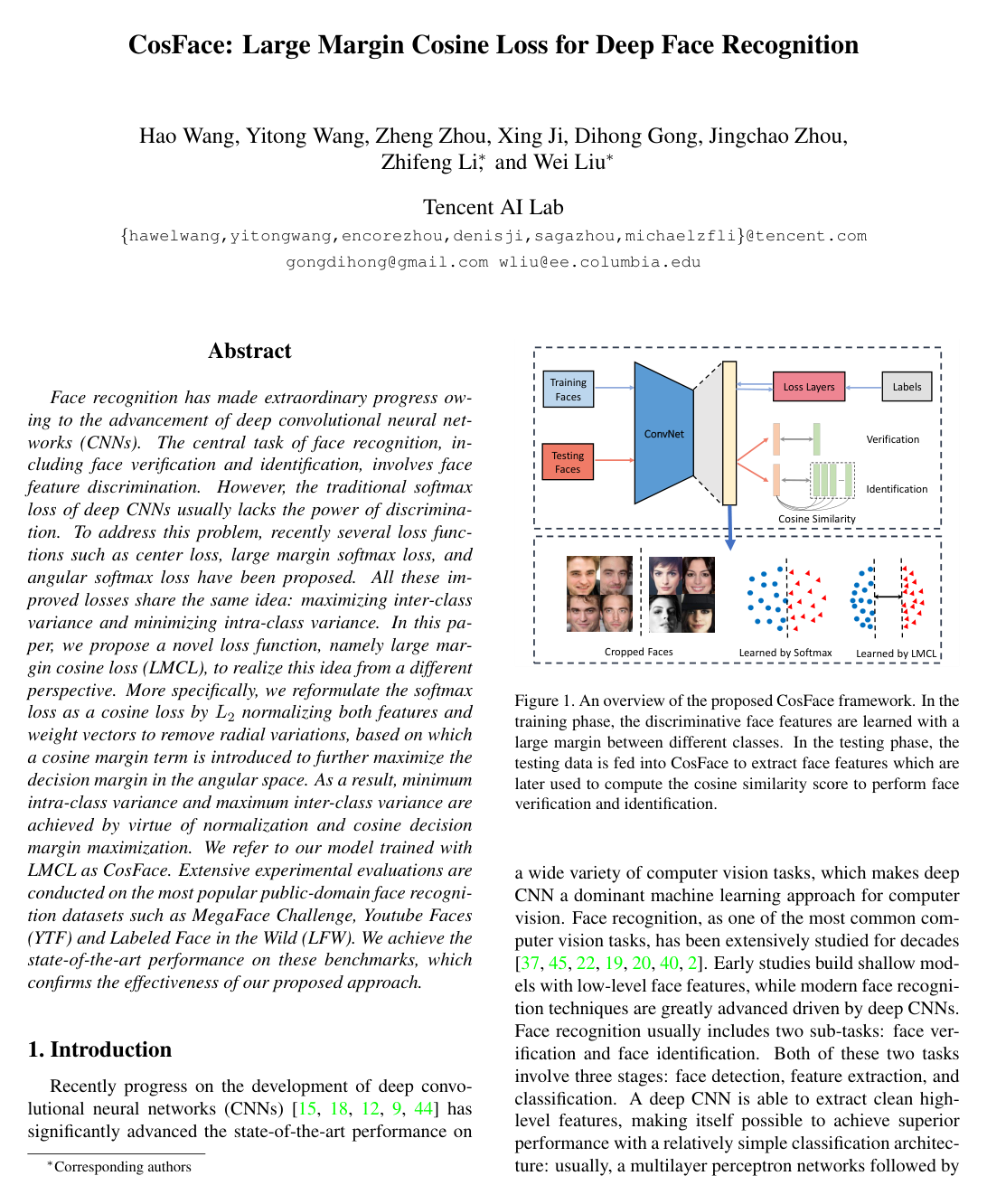
CosFace: Large Margin Cosine Loss for Deep Face Recognition
Hao Wang, Yitong Wang, Zheng Zhou, Xing Ji, Dihong Gong, Jingchao Zhou, Zhifeng Li, Wei Liu
Why you should read this
Introduces the Large Margin Cosine Loss (CosFace), which reformulates traditional softmax loss through vector normalization and an angular margin penalty to maximize feature discrimination for deep face recognition.
Face recognition has made extraordinary progress owing to the advancement of deep convolutional neural networks (CNNs). The central task of face recognition, including face verification and identification, involves face feature discrimination. However, the traditional softmax loss of deep CNNs usually lacks the power of discrimination. To address this problem, recently several loss functions such as center loss, large margin softmax loss, and angular softmax loss have been proposed. All these improved losses share the same idea: maximizing inter-class variance and minimizing intra-class variance. In this paper, we propose a novel loss function, namely large margin cosine loss (LMCL), to realize this idea from a different perspective. More specifically, we reformulate the softmax loss as a cosine loss by normalizing both features and weight vectors to remove radial variations, based on which a cosine margin term is introduced to further maximize the decision margin in the angular space. As a result, minimum intra-class variance and maximum inter-class variance are achieved by virtue of normalization and cosine decision margin maximization. We refer to our model trained with LMCL as CosFace. Extensive experimental evaluations are conducted on the most popular public-domain face recognition datasets such as MegaFace Challenge, Youtube Faces (YTF) and Labeled Face in the Wild (LFW). We achieve the state-of-the-art performance on these benchmarks, which confirms the effectiveness of our proposed approach.
Added
2026-09-13
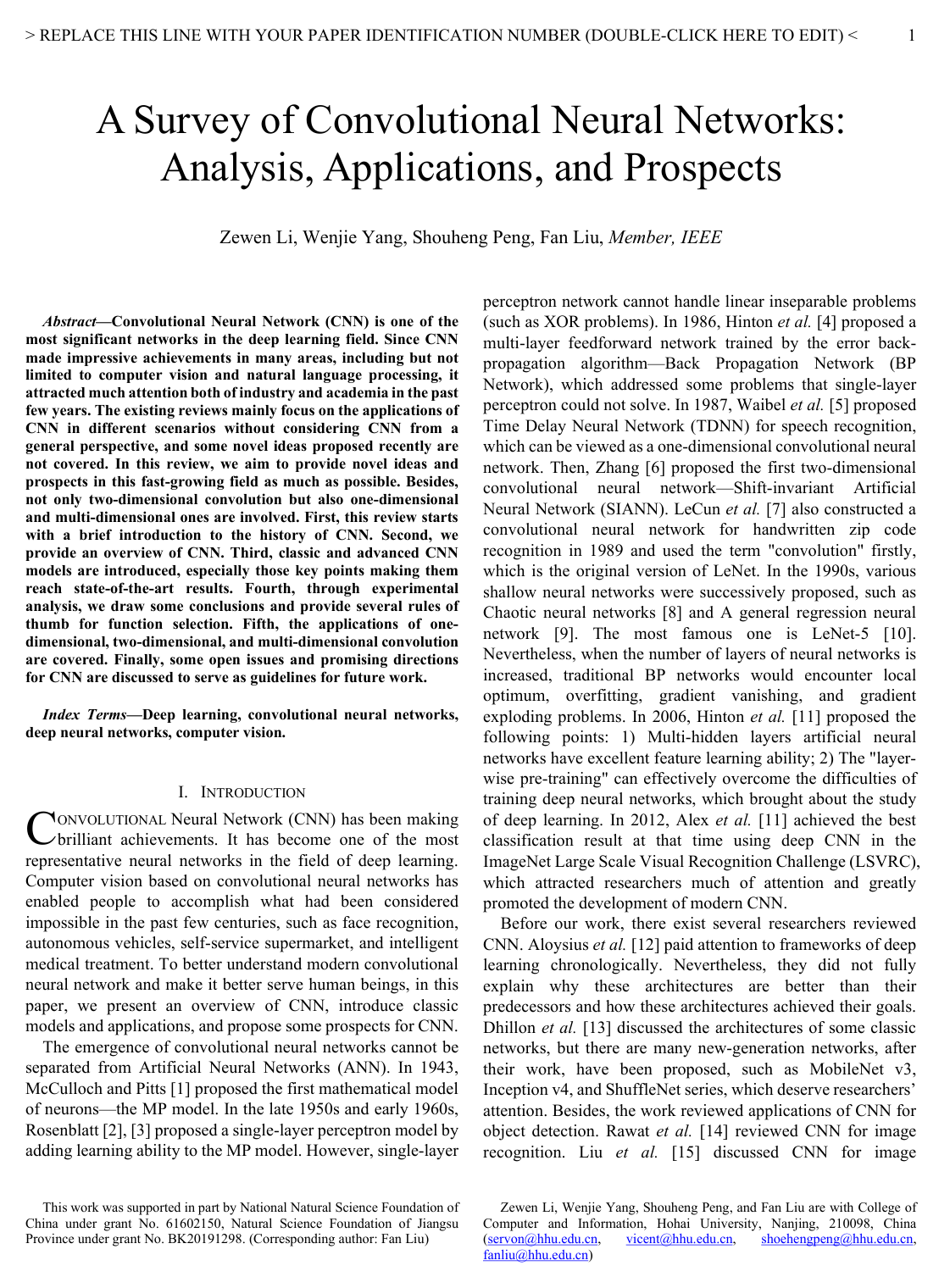
A Survey of Convolutional Neural Networks: Analysis, Applications, and Prospects
Zewen Li, Fan Liu, Wenjie Yang, Shou-Heng Peng, Jun Zhou
Why you should read this
Synthesizes structural advancements across one-dimensional, two-dimensional, and multi-dimensional convolutional neural networks, offering experimentally grounded rules of thumb for model design and highlighting critical directions for future research.
Convolutional Neural Network (CNN) is one of the most significant networks in the deep learning field. Since CNN made impressive achievements in many areas, including but not limited to computer vision and natural language processing, it attracted much attention both of industry and academia in the past few years. The existing reviews mainly focus on the applications of CNN in different scenarios without considering CNN from a general perspective, and some novel ideas proposed recently are not covered. In this review, we aim to provide novel ideas and prospects in this fast-growing field as much as possible. Besides, not only two-dimensional convolution but also one-dimensional and multi-dimensional ones are involved. First, this review starts with a brief introduction to the history of CNN. Second, we provide an overview of CNN. Third, classic and advanced CNN models are introduced, especially those key points making them reach state-of-the-art results. Fourth, through experimental analysis, we draw some conclusions and provide several rules of thumb for function selection. Fifth, the applications of one-dimensional, two-dimensional, and multi-dimensional convolution are covered. Finally, some open issues and promising directions for CNN are discussed to serve as guidelines for future work.
Added
2026-09-13
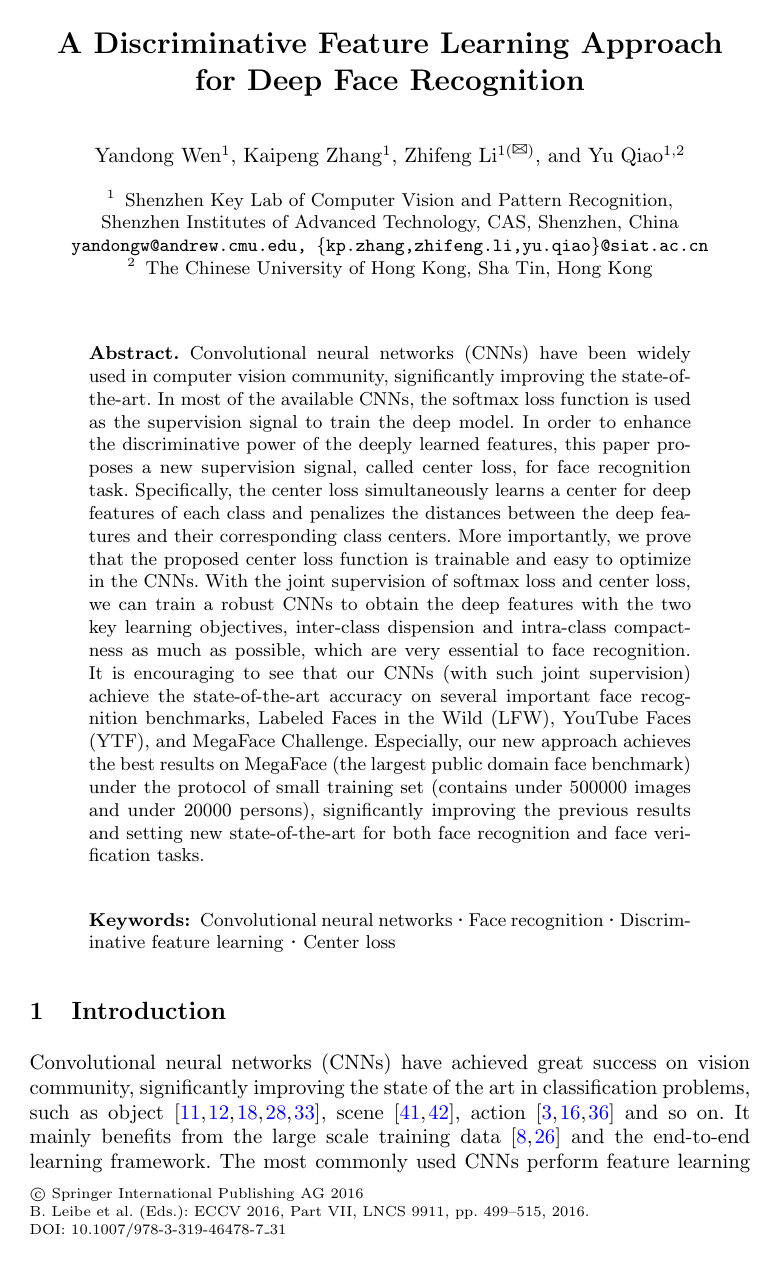
A Discriminative Feature Learning Approach for Deep Face Recognition
Yandong Wen, Kaipeng Zhang, Zhifeng Li, Yu Qiao
Why you should read this
Proposes center loss, an easily optimizable supervision function that penalizes distances between deep features and their learned class centers to minimize intra-class variance alongside softmax loss, achieving state-of-the-art face recognition accuracy without complex sample-pair mining.
Convolutional neural networks (CNNs) have been widely used in computer vision community, significantly improving the state-of-the-art. In most of the available CNNs, the softmax loss function is used as the supervision signal to train the deep model. In order to enhance the discriminative power of the deeply learned features, this paper proposes a new supervision signal, called center loss, for face recognition task. Specifically, the center loss simultaneously learns a center for deep features of each class and penalizes the distances between the deep features and their corresponding class centers. More importantly, we prove that the proposed center loss function is trainable and easy to optimize in the CNNs. With the joint supervision of softmax loss and center loss, we can train a robust CNNs to obtain the deep features with the two key learning objectives, inter-class dispension and intra-class compactness as much as possible, which are very essential to face recognition. It is encouraging to see that our CNNs (with such joint supervision) achieve the state-of-the-art accuracy on several important face recognition benchmarks, Labeled Faces in the Wild (LFW), YouTube Faces (YTF), and MegaFace Challenge. Especially, our new approach achieves the best results on MegaFace (the largest public domain face benchmark) under the protocol of small training set (contains under 500000 images and under 20000 persons), significantly improving the previous results and setting new state-of-the-art for both face recognition and face verification tasks.
Added
2026-09-11
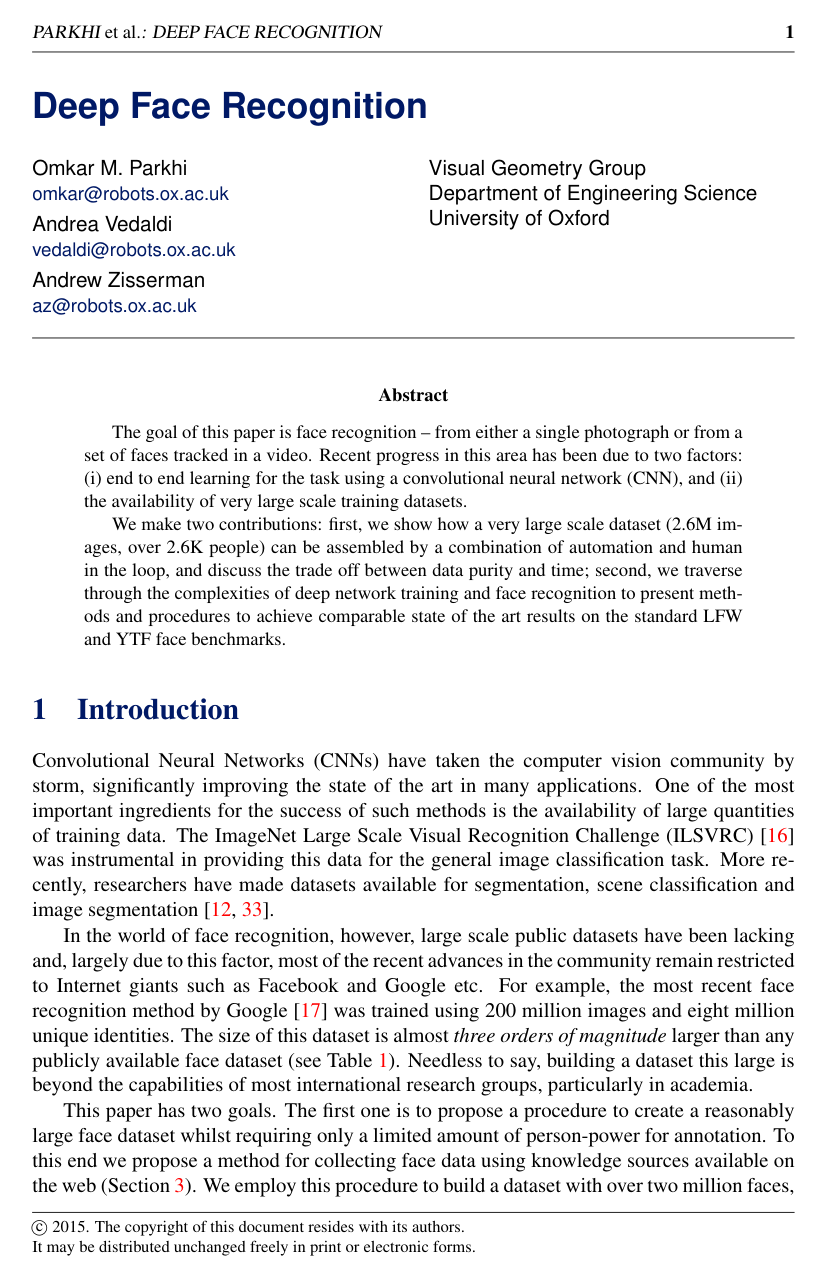
Deep Face Recognition
Omkar M. Parkhi, Andrea Vedaldi, Andrew Zisserman
Why you should read this
Presents a practical pipeline for building a 2.6-million-image dataset alongside training strategies that enable deep convolutional networks to achieve state-of-the-art face recognition accuracy on the LFW and YTF benchmarks.
The goal of this paper is face recognition – from either a single photograph or from a set of faces tracked in a video. Recent progress in this area has been due to two factors: (i) end to end learning for the task using a convolutional neural network (CNN), and (ii) the availability of very large scale training datasets. We make two contributions: first, we show how a very large scale dataset (2.6M images, over 2.6K people) can be assembled by a combination of automation and human in the loop, and discuss the trade off between data purity and time; second, we traverse through the complexities of deep network training and face recognition to present methods and procedures to achieve comparable state of the art results on the standard LFW and YTF face benchmarks.
Added
2026-09-09
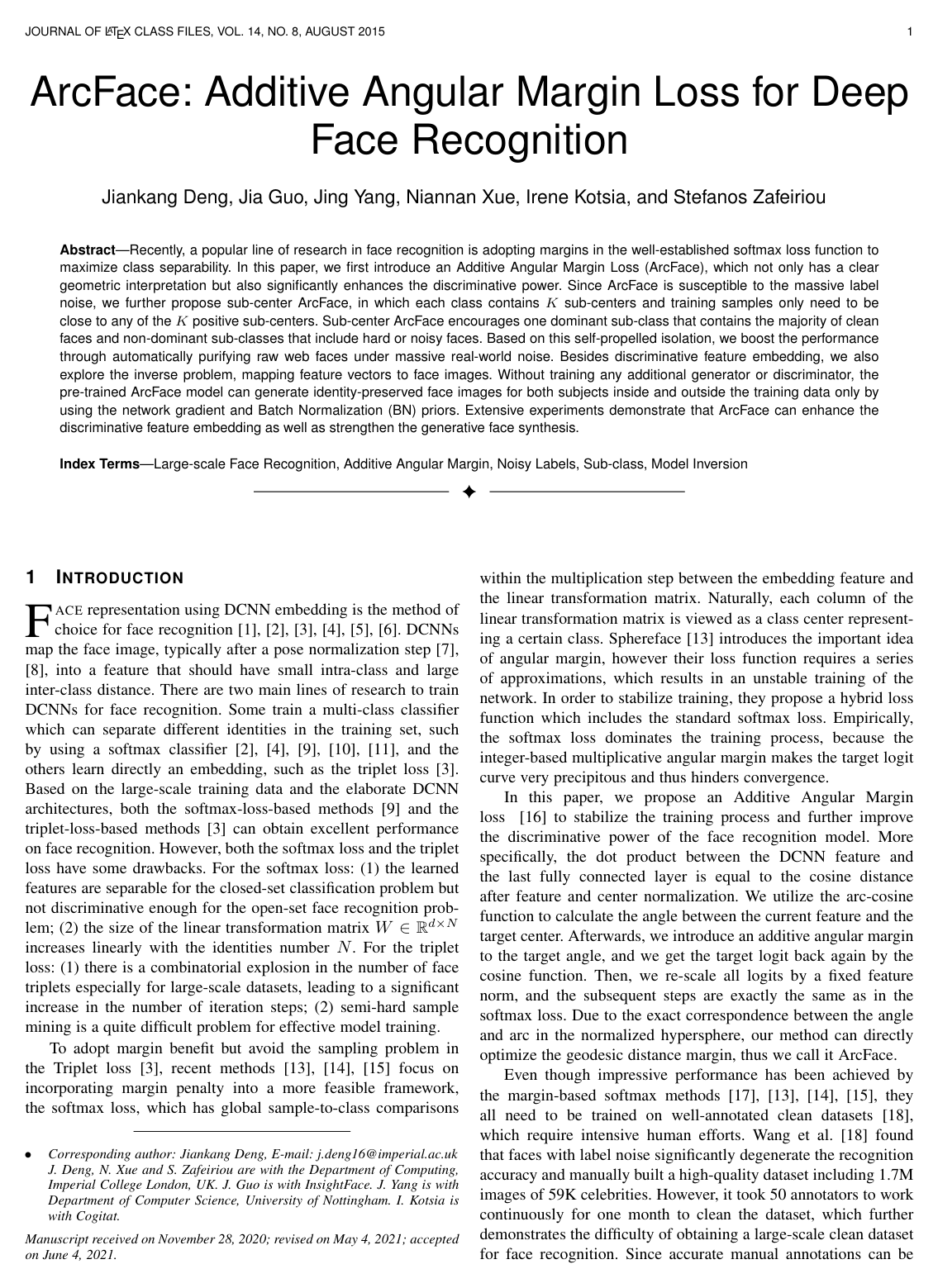
ArcFace: Additive Angular Margin Loss for Deep Face Recognition
Jiankang Deng, J. Guo, Stefanos Zafeiriou
Why you should read this
Proposes an additive angular margin loss that enforces geometric constraints on feature embeddings to maximize class separability in face recognition, effectively isolate training noise, and generate identity-preserving faces without extra models.
Recently, a popular line of research in face recognition is adopting margins in the well-established softmax loss function to maximize class separability. In this paper, we first introduce an Additive Angular Margin Loss (ArcFace), which not only has a clear geometric interpretation but also significantly enhances the discriminative power. Since ArcFace is susceptible to the massive label noise, we further propose sub-center ArcFace, in which each class contains sub-centers and training samples only need to be close to any of the positive sub-centers. Sub-center ArcFace encourages one dominant sub-class that contains the majority of clean faces and non-dominant sub-classes that include hard or noisy faces. Based on this self-propelled isolation, we boost the performance through automatically purifying raw web faces under massive real-world noise. Besides discriminative feature embedding, we also explore the inverse problem, mapping feature vectors to face images. Without training any additional generator or discriminator, the pre-trained ArcFace model can generate identity-preserved face images for both subjects inside and outside the training data only by using the network gradient and Batch Normalization (BN) priors. Extensive experiments demonstrate that ArcFace can enhance the discriminative feature embedding as well as strengthen the generative face synthesis.
Added
2026-09-07