Transcending the Limit of Local Window: Advanced Super-Resolution Transformer with Adaptive Token Dictionary
Leheng ZhangYawei LiXingyu ZhouXiaorui ZhaoShuhang Gu
Proposes an adaptive token dictionary for super-resolution Transformers that overcomes the receptive-field limits of window-based attention by dynamically grouping similar image tokens across the entire image to capture long-range dependencies.
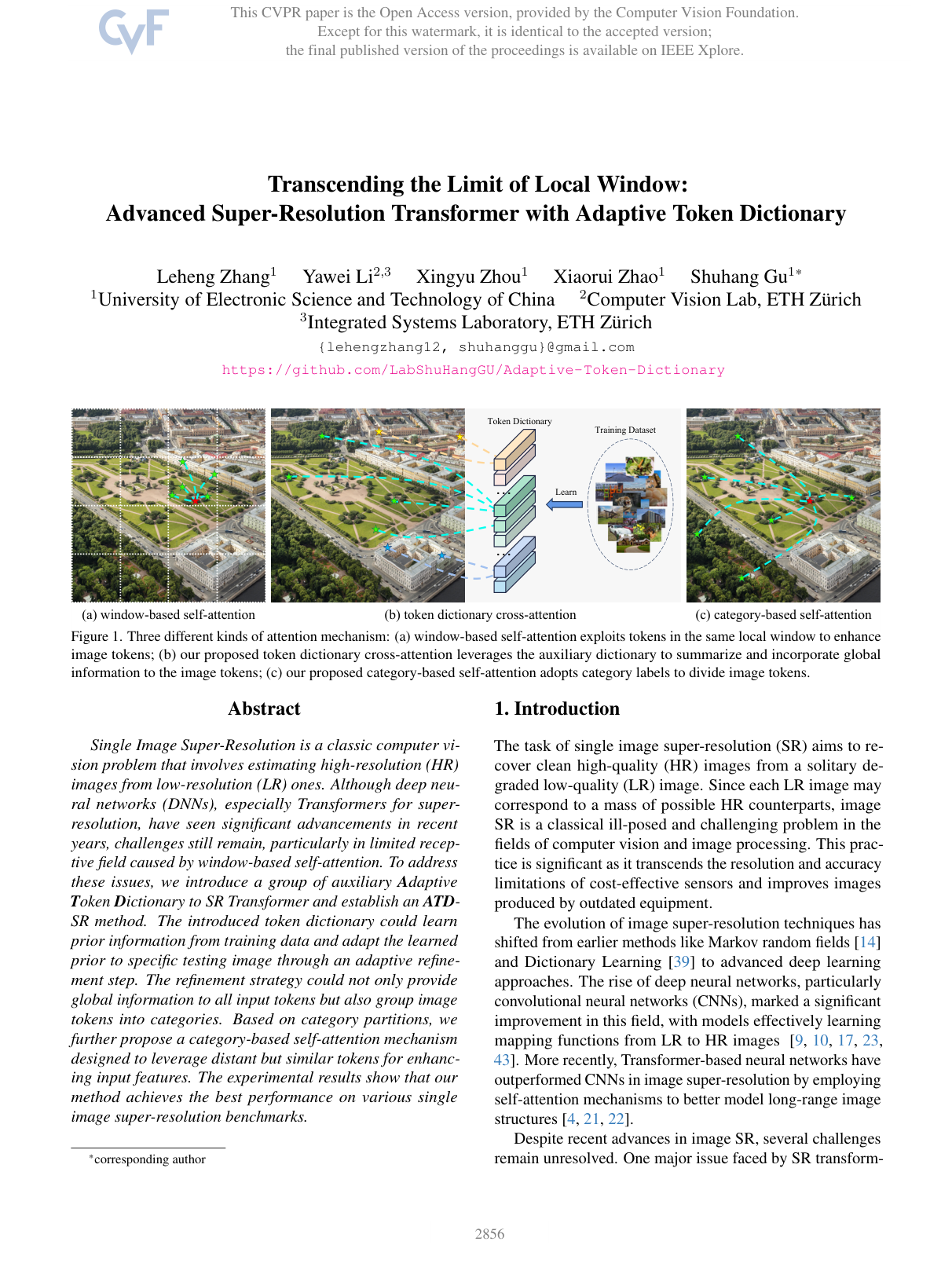
Single-image super-resolution—the process of reconstructing high-resolution images from solitary, low-resolution inputs—is critical for overcoming the physical limitations of low-cost sensors and enhancing legacy imagery. While modern vision transformer architectures achieve strong performance by capturing structural relationships, their computational cost grows quadratically with image size. To manage this burden, existing models restrict their attention mechanism to fixed, local rectangular windows. However, this artificial constraint limits the model's receptive field, preventing it from capturing long-range dependencies across the entire image and grouping unrelated image parts together simply because they are spatially adjacent.
The objective of the article is to demonstrate an advanced super-resolution transformer architecture that overcomes local window boundaries using an adaptive token dictionary. The proposed framework evaluates how external visual priors and global image content can be integrated to capture long-range, content-based similarities without creating excessive computational complexity.
To achieve this, the authors integrated three core mechanisms: a cross-attention module that matches image tokens to a learned auxiliary token dictionary containing general visual structures, an adaptive refinement strategy that dynamically updates the dictionary layer by layer using the test image's specific features, and a category-based self-attention mechanism that groups similar tokens across the entire image regardless of distance. The architecture was evaluated across five standard image benchmark datasets (Set5, Set14, BSD100, Urban100, and Manga109) across both standard and lightweight model configurations, using standard image fidelity metrics.
The evaluation produced four primary findings. First, the proposed full model consistently surpassed leading state-of-the-art architectures, delivering an improvement of 0.25 to 0.28 dB on the Urban100 benchmark across multiple magnification factors with a comparable parameter footprint (approximately 20 million parameters). Second, the lightweight version outperformed competing lightweight models across all benchmarks, notably exceeding the nearest competitor by 0.46 dB on the Manga109 four-times upscaling task while maintaining a compact size of roughly 769,000 parameters. Third, ablation testing confirmed that each component is necessary: combining cross-attention and dictionary refinement provided steady gains, while category-based attention drove the largest performance surge (up to 0.19 dB). Finally, sensitivity testing revealed optimal operating thresholds at a dictionary size of 64 to 128 tokens and a sub-category size of 128; exceeding these points led to diminishing returns or slight performance drops due to over-parameterization.
These findings indicate that content-dependent feature grouping provides a superior, more computationally efficient alternative to arbitrary spatial window partitioning in computer vision. For organizations deploying imaging systems, this approach lowers computational overhead while delivering noticeably sharper edge reconstruction and cleaner fine textures. The ability to deploy high-performing lightweight models also makes advanced image restoration feasible on resource-constrained edge devices and mobile hardware.
Engineering and deployment teams working on image enhancement should consider adopting category-based token grouping and adaptive dictionaries over standard windowed attention. When implementing this architecture, teams should carefully tune dictionary capacity and group partition sizes to prevent model saturation. Further work should explore validating the model on broader real-world camera artifacts, varied degradation types beyond standard synthetic downsampling, and actual hardware inference latency across production environments.
- Paper: SwinIR: Image Restoration Using Swin Transformer, Jingyun Liang et al. (2021). This paper establishes the baseline Swin-based windowed transformer architecture for image super-resolution whose local rectangular window limitations the source paper specifically aims to transcend.
- Paper: Swin Transformer: Hierarchical Vision Transformer using Shifted Windows, Ze Liu et al. (2021). This work introduces the foundational shifted local window self-attention mechanism that enables linear computational complexity in vision transformers.
- Paper: Cross Aggregation Transformer for Image Restoration, Zheng Chen et al. (2022). This paper investigates expanding receptive fields across window boundaries in image restoration using alternating rectangular windows and axial stripes.
- Paper: Restormer: Efficient Transformer for High-Resolution Image Restoration, Syed Waqas Zamir et al. (2022). This paper presents an efficient transformer design for high-resolution image restoration that captures global context while managing computational overhead.
- Paper: Image Deblurring and Super-Resolution by Adaptive Sparse Domain Selection and Adaptive Regularization, Weisheng Dong et al. (2010). This study introduces dictionary clustering and adaptive domain selection based on structural patch similarity for image restoration, providing foundational concepts for dictionary-based super-resolution.
- Paper: Super-resolution from a single image, Daniel Glasner et al. (2009). This foundational work establishes the recurrence of internal image patches across scales as an essential prior for single-image super-resolution.
- Paper: CSWin Transformer: A General Vision Transformer Backbone with Cross-Shaped Windows, Xiaoyi Dong et al. (2021). This paper explores cross-shaped window self-attention to broaden receptive fields beyond conventional square local windows in vision transformers.
- Paper: Uformer: A General U-Shaped Transformer for Image Restoration, Zhendong Wang et al. (2021). This paper explores locally-enhanced window self-attention mechanisms within a hierarchical U-shaped transformer for image restoration tasks.
- Paper: Second-Order Attention Network for Single Image Super-Resolution, Tao Dai et al. (2019). This paper introduces non-local spatial modeling and high-order attention to capture long-range contextual relationships in single-image super-resolution.
- Paper: Image Super-Resolution Using Very Deep Residual Channel Attention Networks, Yulun Zhang et al. (2018). This paper demonstrates deep residual feature learning and channel attention for selective high-frequency feature extraction in image super-resolution.
- Paper: TransNeXt: Robust Foveal Visual Perception for Vision Transformers, Dai Shi (2024). This paper extends efficient vision transformer design by combining fine-grained sliding-window local attention with coarse global perception to eliminate structural window artifacts.
- Paper: CoSeR: Bridging Image and Language for Cognitive Super-Resolution, Haoze Sun et al. (2024). This work advances beyond bottom-up super-resolution transformers by integrating cross-modal cognitive tokens and diffusion generative priors for holistic semantic restoration.