EDVR: Video Restoration With Enhanced Deformable Convolutional Networks
Xintao WangKelvin C. K. ChanKe YuChao DongChen Change Loy
Presents EDVR, a video restoration framework that couples pyramid deformable convolution alignment with spatiotemporal attention fusion to resolve large motions and blur, winning all four tracks of the NTIRE19 competition.
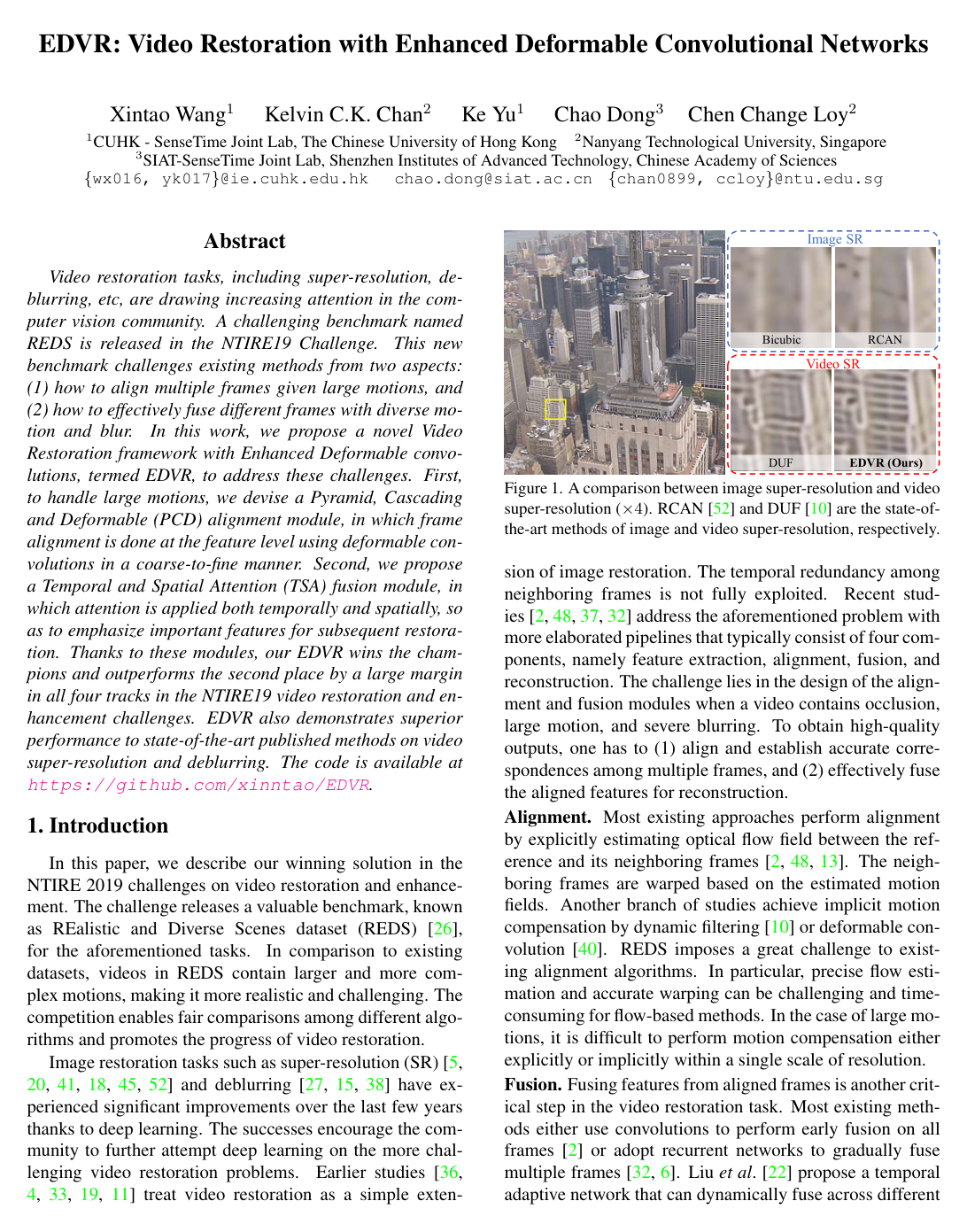
Video restoration tasks, such as enhancing resolution and removing blur, are critical for modern visual systems. However, real-world videos frequently contain severe motion blur, occlusion, and large displacements between frames. Existing approaches struggle because standard motion estimation methods fail under complex motion, and typical frame fusion methods treat all neighboring image regions equally, regardless of blur or alignment quality.
The article evaluates and demonstrates a unified video restoration framework named EDVR (Enhanced Deformable Video Restoration). The main objective is to establish an effective system capable of accurately aligning neighboring frames with large motions and dynamically fusing the most informative visual features across multiple video restoration benchmarks.
The approach introduces two central components: a multi-scale alignment module that uses coarse-to-fine deformable convolutions to align features without requiring separate optical flow estimation, and an attention-based fusion module that dynamically assigns weights to neighboring frames across both space and time. To handle severe blur, a preliminary deblurring module prepares features before alignment, and an optional second-stage network refines the outputs. The system was evaluated across multiple standard benchmarks, including the realistic REDS and Vimeo-90K datasets, across four distinct competitive video restoration tracks.
The findings demonstrate substantial improvements over existing methods. In the NTIRE 2019 competition, the framework won first place across all four tracks, including clean and blurry video super-resolution as well as clean and compressed video deblurring. On the REDS benchmark, the framework achieved an average video super-resolution peak signal-to-noise ratio of 31.09 dB compared to 28.63 dB for the prior leading method, and a deblurring ratio of 34.80 dB compared to 26.98 dB for existing methods. Ablation experiments confirmed that the multi-scale alignment module improved image quality by 0.4 dB without adding computational complexity, while temporal and spatial attention contributed an additional 0.14 dB gain. Furthermore, adding a second refinement stage provided an extra 0.5 dB improvement on highly challenging inputs.
These results show that handling video frame alignment implicitly at the feature level, combined with selective attention during fusion, significantly reduces visual artifacts and improves reconstruction quality over traditional motion compensation. For operational deployments, adopting this unified architecture can lower pipeline complexity by replacing separate optical flow and deblurring steps with an end-to-end learning model.
Organizations seeking to implement advanced video enhancement should adopt feature-level deformable alignment and attention mechanisms as a baseline. For high-demand scenarios with severe blurring, teams should implement the two-stage cascade, weighing the added reconstruction fidelity against the extra computational cost.
A key limitation identified in the article is dataset bias: models trained on one video distribution experienced a performance drop of 0.5 to 1.5 dB when tested on mismatched datasets. Consequently, decision-makers should have high confidence in the framework's algorithmic architecture, but should ensure that models are fine-tuned on representative target data before wide deployment.
- Paper: Video Enhancement with Task-Oriented Flow, Tianfan Xue et al. (2017). This paper establishes the paradigm of task-oriented temporal motion estimation for video restoration and introduces the Vimeo-90K benchmark upon which EDVR builds its multi-frame alignment strategy.
- Paper: Enhanced Deep Residual Networks for Single Image Super-Resolution, Bee Lim et al. (2017). This foundational work on enhanced residual network design for super-resolution provides the architectural backbones and residual scaling techniques adapted by EDVR's reconstruction blocks.
- Paper: ESRGAN: Enhanced Super-Resolution Generative Adversarial Networks, Xintao Wang et al. (2018). It introduces Residual-in-Residual Dense Blocks and training strategies for high-fidelity restoration that directly inform the deep feature processing blocks utilized in EDVR.
- Paper: Residual Dense Network for Image Super-Resolution, Yulun Zhang et al. (2018). It introduces hierarchical dense feature fusion in deep residual architectures, which motivates EDVR's feature extraction and multi-frame fusion structures.
- Paper: Real-Time Single Image and Video Super-Resolution Using an Efficient Sub-Pixel Convolutional Neural Network, Wenzhe Shi et al. (2016). It introduces the sub-pixel convolution layer widely used in deep super-resolution architectures to perform efficient end-stage upsampling.
- Paper: FlowNet: Learning Optical Flow with Convolutional Networks, Philipp Fischer et al. (2015). It provides the foundational CNN-based motion estimation framework that underpins learned feature-level alignment in video restoration tasks.
- Paper: Multi-Stage Progressive Image Restoration, Syed Waqas Zamir et al. (2021). MPRNet extends multi-frame and multi-scale restoration principles to a multi-stage progressive architecture with cross-stage feature fusion for dynamic deblurring and deraining.
- Paper: SwinIR: Image Restoration Using Swin Transformer, Jingyun Liang et al. (2021). SwinIR builds upon the alignment and attention fusion concepts of CNN restoration models by introducing shifting-window vision transformers for image and video restoration.
- Paper: Restormer: Efficient Transformer for High-Resolution Image Restoration, Syed Waqas Zamir et al. (2022). Restormer extends spatial-temporal feature attention mechanisms into an efficient multi-Dconv head-transposed Transformer for high-resolution restoration tasks.
- Paper: Real-ESRGAN: Training Real-World Blind Super-Resolution with Pure Synthetic Data, Xintao Wang et al. (2021). Real-ESRGAN advances restoration architectures like EDVR and ESRGAN toward blind, real-world degradation modeling and practical super-resolution pipelines.
- Paper: Uformer: A General U-Shaped Transformer for Image Restoration, Zhendong Wang et al. (2021). Uformer develops a U-shaped transformer architecture with locally-enhanced window self-attention to advance deep image and video restoration benchmarks beyond convolutional baselines.
- Paper: Pre-Trained Image Processing Transformer, Hanting Chen et al. (2020). IPT extends specialized deep restoration architectures by introducing large-scale Transformer pre-training across multiple low-level vision tasks.
- Paper: Second-Order Attention Network for Single Image Super-Resolution, Tao Dai et al. (2019). SAN extends attention-based restoration by introducing second-order channel attention and non-local operations to capture richer feature dependencies.