TCTrack: Temporal Contexts for Aerial Tracking
Ziang CaoZiyuan HuangLiang PanShiwei ZhangZiwei LiuChanghong Fu
Proposes a real-time aerial tracking framework that exploits multi-level temporal contexts through dynamically calibrated convolutions and memory-efficient transformer refinement to achieve superior tracking accuracy on UAV edge devices.
Visual tracking from unmanned aerial vehicles is critical for applications like surveying, localization, and motion analysis, but it faces major operational bottlenecks. Drones suffer from abrupt camera motion, fast-moving targets, severe occlusions, and motion blur. Simultaneously, their onboard hardware is heavily constrained by battery life and compute power, making heavy state-of-the-art tracking models impractical. Traditional lightweight trackers frequently lose targets because they process individual video frames in isolation, discarding historical temporal context that reveals object trajectory.
The article demonstrates and evaluates TCTrack, a lightweight visual tracking framework designed to exploit temporal context across consecutive frames without exceeding edge hardware constraints. The objective is to achieve tracking robustness and real-time processing speeds on resource-limited aerial platforms.
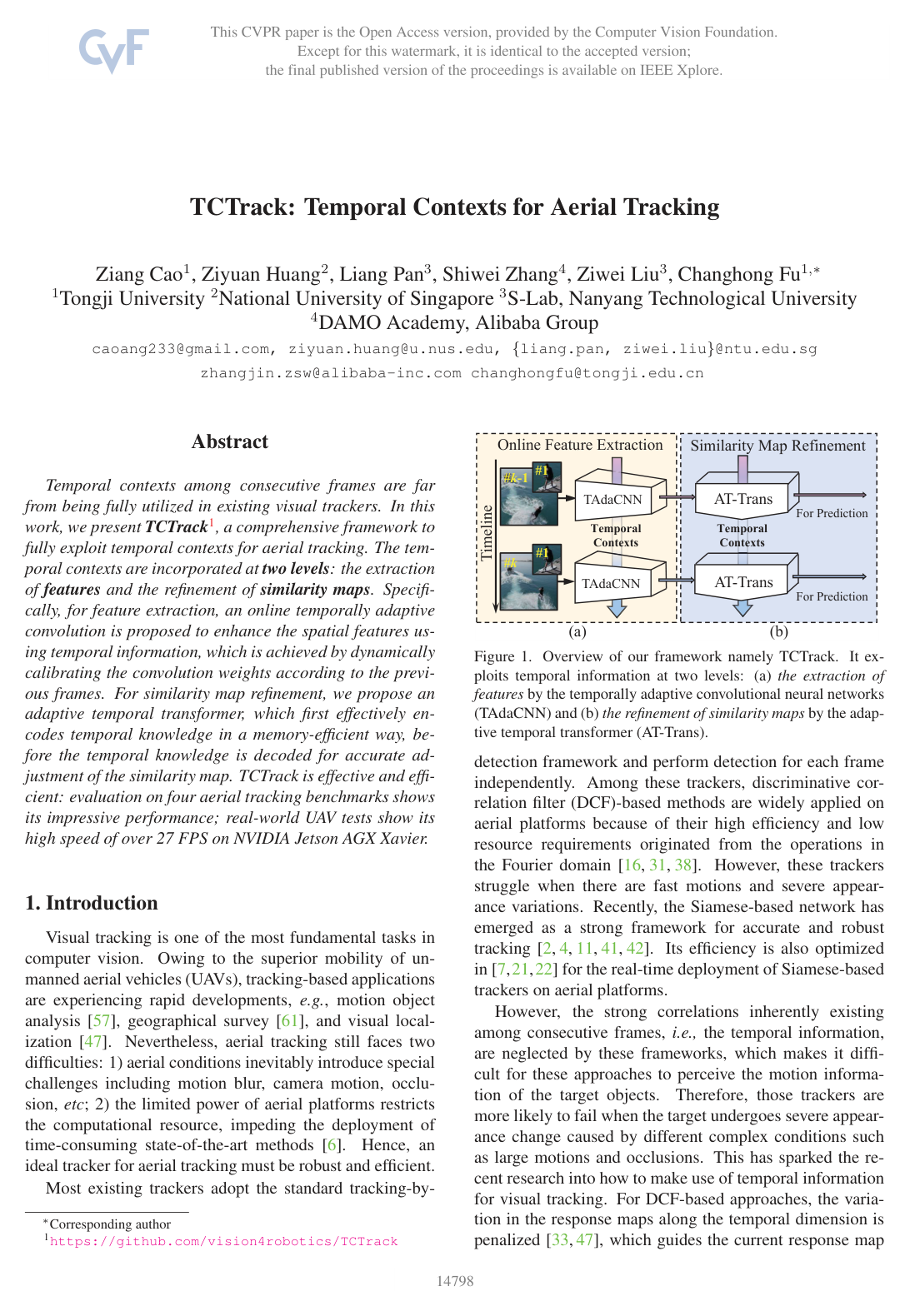
The authors designed a two-level temporal architecture. First, an online temporally adaptive convolutional network dynamically calibrates its feature-extraction weights using feature history from past frames. Second, an adaptive temporal transformer filters out noise and refines target similarity maps by updating a compact memory of prior knowledge. The system was evaluated on four standardized aerial tracking benchmarks against 51 existing trackers and tested in real-world flight trials using an onboard NVIDIA Jetson AGX Xavier computing module.
The key findings demonstrate clear performance gains over existing solutions. On standard aerial benchmarks, the framework achieved top accuracy and precision, delivering a 3% to 5% improvement in area-under-the-curve performance compared to the next-best lightweight trackers. Ablation experiments showed that integrating filtered temporal knowledge improved tracking success in fast-motion conditions by roughly 12% to 15% and in partial-occlusion scenarios by about 11%. When compared to heavy, deep-network trackers, the proposed model achieved competitive tracking quality while operating 2.49 times faster than the leading deep alternative, reaching 125.6 frames per second on desktop hardware. In real-world aerial field tests, the system sustained over 27 frames per second on onboard hardware with low resource consumption (averaging 46% GPU and 12.43% CPU utilization) while maintaining high tracking accuracy under diverse lighting and camera motion.
These findings prove that temporal context can compensate for lightweight neural network architectures, closing the performance gap with computationally expensive deep models. For operational teams, this reduces compute hardware costs, lowers payload power consumption, and enhances mission reliability in complex aerial environments. Organizations deploying aerial vision systems should consider incorporating continuous temporal context architectures rather than relying solely on deeper backbones or single-frame detection.
Decision-makers should proceed with field pilots for target operations, although further development is warranted. The authors note that the framework's training regimen focused on short temporal sequences (four frames), meaning its behavior during extended, long-duration occlusions requires further validation. Recommended next steps include converting the pipeline to specialized runtimes like TensorRT and ONNX for further execution speed improvements, alongside governance controls to prevent unauthorized surveillance deployment.
- Paper: A Benchmark and Simulator for UAV Tracking, Matthias Mueller et al. (2016). It establishes the UAV123 benchmark and defines the specific challenges of low-altitude aerial tracking that TCTrack aims to solve under resource-constrained conditions.
- Paper: Transformer Tracking, Xin Chen et al. (2021). It introduces the fundamental transformer tracking paradigm that replaces conventional correlation with attention-based feature fusion, providing the foundational context for TCTrack's temporal transformer.
- Paper: SiamRPN++: Evolution of Siamese Visual Tracking With Very Deep Networks, Bo Li et al. (2018). It establishes modern Siamese-based deep tracking architectures and cross-correlation matching baselines upon which subsequent lightweight real-time trackers build.
- Paper: Fully-Convolutional Siamese Networks for Object Tracking, Luca Bertinetto et al. (2016). It introduces the fully-convolutional Siamese tracking framework that underpins the offline-trained similarity matching paradigms adapted by modern real-time visual trackers.
- Paper: TSM: Temporal Shift Module for Efficient Video Understanding, Ji Lin et al. (2018). It introduces efficient temporal feature-shifting mechanisms across consecutive video frames to achieve spatio-temporal modeling at negligible computational overhead.
- Paper: Learning Discriminative Model Prediction for Tracking, Goutam Bhat et al. (2019). It presents end-to-end discriminative model prediction and online model updating, providing critical background for TCTrack's dynamic online adaptation.
- Paper: LaSOT: A High-Quality Benchmark for Large-Scale Single Object Tracking, Heng Fan et al. (2018). It provides a standardized large-scale benchmark and evaluation protocols widely used to train and validate robust visual tracking models against attributes like fast motion and occlusion.
- Paper: Learning Adaptive and View-Invariant Vision Transformer for Real-Time UAV Tracking, Yongxin Li et al. (2024). It extends lightweight aerial transformer tracking by introducing dynamic block activation and view-invariant representations to further optimize onboard UAV performance.
- Paper: MixFormerV2: Efficient Fully Transformer Tracking, Yutao Cui et al. (2023). It advances efficient transformer tracking by eliminating dense convolutional heads entirely through token-based prediction and multi-stage model distillation.
- Paper: Transformer Tracking with Cyclic Shifting Window Attention, Zikai Song et al. (2022). It refines attention mechanisms in transformer tracking by introducing cyclic shifting window attention to preserve target structural boundaries under occlusion and distractors.
- Paper: Unifying Visual and Vision-Language Tracking via Contrastive Learning, Yinchao Ma et al. (2024). It broadens visual tracking architectures into a multimodal framework capable of unifying bounding box and natural language prompts via contrastive learning and dynamic historical memory.