
keyword
temporal transformer
A temporal transformer is a neural network architecture or component that applies self-attention mechanisms across sequential time steps to capture dynamic patterns and long-range dependencies over time. Built on the foundational transformer design, it specifically calculates attention along the temporal axis rather than exclusively across spatial positions or text tokens, allowing the system to track how individual features evolve from one frame or moment to the next. In domains such as computer vision, video processing, and sequential analysis, temporal transformers are widely employed in tasks like video generation, visual tracking, action recognition, and human pose estimation, where they are often paired with spatial layers to separate and learn both spatial structure and motion dynamics across consecutive time steps.
5 items
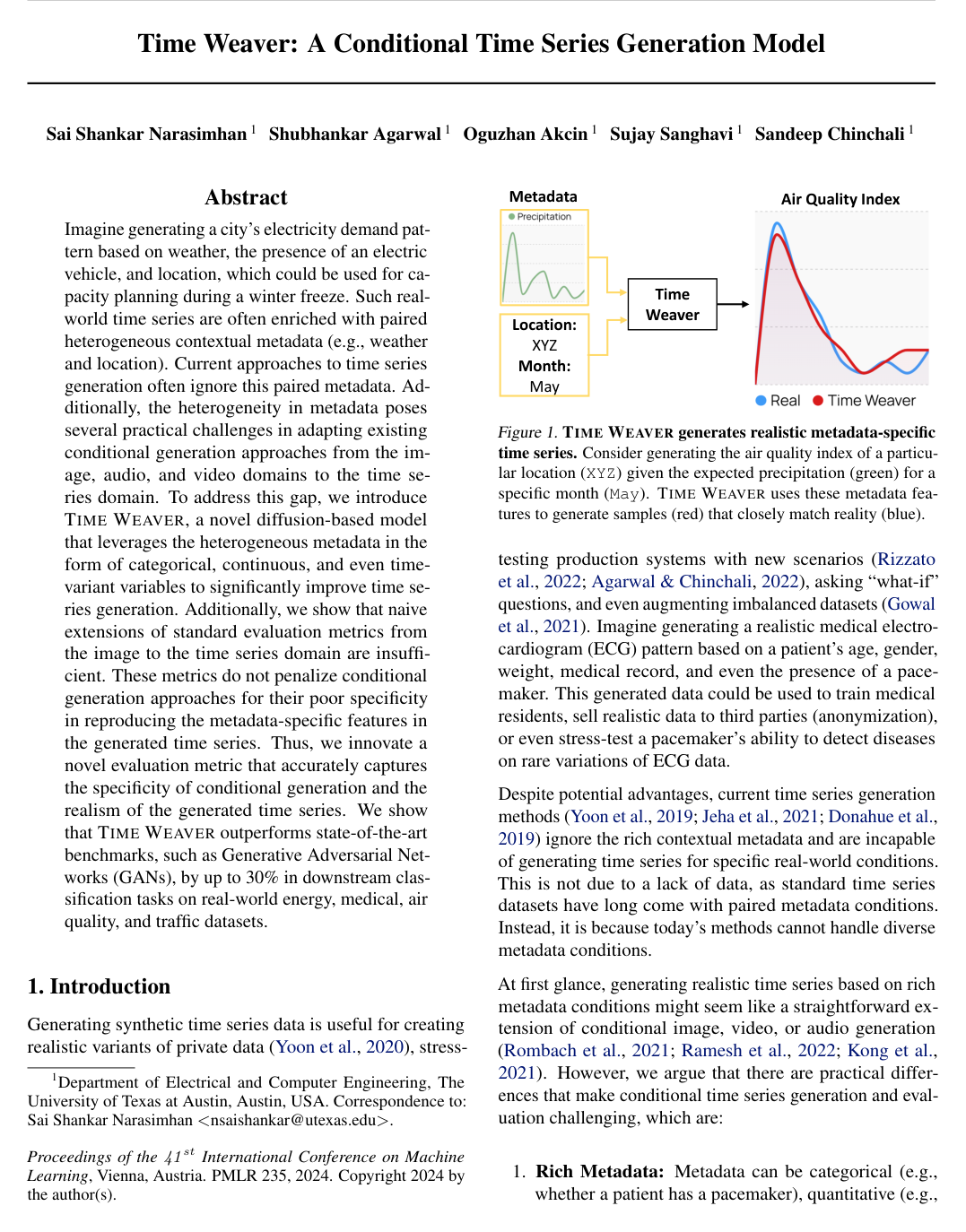
Time Weaver: A Conditional Time Series Generation Model
Sai Shankar Narasimhan, Shubhankar Agarwal, Oguzhan Akcin, Sujay Sanghavi, Sandeep P. Chinchali
Why you should read this
Introduces a diffusion-based framework and a dedicated evaluation metric for generating realistic multivariate time series conditioned on complex categorical, continuous, and time-varying metadata.
Imagine generating a city’s electricity demand pattern based on weather, the presence of an electric vehicle, and location, which could be used for capacity planning during a winter freeze. Such real-world time series are often enriched with paired heterogeneous contextual metadata (e.g., weather and location). Current approaches to time series generation often ignore this paired metadata. Additionally, the heterogeneity in metadata poses several practical challenges in adapting existing conditional generation approaches from the image, audio, and video domains to the time series domain. To address this gap, we introduce TIME WEAVER, a novel diffusion-based model that leverages the heterogeneous metadata in the form of categorical, continuous, and even time-variant variables to significantly improve time series generation. Additionally, we show that naive extensions of standard evaluation metrics from the image to the time series domain are insufficient. These metrics do not penalize conditional generation approaches for their poor specificity in reproducing the metadata-specific features in the generated time series. Thus, we innovate a novel evaluation metric that accurately captures the specificity of conditional generation and the realism of the generated time series. We show that TIME WEAVER outperforms state-of-the-art benchmarks, such as Generative Adversarial Networks (GANs), by up to 30% in downstream classification tasks on real-world energy, medical, air quality, and traffic datasets.
Added
2026-10-05
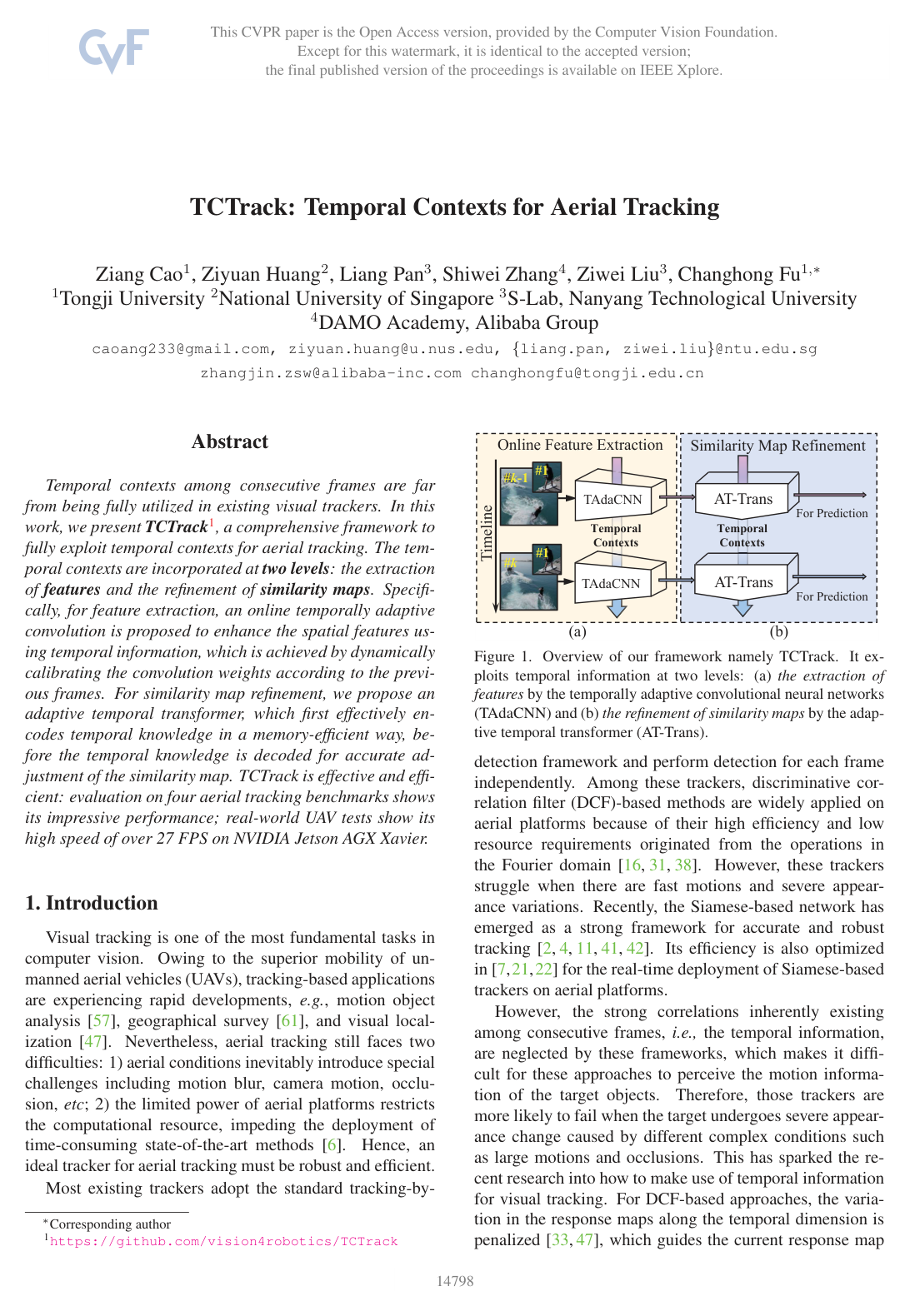
TCTrack: Temporal Contexts for Aerial Tracking
Ziang Cao, Ziyuan Huang, Liang Pan, Shiwei Zhang, Ziwei Liu, Changhong Fu
Why you should read this
Proposes a real-time aerial tracking framework that exploits multi-level temporal contexts through dynamically calibrated convolutions and memory-efficient transformer refinement to achieve superior tracking accuracy on UAV edge devices.
Temporal contexts among consecutive frames are far from being fully utilized in existing visual trackers. In this work, we present TCTrack1, a comprehensive framework to fully exploit temporal contexts for aerial tracking. The temporal contexts are incorporated at two levels: the extraction of features and the refinement of similarity maps. Specifically, for feature extraction, an online temporally adaptive convolution is proposed to enhance the spatial features using temporal information, which is achieved by dynamically calibrating the convolution weights according to the previous frames. For similarity map refinement, we propose an adaptive temporal transformer, which first effectively encodes temporal knowledge in a memory-efficient way, before the temporal knowledge is decoded for accurate adjustment of the similarity map. TCTrack is effective and efficient: evaluation on four aerial tracking benchmarks shows its impressive performance; real-world UAV tests show its high speed of over 27 FPS on NVIDIA Jetson AGX Xavier.
Added
2026-09-26
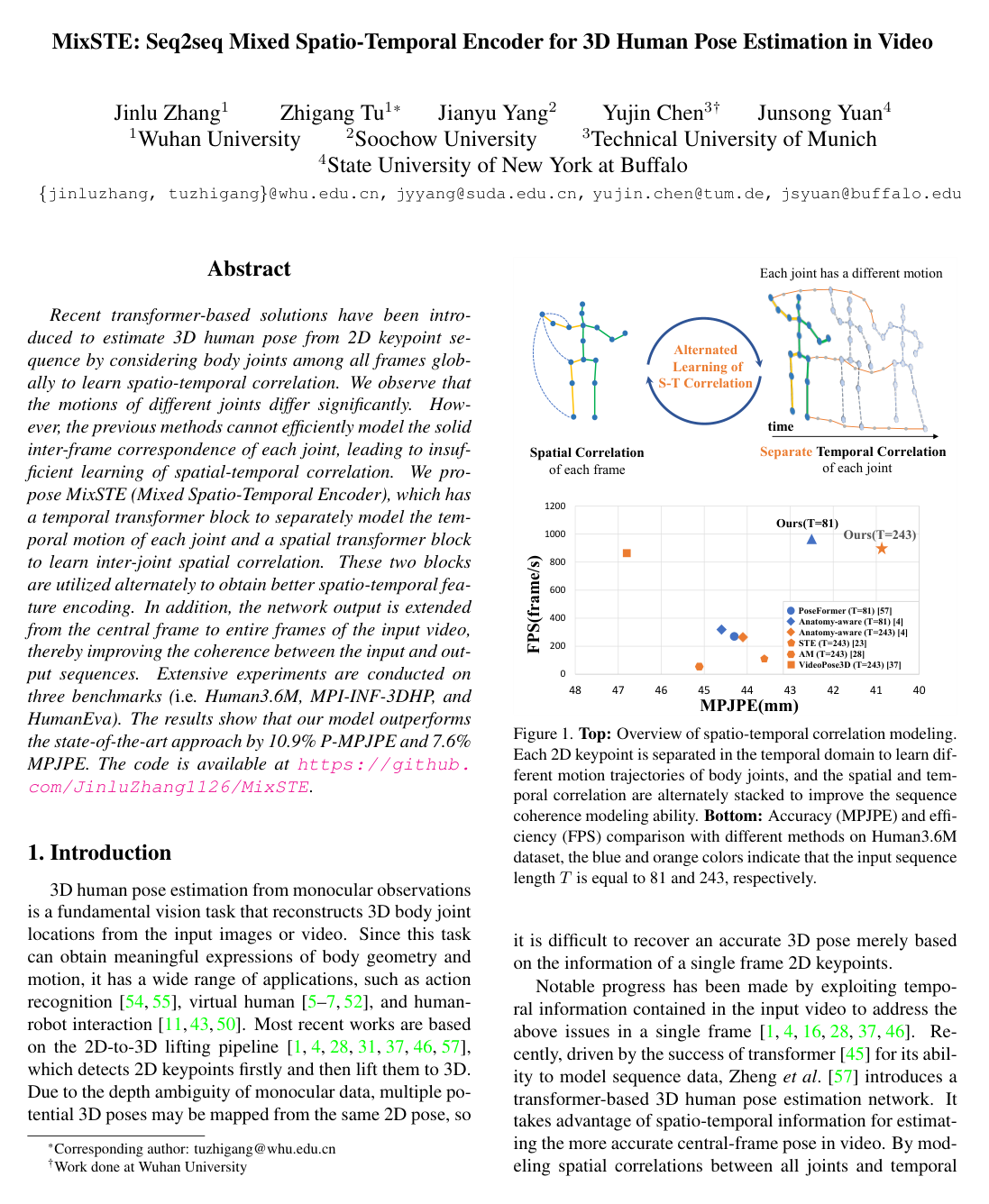
MixSTE: Seq2seq Mixed Spatio-Temporal Encoder for 3D Human Pose Estimation in Video
Jinlu Zhang, Zhigang Tu, Jianyu Yang, Yujin Chen, Junsong Yuan
Why you should read this
Proposes MixSTE, a sequence-to-sequence transformer architecture that alternates between modeling individual joint trajectories over time and spatial joint dependencies within frames to achieve state-of-the-art accuracy in video-based 3D human pose estimation.
Recent transformer-based solutions have been introduced to estimate 3D human pose from 2D keypoint sequence by considering body joints among all frames globally to learn spatio-temporal correlation. We observe that the motions of different joints differ significantly. However, the previous methods cannot efficiently model the solid inter-frame correspondence of each joint, leading to insufficient learning of spatial-temporal correlation. We propose MixSTE (Mixed Spatio-Temporal Encoder), which has a temporal transformer block to separately model the temporal motion of each joint and a spatial transformer block to learn inter-joint spatial correlation. These two blocks are utilized alternately to obtain better spatio-temporal feature encoding. In addition, the network output is extended from the central frame to entire frames of the input video, thereby improving the coherence between the input and output sequences. Extensive experiments are conducted on three benchmarks (Human3.6M, MPI-INF-3DHP, and HumanEva). The results show that our model outperforms the state-of-the-art approach by 10.9% P-MPJPE and 7.6% MPJPE. The code is available at this https URL.
Added
2026-09-26
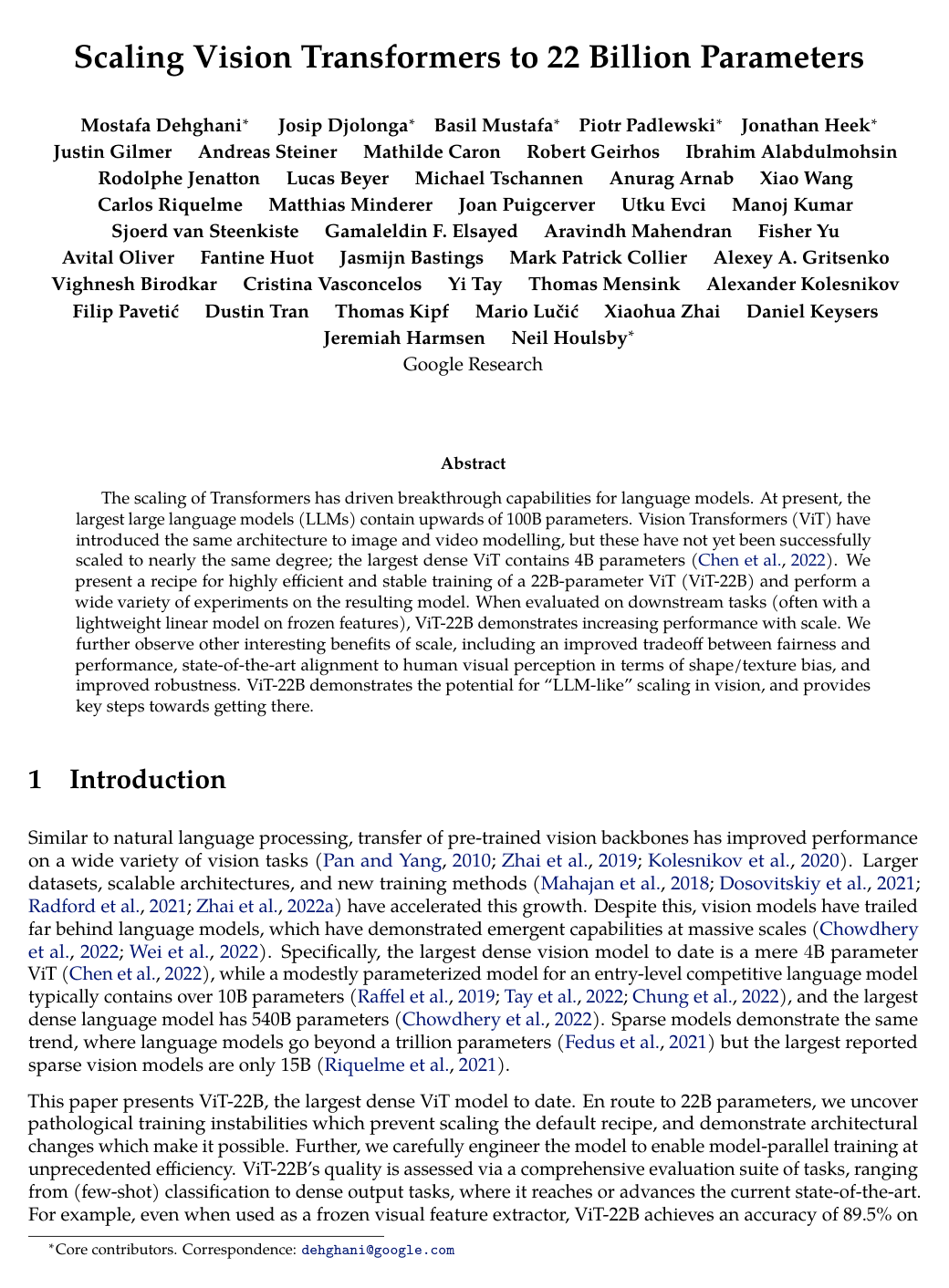
Scaling Vision Transformers
Xiaohua Zhai, Alexander Kolesnikov, Neil Houlsby, Lucas Beyer
Why you should read this
Establishes empirical scaling laws relating compute, data, and model size for Vision Transformers, showing how memory-efficient architecture refinements allow a two-billion-parameter model to achieve 90.45% top-1 accuracy on ImageNet.
Attention-based neural networks such as the Vision Transformer (ViT) have recently attained state-of-the-art results on many computer vision benchmarks. Scale is a primary ingredient in attaining excellent results, therefore, understanding a model's scaling properties is a key to designing future generations effectively. While the laws for scaling Transformer language models have been studied, it is unknown how Vision Transformers scale. To address this, we scale ViT models and data, both up and down, and characterize the relationships between error rate, data, and compute. Along the way, we refine the architecture and training of ViT, reducing memory consumption and increasing accuracy of the resulting models. As a result, we successfully train a ViT model with two billion parameters, which attains a new state-of-the-art on ImageNet of 90.45% top-1 accuracy. The model also performs well for few-shot transfer, for example, reaching 84.86% top-1 accuracy on ImageNet with only 10 examples per class.
Added
2026-09-25
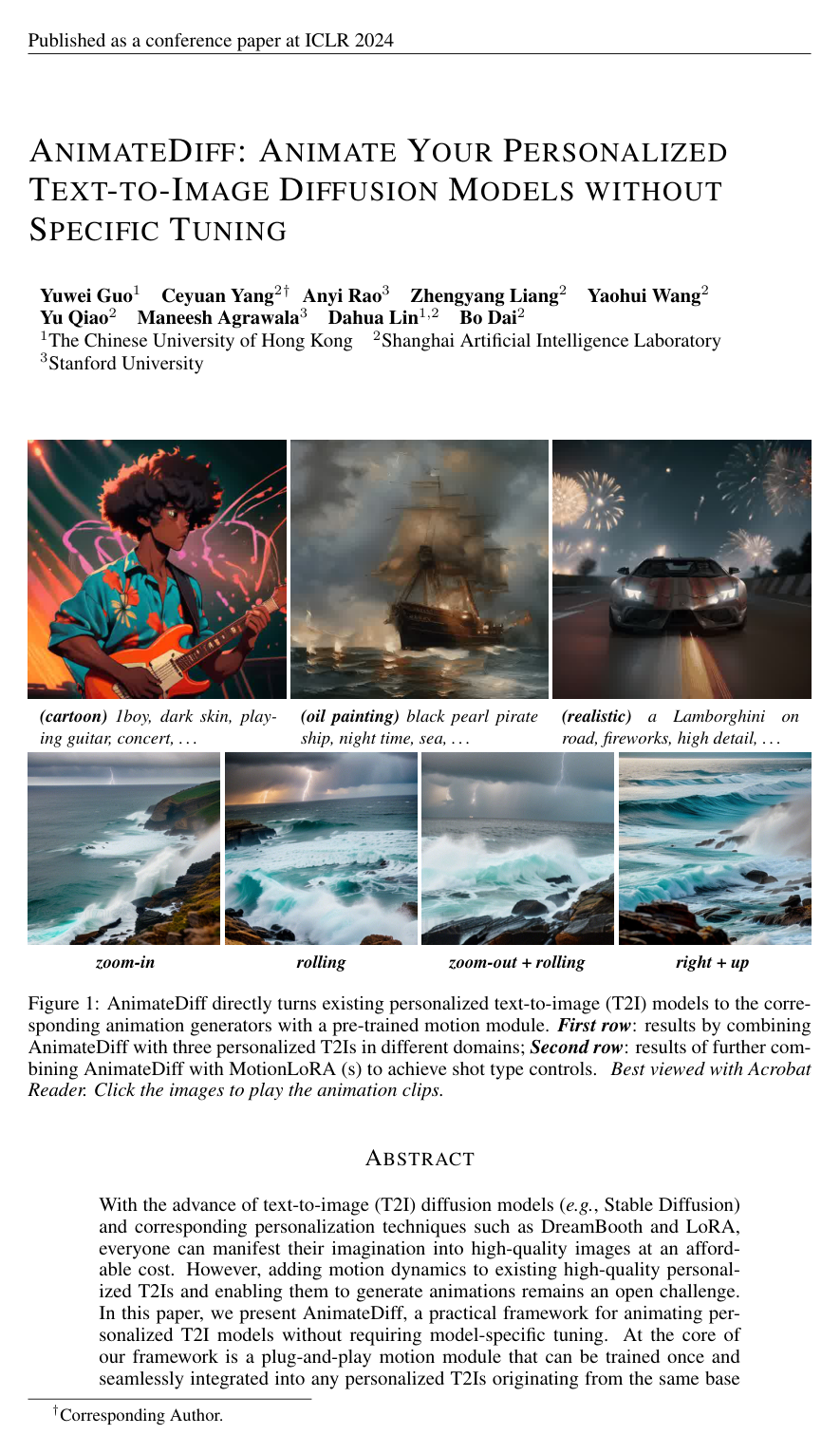
AnimateDiff: Animate Your Personalized Text-to-Image Diffusion Models without Specific Tuning
Yuwei Guo, Ceyuan Yang, Anyi Rao, Zhengyang Liang, Yaohui Wang, Yu Qiao, Maneesh Agrawala, Dahua Lin, Bo Dai
Why you should read this
Presents a plug-and-play motion module that learns generic temporal priors, allowing users to instantly animate any personalized or fine-tuned text-to-image model without retraining.
With the advance of text-to-image (T2I) diffusion models (e.g., Stable Diffusion) and corresponding personalization techniques such as DreamBooth and LoRA, everyone can manifest their imagination into high-quality images at an affordable cost. However, adding motion dynamics to existing high-quality personalized T2Is and enabling them to generate animations remains an open challenge. In this paper, we present AnimateDiff, a practical framework for animating personalized T2I models without requiring model-specific tuning. At the core of our framework is a plug-and-play motion module that can be trained once and seamlessly integrated into any personalized T2Is originating from the same base T2I. Through our proposed training strategy, the motion module effectively learns transferable motion priors from real-world videos. Once trained, the motion module can be inserted into a personalized T2I model to form a personalized animation generator. We further propose MotionLoRA, a lightweight fine-tuning technique for AnimateDiff that enables a pre-trained motion module to adapt to new motion patterns, such as different shot types, at a low training and data collection cost. We evaluate AnimateDiff and MotionLoRA on several public representative personalized T2I models collected from the community. The results demonstrate that our approaches help these models generate temporally smooth animation clips while preserving the visual quality and motion diversity. Codes and pre-trained weights are available at https://github.com/guoyww/AnimateDiff.
Added
2026-03-11