Time Weaver: A Conditional Time Series Generation Model

Sai Shankar NarasimhanShubhankar AgarwalOguzhan AkcinSujay SanghaviSandeep P. Chinchali

article2024ICML41 citations

Introduces a diffusion-based framework and a dedicated evaluation metric for generating realistic multivariate time series conditioned on complex categorical, continuous, and time-varying metadata.

Listen

Generating realistic synthetic time series data is vital for high-stakes applications such as stress-testing infrastructure systems, conducting scenario planning, preserving privacy through data anonymization, and training machine learning models. In real-world environments, time series data naturally pairs with rich contextual metadata, including discrete categories, continuous measurements, and time-varying external variables like weather forecasts. However, existing generative models largely fail to incorporate these diverse metadata conditions, limiting their ability to generate targeted, scenario-specific sequences. Furthermore, standard evaluation metrics fail to verify whether generated data actually matches paired metadata conditions.

The article develops and evaluates TIME WEAVER, a diffusion-based generative model designed to synthesize realistic multivariate time series conditioned on complex, heterogeneous metadata. Additionally, the article introduces a specialized evaluation metric to measure both the overall realism of generated time series and their precise fidelity to specific input metadata.

The authors designed a dedicated architecture that separately tokenizes categorical and continuous variables, links them through self-attention mechanisms, and feeds the resulting representations into sequential diffusion denoisers. To evaluate model outputs fairly, the authors established the Joint Frechet Time Series Distance (J-FTSD), a metric that measures distance across joint data-metadata representations trained via contrastive learning. The authors tested the framework across four diverse real-world benchmarks: urban air quality monitoring, highway traffic flow, electricity demand, and medical electrocardiograms (ECGs).

The experimental findings show that TIME WEAVER consistently outperforms traditional generative adversarial networks (GANs) and standard diffusion baselines across all datasets. In distributional similarity evaluated by J-FTSD, TIME WEAVER beats baseline GAN models by roughly 6 times on air quality data, 1.75 times on ECG signals, 4 times on electricity demand, and over 40 times on traffic volume. Downstream classification models trained entirely on synthetic data and evaluated on real-world test sets achieve up to 30% higher accuracy when using TIME WEAVER samples over GAN-generated baselines. In addition, ablations show that while GANs degrade significantly when tasked with handling continuous and time-varying inputs, TIME WEAVER reliably preserves complex relationships, value distributions, and physical trends across diverse time horizons.

These results demonstrate that incorporating paired contextual metadata into specialized diffusion architectures creates substantially higher-utility synthetic data. Organizations relying on data simulation for capacity planning, medical research, or risk testing can generate high-fidelity scenarios without suffering the training instability or mode collapse common in GANs. Moreover, adopting joint evaluation metrics like J-FTSD ensures that practitioners can accurately verify whether synthetic data reflects the true underlying conditions before deploying models into production.

Organizations developing or deploying time series generation tools should adopt diffusion architectures specifically tailored to handle multimodal conditioning and transition from unconditional evaluation metrics to paired metrics like J-FTSD. When implementing these architectures, engineering teams must evaluate operational trade-offs: the attention-based denoiser variant provides lower latency for individual sequence generation, whereas state-space denoiser backbones offer better scalability for large-batch synthesis. Future efforts should also focus on integrating progressive distillation techniques to accelerate inference speeds and extending metadata-conditioned diffusion into anomaly detection and forecasting pipelines.

Decision-makers should consider the computational demands of diffusion models, as both training iterations and sequential sampling steps require more computational time and memory than simpler generative frameworks. Additionally, while the generated patterns qualitatively adhere to known physical dependencies, such as rainfall reducing air pollutants, the authors note that empirical correlation does not constitute a formal mathematical proof of causality. Confidence in the model's performance on standard benchmark distributions is high, but validation on specialized edge-case conditions is recommended prior to mission-critical deployment.

arXiv: 2403.02682
Cover for Time Weaver: A Conditional Time Series Generation Model

Abstract

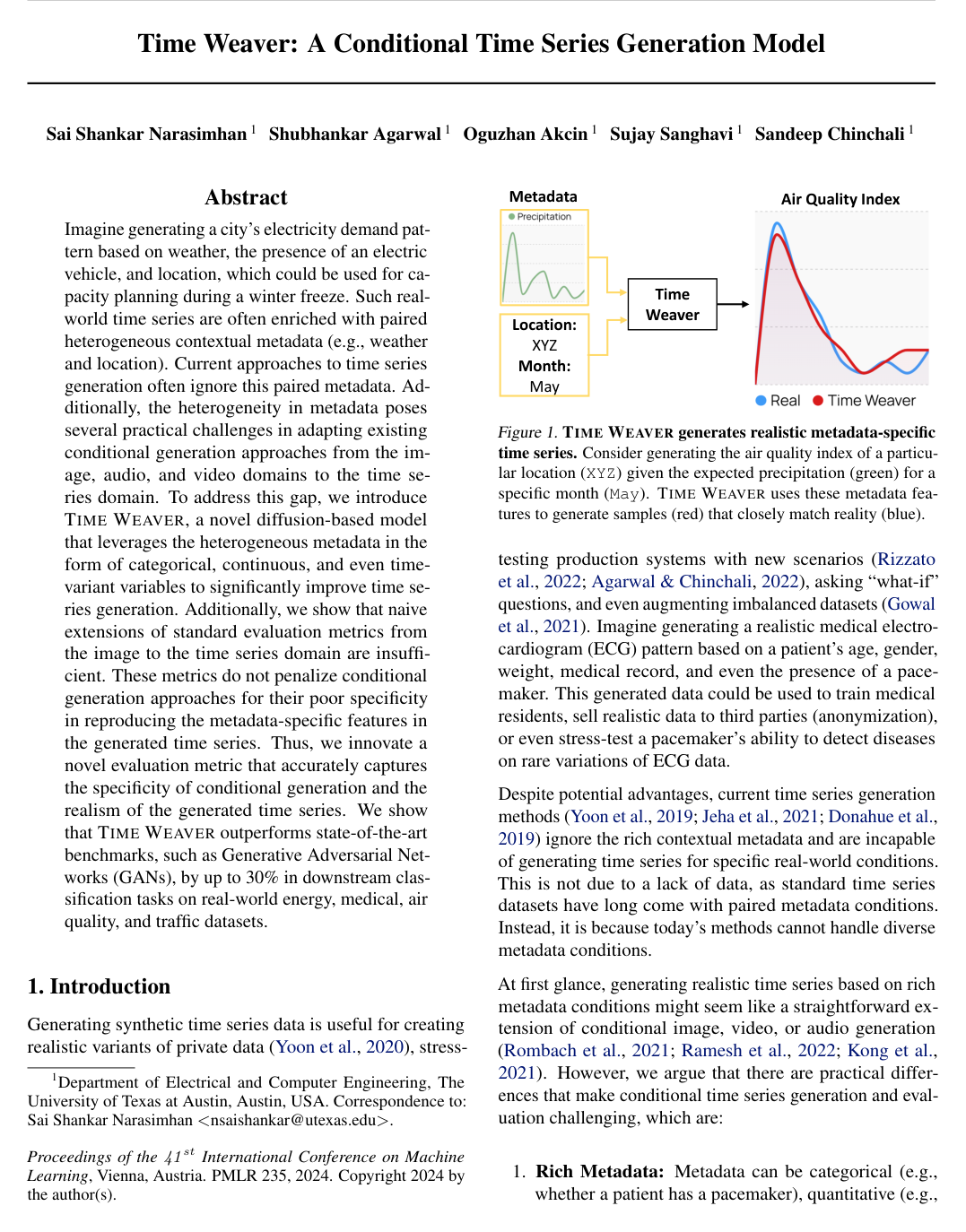
Imagine generating a city’s electricity demand pattern based on weather, the presence of an electric vehicle, and location, which could be used for capacity planning during a winter freeze. Such real-world time series are often enriched with paired heterogeneous contextual metadata (e.g., weather and location). Current approaches to time series generation often ignore this paired metadata. Additionally, the heterogeneity in metadata poses several practical challenges in adapting existing conditional generation approaches from the image, audio, and video domains to the time series domain. To address this gap, we introduce TIME WEAVER, a novel diffusion-based model that leverages the heterogeneous metadata in the form of categorical, continuous, and even time-variant variables to significantly improve time series generation. Additionally, we show that naive extensions of standard evaluation metrics from the image to the time series domain are insufficient. These metrics do not penalize conditional generation approaches for their poor specificity in reproducing the metadata-specific features in the generated time series. Thus, we innovate a novel evaluation metric that accurately captures the specificity of conditional generation and the realism of the generated time series. We show that TIME WEAVER outperforms state-of-the-art benchmarks, such as Generative Adversarial Networks (GANs), by up to 30% in downstream classification tasks on real-world energy, medical, air quality, and traffic datasets.

Knowls

  1. Knowl 1 — TIME WEAVER conditions diffusion on heterogeneous, time-varying metadata

    model/method

    TIME WEAVER generates a multivariate time series x∈RL×Fx\in\mathbb{R}^{L\times F}, with horizon LL and FF channels, conditioned on paired metadata. Categorical metadata ccat∈NL×Kcatc_{\mathrm{cat}}\in\mathbb{N}^{L\times K_{\mathrm{cat}}} and continuous metadata ccont∈RL×Kcontc_{\mathrm{cont}}\in\mathbb{R}^{L\times K_{\mathrm{cont}}} may vary over the same time horizon; KcatK_{\mathrm{cat}} and KcontK_{\mathrm{cont}} are their respective feature counts.

    The model processes the metadata modalities separately: categorical values are one-hot encoded and passed through fully connected layers, while continuous values are encoded with fully connected layers. It concatenates the resulting embeddings and applies self-attention to produce a metadata representation that captures temporal relationships. That representation conditions a diffusion denoiser at each reverse step. TIME WEAVER uses either the CSDI denoiser, with temporal and feature attention, or the SSSD denoiser, with structured state-space layers; both are adapted to use the metadata representation.

  2. Knowl 2 — Conditional diffusion training and generation objective

    equation

    TIME WEAVER jointly trains its metadata encoders and denoiser to predict the Gaussian noise added to a time-series sample. Let (x,c)(x,c) be a paired time series and metadata sample drawn from the training dataset, let TT be the number of diffusion steps, and let tt be sampled uniformly from {1,…,T}\{1,\ldots,T\}. The noisy sample xtx_t is obtained by applying the forward diffusion process to xx through step tt, using the selected variance schedule. Let ϵ∼N(0,I)\epsilon\sim\mathcal{N}(0,I) denote the added noise, θdenoiser\theta_{\mathrm{denoiser}} the noise-prediction network, and z(c)z(c) the learned metadata embedding. The training objective is

    L=E(x,c),ϵ,t[∥ϵ−θdenoiser(xt,t,z(c))∥22].\mathcal{L}=\mathbb{E}_{(x,c),\epsilon,t}\left[\left\|\epsilon-\theta_{\mathrm{denoiser}}(x_t,t,z(c))\right\|_2^2\right].

    At generation time, the model starts from xT∼N(0,I)x_T\sim\mathcal{N}(0,I) and repeatedly denoises, supplying the requested metadata cc at each reverse step, to produce a sample intended to follow the conditional distribution p(x∣c)p(x\mid c).

  3. Knowl 3 — Joint Frechet Time Series Distance evaluates conditional fidelity

    equation

    The Joint Frechet Time Series Distance (J-FTSD) compares real and generated samples in a joint embedding of the time series and its paired metadata. For each pair (xid,ci)(x_i^d,c_i) in dataset DdD_d, where d∈{r,g}d\in\{r,g\} denotes real or generated data, define zid=ϕtime(xid)⊕ϕmeta(ci)z_i^d=\phi_{\mathrm{time}}(x_i^d)\oplus\phi_{\mathrm{meta}}(c_i). The feature extractors map time series and metadata to Rdemb\mathbb{R}^{d_{\mathrm{emb}}}, and ⊕\oplus concatenates the embeddings. For nn paired samples, let μzd\mu_z^d and Σzd\Sigma_z^d be the sample mean and unbiased sample covariance of the joint embeddings. J-FTSD is the Frechet distance between the Gaussian approximations to the real and generated joint embedding distributions:

    J-FTSD⁡(Dg,Dr)=∥μzr−μzg∥22+Tr⁡ ⁣(Σzr+Σzg−2(ΣzrΣzg)1/2).\operatorname{J\text{-}FTSD}(D_g,D_r)=\|\mu_z^r-\mu_z^g\|_2^2+\operatorname{Tr}\!\left(\Sigma_z^r+\Sigma_z^g-2(\Sigma_z^r\Sigma_z^g)^{1/2}\right).

    Lower values indicate closer real and generated joint distributions. Including metadata embeddings and the covariance between metadata and time-series embeddings is intended to penalize samples that look plausible marginally but fail to reflect their assigned conditions. The metric's usefulness therefore depends on feature extractors that represent the relationship between each time series and its paired metadata.

  4. Knowl 4 — Contrastively trained feature extractors provide J-FTSD embeddings

    algorithm

    TIME WEAVER trains the J-FTSD time-series encoder ϕtime\phi_{\mathrm{time}} and metadata encoder ϕmeta\phi_{\mathrm{meta}} jointly, so matched time-series and metadata patches have similar embeddings and mismatched pairs do not. For a batch of NbatchN_{\mathrm{batch}} paired samples, it randomly selects NpatchN_{\mathrm{patch}} aligned patches of length LpatchL_{\mathrm{patch}} from each time series and its metadata. The M=NbatchNpatchM=N_{\mathrm{batch}}N_{\mathrm{patch}} patches from each modality are encoded, and their pairwise dot products form an M×MM\times M logits matrix. The matching patch pairs are the diagonal entries. The model uses labels [0,1,…,M−1][0,1,\ldots,M-1], computes cross-entropy once on the logits and once on their transpose, averages the two losses, and updates both encoders to minimize that average.

    The encoders use modified Informer architectures. For the time-series encoder, 1D convolutions precede positional encoding and self-attention; the metadata encoder uses the same separate categorical/continuous preprocessing principle as TIME WEAVER, followed by positional encoding and self-attention. Both encoders use 1D convolutions after self-attention layers, with stride-2 convolution after every third layer, then flatten and project to the embedding space. The reported settings are model dimension 128, 8 attention heads, 8 self-attention layers, dropout 0.05, GELU activation, 2 patches per sample, and learning rate 10−410^{-4}. Patch lengths and output embedding sizes are Air Quality: 64 and 128; ECG: 256 and 256; Electricity: 64 and 48; Traffic: 64 and 48.

  5. Knowl 5 — Evaluation covers four datasets and tests metadata recoverability

    experimental setup

    The experiments evaluate conditional generation on datasets with different horizons, channel counts, and metadata modalities. All generative models are trained on training splits and evaluated on test splits. The dataset characteristics and the categorical targets used for the Train on Synthetic Test on Real (TSTR) classifier are summarized below.

    Dataset Horizon Channels Categorical metadata Continuous metadata
    Air Quality 96 6 12 stations, 5 years, 12 months, 31 dates, 24 hours, 17 wind directions Temperature, pressure, dew point temperature, rain levels, wind speed
    Traffic 96 1 12 holidays, 7 years, 12 months, 31 dates, 24 hours, 11 broad and 38 fine weather descriptions Temperature, rain levels, snowfall levels, cloud conditions
    Electricity 96 1 370 users, 4 years, 12 months, 31 dates None
    ECG 1000 8 71 heart-disease statements None

    For TSTR, a ResNet-1D classifier is trained on synthetic samples to predict metadata and tested on real unseen samples; its ROC AUC is the reported score, so higher is better. The classification target is month for Electricity, heart-disease statements for ECG, coarse weather description for Traffic, and station for Air Quality. The ECG and Traffic tasks are multilabel; the Electricity and Air Quality tasks use multiclass cross-entropy.

  6. Knowl 6 — TIME WEAVER outperforms conditional GAN baselines on the main benchmarks

    data/table

    The table reports test-set J-FTSD (lower is better) and TSTR ROC AUC (higher is better) for the two TIME WEAVER denoisers and two GAN baselines on four datasets. Values are mean ±\pm standard deviation over three seeds. Both TIME WEAVER variants outperform the GANs on J-FTSD for every dataset; they also attain higher TSTR than either GAN on every dataset. The particularly large J-FTSD gaps occur on Traffic and Electricity.

    Air Quality ECG Traffic Electricity
    Approach J-FTSD ↓\downarrow TSTR ↑\uparrow J-FTSD ↓\downarrow TSTR ↑\uparrow J-FTSD ↓\downarrow TSTR ↑\uparrow J-FTSD ↓\downarrow TSTR ↑\uparrow
    WaveGAN 14.25±0.7914.25\pm0.79 0.61±0.010.61\pm0.01 9.55±0.019.55\pm0.01 0.65±0.0010.65\pm0.001 25.69±0.0125.69\pm0.01 0.54±0.010.54\pm0.01 7.82±0.0027.82\pm0.002 0.57±0.0070.57\pm0.007
    Pulse2Pulse 22.07±0.0222.07\pm0.02 0.60±0.0020.60\pm0.002 13.49±0.0413.49\pm0.04 0.63±0.030.63\pm0.03 17.70±0.00217.70\pm0.002 0.52±0.030.52\pm0.03 2.8±0.012.8\pm0.01 0.71±0.0040.71\pm0.004
    TIME WEAVER-CSDI 2.2±0.072.2\pm0.07 0.77±0.010.77\pm0.01 7.25±0.097.25\pm0.09 0.83±0.0010.83\pm0.001 0.53±0.010.53\pm0.01 0.66±0.060.66\pm0.06 0.6±0.0030.6\pm0.003 0.78±0.0010.78\pm0.001
    TIME WEAVER-SSSD 8.61±0.188.61\pm0.18 0.63±0.020.63\pm0.02 5.43±0.15.43\pm0.1 0.85±0.0070.85\pm0.007 0.36±0.030.36\pm0.03 0.65±0.070.65\pm0.07 1.19±0.0081.19\pm0.008 0.77±0.0010.77\pm0.001

    The CSDI variant has the best Air Quality and Electricity TSTR values, while the SSSD variant has the best ECG and Traffic TSTR values. The paper also reports that TIME WEAVER's J-FTSD advantage over the best GAN is approximately 6×6\times on Air Quality, 1.75×1.75\times on ECG, 4×4\times on Electricity, and more than 40×40\times on Traffic.

  7. Knowl 7 — J-FTSD responds to metadata mismatches that time-series-only metrics miss

    empirical result

    On the Air Quality dataset, the authors tested metric sensitivity by perturbing samples with increasing Gaussian noise, time warping, local-mean imputation, and random changes to paired metadata labels. They compared J-FTSD with a time-series-only Frechet distance (FTSD), Context-FID, and an intra-modal J-FTSD variant whose time-series and metadata encoders were trained independently. J-FTSD showed the strongest sensitivity to the perturbations. In particular, it increased as the probability of metadata label flipping rose, while the other metrics were essentially unchanged in that test. The intra-modal variant was also mostly insensitive to the perturbations. This experiment supports the authors' claim that the joint embedding and joint contrastive training capture conditional mismatches that metrics based only on time-series features, or independently trained modality encoders, can fail to detect.

  8. Knowl 8 — Time-series-specific diffusion denoisers outperform a 1D U-Net baseline

    empirical result

    The paper compared its best-performing TIME WEAVER model, selected using TSTR, with a conditional diffusion baseline using a 1D U-Net denoiser. The following are the reported test results; lower J-FTSD and higher TSTR are preferred. The authors report average improvements of about 9% in TSTR and 17% in J-FTSD for TIME WEAVER relative to this baseline.

    Air Quality ECG Traffic Electricity
    TSTR ↑\uparrow
    U-Net 1D 0.66±0.010.66\pm0.01 0.71±0.010.71\pm0.01 0.65±0.020.65\pm0.02 0.78±0.0030.78\pm0.003
    TIME WEAVER 0.77±0.010.77\pm0.01 0.85±0.0070.85\pm0.007 0.66±0.060.66\pm0.06 0.78±0.0010.78\pm0.001
    J-FTSD ↓\downarrow
    U-Net 1D 7.32±0.047.32\pm0.04 12.47±0.0712.47\pm0.07 0.19±0.010.19\pm0.01 0.64±0.0030.64\pm0.003
    TIME WEAVER 2.2±0.072.2\pm0.07 5.43±0.15.43\pm0.1 0.53±0.010.53\pm0.01 0.6±0.0030.6\pm0.003

    The comparison favors TIME WEAVER on both metrics for Air Quality and ECG, and on TSTR for Traffic; the U-Net has lower J-FTSD on Traffic. The paper attributes the overall advantage to time-series-specific denoiser structure that can model temporal and channel-wise relationships.

  9. Knowl 9 — Metadata conditioning changes which generator best matches the data

    empirical result

    An ablation compared TIME WEAVER-CSDI and WaveGAN on Air Quality and Electricity, with metadata supplied or omitted. It used FTSD, a Frechet distance computed from time-series embeddings only, so lower values indicate closer time-series distributions. Without metadata, WaveGAN had lower FTSD on Air Quality, whereas TIME WEAVER-CSDI had lower FTSD on Electricity. When metadata was provided, TIME WEAVER-CSDI had lower FTSD on both datasets. The result supports the narrower conclusion that TIME WEAVER handles these conditional generation tasks better; the no-metadata comparison does not show uniform superiority.

    Air Quality Electricity
    Approach Without metadata With metadata Without metadata With metadata
    WaveGAN 1.40±0.0451.40\pm0.045 2.62±0.0012.62\pm0.001 5.26±0.0255.26\pm0.025 0.92±0.0050.92\pm0.005
    TIME WEAVER-CSDI 2.98±0.0972.98\pm0.097 0.51±0.0160.51\pm0.016 0.57±0.0190.57\pm0.019 0.29±0.0010.29\pm0.001
  10. Knowl 10 — Diffusion sampling is slower than GAN generation in the reported setup

    limitation

    TIME WEAVER inherits the longer training and inference times associated with diffusion models, which the authors identify as a limitation relative to GAN-based generation. For single-sample generation on one NVIDIA RTX A5000 GPU, the reported mean latency and standard deviation over ten runs, in seconds, were:

    Model Air Quality ECG Traffic Electricity
    TIME WEAVER-CSDI 3.42±0.3033.42\pm0.303 10.90±0.23610.90\pm0.236 2.63±0.2882.63\pm0.288 1.68±0.2711.68\pm0.271
    TIME WEAVER-SSSD 6.15±0.3026.15\pm0.302 64.30±0.08564.30\pm0.085 5.07±0.2995.07\pm0.299 3.93±0.2993.93\pm0.299

    CSDI had lower single-sample latency in all four datasets. The authors note that SSSD is more suitable for batched generation because CSDI's feature-transformer forward pass sharply limits the maximum batch size. They identify diffusion distillation as a possible direction for reducing sampling cost.

Coverage note — Qualitative sample grids and the rainfall–PM2.5 examples are omitted because they are illustrative rather than independently quantified; the authors explicitly state that the latter do not establish causality rigorously.

References

  1. 1.Agarwal, S. and Chinchali, S. P. Synthesizing adversarial visual scenarios for model-based robotic control. In 6th Annual Conference on Robot Learning, 2022.
  2. 2.Alcaraz, J. L. and Strodthoff, N. Diffusion-based time series imputation and forecasting with structured state space models. Transactions on Machine Learning Research, 2022. ISSN 2835-8856. URL https://openreview.net/forum?id=hHiIbk7ApW.
  3. 3.Alcaraz, J. M. L. and Strodthoff, N. Diffusion-based conditional ecg generation with structured state space models. Computers in Biology and Medicine, pp. 107115, 2023.
  4. 4.Bahrpeyma, F., Roantree, M., Cappellari, P., Scriney, M., and McCarren, A. A methodology for validating diversity in synthetic time series generation. MethodsX, 8:101459, 2021. ISSN 2215-0161. doi: https://doi.org/10.1016/j.mex.2021.101459. URL https://www.sciencedirect.com/science/article/pii/S2215016121002521.
  5. 5.Benny, Y., Galanti, T., Benaim, S., and Wolf, L. Evaluation metrics for conditional image generation. International Journal of Computer Vision, 129:1712 – 1731, 2020. URL https://api.semanticscholar.org/CorpusID:216553817.
  6. 6.Chen, H. Challenges and corresponding solutions of generative adversarial networks (gans): A survey study. Journal of Physics: Conference Series, 1827(1):012066, mar 2021. doi: 10.1088/1742-6596/1827/1/012066. URL https://dx.doi.org/10.1088/1742-6596/1827/1/012066.
  7. 7.Chen, N., Zhang, Y., Zen, H., Weiss, R. J., Norouzi, M., and Chan, W. Wavegrad: Estimating gradients for waveform generation. In International Conference on Learning Representations, 2020.
  8. 8.Chen, S. Beijing Multi-Site Air-Quality Data. UCI Machine Learning Repository, 2019. DOI: https://doi.org/10.24432/C5RK5G.
  9. 9.DeVries, T., Romero, A., Pineda, L., Taylor, G. W., and Drozdzal, M. On the evaluation of conditional GANs. arXiv preprint arXiv:1907.08175, 2019.
  10. 10.Dhariwal, P. and Nichol, A. Diffusion models beat gans on image synthesis. Advances in neural information processing systems, 34:8780–8794, 2021.
  11. 11.Ding, X., Wang, Y., Xu, Z., Welch, W. J., and Wang, Z. J. Ccgan: Continuous conditional generative adversarial networks for image generation. In International conference on learning representations, 2020.
  12. 12.Donahue, C., McAuley, J., and Puckette, M. Adversarial audio synthesis. In ICLR, 2019.
  13. 13.Du, W., Cotˆ e, D., and Liu, Y. Saits: Self-attention-based imputation for time series. Expert Systems with Applications, 219:119619, June 2023. ISSN 0957-4174. doi: 10.1016/j.eswa.2023.119619. URL http://dx.doi.org/10.1016/j.eswa.2023.119619.
  14. 14.Esteban, C., Hyland, S. L., and Ratsch, G. Real-valued (medical) time series generation with recurrent conditional gans, 2017.
  15. 15.Frechet, M. Sur la distance de deux lois de probabilit e. Annales de l’ISUP, VI(3):183–198, 1957. URL https://hal.science/hal-04093677.
  16. 16.Gowal, S., Rebuffi, S.-A., Wiles, O., Stimberg, F., Calian, D. A., and Mann, T. A. Improving robustness using generated data. Advances in Neural Information Processing Systems, 34:4218–4233, 2021.
  17. 17.Gu, A., Goel, K., and Re, C. Efficiently modeling long sequences with structured state spaces. In International Conference on Learning Representations, 2022. URL https://openreview.net/forum?id=uYLFoz1vlAC.
  18. 18.He, K., Zhang, X., Ren, S., and Sun, J. Identity mappings in deep residual networks. In Computer Vision–ECCV 2016: 14th European Conference, Amsterdam, The Netherlands, October 11–14, 2016, Proceedings, Part IV 14, pp. 630–645. Springer, 2016.
  19. 19.Heusel, M., Ramsauer, H., Unterthiner, T., Nessler, B., and Hochreiter, S. Gans trained by a two time-scale update rule converge to a local nash equilibrium. In Proceedings of the 31st International Conference on Neural Information Processing Systems, NIPS’17, pp. 6629–6640, Red Hook, NY, USA, 2017. Curran Associates Inc. ISBN 9781510860964.
  20. 20.Ho, J., Jain, A., and Abbeel, P. Denoising diffusion probabilistic models. Advances in neural information processing systems, 33:6840–6851, 2020.
  21. 21.Ho, J., Salimans, T., Gritsenko, A., Chan, W., Norouzi, M., and Fleet, D. J. Video diffusion models. arXiv:2204.03458, 2022.
  22. 22.Hogue, J. Metro Interstate Traffic Volume. UCI Machine Learning Repository, 2019. DOI: https://doi.org/10.24432/C5X60B.
  23. 23.Huang, X., Liu, M.-Y., Belongie, S., and Kautz, J. Multimodal unsupervised image-to-image translation. In Proceedings of the European Conference on Computer Vision (ECCV), pp. 172–189, 2018.
  24. 24.Itakura, F. Minimum prediction residual principle applied to speech recognition. IEEE Transactions on Acoustics, Speech, and Signal Processing, 23(1):67–72, 1975. doi: 10.1109/TASSP.1975.1162641.
  25. 25.Jeha, P., Bohlke-Schneider, M., Mercado, P., Kapoor, S., Nirwan, R. S., Flunkert, V., Gasthaus, J., and Januschowski, T. Psa-gan: Progressive self attention gans for synthetic time series. In International Conference on Learning Representations, 2021.
  26. 26.Jordon, J., Yoon, J., and van der Schaar, M. Pate-gan: Generating synthetic data with differential privacy guarantees. In International Conference on Learning Representations, 2018. URL https://api.semanticscholar.org/CorpusID:53342261.
  27. 27.Kong, Z., Ping, W., Huang, J., Zhao, K., and Catanzaro, B. Diffwave: A versatile diffusion model for audio synthesis. In 9th International Conference on Learning Representations, ICLR 2021, 2021.
  28. 28.Li, X., Metsis, V., Wang, H., and Ngu, A. H. H. Tts-gan: A transformer-based time-series generative adversarial network. In Conference on Artificial Intelligence in Medicine in Europe, 2022. URL https://api.semanticscholar.org/CorpusID:246634793.
  29. 29.Lin, Z., Jain, A., Wang, C., Fanti, G., and Sekar, V. Using gans for sharing networked time series data: Challenges, initial promise, and open questions. In Proceedings of the ACM Internet Measurement Conference, IMC ’20, pp. 464–483, New York, NY, USA, 2020. Association for Computing Machinery. ISBN 9781450381383. doi: 10.1145/3419394.3423643. URL https://doi.org/10.1145/3419394.3423643.
  30. 30.Liu, S., Wei, Y., Lu, J., and Zhou, J. An improved evaluation framework for generative adversarial networks. arXiv preprint arXiv:1803.07474, 2018.
  31. 31.Lugmayr, A., Danelljan, M., Romero, A., Yu, F., Timofte, R., and Gool, L. V. Repaint: Inpainting using denoising diffusion probabilistic models. In CVPR, pp. 11451–11461. IEEE, 2022.
  32. 32.Miyato, T. and Koyama, M. cgans with projection discriminator. arXiv preprint arXiv:1802.05637, 2018.
  33. 33.Murray, N. PfaGAN: An aesthetics-conditional GAN for generating photographic fine art. In Proceedings of the IEEE/CVF International Conference on Computer Vision Workshops, pp. 0–0, 2019.
  34. 34.Odena, A., Olah, C., and Shlens, J. Conditional image synthesis with auxiliary classifier gans. In International conference on machine learning, pp. 2642–2651. PMLR, 2017.
  35. 35.Preuer, K., Renz, P., Unterthiner, T., Hochreiter, S., and Klambauer, G. Frechet chemnet distance: a metric for generative models for molecules in drug discovery. Journal of chemical information and modeling, 58(9):1736–1741, 2018.
  36. 36.Radford, A., Kim, J. W., Hallacy, C., Ramesh, A., Goh, G., Agarwal, S., Sastry, G., Askell, A., Mishkin, P., Clark, J., Krueger, G., and Sutskever, I. Learning transferable visual models from natural language supervision, 2021.
  37. 37.Ramesh, A., Dhariwal, P., Nichol, A., Chu, C., and Chen, M. Hierarchical text-conditional image generation with clip latents, 2022.
  38. 38.Rizzato, M., Morizet, N., Marechal, W., and Geissler, C. Stress testing electrical grids: Generative adversarial networks for load scenario generation. Energy and AI, 9:100177, 2022. ISSN 2666-5468. doi: https://doi.org/10.1016/j.egyai.2022.100177. URL https://www.sciencedirect.com/science/article/pii/S2666546822000295.
  39. 39.Rombach, R., Blattmann, A., Lorenz, D., Esser, P., and Ommer, B. High-resolution image synthesis with latent diffusion models, 2021.
  40. 40.Ronneberger, O., Fischer, P., and Brox, T. U-net: Convolutional networks for biomedical image segmentation. In Medical Image Computing and Computer-Assisted Intervention–MICCAI 2015: 18th International Conference, Munich, Germany, October 5-9, 2015, Proceedings, Part III 18, pp. 234–241. Springer, 2015.
  41. 41.Saharia, C., Chan, W., Chang, H., Lee, C. A., Ho, J., Salimans, T., Fleet, D. J., and Norouzi, M. Palette: Image-to-image diffusion models. In NeurIPS 2021 Workshop on Deep Generative Models and Downstream Applications, 2021.
  42. 42.Salimans, T. and Ho, J. Progressive distillation for fast sampling of diffusion models. In International Conference on Learning Representations, 2022. URL https://openreview.net/forum?id=TIdIXIpzhoI.
  43. 43.Sohl-Dickstein, J., Weiss, E., Maheswaranathan, N., and Ganguli, S. Deep unsupervised learning using nonequilibrium thermodynamics. In International conference on machine learning, pp. 2256–2265. PMLR, 2015.
  44. 44.Soloveitchik, M., Diskin, T., Morin, E., and Wiesel, A. Conditional frechet inception distance, 2022.
  45. 45.Song, Y. and Ermon, S. Generative modeling by estimating gradients of the data distribution. Advances in Neural Information Processing Systems, 32, 2019.
  46. 46.Song, Y., Sohl-Dickstein, J., Kingma, D. P., Kumar, A., Ermon, S., and Poole, B. Score-based generative modeling through stochastic differential equations. In International Conference on Learning Representations, 2021.
  47. 47.Szegedy, C., Vanhoucke, V., Ioffe, S., Shlens, J., and Wojna, Z. Rethinking the inception architecture for computer vision. 2016 IEEE Conference on Computer Vision and Pattern Recognition (CVPR), pp. 2818–2826, 2015.
  48. 48.Tashiro, Y., Song, J., Song, Y., and Ermon, S. Csdi: Conditional score-based diffusion models for probabilistic time series imputation. Advances in Neural Information Processing Systems, 34:24804–24816, 2021.
  49. 49.Thambawita, V., Isaksen, J. L., Hicks, S. A., Ghouse, J., Ahlberg, G., Linneberg, A., Grarup, N., Ellervik, C., Olesen, M. S., Hansen, T., Graff, C., Holstein-Rathlou, N.-H., Strumke, I., Hammer, H. L., Maleckar, M. M., Halvorsen, P., Riegler, M. A., and Kanters, J. K. Deepfake electrocardiograms using generative adversarial networks are the beginning of the end for privacy issues in medicine. Scientific Reports, 11(1):21896, 2021. doi: 10.1038/s41598-021-01295-2. URL https://doi.org/10.1038/s41598-021-01295-2.
  50. 50.Trindade, A. Electricity Load Diagrams. UCI Machine Learning Repository, 2015. DOI: https://doi.org/10.24432/C58C86.
  51. 51.Unterthiner, T., van Steenkiste, S., Kurach, K., Marinier, R., Michalski, M., and Gelly, S. Towards accurate generative models of video: A new metric & challenges. arXiv preprint arXiv:1812.01717, 2018.
  52. 52.Wagner, P., Strodthoff, N., Bousseljot, R.-D., Kreiseler, D., Lunze, F. I., Samek, W., and Schaeffter, T. Ptb-xl, a large publicly available electrocardiography dataset. Scientific data, 7(1):154, 2020.
  53. 53.Wu*, Y., Chen*, K., Zhang*, T., Hui*, Y., Berg-Kirkpatrick, T., and Dubnov, S. Large-scale contrastive language-audio pretraining with feature fusion and keyword-to-caption augmentation. In IEEE International Conference on Acoustics, Speech and Signal Processing, ICASSP, 2023.
  54. 54.Yoon, J., Jarrett, D., and van der Schaar, M. Time-series generative adversarial networks. In Wallach, H., Larochelle, H., Beygelzimer, A., d'Alche-Buc, F., Fox, E., and Garnett, R. (eds.), Advances in Neural Information Processing Systems, volume 32. Curran Associates, Inc., 2019. URL https://proceedings.neurips.cc/paper_files/paper/2019/file/c9efe5f26cd17ba6216bbe2a7d26d490-Paper.pdf.
  55. 55.Yoon, J., Drumright, L., and Schaar, M. Anonymization through data synthesis using generative adversarial networks (ads-gan). IEEE Journal of Biomedical and Health Informatics, PP:1–1, 03 2020. doi: 10.1109/JBHI.2020.2980262.
  56. 56.Yuan, X., Lin, Z. L., Kuen, J., Zhang, J., Wang, Y., Maire, M., Kale, A., and Faieta, B. Multimodal contrastive training for visual representation learning. 2021 IEEE/CVF Conference on Computer Vision and Pattern Recognition (CVPR), pp. 6991–7000, 2021. URL https://api.semanticscholar.org/CorpusID:233407906.
  57. 57.Zhang, Y., Jiang, H., Miura, Y., Manning, C. D., and Langlotz, C. P. Contrastive learning of medical visual representations from paired images and text. In Lipton, Z., Ranganath, R., Sendak, M., Sjoding, M., and Yeung, S. (eds.), Proceedings of the 7th Machine Learning for Healthcare Conference, volume 182 of Proceedings of Machine Learning Research, pp. 2–25. PMLR, 05–06 Aug 2022. URL https://proceedings.mlr.press/v182/zhang22a.html.
  58. 58.Zhou, H., Zhang, S., Peng, J., Zhang, S., Li, J., Xiong, H., and Zhang, W. Informer: Beyond efficient transformer for long sequence time-series forecasting. In Proceedings of the AAAI conference on artificial intelligence, volume 35, pp. 11106–11115, 2021.

Citation

MLA
Narasimhan, S. S., et al. “Time Weaver: A Conditional Time Series Generation Model”. arXiv, 2024, http://arxiv.org/abs/2403.02682v2.
APA
Narasimhan, S. S., Agarwal, S., Akcin, O., Sanghavi, S., & Chinchali, S. (2024). Time Weaver: A Conditional Time Series Generation Model. arXiv. http://arxiv.org/abs/2403.02682v2
Chicago
Narasimhan, S. S., S. Agarwal, O. Akcin, S. Sanghavi, and S. Chinchali. 2024. “Time Weaver: A Conditional Time Series Generation Model”. arXiv. http://arxiv.org/abs/2403.02682v2.
Harvard
Narasimhan, S.S. et al. (2024) “Time Weaver: A Conditional Time Series Generation Model”, arXiv [Preprint]. Available at: http://arxiv.org/abs/2403.02682v2.
Vancouver
1. Narasimhan SS, Agarwal S, Akcin O, Sanghavi S, Chinchali S (2024) Time Weaver: A Conditional Time Series Generation Model. arXiv

BibTeX

@article{narasimhan2024time,
  title = {Time Weaver: A Conditional Time Series Generation Model},
  author = {Narasimhan, Sai Shankar and Agarwal, Shubhankar and Akcin, Oguzhan and Sanghavi, Sujay and Chinchali, Sandeep},
  year = {2024},
  journal = {arXiv},
  url = {http://arxiv.org/abs/2403.02682v2},
  eprint = {2403.02682}
}
Metadata:arXiv

Access the Paper

This paper is available from its original source. Click below to access the PDF.

Open PDF
License: https://creativecommons.org/licenses/by/4.0/