MatSynth: A Modern PBR Materials Dataset

Giuseppe VecchioValentin Deschaintre

article2024CVPR67 citations

Introduces MatSynth, a publicly available dataset of over 4,000 high-resolution physically based rendering materials and millions of multi-illumination renders designed to advance material acquisition and generative models beyond the limits of proprietary industry libraries.

Listen

High-fidelity digital materials are critical for realistic computer vision, inverse rendering, and graphics workflows. However, the machine learning models that generate or capture these materials have faced severe bottlenecks due to a scarcity of open training data. For years, researchers have largely depended on a single public dataset of around 1,600 samples or restricted proprietary corporate libraries. This data limitation has hindered open academic progress, restricted model variety, and limited the resolution of synthetic workflows.

The article demonstrates the creation and utility of MatSynth, an open-access dataset containing 4,069 ultra-high-resolution (4K) tileable physically based rendering materials distributed under permissive licenses. The primary objective is to evaluate whether expanding public training data with diverse, multi-scale, and augmented material maps directly improves the performance of learning-based material capture and material generation algorithms.

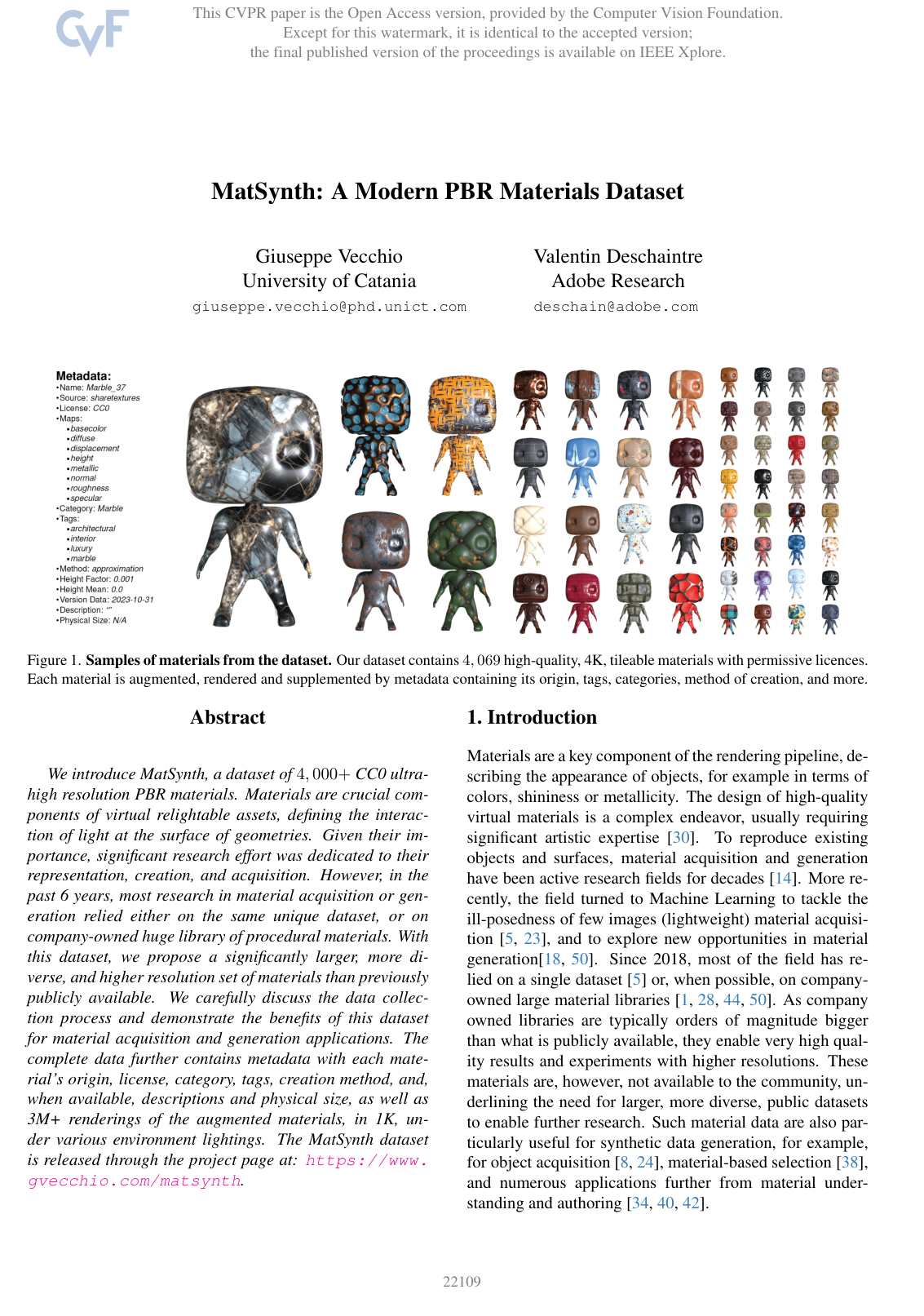
To construct the dataset, the authors gathered over 6,000 public materials, applying strict automated filtering and manual visual inspection to eliminate duplicates and artifacts. The curated assets were augmented using height-based blending, rotations, and multi-scale crops to generate 683,592 unique material crops and nearly 3.42 million photorealistic renderings under various indoor and outdoor lighting environments. The authors then benchmarked established material acquisition models and diffusion-based generative architectures trained on MatSynth against identical models trained on prior baseline data.

The evaluation demonstrates clear performance gains across core tasks. In material capture, models trained on MatSynth achieved lower error rates across all reflectance maps, notably reducing roughness error by roughly 25% to 33% and improving perceptual rendering metrics. In material generation, fine-tuning a diffusion model on MatSynth improved image fidelity by reducing its Frechet Inception Distance score from 239.9 to 210.3, while training from scratch yielded a substantial improvement to 89.84. Furthermore, the generated output exhibited a much more balanced distribution across previously underrepresented material categories such as fabrics and ground surfaces.

These findings indicate that data scale and diversity, rather than model architecture alone, have been key limiting factors in material acquisition and synthesis. By providing a standardized 4K dataset with permissive licensing, MatSynth lowers the barrier to entry for institutions lacking private asset libraries, reducing costs and accelerating development in 3D content creation, digital twinning, and autonomous simulation.

Organizations developing virtual asset pipelines or computer vision systems should adopt MatSynth as a primary baseline and integrate its standardized base color/metallic and diffuse/specular maps into their training pipelines. While the dataset provides strong empirical reliability across common stationary and non-stationary surface types, future efforts should continue addressing subtle domain gaps between synthetic renders and real-world photographs, as well as expanding annotations for physical dimensions and descriptions.

arXiv: 2401.06056
Cover for MatSynth: A Modern PBR Materials Dataset

Abstract

We introduce MatSynth, a dataset of 4,000+ CC0 ultra-high resolution PBR materials. Materials are crucial components of virtual relightable assets, defining the interaction of light at the surface of geometries. Given their importance, significant research effort was dedicated to their representation, creation, and acquisition. However, in the past 6 years, most research in material acquisition or generation relied either on the same unique dataset, or on company-owned huge library of procedural materials. With this dataset, we propose a significantly larger, more diverse, and higher resolution set of materials than previously publicly available. We carefully discuss the data collection process and demonstrate the benefits of this dataset for material acquisition and generation applications. The complete data further contains metadata with each material’s origin, license, category, tags, creation method, and, when available, descriptions and physical size, as well as 3M+ renderings of the augmented materials, in 1K, under various environment lightings. The MatSynth dataset is released through the project page at: https://www.gvecchio.com/matsynth.

Table of Contents

  • 1. Introduction
  • 2. Related Work
  • 2.1. Existing dataset
  • 2.2. Material acquisition
  • 2.3. Material generation
  • 2.4. Data generation
  • 3. The Dataset
  • 3.1. Materials Collection
  • 3.2. Data Annotations
  • 3.3. Data Processing
  • 3.4. Data Augmentation
  • 3.5. Compatibility with previous datasets
  • 3.6. Dataset Statistics
  • 4. Experimental Results
  • 4.1. Test dataset
  • 4.2. Evaluation Methodology
  • 4.3. Training Strategy
  • 4.4. SVBRDF Estimation Results
  • MatFuse Retrained
  • 4.5. Materials Generation Results
  • 5. Conclusion
  • 6. Acknowledgments
  • References

Knowls

  1. Knowl 1 — MatSynth dataset composition and scope

    definition

    MatSynth is a publicly released dataset of 4,069 unique, tileable, 4K PBR materials gathered under permissive CC0 or CC-BY licensing. Each material is represented using seven standardized maps—base color, diffuse, normal, height, roughness, metallic, and specular—and some materials additionally include an opacity map. The release also contains 683,592 augmented material crops, 3,417,960 1K renderings under varied illumination, and metadata describing material origin, licensing, source link, author when available, tags, creation method, stationarity, version timestamp, description when available, and physical size when available. The dataset is intended for material acquisition, material generation, and synthetic-data generation; complete procedural material graphs are outside its scope.

  2. Knowl 2 — Material collection and duplicate-quality filtering

    model/method

    The authors collected more than 6,000 candidate materials from AmbientCG, CGBookCase, PolyHaven, ShareTextures, TextureCan, and a limited CC-BY collection by Julio Sillet. They retained materials that were tileable and available at 4K resolution, discarded blurry or visibly low-quality samples, and manually inspected maps for defects such as baked shadows, baked highlights, or implausible reflectance. Remaining rendered materials were evaluated with CLIP embeddings and contrastive prompts for quality, sharpness, noisiness, and realism. Potential duplicates were identified by comparing CLIP embeddings across the collected materials and against the previously available large-scale material dataset; each candidate duplicate was manually checked before removal. The filtering produced 3,736 unique collected materials, which were expanded with semantically compatible blends and variations to form the final set of 4,069 unique materials.

  3. Knowl 3 — Standardized maps, annotations, and physical-consistency processing

    model/method

    Every MatSynth material uses the OpenGL normal-map convention with the Y axis pointing upward, and its height map is stored as a 16-bit single-channel image. The annotations identify whether a material was produced by photogrammetry or acquisition, procedural generation, manual approximation, or blending; they also record descriptive tags, source website and link, license, timestamp, and optional author, description, and physical size. The optional fields are available for 387 authors, 572 descriptions, and 358 physical-size annotations, where physical size is the edge length in centimeters. To enforce normal consistency, the authors differentiate each height map into a normal map, count vectors with a discordant Y component, manually inspect materials with more than 30% discordant vectors, invert the Y component when necessary, and perform a final visual check. They additionally optimize a displacement scale so that normals derived from the scaled height map match the supplied normal map, and release the scaled height map together with the original map, scale factor, and mid-value needed by Blender's Displacement node.

  4. Knowl 4 — Height-based semantic material blending

    algorithm

    MatSynth creates additional materials by blending predefined compatible pairs of base-layer and top-layer material classes, such as snow over ground. For each pair, the algorithm randomly samples a height threshold between the minimum and maximum height values of the base material, shifts the mean height of the top material to that threshold, and forms a per-pixel height-based intersection by selecting the larger of the two height values. The resulting blend mask is smoothed with a 9-pixel Gaussian kernel. For every material map and pixel pp, the blended value is computed as Mp=Mpbasemaskp+Mptop(1−maskp)M_p = M_p^{base} mask_p + M_p^{top}(1-mask_p), where MpbaseM_p^{base} and MptopM_p^{top} are the base- and top-material map values and maskpmask_p is the corresponding smoothed blend-mask value. The mask is stored with each blended material. This procedure produced 332 blended materials.

  5. Knowl 5 — Rotation, multiscale cropping, and environment-light augmentation

    algorithm

    Each of the 4,069 collected materials is augmented using eight rotations: 0°, 45°, 90°, 135°, 180°, 225°, 270°, and 315°. For non-right-angle rotations, the material is first tiled, then rotated, and then center-cropped at 4K resolution. For every rotation, the procedure extracts 16 non-overlapping 1K crops, four 2K crops, and one 4K crop, giving 21 crops per rotation and 168 crops per material; all resulting crops are resized to 1024 × 1024 pixels. Every crop is rendered under five environment illuminations—two outdoor, two indoor, and one studio environment—with a random rotation of the environment map for each render. This produces 683,592 augmented crops and 840 renderings per original material, for 3,417,960 total renderings.

  6. Knowl 6 — Two-pass rendering for aligned maps with specular highlights

    model/method

    MatSynth renders each material with mesh displacement driven by its height map so that the images contain realistic cast shadows. An orthographic camera is used for the diffuse pass to preserve pixel alignment between the rendered image and the material maps, but orthographic rendering would suppress specular reflections from perfectly flat surfaces. The authors therefore render the diffuse component with displacement enabled and an orthographic camera, render the glossy/specular component with displacement disabled and a perspective camera, and add the two passes to form the final image. This strategy preserves map-to-image alignment and displaced cast shadows while restoring specular highlights.

  7. Knowl 7 — Integration with the previous public material dataset

    model/method

    To make MatSynth combinable with the earlier large-scale public material dataset, the authors process that dataset using the same map and rendering conventions. They derive base-color and metallic maps from the earlier diffuse and specular maps, extract five crops per material because the earlier assets are 2048 × 2048, omit rotation augmentation because those materials are not tileable, and render each crop under five illuminations. The processed legacy set contributes 8,140 material crops and 40,700 renderings, with origin annotations retained. Together with MatSynth, the release provides approximately 6,000 research materials with explicit licensing information.

  8. Knowl 8 — Dataset diversity statistics and fixed evaluation set

    data/table

    MatSynth contains 21,737 tag assignments covering 1,239 unique tags; each material has 0–20 tags, with mean 5.74, standard deviation 4.35, and median 5. The creation-method counts are 299 manual approximations, 651 photogrammetry/acquisition materials, 2,689 procedural materials, 332 blends, and 98 materials with unknown method. There are 3,061 stationary and 1,008 non-stationary materials. Stationarity is estimated from eight random base-color and height crops: if more than 12.5% of the CLIP cross-similarities fall below the empirically selected threshold 0.9, the material is labeled non-stationary. The category counts are wood 560, terracotta 225, stone 308, plastic 153, plaster 144, miscellaneous 257, metal 349, marble 136, leather 144, ground 414, fabric 390, concrete 226, ceramic 431, and blends 332. Source counts are AmbientCG 1,425 plus 205 variations, CGBookCase 278, PolyHaven 387, ShareTextures 647, TextureCan 571, Julio Sillet 224, and 332 generated blends. For reproducible evaluation, the authors handpick five unique samples per category, exclude samples that are simple training-set variations, and combine the resulting 65 materials with 24 materials from an earlier test set, yielding 89 test materials.

  9. Knowl 9 — Benchmark protocol and training configurations

    experimental setup

    The dataset is evaluated on single-image SVBRDF estimation and material generation using publicly available implementations. Deschaintre et al. and SurfaceNet are trained for estimation on flash-lit data using a single NVIDIA RTX 4090; the comparison uses versions trained on the earlier dataset and versions trained with the MatSynth data. Deschaintre et al. is trained for 400,000 steps with batch size 8 and learning rate 2−52^{-5}, requiring about 72 hours. SurfaceNet is trained for 400,000 steps with batch size 8 and learning rate 2−52^{-5}, with its adversarial discriminator introduced after 100,000 steps, requiring about 96 hours. MatFuse is evaluated both by fine-tuning its latent diffusion model and by training the full model from scratch. Fine-tuning uses 150,000 iterations, batch size 20, learning rate 10−510^{-5}, and linear warm-up through step 10,000. Full training uses 1,000,000 autoencoder iterations with batch size 4 and learning rate 10−410^{-4}, introduces the discriminator after 300,000 steps, then trains the diffusion model for 500,000 iterations with batch size 16, AdamW, learning rate 10−410^{-4}, and warm-up through step 10,000. Generation inference uses DDIM sampling with 50 denoising timesteps.

  10. Knowl 10 — MatSynth improves single-image SVBRDF estimation

    empirical result

    Training the two single-image SVBRDF estimators with MatSynth improves both predicted material maps and rendered appearance on the 89-material evaluation set. The reported map and rendering errors are RMSE, except for normal maps, which use cosine distance; rendering errors are averaged over five environment illuminations. For Deschaintre et al., the errors for renderings, diffuse, normal, roughness, and specular decrease respectively from 0.172, 0.100, 0.576, 0.322, and 0.119 to 0.160, 0.093, 0.573, 0.215, and 0.080 when using MatSynth. For SurfaceNet, the corresponding values decrease from 0.161, 0.119, 0.600, 0.221, and 0.086 to 0.135, 0.094, 0.544, 0.162, and 0.057. Perceptual rendering quality also improves: Deschaintre et al. changes from SSIM 0.532 and LPIPS 0.560 to SSIM 0.560 and LPIPS 0.294, while SurfaceNet changes from SSIM 0.494 and LPIPS 0.395 to SSIM 0.613 and LPIPS 0.281. Higher SSIM and lower LPIPS indicate better agreement with the target renderings. The largest improvements occur for challenging roughness and specular maps, particularly for SurfaceNet.

  11. Knowl 11 — MatSynth improves material-generation fidelity and class diversity

    empirical result

    The authors evaluate MatFuse using 1,000 randomly generated materials and compute FID on renderings under environment lighting, using only the earlier dataset to define the ground-truth distribution for fairness. The FID decreases from 239.9 without MatSynth data to 210.3 after fine-tuning on MatSynth and to 89.84 when the full model is trained from scratch on MatSynth; lower FID is better. CLIP-based zero-shot classification also shows that the generated class distribution becomes more diverse. The percentages for original training, MatSynth fine-tuning, and full MatSynth training are: wood 36.1%, 25.72%, and 7.5%; ceramic 1.1%, 12.51%, and 8.5%; stone 21.5%, 14.8%, and 7.3%; metal 3.45%, 8.4%, and 6.4%; fabric 0.33%, 7.34%, and 7.8%; ground 1.8%, 16.2%, and 6.4%; and other classes 35.72%, 15.03%, and 56.1%. The authors attribute the especially large full-training improvement partly to retraining MatFuse's autoencoder on MatSynth, whereas the fine-tuning experiment retains the original autoencoder.

Coverage note — Qualitative acquisition and generation examples, along with supplemental augmentation ablations, were omitted because they visually corroborate the summarized results or provide auxiliary sensitivity analysis rather than additional standalone findings.

References

  1. 1.Adobe. Substance 3D Assets. https://substance3d.adobe.com/assets/, 2023.
  2. 2.AmbientCG. https://www.ambientcg.com/, 2023.
  3. 3.Tom Brown, Benjamin Mann, Nick Ryder, Melanie Subbiah, Jared D Kaplan, Prafulla Dhariwal, Arvind Neelakantan, Pranav Shyam, Girish Sastry, Amanda Askell, et al. Language models are few-shot learners. Advances in neural information processing systems, 33:1877–1901, 2020.
  4. 4.CGBookCase. https://www.cgbookcase.com/, 2023.
  5. 5.Valentin Deschaintre, Miika Aittala, Fredo Durand, George Drettakis, and Adrien Bousseau. Single-image svbrdf capture with a rendering-aware deep network. ACM Transactions on Graphics (SIGGRAPH Conference Proceedings), 37(128):15, 2018.
  6. 6.Valentin Deschaintre, Miika Aittala, Fredo Durand, George Drettakis, and Adrien Bousseau. Flexible svbrdf capture with a multi-image deep network. Computer Graphics Forum(Eurographics Symposium on Rendering Conference Proceedings), 38(4):13, 2019.
  7. 7.Valentin Deschaintre, George Drettakis, and Adrien Bousseau. Guided fine-tuning for large-scale material transfer. Computer Graphics Forum (Proceedings of EGSR), 39(4), 2020.
  8. 8.Valentin Deschaintre, Yiming Lin, and Abhijeet Ghosh. Deep polarization imaging for 3d shape and svbrdf acquisition. In Proceedings of the IEEE/CVF Conference on Computer Vision and Pattern Recognition (CVPR), 2021.
  9. 9.Valentin Deschaintre, Julia Guerrero-Viu, Diego Gutierrez, Tamy Boubekeur, and Belen Masia. The visual language of fabrics. ACM Transactions on Graphics, 42(4):1–15, 2023.
  10. 10.Jonathan Dupuy and Wenzel Jakob. An adaptive parameterization for efficient material acquisition and rendering. Transactions on Graphics (Proceedings of SIGGRAPH Asia), 37(6):274:1–274:18, 2018.
  11. 11.Michael Fischer and Tobias Ritschel. Metappearance: Meta-learning for visual appearance reproduction. ACM Trans Graph (Proc. SIGGRAPH Asia), 41(4), 2022.
  12. 12.DUAN Gao, Xiao Li, Yue Dong, Pieter Peers, Kun Xu, and Xin Tong. Deep inverse rendering for high-resolution svbrdf estimation from an arbitrary number of images. ACM Trans. Graph., 38(4), 2019.
  13. 13.David Griffiths, Tobias Ritschel, and Julien Philip. Outcast: Single image relighting with cast shadows. Computer Graphics Forum, 43, 2022.
  14. 14.D. Guarnera, G.C. Guarnera, A. Ghosh, C. Denk, and M. Glencross. Brdf representation and acquisition. Computer Graphics Forum, 35(2):625–650, 2016.
  15. 15.Paul Guerrero, Milos Hasan, Kalyan Sunkavalli, Radomir Mech, Tamy Boubekeur, and Niloy Mitra. Matformer: A generative model for procedural materials. ACM Trans. Graph., 41(4), 2022.
  16. 16.Jie Guo, Shuichang Lai, Chengzhi Tao, Yuelong Cai, Lei Wang, Yanwen Guo, and Ling-Qi Yan. Highlight-aware two-stream network for single-image svbrdf acquisition. ACM Trans. Graph., 40(4), 2021.
  17. 17.Jie Guo, Shuichang Lai, Qinghao Tu, Chengzhi Tao, Changqing Zou, and Yanwen Guo. Ultra-high resolution svbrdf recovery from a single image. ACM Trans. Graph., 42(3), 2023.
  18. 18.Yu Guo, Cameron Smith, Milos Hašan, Kalyan Sunkavalli, and Shuang Zhao. MaterialGAN: Reflectance capture using a generative svbrdf model. ACM Trans. Graph., 39(6), 2020.
  19. 19.Zhen He, Jie Guo, Yan Zhang, Qinghao Tu, Mufan Chen, Yanwen Guo, Pengyu Wang, and Wei Dai. Text2Mat: Generating Materials from Text. In Pacific Graphics Short Papers and Posters. The Eurographics Association, 2023.
  20. 20.Philipp Henzler, Valentin Deschaintre, Niloy J Mitra, and Tobias Ritschel. Generative modelling of brdf textures from flash images. ACM Trans Graph (Proc. SIGGRAPH Asia), 40(6), 2021.
  21. 21.Yiwei Hu, Paul Guerrero, Milos Hasan, Holly Rushmeier, and Valentin Deschaintre. Generating Procedural Materials from Text or Image Prompts. In ACM SIGGRAPH 2023 Conference Proceedings, 2023.
  22. 22.Tero Karras, Samuli Laine, Miika Aittala, Janne Hellsten, Jaakko Lehtinen, and Timo Aila. Analyzing and improving the image quality of stylegan. In Proceedings of the IEEE/CVF conference on computer vision and pattern recognition, pages 8110–8119, 2020.
  23. 23.Xiao Li, Yue Dong, Pieter Peers, and Xin Tong. Modeling surface appearance from a single photograph using self-augmented convolutional neural networks. ACM Trans. Graph., 36(4), 2017.
  24. 24.Zhengqin Li, Zexiang Xu, Ravi Ramamoorthi, Kalyan Sunkavalli, and Manmohan Chandraker. Learning to reconstruct shape and spatially-varying reflectance from a single image. In SIGGRAPH Asia 2018 Technical Papers, page 269. ACM, 2018.
  25. 25.Zhengqin Li, Mohammad Shafiei, Ravi Ramamoorthi, Kalyan Sunkavalli, and Manmohan Chandraker. Inverse rendering for complex indoor scenes: Shape, spatially-varying lighting and svbrdf from a single image. In Proceedings of the IEEE/CVF Conference on Computer Vision and Pattern Recognition, pages 2475–2484, 2020.
  26. 26.Zhengqin Li, Ting-Wei Yu, Shen Sang, Sarah Wang, Meng Song, Yuhan Liu, Yu-Ying Yeh, Rui Zhu, Nitesh Gundavarapu, Jia Shi, et al. Openrooms: An open framework for photorealistic indoor scene datasets. In Proceedings of the IEEE/CVF conference on computer vision and pattern recognition, pages 7190–7199, 2021.
  27. 27.Ilya Loshchilov and Frank Hutter. Decoupled weight decay regularization. arXiv preprint arXiv:1711.05101, 2017.
  28. 28.Rosalie Martin, Arthur Roullier, Romain Rouffet, Adrien Kaiser, and Tamy Boubekeur. MaterIA: Single image high-resolution material capture in the wild. Computer Graphics Forum, 41(2):163–177, 2022.
  29. 29.W. Matusik, H. Pfister, M. Brand, and L. McMillan. A data-driven reflectance model. ACM Transactions on Graphics (TOG), 22(3):759–769, 2003.
  30. 30.Wes McDermott. The PBR Guide. Allegorithmic, 2018.
  31. 31.Maxine Perroni-Scharf, Kalyan Sunkavalli, Jonathan Eisenmann, and Yannick Hold-Geoffroy. Material swapping for 3d scenes using a learnt material similarity measure. In Proceedings of the IEEE/CVF Conference on Computer Vision and Pattern Recognition (CVPR) Workshops, pages 2034–2043, 2022.
  32. 32.PolyHaven. https://www.polyhaven.com/, 2023.
  33. 33.Alec Radford, Jong Wook Kim, Chris Hallacy, Aditya Ramesh, Gabriel Goh, Sandhini Agarwal, Girish Sastry, Amanda Askell, Pamela Mishkin, Jack Clark, et al. Learning transferable visual models from natural language supervision. In International conference on machine learning, pages 8748–8763. PMLR, 2021.
  34. 34.Alexander Raistrick, Lahav Lipson, Zeyu Ma, Lingjie Mei, Mingzhe Wang, Yiming Zuo, Karhan Kayan, Hongyu Wen, Beining Han, Yihan Wang, Alejandro Newell, Hei Law, Ankit Goyal, Kaiyu Yang, and Jia Deng. Infinite photorealistic worlds using procedural generation. In Proceedings of the IEEE/CVF Conference on Computer Vision and Pattern Recognition, pages 12630–12641, 2023.
  35. 35.Aditya Ramesh, Prafulla Dhariwal, Alex Nichol, Casey Chu, and Mark Chen. Hierarchical text-conditional image generation with clip latents. arXiv preprint arXiv:2204.06125, 1(2):3, 2022.
  36. 36.Mike Roberts, Jason Ramapuram, Anurag Ranjan, Atulit Kumar, Miguel Angel Bautista, Nathan Paczan, Russ Webb, and Joshua M. Susskind. Hypersim: A photorealistic synthetic dataset for holistic indoor scene understanding. In International Conference on Computer Vision (ICCV) 2021, 2021.
  37. 37.ShareTextures. https://www.sharetextures.com/, 2023.
  38. 38.Prafull Sharma, Julien Philip, Michael Gharbi, Bill Freeman, Fredo Durand, and Valentin Deschaintre. Materialistic: Selecting similar materials in images. ACM Trans. Graph., 42(4), 2023.
  39. 39.Jiaming Song, Chenlin Meng, and Stefano Ermon. Denoising diffusion implicit models. arXiv preprint arXiv:2010.02502, 2020.
  40. 40.Zhihang Song, Zimin He, Xingyu Li, Qiming Ma, Ruibo Ming, Zhiqi Mao, Huaxin Pei, Lihui Peng, Jianming Hu, Danya Yao, and Yi Zhang. Synthetic datasets for autonomous driving: A survey. 2023.
  41. 41.TextureCan. https://www.texturecan.com/, 2023.
  42. 42.Giuseppe Vecchio. Accelerating reality: virtual environment generation for outdoor robot navigation using deep learning. PhD thesis, Universita degli studi di Catania, 2023.
  43. 43.Giuseppe Vecchio, Simone Palazzo, and Concetto Spampinato. Surfacenet: Adversarial svbrdf estimation from a single image. In Proceedings of the IEEE/CVF International Conference on Computer Vision, pages 12840–12848, 2021.
  44. 44.Giuseppe Vecchio, Rosalie Martin, Arthur Roullier, Adrien Kaiser, Romain Rouffet, Valentin Deschaintre, and Tamy Boubekeur. ControlMat: A Controlled Generative Approach to Material Capture. arXiv preprint arXiv:2309.01700, 2023.
  45. 45.Giuseppe Vecchio, Renato Sortino, Simone Palazzo, and Concetto Spampinato. MatFuse: Controllable Material Generation with Diffusion Models. In Proceedings of the IEEE/CVF Conference on Computer Vision and Pattern Recognition, 2024.
  46. 46.VRay. VRay:MaterialLibrary. http://www.vray-materials.de/, 2023.
  47. 47.Jianyi Wang, Kelvin CK Chan, and Chen Change Loy. Exploring clip for assessing the look and feel of images. In Proceedings of the AAAI Conference on Artificial Intelligence, pages 2555–2563, 2023.
  48. 48.K. Yan, F. Luan, M. Hasan, T. Groueix, V. Deschaintre, and S. Zhao. Psdr-room: Single photo to scene using differentiable rendering. In ACM SIGGRAPH Asia 2023 Conference Proceedings, 2023.
  49. 49.Xilong Zhou and Nima Khademi Kalantari. Adversarial single-image svbrdf estimation with hybrid training. Computer Graphics Forum, 2021.
  50. 50.Xilong Zhou, Milos Hasan, Valentin Deschaintre, Paul Guerrero, Kalyan Sunkavalli, and Nima Khademi Kalantari. Tilegen: Tileable, controllable material generation and capture. In SIGGRAPH Asia 2022 Conference Papers, New York, NY, USA, 2022. Association for Computing Machinery.
  51. 51.Xilong Zhou, Milos Hasan, Valentin Deschaintre, Paul Guerrero, Kalyan Sunkavalli, and Nima Khademi Kalantari. Tilegen: Tileable, controllable material generation and capture. In SIGGRAPH Asia 2022 Conference Papers, pages 1–9, 2022.
  52. 52.Xilong Zhou, Milos Hasan, Valentin Deschaintre, Paul Guerrero, Yannick Hold-Geoffroy, Kalyan Sunkavalli, and Nima Khademi Kalantari. Photomat: A material generator learned from single flash photos. In ACM SIGGRAPH 2023 Conference Proceedings, New York, NY, USA, 2023. Association for Computing Machinery.
  53. 53.Jingsen Zhu, Fujun Luan, Yuchi Huo, Zihao Lin, Zhihua Zhong, Dianbing Xi, Rui Wang, Hujun Bao, Jiaxiang Zheng, and Rui Tang. Learning-based inverse rendering of complex indoor scenes with differentiable monte carlo raytracing. In SIGGRAPH Asia 2022 Conference Papers. ACM, 2022.
  54. 54.Rui Zhu, Zhengqin Li, Janarbek Matai, Fatih Porikli, and Manmohan Chandraker. Irisformer: Dense vision transformers for single-image inverse rendering in indoor scenes. In Proceedings of the IEEE/CVF Conference on Computer Vision and Pattern Recognition, pages 2822–2831, 2022.

Citation

MLA
Vecchio, G., and V. Deschaintre. “MatSynth: A Modern PBR Materials Dataset”. 2024 IEEE/CVF Conference on Computer Vision and Pattern Recognition (CVPR), 2024, pp. 22109–18, https://doi.org/10.1109/CVPR52733.2024.02087.
APA
Vecchio, G., & Deschaintre, V. (2024). MatSynth: A Modern PBR Materials Dataset. 2024 IEEE/CVF Conference on Computer Vision and Pattern Recognition (CVPR), 22109–22118. https://doi.org/10.1109/CVPR52733.2024.02087
Chicago
Vecchio, G., and V. Deschaintre. 2024. “MatSynth: A Modern PBR Materials Dataset”. 2024 IEEE/CVF Conference on Computer Vision and Pattern Recognition (CVPR), 22109–18. https://doi.org/10.1109/CVPR52733.2024.02087.
Harvard
Vecchio, G. and Deschaintre, V. (2024) “MatSynth: A Modern PBR Materials Dataset”, 2024 IEEE/CVF Conference on Computer Vision and Pattern Recognition (CVPR). IEEE, pp. 22109–22118. Available at: https://doi.org/10.1109/CVPR52733.2024.02087.
Vancouver
1. Vecchio G, Deschaintre V (2024) MatSynth: A Modern PBR Materials Dataset. In: 2024 IEEE/CVF Conference on Computer Vision and Pattern Recognition (CVPR). IEEE, pp 22109–22118

BibTeX

@inproceedings{Vecchio_2024, title={MatSynth: A Modern PBR Materials Dataset}, url={http://dx.doi.org/10.1109/CVPR52733.2024.02087}, DOI={10.1109/cvpr52733.2024.02087}, booktitle={2024 IEEE/CVF Conference on Computer Vision and Pattern Recognition (CVPR)}, publisher={IEEE}, author={Vecchio, Giuseppe and Deschaintre, Valentin}, year={2024}, month=June, pages={22109–22118} }
Metadata:Crossref

Access the Paper

This paper is available from its original source. Click below to access the PDF.

Open PDF
License: IEEE