PIFu: Pixel-Aligned Implicit Function for High-Resolution Clothed Human Digitization
Shunsuke SaitoZeng HuangRyota NatsumeShigeo MorishimaAngjoo KanazawaHao Li
Proposes a pixel-aligned implicit function representation that reconstructs complete, high-resolution 3D clothed humans and surface textures directly from single 2D photographs, overcoming the memory limits of traditional voxel-based methods.
High-resolution 3D digitization of clothed humans typically requires expensive multi-camera studios or specialized scanning equipment. Existing single-image 3D deep learning approaches often rely on memory-heavy volumetric grids or coarse body templates that fail to recover complex clothing shapes, loose hairstyles, and realistic color textures.
The article evaluates a new deep learning framework, the Pixel-aligned Implicit Function, designed to infer both high-resolution 3D surface geometry and complete 360-degree color textures from a single photograph or sparse multi-view images.
The framework combines a fully convolutional image encoder with a continuous implicit function that classifies whether any point along a camera ray is inside or outside the object's surface. By tying local pixel features directly to 3D spatial coordinates rather than using discrete grid cells, the system operates with high memory efficiency and handles arbitrary clothing shapes. The model was trained and evaluated on photogrammetry datasets containing hundreds of high-quality 3D scans and benchmarked against real-world photographs.
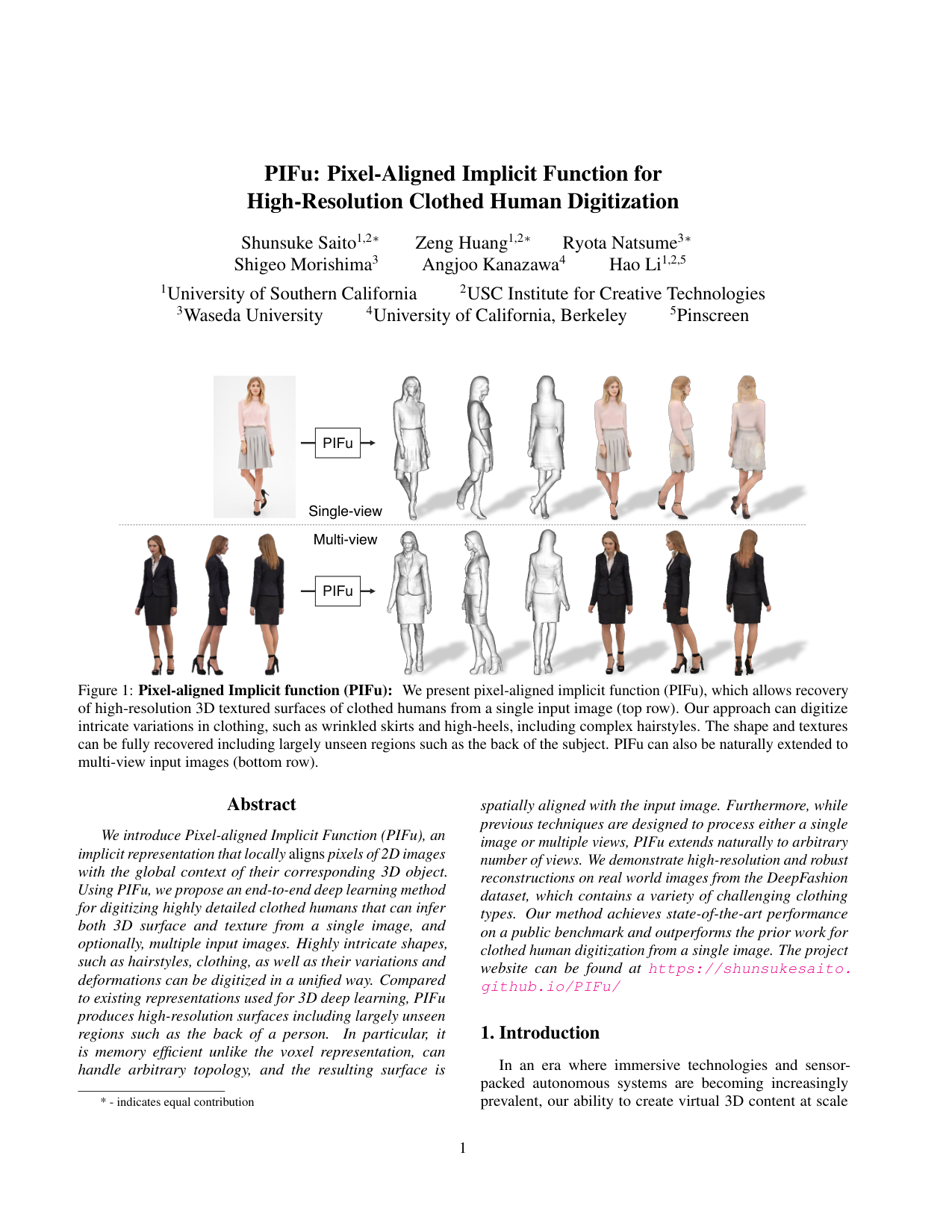
The evaluation yielded several key findings. First, the framework achieved state-of-the-art accuracy in single-image reconstruction, cutting point-to-surface errors by more than half compared to voxel-based and template-free baselines on benchmark datasets. Second, the method successfully reconstructs intricate surface details such as clothing wrinkles and high heels while synthesizing plausible geometry and color for unseen regions like the subject's back. Third, the system naturally scales across varying inputs: when three calibrated views were provided, reconstruction errors decreased significantly, outperforming prior multi-view and video-based methods.
These results demonstrate that high-quality, fully textured 3D digital humans can be generated directly from standard RGB imagery without specialized capture hardware. This significantly lowers production costs and deployment complexity for immersive virtual reality, visual effects, and digital avatar creation.
Organizations developing 3D capture workflows should consider adopting continuous implicit representations over legacy voxel or rigid template pipelines. Before production deployment, technical teams should implement robust preprocessing steps to estimate scale factors and evaluate generative enhancement techniques for ultra-high-resolution texture detail.
Confidence in these findings is high for fully visible, upright subjects, as supported by consistent quantitative benchmarks. However, stakeholders should exercise caution regarding real-world scenes with partial body occlusions, foreground clutter, or unknown camera scaling, which remain active areas for further refinement.
- Paper: DeepSDF: Learning Continuous Signed Distance Functions for Shape Representation, Jeong Joon Park et al. (2019). Introduces continuous implicit neural surface representations via signed distance functions, establishing the fundamental continuous implicit formulation that PIFu extends to pixel-aligned local features.
- Paper: Learning Implicit Fields for Generative Shape Modeling, Zhiqin Chen et al. (2018). Pioneers the use of neural implicit field decoders (IM-NET) for continuous 3D shape generation, laying foundational concepts for learning coordinate-based implicit 3D functions.
- Paper: Pixel2Mesh: Generating 3D Mesh Models from Single RGB Images, Nanyang Wang et al. (2018). Demonstrates single-image 3D shape reconstruction via 2D perceptual feature pooling, motivating PIFu's direct alignment of 2D image pixels with 3D coordinate queries.
- Paper: SMPL, Matthew Loper et al. (2015). Introduces the SMPL parametric body model, the standard reference and baseline representation for 3D human pose and shape recovery that PIFu builds upon and compares against.
- Paper: End-to-End Recovery of Human Shape and Pose, Angjoo Kanazawa et al. (2017). Presents an end-to-end framework for reconstructing 3D human mesh models from single RGB images, illustrating the limitations of parametric body models when capturing detailed clothing and geometry.
- Paper: DensePose: Dense Human Pose Estimation in the Wild, Rıza Alp Güler et al. (2018). Establishes dense pixel-to-surface correspondences for humans in the wild, motivating pixel-aligned feature architectures for full-body surface recovery.
- Paper: DeepFashion: Powering Robust Clothes Recognition and Retrieval with Rich Annotations, Ziwei Liu et al. (2016). Supplies the DeepFashion benchmark dataset and clothing feature analysis used by PIFu to evaluate clothed human reconstruction across diverse real-world attire.
- Paper: Stacked Hourglass Networks for Human Pose Estimation, Alejandro Newell et al. (2016). Develops the stacked hourglass architecture for multi-scale 2D pixel-aligned feature extraction, which serves as the core 2D image encoder backbone in PIFu.
- Paper: pixelNeRF: Neural Radiance Fields from One or Few Images, Alex Yu et al. (2021). Extends PIFu's spatial pixel-aligned feature conditioning to continuous neural radiance fields (NeRF) for general single- and sparse-view novel view synthesis.
- Paper: NeuS: Learning Neural Implicit Surfaces by Volume Rendering for Multi-view Reconstruction, Peng Wang et al. (2021). Advances implicit surface reconstruction by integrating volume rendering with signed distance functions, enabling high-fidelity 3D geometry extraction directly from multi-view images.
- Paper: Nerfies: Deformable Neural Radiance Fields, Keunhong Park et al. (2020). Builds upon continuous neural representations to capture non-rigidly deforming humans and dynamic subjects from casual monocular video captures.
- Paper: Efficient Geometry-aware 3D Generative Adversarial Networks, Eric R. Chan et al. (2022). Combines implicit representations and neural volume rendering with generative adversarial architectures for 3D-aware image synthesis and detailed human geometry generation.
- Paper: LRM: Large Reconstruction Model for Single Image to 3D, Yicong Hong et al. (2024). Scales single-image 3D reconstruction into a feed-forward large model predicting triplane NeRF representations, advancing instant high-fidelity 3D object generation.
- Paper: SyncDreamer: Generating Multiview-consistent Images from a Single-view Image, Yuan Liu et al. (2024). Leverages multi-view consistent diffusion models to generate comprehensive viewpoints from a single image, enabling complete downstream 3D surface reconstruction.