Can a Suit of Armor Conduct Electricity? A New Dataset for Open Book Question Answering
Todor MihaylovPeter ClarkTushar KhotAshish Sabharwal
Introduces OpenBookQA, a benchmark that challenges question-answering systems to perform multi-hop reasoning by combining explicit science facts with broad commonsense knowledge, exposing a substantial gap between machine and human performance.
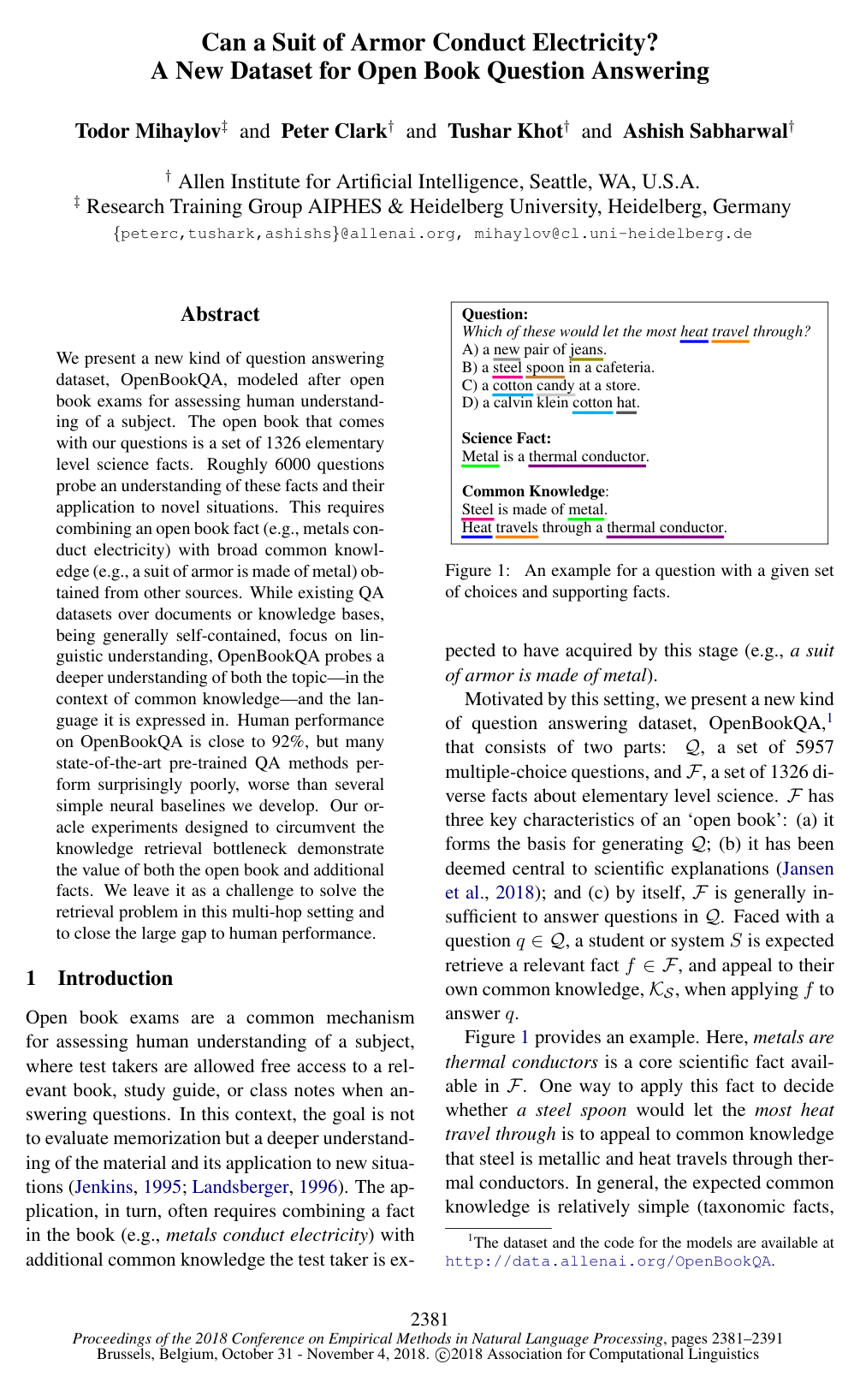
The article introduces OpenBookQA, a dataset of nearly 6000 multiple-choice questions built on 1326 elementary science facts. It targets a gap in existing question answering resources, which typically test only linguistic matching or self-contained documents and therefore fail to assess how well systems combine core facts with everyday knowledge to handle new situations.
The work set out to create and benchmark a resource that forces models to retrieve one core fact from the provided set and combine it with simple external common knowledge for multi-hop reasoning. The authors generated questions through a multi-stage crowdsourcing pipeline that included automatic hardness filters against retrieval and word-association solvers, followed by human answerability checks and expert review of the development and test sets.
Human solvers reached approximately 92 percent accuracy. In contrast, several established science question answering systems scored near the 25 percent random baseline. Simple neural models that ignore the question text or exploit choice biases reached about 50 percent. When models were given the exact core fact used to write each question plus an author-provided supporting fact, accuracy rose to roughly 77 percent but remained well below human performance.
These results show that current methods struggle with the retrieval and combination steps required for this task, even though the needed common knowledge is usually basic taxonomic or property information. The gap matters because many real-world applications depend on precisely this form of flexible, knowledge-augmented reasoning rather than surface-level pattern matching.
The authors recommend focusing future work on improved multi-hop retrieval from broad knowledge sources and on reasoning mechanisms that reliably chain a core fact with one or two additional pieces of information. They release the dataset with the core fact for each training and development question as partial supervision to support such research.
The main limitations are that the auxiliary facts collected during crowdsourcing are often noisy or incomplete, and the exact common-knowledge facts required can be somewhat subjective. The reported human performance estimate rests on a statistical bound derived from the original annotators rather than entirely new subjects, so readers should treat the precise 92 percent figure as a conservative lower bound.
- Paper: Think you have Solved Question Answering? Try ARC, the AI2 Reasoning Challenge, Peter Clark et al. (2018). ARC introduced the benchmark framework for grade-school science questions requiring non-trivial reasoning and knowledge retrieval beyond surface matching, directly motivating OpenBookQA's focus on combining core facts with commonsense.
- Paper: Reading Wikipedia to Answer Open-Domain Questions, Danqi Chen et al. (2017). DrQA established the fundamental two-stage open-domain question answering paradigm of retrieving evidence passages from Wikipedia followed by machine reading comprehension.
- Paper: SQuAD: 100,000+ Questions for Machine Comprehension of Text, Pranav Rajpurkar et al. (2016). SQuAD provided the foundational standard for reading comprehension benchmarks and baselines whose extractive limitations OpenBookQA was explicitly designed to overcome.
- Paper: FEVER: a Large-scale Dataset for Fact Extraction and VERification, James Thorne et al. (2018). FEVER formulated the task of verifying claims by retrieving evidence from open corpora, establishing multi-hop retrieval benchmarks that OpenBookQA builds upon.
- Paper: TriviaQA: A Large Scale Distantly Supervised Challenge Dataset for Reading Comprehension, Mandar Joshi et al. (2017). TriviaQA pioneered the decoupling of question generation from explicit context to test open-domain reading comprehension against surface-matching biases.
- Paper: CommonsenseQA: A Question Answering Challenge Targeting Commonsense Knowledge, Alon Talmor et al. (2019). CommonsenseQA extends the challenge of multi-hop commonsense reasoning tested in OpenBookQA by constructing questions grounded directly in ConceptNet relational subgraphs.
- Paper: Retrieval-Augmented Generation for Knowledge-Intensive NLP Tasks, Patrick Lewis et al. (2020). RAG applies end-to-end neural retrieval-augmented generation to address the multi-fact retrieval and reasoning deficiencies identified in OpenBookQA.
- Paper: Dense Passage Retrieval for Open-Domain Question Answering, Vladimir Karpukhin et al. (2020). Dense Passage Retrieval addresses the open retrieval bottleneck highlighted by OpenBookQA by substituting keyword matching with learned dense semantic vectors.
- Paper: Leveraging Passage Retrieval with Generative Models for Open Domain Question Answering, Gautier Izacard et al. (2021). Fusion-in-Decoder directly tackles the multi-evidence combination challenges observed in OpenBookQA by enabling generative decoders to attend over numerous retrieved passages.
- Paper: Learn to Explain: Multimodal Reasoning via Thought Chains for Science Question Answering, Pan Lu et al. (2022). ScienceQA builds upon OpenBookQA's science question-answering domain by evaluating chain-of-thought explanation generation across multimodal science problems.
- Paper: Measuring Massive Multitask Language Understanding, Dan Hendrycks et al. (2020). MMLU generalizes multiple-choice factual and scientific knowledge evaluation across 57 academic and professional subjects.
- Paper: Atlas: Few-shot Learning with Retrieval Augmented Language Models, Gautier Izacard et al. (2023). Atlas advances the retrieval-augmented question answering paradigm highlighted in OpenBookQA by jointly pre-training dense retrieval and sequence generation for few-shot reasoning.