
Leveraging Passage Retrieval with Generative Models for Open Domain Question Answering
Gautier Izacard $^{1,2,3}$ Edouard Grave $^{1}$
$^{1}$ Facebook AI Research, Paris
$^{2}$ ENS, PSL University, Paris
$^{3}$ Inria, Paris
{gizacard|egrave}@fb.com
Abstract
Generative models for open domain question answering have proven to be competitive, without resorting to external knowledge. While promising, this approach requires to use models with billions of parameters, which are expensive to train and query. In this paper, we investigate how much these models can benefit from retrieving text passages, potentially containing evidence. We obtain state-of-the-art results on the Natural Questions and TriviaQA open benchmarks. Interestingly, we observe that the performance of this method significantly improves when increasing the number of retrieved passages. This is evidence that sequence-to-sequence models offers a flexible framework to efficiently aggregate and combine evidence from multiple passages.
Executive Summary: The paper addresses a core challenge in open-domain question answering: building systems that can answer general questions accurately without receiving supporting text at input time. Pure generative models can store knowledge in their parameters but require billions of parameters to reach competitive accuracy, raising training and inference costs. Retrieval-based methods reduce this burden by fetching evidence from sources such as Wikipedia, yet they struggle to combine information across many passages.
The authors therefore set out to test whether a generative model can gain substantial accuracy by conditioning on retrieved passages and to measure how performance scales with the amount of retrieved evidence.
They adopted a straightforward two-step pipeline. First, either sparse (BM25) or dense (DPR) retrieval returns up to 100 passages from a 2018 Wikipedia dump. Second, a T5 sequence-to-sequence model encodes each passage independently and lets the decoder attend jointly over all encoded passages to produce the answer. Experiments were run on the standard open versions of Natural Questions, TriviaQA, and SQuAD using exact-match accuracy; models of 220 M and 770 M parameters were fine-tuned from public checkpoints.
The approach reaches new state-of-the-art exact-match scores: 51.4 % on Natural Questions and 67.6–80.1 % on TriviaQA, comfortably ahead of both prior extractive systems and closed-book generative baselines. Accuracy rises steadily as the number of passages grows from 10 to 100, delivering gains of 3.5–6 points. Training on only 25 passages and then fine-tuning briefly on 100 passages recovers nearly all of the final accuracy while cutting GPU hours by roughly two-thirds. Finally, the 770 M model plus explicit Wikipedia retrieval matches or exceeds the accuracy of an 11 B closed-book model while using far less memory for knowledge storage.
These results indicate that explicit retrieval paired with a modestly sized generative model can deliver higher accuracy at lower cost than storing all facts inside model weights. The decoder’s ability to fuse evidence across dozens of passages also removes a key limitation of extractive readers, which typically plateau after 10–20 passages.
The authors recommend integrating retrieval directly into the model and training the full system end-to-end. They also call for further work on inference speed when handling very large numbers of passages. The main limitation is that all experiments rely on Wikipedia as the sole knowledge source and report results on three English benchmarks only; performance on other domains or languages remains untested.
1. Introduction
Section Summary: Recent work has shown that large language models can answer questions using only the facts stored in their parameters, but this requires extremely big and costly models. The authors explore a simpler alternative that first retrieves relevant passages from an external source such as Wikipedia and then feeds those passages to a generative sequence-to-sequence model, which produces the final answer. This hybrid method reaches new state-of-the-art results on standard benchmarks and improves further as more passages are provided, suggesting that generative models can effectively combine evidence from multiple sources.
Recently, several works have shown that factual information can be extracted from large scale language models trained on vast quantities of data ([1, 2, 3, 4]). Building on that observation and the advances in pretraining of natural language processing models, [5] introduced a generative model for open domain question answering. Without relying on external knowledge, this method obtained competitive results on several benchmarks. However, it requires models containing billions of parameters, since all the information needs to be stored in the weights. This makes models expensive to query and train. In this paper, we investigate how much this method could benefit from having access to an external source of knowledge, such as Wikipedia.

Retrieval based approaches were previously considered in the context of open domain question answering with extractive models ([6]). In that case, systems start by retrieving support documents, before extracting the answer from these documents. Different retrieval techniques have been considered, either using sparse representations based on TF/IDF or using dense embeddings ([7, 8]). The models which extract the answers are often based on contextualized word representations such as ELMo or BERT ([9, 10]), and predict a span as answer. Aggregating and combining evidence from multiple passages is not straightforward when using extractive models, and multiple techniques have been proposed to address this limitation ([11, 12]).
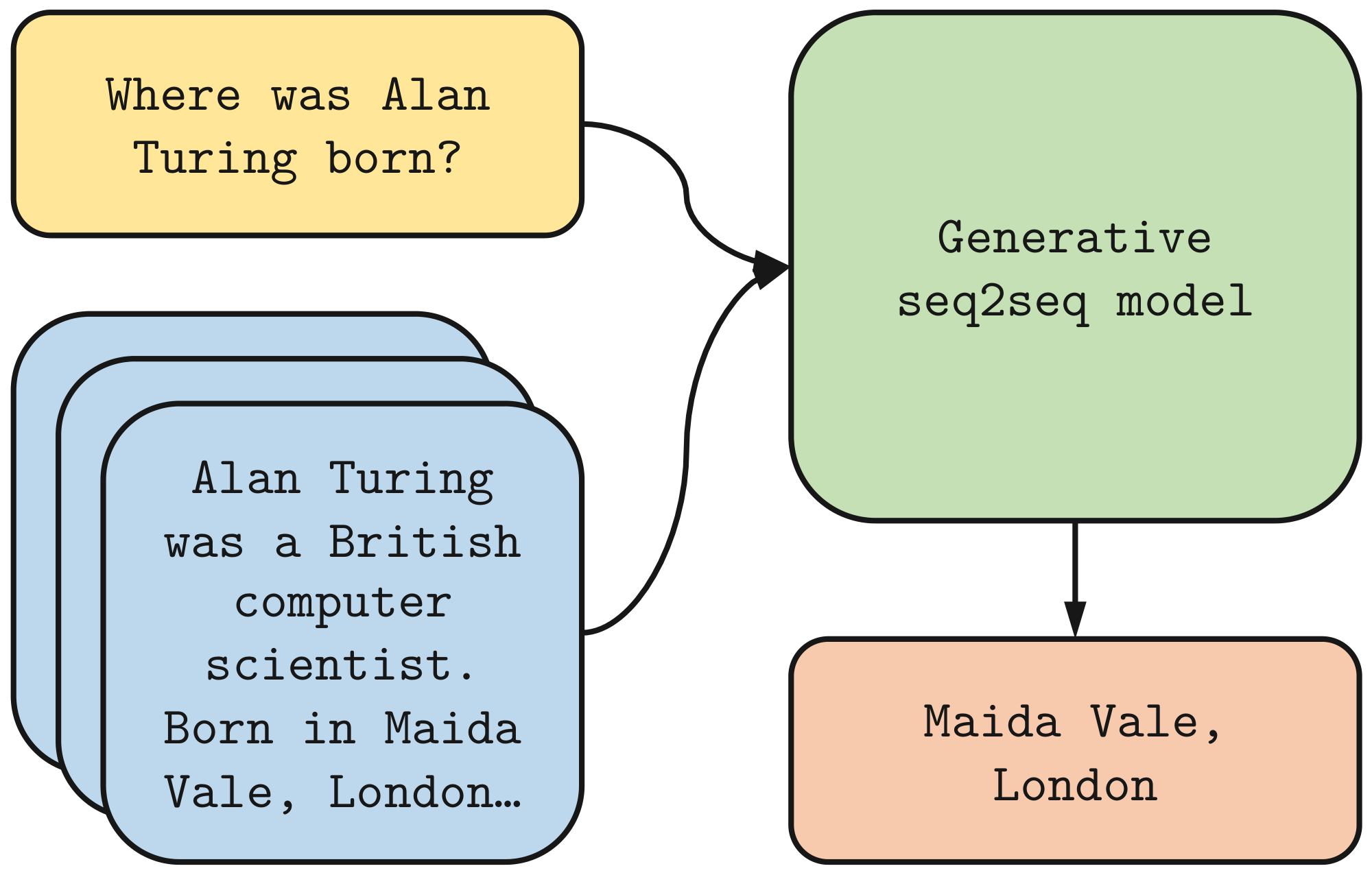
In this paper, we explore a simple approach having the best of both worlds, by building on the exciting developments in generative modeling and retrieval for open domain question answering. This method proceeds in two steps, by first retrieving supporting passages using either sparse or dense representations. Then, a sequence-to-sequence model generates the answer, taking as input the retrieved passages in addition to the question. While conceptually simple, this method sets new state-of-the-art results on the TriviaQA and NaturalQuestions benchmarks. In particular, we show that the performance of our method significantly improves when the number of retrieved passages increases. We believe that this is evidence that generative models are good at combining evidence from multiple passages, compared to extractive ones.
2. Related work
Section Summary: Researchers have long studied open-domain question answering, where systems must locate answers to general questions from large collections such as Wikipedia rather than from supplied evidence, using both supervised span-based methods and weaker supervision that provides only the final answer. Passage retrieval, a key step in these systems, has progressed from traditional keyword matching to neural ranking models and dense vector approaches that can be trained directly from question-answer data. More recent efforts have turned to generative models that produce answers rather than extract them, including approaches that combine retrieved passages with large pretrained language models to scale to many documents.
Open domain question answering
is the task of answering general domain questions, in which the evidence is not given as input to the system. While being a longstanding problem in natural language processing ([13]), this task has recently regained interest following the work by [6]. In that version of the problem, strong supervision is available to the learning system, in the form of spans corresponding to answers. [6] proposed to solve the problem by first retrieving support document from Wikipedia, before extracting the answer from the retrieved document. Different methods were proposed to tackle the setting where no gold spans are given to the system, but only the correct answer. [11] proposed to use a global normalization over all the span corresponding to the answer, which was later applied to BERT based models ([14]). [12] introduced a method based on hard expectation-maximization to tackle noisy supervision from this setting. [15] described a technique to aggregate answers from different paragraphs, using confidence and coverage scores.
Passage retrieval
is an important step in open domain question answering, and is an active area of research to improve QA systems. Initially, sparse representations based on TF/IDF were used to retrieve support documents ([6]). [16] introduced a supervised learning method to rerank paragraphs based on BiLSTM, while [17] trained a ranking system with reinforcement learning. A second approach to improve the retrieval step of QA systems is to used additional information such as the Wikipedia or Wikidata graphs ([18, 19]). Recently, multiple works show that retrieval systems entirely based on dense representation and approximate nearest neighbors were competitive with traditional approaches. Such models can be trained using weak supervision in the form of question-answer pairs ([8]), or pretrained using a cloze task and finetuned end-to-end ([7, 20]).
Generative question answering
was mostly considered in previous work for datasets requiring to generate answers, such as NarrativeQA ([21]), CoQA ([22]) or ELI5 ([23]). These datasets were generated in a way that answers do not correspond to spans in support documents, thus requiring abstractive models. [24] showed that generative models are competitive for reading comprehension tasks such as SQuAD ([25]), where answers are spans. [5] proposed to use large pretrained generative models, without using additional knowledge, for open domain question answering. Closest to our work, [26] and [27] introduced retrieval augmented generative models for open domain question answering. Our approach differs from these works by how the generative model processes the retrieved passages. This allows to scale to large numbers of documents, and to benefit from this large amount of evidence.
3. Method
Section Summary: The method for open domain question answering works in two stages. First, relevant passages are retrieved from a large collection using either a traditional keyword-based approach like BM25 or a neural method like DPR that matches dense vector representations of questions and passages. Second, a pretrained sequence-to-sequence model such as T5 or BART encodes each retrieved passage independently together with the question, then lets the decoder jointly attend over all the encoded passages to generate the answer through evidence fusion.
In this section, we describe our approach to open domain question answering. It proceeds in two steps, first retrieving support passages before processing them with a sequence to sequence model.
```latextable {caption="Table 1: Comparison to state-of-the-art. On TriviaQA, we report results on the open domain test set (left), and on the hidden test set (right), competitions.codalab.org/competitions/17208#results)."}
\begin{tabular}{l>{\arraybackslash }p{1.2cm}>{\arraybackslash }p{1.2cm}>{\arraybackslash }p{1.2cm}>{\arraybackslash }p{1.2cm}>{\arraybackslash }p{1.2cm}}
\toprule
Model & NQ & \multicolumn{2}{c}{TriviaQA} & \multicolumn{2}{c}{SQuAD Open} \
& EM & EM & EM & EM & F1 \
\midrule
DrQA ([6]) & - & - & - & 29.8 & - \
Multi-Passage BERT ([14]) & - & - & - & 53.0 & 60.9 \
Path Retriever ([19]) & 31.7 & - & - & \textbf{56.5} & \textbf{63.8} \
Graph Retriever ([18]) & 34.7 & 55.8 & - & - & -\
Hard EM ([12]) & 28.8 & 50.9 & - & - & -\
ORQA ([20]) & 31.3 & 45.1 & - & 20.2 & -\
REALM ([7]) & 40.4 & - & - & - & - \
DPR ([8]) & 41.5 & 57.9 & - & 36.7 & -\
SpanSeqGen ([26]) & 42.5 & - & - & - & -\
RAG ([27]) & 44.5 & 56.1 & 68.0 & - & -\
\midrule
T5 ([5]) & 36.6 & - & 60.5 & - & -\
GPT-3 few shot ([28]) & 29.9 & - & 71.2 & - & -\
\midrule
Fusion-in-Decoder (base) & 48.2 & 65.0 & 77.1 & 53.4 & 60.6\
Fusion-in-Decoder (large) & \textbf{51.4} & \textbf{67.6} & \textbf{80.1} & \textbf{56.7} & 63.2 \
\bottomrule
\end{tabular}
**Retrieval.**
For the retrieval of support passages, we consider two methods: BM25 ([29]) and DPR ([8]). In BM25, passages are represented as bag of words, and the ranking function is based on term and inverse document frequencies. We use the implementation from Apache Lucene[^1] with default parameters, and tokenize questions and passages with SpaCy.[^2] In DPR, passages and questions are represented as dense vector representations, computed using two BERT networks. The ranking function is the dot product between the query and passage representations. Retrieval is performed using approximate nearest neighbors with the FAISS library.[^3]
[^1]: `lucene.apache.org`
[^2]: `spacy.io`
[^3]: `github.com/facebookresearch/faiss`
**Reading.**
Our generative model for open domain QA is based on a sequence-to-sequence network, pretrained on unsupervised data, such as T5 or BART ([24, 30]). The model takes as input the question, as well as the support passages, and generates the answer. More precisely, each retrieved passage and its title are concatenated with the question, and processed independently from other passages by the encoder. We add special tokens `question:`, `title:` and `context:` before the question, title and text of each passage. Finally, the decoder performs attention over the concatenation of the resulting representations of all the retrieved passages. The model thus performs evidence fusion in the decoder only, and we refer to it as *Fusion-in-Decoder*.
By processing passages independently in the encoder, but jointly in the decoder, this method differs from [26] and [27]. Processing passages independently in the encoder allows to scale to large number of contexts, as it only performs self attention over one context at a time. This means that the computation time of the model grows linearly with the number of passages, instead of quadratically. On the other hand, processing passages jointly in the decoder allows to better aggregate evidence from multiple passages.
## 4. Experiments
> **Section Summary**: The experiments evaluate Fusion-in-Decoder on standard open-domain question answering benchmarks including NaturalQuestions, TriviaQA, and SQuAD, using exact-match scoring after initializing from pretrained T5 models and retrieving up to 100 passages per question. The approach outperforms prior methods on NaturalQuestions and TriviaQA, with generative models showing particular strength at combining evidence across many passages, and it achieves strong accuracy even when using far less total memory than larger closed-book models. Additional tests reveal that accuracy rises steadily as the number of retrieved passages increases to 100, and that training on fewer passages followed by brief fine-tuning can match full-training performance at much lower computational cost.
In this section, we report empirical evaluations of Fusion-in-Decoder for open domain QA.
**Datasets.**
We consider the following datasets, and use the same setting as [20]:
- NaturalQuestions ([31]) contains questions corresponding to Google search queries. The open-domain version of this dataset is obtained by discarding answers with more than 5 tokens.
- TriviaQA ([32]) contains questions gathered from trivia and quiz-league websites. The *unfiltered* version of TriviaQA is used for open-domain question answering.
- SQuAD v1.1 ([25]) is a reading comprehension dataset. Given a paragraph extracted from Wikipedia, annotators were asked to write questions, for which the answer is a span from the corresponding paragraph.
Following [20] we use the validation as test, and keep 10% of the training set for validation. We use the Wikipedia dumps from Dec. 20, 2018 for NQ and TriviaQA and from Dec. 21, 2016 for SQuAD. We apply the same preprocessing as [6, 8], leading to passages of 100 words, which do not overlap.
**Evaluation.**
Predicted answers are evaluated with the standard exact match metric (EM), as introduced by [25]. A generated answer is considered correct if it matches any answer of the list of acceptable answers after normalization. This normalization step consists in lowercasing and removing articles, punctuation and duplicated whitespace.
**Technical details.**
We initialize our models with the pretrained T5 models ([24]), available in the HuggingFace Transformers library.[^4] We consider two model sizes, base and large, containing respectively 220M and 770M parameters. We fine-tune the models on each dataset independently, using Adam ([33]) with a constant learning rate of $10^{-4}$ and a dropout rate of 10%. We train the model for 10k gradient steps, with a batch size of 64, using 64 Tesla V100 32Gb. We evaluate models every 500 steps and select the best one on the validation set based on the Exact Match score. During training on NaturalQuestions and SQuAD, we sample the target among the list of answers, while for TriviaQA, we use the unique human-generated answer. For TriviaQA, answers in uppercase are normalized by converting all letters in lowercase except the first letter of each word, using the `title` Python string method. For both training and testing, we retrieve 100 passages (unless said otherwise), and truncate them to 250 word pieces. Following the results of [8], passages are retrieved with DPR for NQ and TriviaQA, and with BM25 for SQuAD. We generate answers by using greedy decoding.
[^4]: `github.com/huggingface/transformers`
**Comparison to state-of-the-art.**
In Table 1, we compare the results obtained by Fusion-in-Decoder with existing approaches for open domain question answering. We observe that while conceptually simple, this method outperforms existing work on the NaturalQuestion and TriviaQA benchmarks. In particular, generative models seem to perform well when evidence from multiple passages need to be aggregated, compared to extractive approaches. Our method also performs better than other generative models, showing that scaling to large number of passages and processing them jointly leads to improvement in accuracy. Second, we observe that using additional knowledge in generative models by using retrieval lead to important performance gains. On NaturalQuestions, the *closed book* T5 model obtains 36.6% accuracy with 11B parameters, while our approach obtains 44.1% with 770M parameters plus Wikipedia with BM25 retrieval. Both methods use roughly the same amount of memory to store information, indicating that text based explicit memories are competitive for knowledge retrieval tasks.
**Scaling with number of passages.**
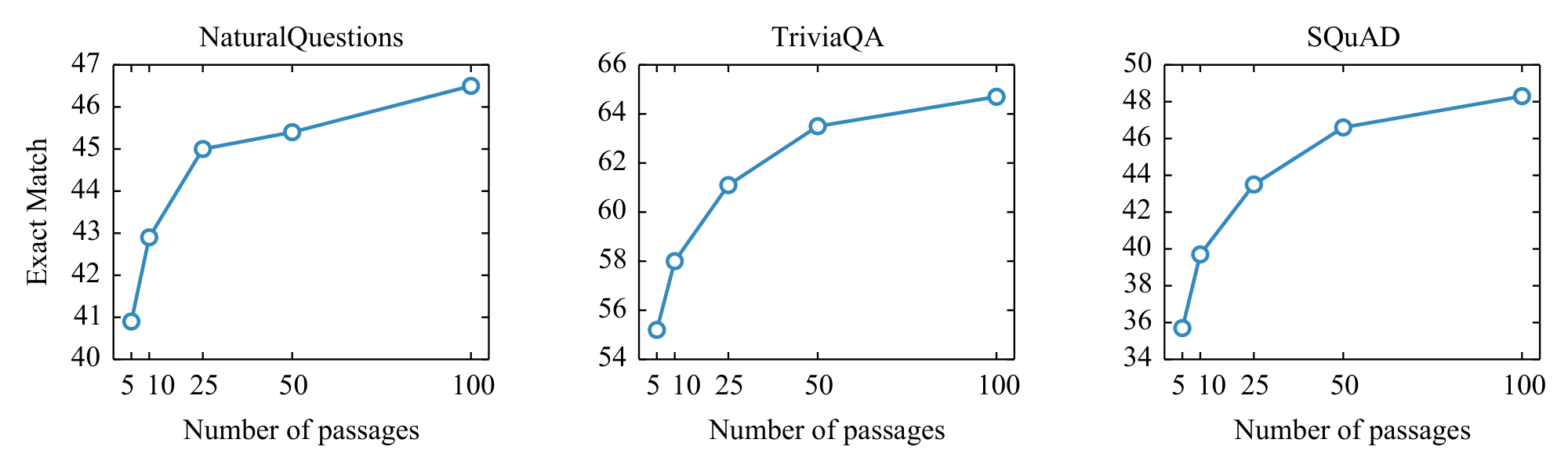
In Figure 3, we report the performance with respect to the number of retrieved passages. In particular, we observe that increasing the number of passages from 10 to 100 leads to 6% improvement on TriviaQA and 3.5% improvement on NaturalQuestions. On the other hand, the performance of most extractive models seems to peak around 10 to 20 passages ([14, 34]). We believe that this is evidence that sequence-to-sequence models are good at combining informations from multiple passages.
**Impact of the number of training passages.**
In the previous section, the model was trained and evaluated with the same number of passages. To reduce the training computational budget, a simple solution consists in training the model with fewer passages. In Table 2, we report the performance obtained by training with different numbers of passages, while testing with 100 passages. We observe that reducing the number of training passages leads to a decrease of accuracy. Further, we propose to finetune the previous models using 100 passages for 1000 steps. This allows to reduce the accuracy gap, while using significantly less computational resources: we can reach 46.0 EM on NaturalQuestions, using 147 GPU hours, compared to 425 GPU hours when training on 100 passages.
```latextable {caption="Table 2: Performance depending on the number of passages used during training. Exact Match scores are reported on dev sets."}
\begin{tabular}{>{\arraybackslash }p{4cm}cccc}
\toprule
& \multicolumn{2}{c}{NaturalQuestions} & \multicolumn{2}{c}{TriviaQA} \\
Training Passages & w/o finetuning & w/ finetuning & w/o finetuning & w/ finetuning \\
\midrule
5 & 37.8 & 45.0 & 58.1 & 64.2\\
10 & 42.3 & 45.3 & 61.1 & 63.6\\
25 & 45.3 & 46.0 & 63.2 & 64.2\\
50 & 45.7 & 46.0 & 64.2 & 64.3\\
100 & 46.5 & - & 64.7 & -\\
\bottomrule
\end{tabular}
5. Conclusion
Section Summary: This paper explores a straightforward method for answering questions across various topics by first finding relevant text passages and then using a model to generate answers from them. The results indicate that this basic strategy performs as well as more complex ones and improves as more passages are included. Looking ahead, the researchers aim to enhance efficiency with larger sets of passages, combine the retrieval step directly into the model, and train the entire system together.
In this paper, we study a simple approach to open domain question answering, which relies on retrieving support passages before processing them with a generative model. We show that while conceptually simple, this approach is competitive with existing methods, and that it scales well with the number of retrieved passages. In future work, we plan to make this model more efficient, in particular when scaling to large number of support passages. We also plan to integrate the retrieval in our model, and to learn the whole system end-to-end.
References
Section Summary: This section consists of a numbered bibliography with over thirty academic papers and technical reports, mostly published between 2018 and 2020. The listed works focus on language models, their potential to act as stores of factual knowledge, and techniques for open-domain question answering that combine retrieval from large text collections with neural network reading systems. They also include key benchmarks, datasets, and earlier foundational studies in natural language processing.
[1] Alec Radford, Jeffrey Wu, Rewon Child, David Luan, Dario Amodei, and Ilya Sutskever. 2019. Language models are unsupervised multitask learners. OpenAI Technical Report.
[2] Fabio Petroni, Tim Rocktäschel, Sebastian Riedel, Patrick Lewis, Anton Bakhtin, Yuxiang Wu, and Alexander Miller. 2019. Language models as knowledge bases? In Proc. EMNLP-IJCNLP.
[3] Zhengbao Jiang, Frank F Xu, Jun Araki, and Graham Neubig. 2019. How can we know what language models know? arXiv preprint arXiv:1911.12543.
[4] Alon Talmor, Yanai Elazar, Yoav Goldberg, and Jonathan Berant. 2019. oLMpics–on what language model pre-training captures. arXiv preprint arXiv:1912.13283.
[5] Adam Roberts, Colin Raffel, and Noam Shazeer. 2020. How much knowledge can you pack into the parameters of a language model? arXiv preprint arXiv:2002.08910.
[6] Danqi Chen, Adam Fisch, Jason Weston, and Antoine Bordes. 2017. Reading Wikipedia to answer open-domain questions. In Proc. ACL.
[7] Kelvin Guu, Kenton Lee, Zora Tung, Panupong Pasupat, and Ming-Wei Chang. 2020. Realm: Retrieval-augmented language model pre-training. arXiv preprint arXiv:2002.08909.
[8] Vladimir Karpukhin, Barlas Oğuz, Sewon Min, Ledell Wu, Sergey Edunov, Danqi Chen, and Wen-tau Yih. 2020. Dense passage retrieval for open-domain question answering. arXiv preprint arXiv:2004.04906.
[9] Matthew Peters, Mark Neumann, Mohit Iyyer, Matt Gardner, Christopher Clark, Kenton Lee, and Luke Zettlemoyer. 2018. Deep contextualized word representations. In Proc. NAACL.
[10] Jacob Devlin, Ming-Wei Chang, Kenton Lee, and Kristina Toutanova. 2019. BERT: Pre-training of deep bidirectional transformers for language understanding. In Proc. NAACL.
[11] Christopher Clark and Matt Gardner. 2018. Simple and effective multi-paragraph reading comprehension. In Proc. ACL.
[12] Sewon Min, Danqi Chen, Hannaneh Hajishirzi, and Luke Zettlemoyer. 2019a. A discrete hard EM approach for weakly supervised question answering. In Proc. EMNLP-IJCNLP.
[13] Ellen M Voorhees et al. 1999. The TREC-8 question answering track report. In TREC.
[14] Zhiguo Wang, Patrick Ng, Xiaofei Ma, Ramesh Nallapati, and Bing Xiang. 2019. Multi-passage BERT: A globally normalized BERT model for open-domain question answering. In Proc. EMNLP-IJCNLP.
[15] Shuohang Wang, Mo Yu, Jing Jiang, Wei Zhang, Xiaoxiao Guo, Shiyu Chang, Zhiguo Wang, Tim Klinger, Gerald Tesauro, and Murray Campbell. 2018b. Evidence aggregation for answer re-ranking in open-domain question answering. In Proc. ICLR.
[16] Jinhyuk Lee, Seongjun Yun, Hyunjae Kim, Miyoung Ko, and Jaewoo Kang. 2018. Ranking paragraphs for improving answer recall in open-domain question answering. In Proc. EMNLP.
[17] Shuohang Wang, Mo Yu, Xiaoxiao Guo, Zhiguo Wang, Tim Klinger, Wei Zhang, Shiyu Chang, Gerry Tesauro, Bowen Zhou, and Jing Jiang. 2018a. R$^3$: Reinforced ranker-reader for open-domain question answering. In Proc. AAAI.
[18] Sewon Min, Danqi Chen, Luke Zettlemoyer, and Hannaneh Hajishirzi. 2019b. Knowledge guided text retrieval and reading for open domain question answering. arXiv preprint arXiv:1911.03868.
[19] Akari Asai, Kazuma Hashimoto, Hannaneh Hajishirzi, Richard Socher, and Caiming Xiong. 2020. Learning to retrieve reasoning paths over wikipedia graph for question answering. In Proc. ICLR.
[20] Kenton Lee, Ming-Wei Chang, and Kristina Toutanova. 2019. Latent retrieval for weakly supervised open domain question answering. In Proc. ACL.
[21] Tomáš Kočiskỳ, Jonathan Schwarz, Phil Blunsom, Chris Dyer, Karl Moritz Hermann, Gábor Melis, and Edward Grefenstette. 2018. The NarrativeQA reading comprehension challenge. TACL.
[22] Siva Reddy, Danqi Chen, and Christopher D Manning. 2019. CoQA: A conversational question answering challenge. TACL.
[23] Angela Fan, Yacine Jernite, Ethan Perez, David Grangier, Jason Weston, and Michael Auli. 2019. ELI5: Long form question answering. In Proc. ACL.
[24] Colin Raffel, Noam Shazeer, Adam Roberts, Katherine Lee, Sharan Narang, Michael Matena, Yanqi Zhou, Wei Li, and Peter J Liu. 2019. Exploring the limits of transfer learning with a unified text-to-text transformer. arXiv preprint arXiv:1910.10683.
[25] Pranav Rajpurkar, Jian Zhang, Konstantin Lopyrev, and Percy Liang. 2016. SQuAD: 100,000+ questions for machine comprehension of text. In Proc. EMNLP.
[26] Sewon Min, Julian Michael, Hannaneh Hajishirzi, and Luke Zettlemoyer. 2020. Ambigqa: Answering ambiguous open-domain questions. arXiv preprint arXiv:2004.10645.
[27] Patrick Lewis, Ethan Perez, Aleksandara Piktus, Fabio Petroni, Vladimir Karpukhin, Naman Goyal, Heinrich Küttler, Mike Lewis, Wen-tau Yih, Tim Rocktäschel, et al. 2020. Retrieval-augmented generation for knowledge-intensive nlp tasks. arXiv preprint arXiv:2005.11401.
[28] Tom B Brown, Benjamin Mann, Nick Ryder, Melanie Subbiah, Jared Kaplan, Prafulla Dhariwal, Arvind Neelakantan, Pranav Shyam, Girish Sastry, Amanda Askell, et al. 2020. Language models are few-shot learners. arXiv preprint arXiv:2005.14165.
[29] Stephen E Robertson, Steve Walker, Susan Jones, Micheline M Hancock-Beaulieu, Mike Gatford, et al. 1995. Okapi at TREC-3. NIST Special Publication Sp.
[30] Mike Lewis, Yinhan Liu, Naman Goyal, Marjan Ghazvininejad, Abdelrahman Mohamed, Omer Levy, Ves Stoyanov, and Luke Zettlemoyer. 2019. BART: Denoising sequence-to-sequence pre-training for natural language generation, translation, and comprehension. arXiv preprint arXiv:1910.13461.
[31] Tom Kwiatkowski, Jennimaria Palomaki, Olivia Redfield, Michael Collins, Ankur Parikh, Chris Alberti, Danielle Epstein, Illia Polosukhin, Matthew Kelcey, Jacob Devlin, Kenton Lee, Kristina N. Toutanova, Llion Jones, Ming-Wei Chang, Andrew Dai, Jakob Uszkoreit, Quoc Le, and Slav Petrov. 2019. Natural Questions: a benchmark for question answering research. TACL.
[32] Mandar Joshi, Eunsol Choi, Daniel S. Weld, and Luke Zettlemoyer. 2017. Triviaqa: A large scale distantly supervised challenge dataset for reading comprehension. In Proc. ACL.
[33] Diederik P Kingma and Jimmy Ba. 2014. Adam: A method for stochastic optimization. arXiv preprint arXiv:1412.6980.
[34] Wei Yang, Yuqing Xie, Aileen Lin, Xingyu Li, Luchen Tan, Kun Xiong, Ming Li, and Jimmy Lin. 2019. End-to-end open-domain question answering with BERTserini. In Proc. NAACL (Demonstrations).