CommonsenseQA: A Question Answering Challenge Targeting Commonsense Knowledge
Alon TalmorJonathan HerzigNicholas LourieJonathan Berant
Introduces CommonsenseQA, a 12,247-question multiple-choice benchmark derived from ConceptNet semantic relations that tests language models on background world knowledge and exposes a wide performance gap with human reasoning.
The article addresses the challenge that current natural language understanding systems struggle with commonsense reasoning, even though humans routinely use background knowledge about spatial relations, causes, effects, and social conventions to answer questions. Existing question-answering benchmarks either supply explicit context or remain too small to test broad commonsense abilities at scale, leaving a gap in evaluating what models truly capture.
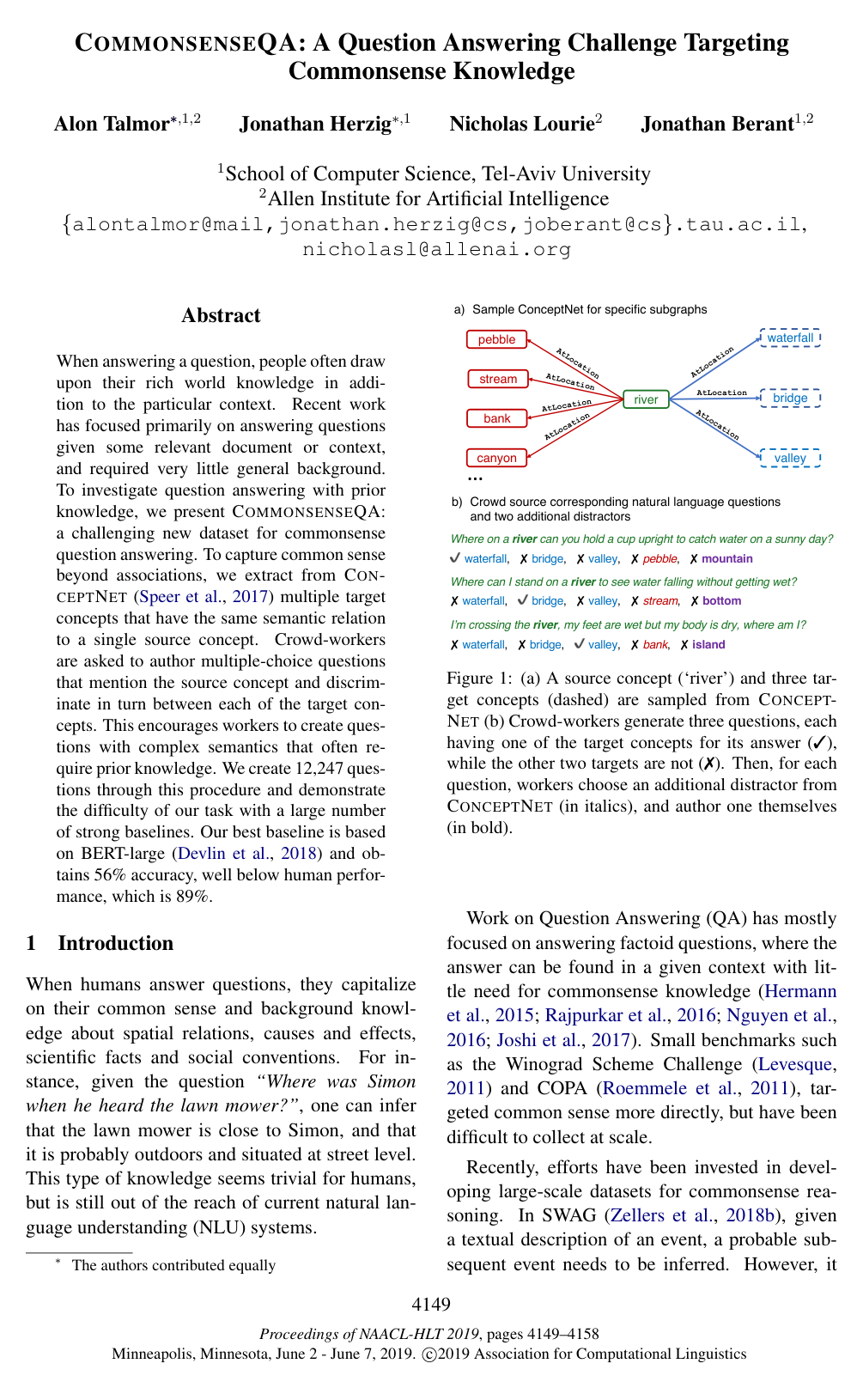
The article set out to build and release a large dataset of multiple-choice questions that require commonsense knowledge without any accompanying text. Researchers extracted subgraphs from the ConceptNet knowledge base to identify a source concept linked to three related target concepts by the same relation. Crowd workers then wrote natural-language questions that mentioned the source and pointed to only one of the targets as the correct answer, while also adding two extra distractors per question.
This process produced 12,247 questions. Strong baseline models were tested, including language-model approaches and reading-comprehension systems that received web search snippets. The best result came from fine-tuning BERT-large, which reached 55.9 percent accuracy on a random data split. Human performance on the same questions reached 88.9 percent. Using web snippets did not meaningfully improve results, and performance dropped further when questions shared source concepts with the training set but required different answers.
These findings show that even large pre-trained language models still miss many commonsense distinctions that humans find straightforward. The gap matters because reliable commonsense reasoning is essential for safer dialogue systems, better information retrieval, and more robust decision support tools. The dataset therefore provides a clear benchmark for measuring progress.
The authors recommend that future work focus on scaling training data, improving model architectures that explicitly incorporate structured knowledge, and conducting targeted error analysis on categories such as negation, granularity, and conjunctions where current models perform worst. They note that the questions depend on the coverage and biases of ConceptNet and that crowdsourced collection may introduce some artifacts, so results should be interpreted with those boundaries in mind. Overall confidence in the core performance gap is high because multiple strong baselines were evaluated against a clear human reference.
- Paper: Can a Suit of Armor Conduct Electricity? A New Dataset for Open Book Question Answering, Todor Mihaylov et al. (2018). OpenBookQA introduced core multi-hop question answering combining facts with everyday commonsense, establishing the evaluation paradigm that CommonsenseQA builds upon.
- Paper: Think you have Solved Question Answering? Try ARC, the AI2 Reasoning Challenge, Peter Clark et al. (2018). The AI2 Reasoning Challenge (ARC) highlighted the failure of surface-level retrieval models on commonsense science questions, motivating the creation of dedicated commonsense benchmarks like CommonsenseQA.
- Paper: Improving Language Understanding by Generative Pre-Training, Alec Radford et al. (2018). This foundational paper established the pre-training and fine-tuning paradigm for Transformers on commonsense reasoning benchmarks, providing the direct baseline methodology evaluated in CommonsenseQA.
- Paper: HotpotQA: A Dataset for Diverse, Explainable Multi-hop Question Answering, Zhilin Yang et al. (2018). HotpotQA pioneered multi-hop reasoning dataset construction and baseline benchmarking, heavily influencing the formulation of multi-target relation reasoning in CommonsenseQA.
- Paper: TriviaQA: A Large Scale Distantly Supervised Challenge Dataset for Reading Comprehension, Mandar Joshi et al. (2017). TriviaQA demonstrated the limitations of reading comprehension systems when exposed to broad external knowledge and web-retrieved evidence, directly informing CommonsenseQA's web snippet baseline setup.
- Paper: Know What You Don't Know: Unanswerable Questions for SQuAD, Pranav Rajpurkar et al. (2018). SQuAD 2.0 explored the vulnerabilities and distractor sensitivity of reading comprehension models, which CommonsenseQA addresses by requiring unassisted commonsense inference.
- Paper: SQuAD: 100,000+ Questions for Machine Comprehension of Text, Pranav Rajpurkar et al. (2016). As the benchmark that popularized large-scale neural reading comprehension, SQuAD serves as the key reference point for what text-dependent QA captures versus what context-free commonsense QA requires.
- Paper: A Broad-Coverage Challenge Corpus for Sentence Understanding through Inference, Adina Williams et al. (2016). MultiNLI established the standard for evaluating broad inferential semantics across diverse genres, framing the linguistic reasoning challenges examined in CommonsenseQA.
- Paper: STaR: Bootstrapping Reasoning With Reasoning, Eric Zelikman et al. (2022). STaR directly utilizes CommonsenseQA as a primary evaluation benchmark to demonstrate how language models can iteratively bootstrap commonsense reasoning rationales.
- Paper: Chain-of-Thought Prompting Elicits Reasoning in Large Language Models, Jason Wei et al. (2022). This paper evaluates chain-of-thought prompting on CommonsenseQA to bridge the performance gap between standard model prompting and human reasoning.
- Paper: Large Language Models are Zero-Shot Reasoners, Takeshi Kojima et al. (2022). This work uses CommonsenseQA to show that zero-shot chain-of-thought prompting elicits latent multi-step commonsense reasoning in large models.
- Paper: PIQA: Reasoning about Physical Commonsense in Natural Language, Yonatan Bisk et al. (2019). PIQA extends the commonsense question answering evaluation paradigm of CommonsenseQA into the specific domain of physical commonsense reasoning.
- Paper: HellaSwag: Can a Machine Really Finish Your Sentence?, Rowan Zellers et al. (2019). HellaSwag advances beyond CommonsenseQA by applying adversarial filtering to build a harder commonsense reasoning benchmark that challenges models like BERT.
- Paper: Language Models as Knowledge Bases?, Fabio Petroni et al. (2019). LAMA directly probes the extent to which pretrained models like BERT capture relational and commonsense knowledge without fine-tuning, explaining behaviors observed on CommonsenseQA.
- Paper: SuperGLUE: A Stickier Benchmark for General-Purpose Language Understanding Systems, Alex Wang et al. (2019). SuperGLUE incorporates demanding commonsense and causal reasoning tasks to establish a stickier general-purpose language understanding benchmark beyond single-domain evaluations.
- Paper: TruthfulQA: Measuring How Models Mimic Human Falsehoods, Stephanie C. Lin et al. (2022). TruthfulQA builds on commonsense evaluation methodologies to measure how language models fail on human falsehoods and misconceptions.
- Paper: Self-Consistency Improves Chain of Thought Reasoning in Language Models, Xuezhi Wang et al. (2023). Self-consistency improves upon chain-of-thought reasoning paths across commonsense benchmarks like CommonsenseQA by aggregating multiple sampled thoughts.
- Paper: Measuring Massive Multitask Language Understanding, Dan Hendrycks et al. (2020). MMLU broadens the multiple-choice knowledge evaluation framework of CommonsenseQA to measure factual knowledge and problem-solving across 57 distinct academic and professional subjects.