SAM-6D: Segment Anything Model Meets Zero-Shot 6D Object Pose Estimation
Jiehong LinLihua LiuDekun LuKui Jia
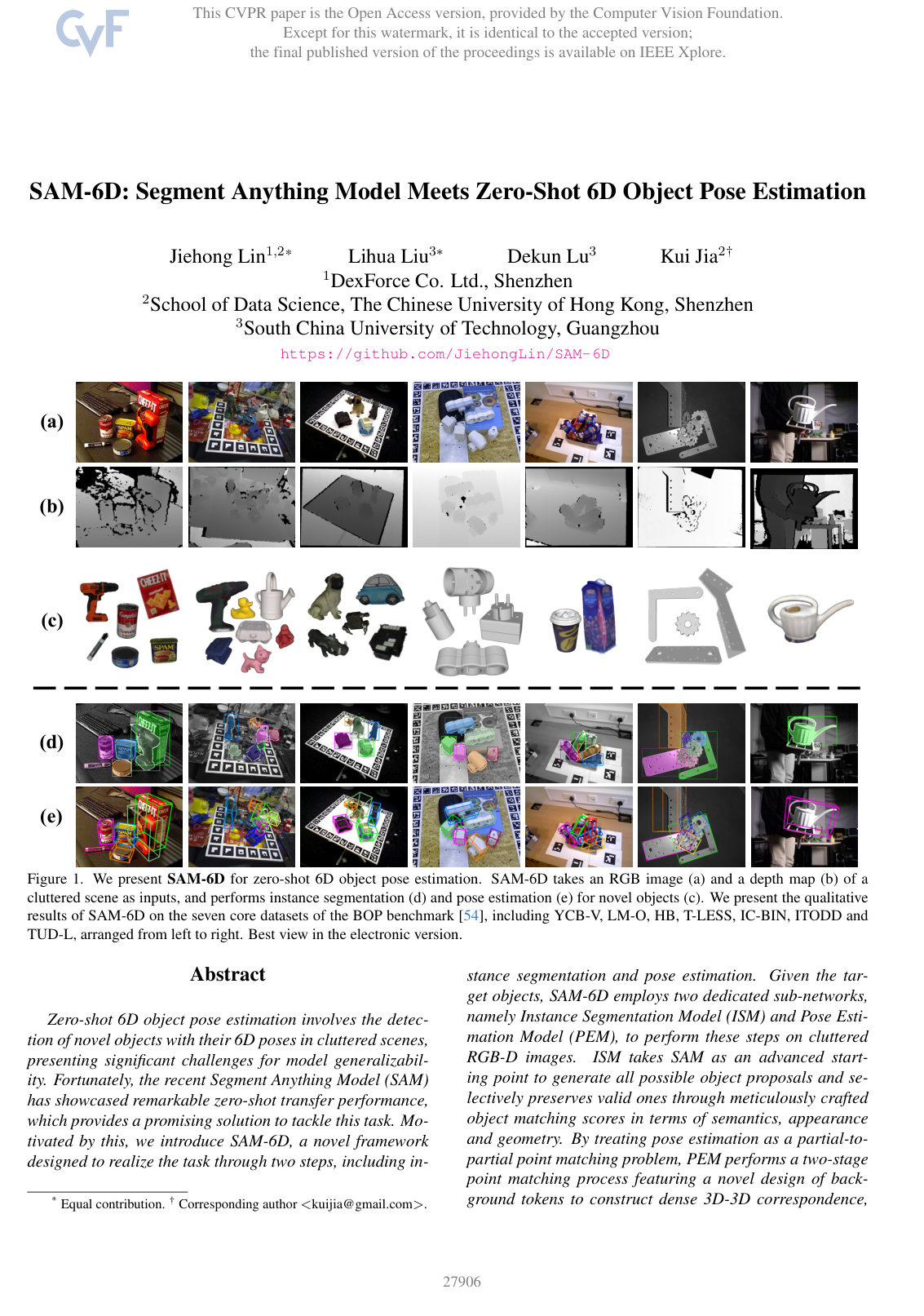
Presents SAM-6D, a framework that couples the zero-shot capabilities of the Segment Anything Model with a two-stage 3D point-matching network using background tokens to detect and estimate 6D poses of unseen objects in cluttered RGB-D scenes.
Identifying novel objects and accurately determining their three-dimensional position and orientation—known as six-degree-of-freedom, or 6D, pose estimation—in complex, cluttered environments is critical for modern robotic automation and augmented reality. Traditional computer vision methods require extensive labeled training images for each specific item or category, which severely restricts real-time adaptability in dynamic industrial settings. The article addresses this operational bottleneck by introducing SAM-6D, an end-to-end vision framework designed to detect previously unseen objects and accurately estimate their 6D poses without requiring object-specific model training.
The article demonstrates the performance of SAM-6D across a standardized benchmark by decomposing the workflow into two dedicated sub-models: an Instance Segmentation Model that isolates target items from background clutter, and a Pose Estimation Model that computes precise spatial coordinates. The segmentation pipeline leverages the Segment Anything Model to propose candidate regions, filtering valid instances using a multi-factor matching score across semantic category, visual appearance, and geometric scale. The pose estimation module formulates alignment as a two-stage 3D point matching task, moving from a coarse initial alignment to a fine registration using learned background tokens to handle occlusions and novel Sparse-to-Dense Point Transformers for computational efficiency. The framework was trained purely on large-scale synthetic datasets comprising approximately 50,000 objects across two million synthetic images and evaluated against seven core real-world benchmark datasets without fine-tuning.
The findings establish new performance benchmarks in zero-shot vision tasks. In instance segmentation, SAM-6D achieved a mean average precision of 48.1% across the core datasets, outperforming existing baselines that rely solely on semantic filtering by roughly 7 to 8 percentage points. In 6D pose estimation, SAM-6D achieved an average recall of 70.4%, surpassing leading competing frameworks like MegaPose and ZeroPose by approximately 8 to 13 percentage points. Furthermore, ablation experiments confirmed that the learned background tokens accelerate inference by more than three times compared to traditional optimization techniques (1.36 seconds versus 4.31 seconds per image on the evaluation hardware) while simultaneously increasing spatial accuracy.
These results demonstrate that organizations can deploy high-precision robotic manipulation and computer vision systems for new parts and products instantly, eliminating the cost, downtime, and data-collection overhead associated with retraining deep models. By removing the need for computationally heavy rendering-based pose refinement, the system lowers hardware latency and broadens deployment feasibility. When selecting deployment configurations, engineering teams can choose between the standard foundation model for maximum precision (4.37 seconds per image) or an accelerated lightweight alternative that reduces overall processing time to 1.43 seconds per image with only a moderate drop in accuracy.
Decision-makers should validate SAM-6D through pilot studies on target hardware and operational workflows to identify the ideal speed-versus-accuracy operating point. Readers should note that current benchmark evaluations relied on synthetic training data and calibrated color-and-depth camera inputs; consequently, performance may vary in operational settings characterized by extreme sensor noise, heavy material translucency, or severe visual occlusions.
- Paper: Segment Anything, Alexander M. Kirillov et al. (2023). Introduces the Segment Anything Model (SAM) and promptable zero-shot segmentation framework that SAM-6D builds upon directly for object proposal generation.
- Paper: FS6D: Few-Shot 6D Pose Estimation of Novel Objects, Yisheng He et al. (2022). Establishes foundational paradigms for few-shot and open-set 6D pose estimation of novel objects using prototype and point-level matching.
- Paper: PoseCNN: A Convolutional Neural Network for 6D Object Pose Estimation in Cluttered Scenes, Yu Xiang et al. (2017). Presents essential formulations for multi-stage 6D pose estimation and handling symmetric object ambiguities in cluttered scenes.
- Paper: PANet: Few-Shot Image Semantic Segmentation With Prototype Alignment, Kaixin Wang et al. (2019). Demonstrates prototype-based metric matching and alignment techniques for zero- and few-shot segmentation that inform instance matching modules.
- Paper: SAM 2: Segment Anything in Images and Videos, Nikhila Ravi et al. (2025). Extends the foundation of promptable Segment Anything architectures into continuous temporal domains and video-based tracking.
- Paper: SAM 3: Segment Anything with Concepts, Nicolas Carion et al. (2025). Advances zero-shot promptable segmentation models by unifying text concept detection and visual prompts across images and video.
- Paper: WildDet3D: Scaling Promptable 3D Detection in the Wild, Weikai Huang et al. (2026). Scales zero-shot, promptable 3D object detection in open-world settings by combining visual cues, geometry, and flexible user prompts.
- Paper: Telling Left from Right: Identifying Geometry-Aware Semantic Correspondence, Junyi Zhang et al. (2024). Explores resolving geometric and orientation ambiguities in foundation model semantic correspondences, addressing related point-matching challenges.