PoseCNN: A Convolutional Neural Network for 6D Object Pose Estimation in Cluttered Scenes
Yu XiangTanner SchmidtVenkatraman NarayananDieter Fox
Presents PoseCNN, a convolutional network that estimates full 6D object poses from color images by decoupling 3D translation and quaternion rotation to handle symmetric objects and severe occlusions, while introducing the standard YCB-Video benchmark.
For autonomous robotic systems to effectively manipulate items and interact with their surroundings, they must accurately determine an object's precise position and orientation in three-dimensional space, known as its six-dimensional pose. This capability is critical for practical automation in environments like logistics warehouses and manufacturing facilities. However, existing computer vision approaches struggle in real-world conditions where scenes are cluttered, objects partially block one another from view, surfaces lack distinctive visual textures, or shapes exhibit geometric symmetry.
The article set out to introduce and evaluate a deep learning framework, named PoseCNN, designed to robustly estimate six-dimensional object poses in cluttered and occluded scenes using standard color imagery, with optional depth-based refinement. Additionally, it aimed to demonstrate a training loss function tailored for symmetric objects and establish a large-scale video benchmark to advance research in this area.
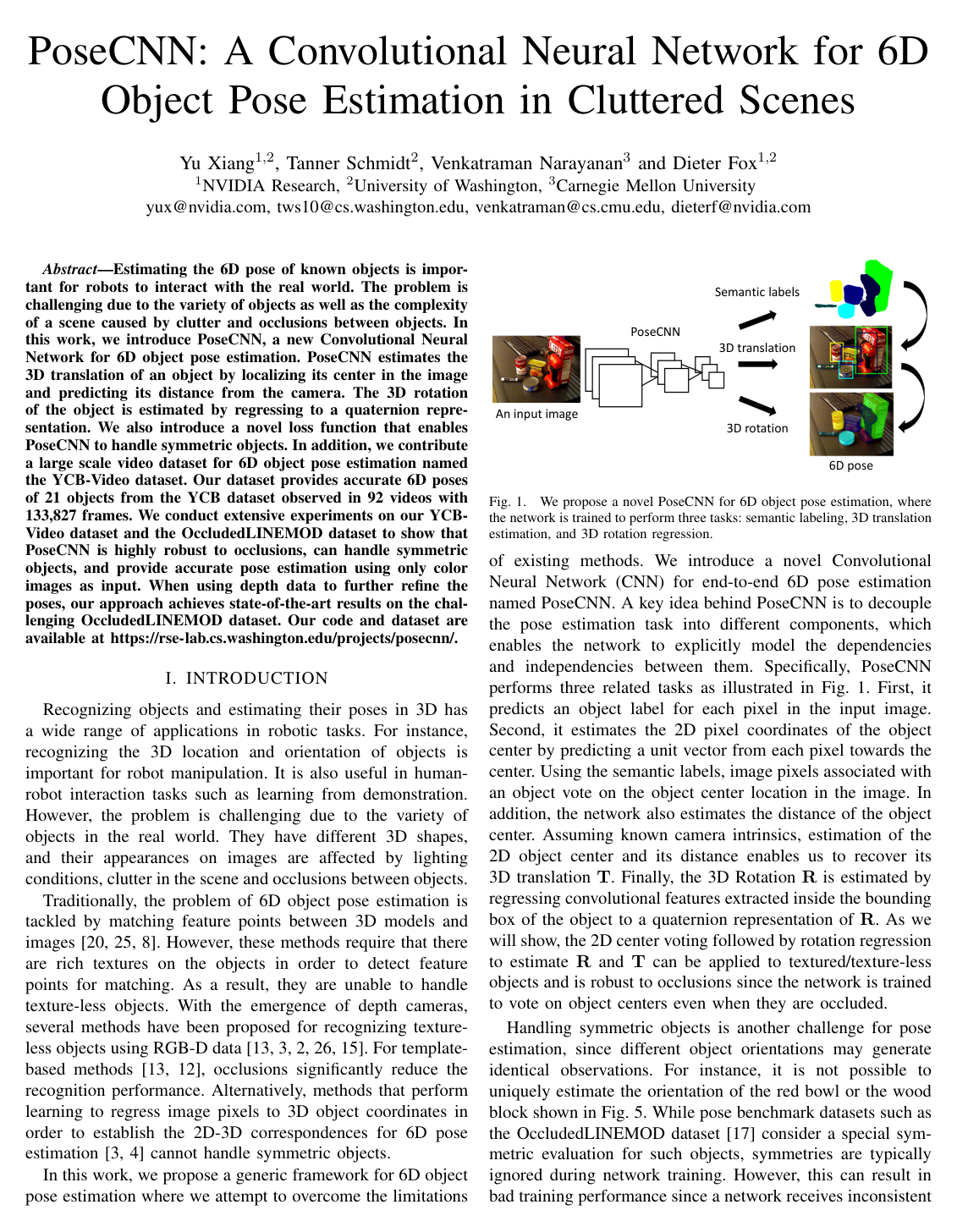
The authors designed a neural network architecture that decouples pose estimation into three distinct steps: identifying object pixels, localizing the object center and its distance via a scale-invariant voting mechanism, and directly predicting the three-dimensional rotation. To address the ambiguity of symmetric objects, the authors introduced ShapeMatch-Loss, a training function that measures how closely estimated shapes align with physical targets rather than enforcing a single rigid orientation. The system was trained and evaluated on 80,000 synthetic images, the challenging OccludedLINEMOD benchmark, and the newly created YCB-Video dataset—a benchmark comprising 133,827 video frames across 92 video sequences covering 21 distinct objects.
The evaluation revealed several key findings. First, when relying strictly on standard color images, PoseCNN significantly outperformed previous state-of-the-art methods and alternative regression baselines on cluttered scenes, achieving an area under the accuracy curve of 75.9% on the YCB-Video dataset compared to 29.8% for standard coordinate regression. Second, when depth sensor data was incorporated for pose refinement, PoseCNN achieved a state-of-the-art mean accuracy of 78.0% on the OccludedLINEMOD dataset, surpassing established competing approaches. Third, the ShapeMatch-Loss successfully resolved rotational ambiguities for symmetric items, eliminating large orientation errors on objects like wooden blocks and clamps that previously caused training failures.
These findings demonstrate that automated robotic perception can achieve high reliability even under significant visual obstruction and without relying on highly textured surfaces. In practical applications, this reduces hardware costs and sensor complexity by enabling effective pose estimation using standard camera images, while allowing high-precision tasks to be completed when depth data is integrated for final alignment. It also eliminates the manual overhead previously required to explicitly program geometric symmetry rules for every manufactured part.
Organizations developing automated manipulation pipelines should consider adopting decoupled pose estimation architectures to handle occlusion and symmetry in complex operational environments. For tasks demanding high spatial precision under strict tolerances, implementing depth-based refinement alongside the network provides optimal reliability. Future development should focus on addressing remaining algorithmic limitations, such as optimizing symmetry loss functions to prevent convergence to local error minimums and improving the discrimination of identical objects that differ only in scale.
Confidence in these findings is high given the extensive validation across tens of thousands of real and synthetic frames. However, decision-makers should note that color-only pose accuracy experiences noticeable drops under extremely tight spatial thresholds (such as sub-two-centimeter tolerances), and performance can degrade on very small, texture-free items or visually identical objects of different sizes. In addition, the video dataset ground-truth annotations carry minor sensor artifacts, including camera rolling shutter and minor synchronization offsets between color and depth feeds.
- Paper: You Only Look Once: Unified, Real-Time Object Detection, Joseph Redmon et al. (2016). You Only Look Once establishes the foundational real-time single-pass regression framework that PoseCNN adapts to predict 3D bounding coordinates and object classes.
- Paper: PointNet: Deep Learning on Point Sets for 3D Classification and Segmentation, Charles R. Qi et al. (2017). PointNet introduces the direct deep learning principles for processing raw geometric coordinates that inform PoseCNN's approach to spatial regression and feature extraction.
- Paper: Frustum PointNets for 3D Object Detection from RGB-D Data, Charles R. Qi et al. (2018). Frustum PointNets builds directly upon PoseCNN's 2D object localization approach by lifting detections into viewing frustums for improved 3D bounding-box regression.