
keyword
CAD models
CAD models, or computer-aided design models, are digital three-dimensional representations of physical or conceptual objects created using specialized design and drafting software. Unlike raw sensor scans captured directly from real-world environments, these models are typically synthetically authored, containing structured geometric definitions such as polygonal meshes, boundary representations, parametric surfaces, or volumetric grids, alongside associated material and texture properties. They mathematically capture the exact spatial dimensions, topologies, and functional features of objects for manufacturing, engineering, and visual design. In computer vision and machine learning, CAD models serve as standard digital assets and geometric ground truth for tasks such as synthetic image generation, 3D shape classification, novel view synthesis, and 3D object reconstruction.
7 items
Objaverse-XL: A Universe of 10M+ 3D Objects
Matt Deitke, Ruoshi Liu, Matthew Wallingford, Huong Ngo, Oscar Michel, Aditya Kusupati, Alan Fan, Christian Laforte, Vikram Voleti, Samir Yitzhak Gadre, Eli VanderBilt, Aniruddha Kembhavi, Carl Vondrick, Georgia Gkioxari, Kiana Ehsani, Ludwig Schmidt, Ali Farhadi
Why you should read this
Introduces Objaverse-XL, an open dataset of over 10 million 3D models and 100 million multi-view images that scales up training for 3D computer vision and enables strong zero-shot generalization in novel view synthesis.
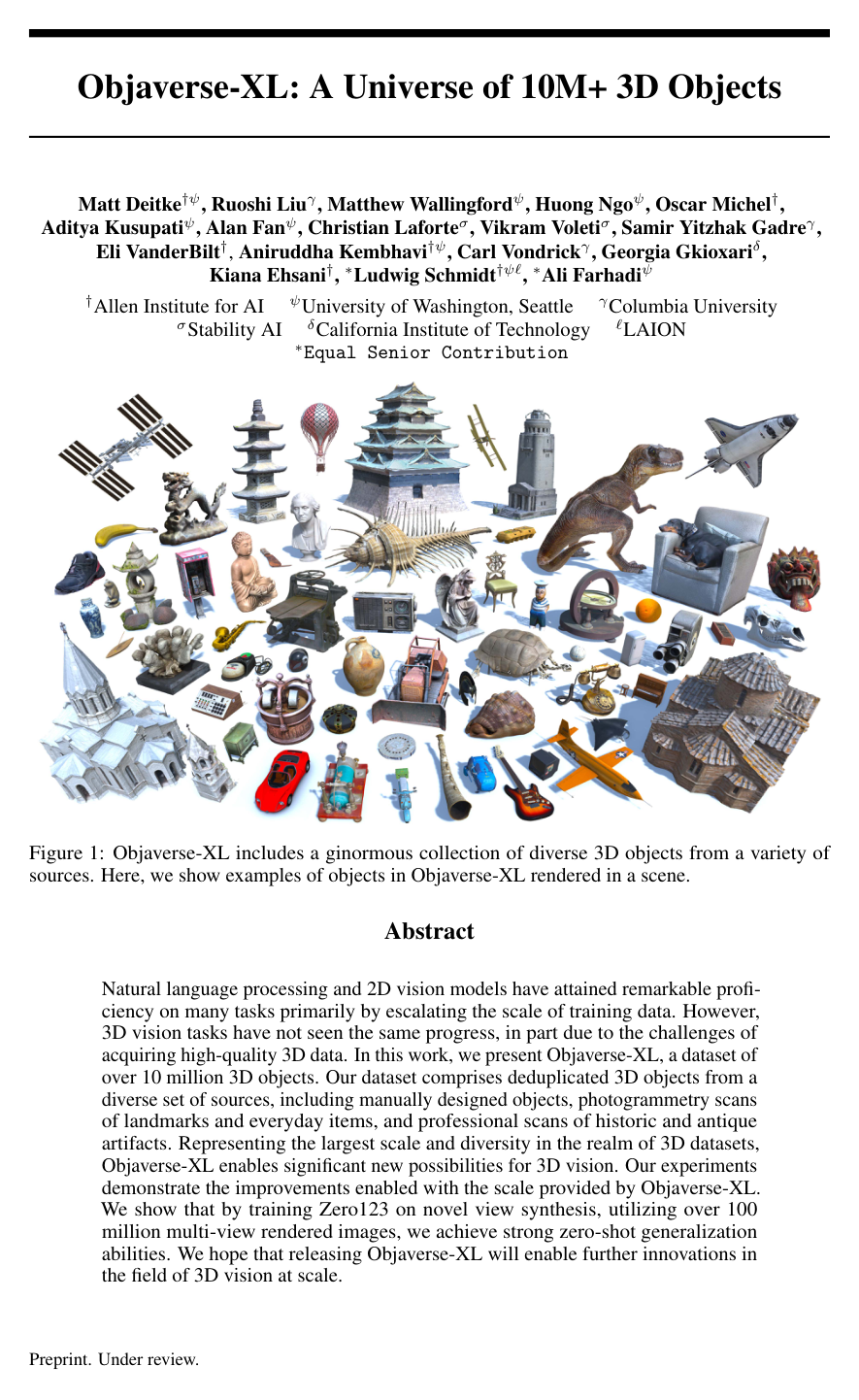
Natural language processing and 2D vision models have attained remarkable proficiency on many tasks primarily by escalating the scale of training data. However, 3D vision tasks have not seen the same progress, in part due to the challenges of acquiring high-quality 3D data. In this work, we present Objaverse-XL, a dataset of over 10 million 3D objects. Our dataset comprises deduplicated 3D objects from a diverse set of sources, including manually designed objects, photogrammetry scans of landmarks and everyday items, and professional scans of historic and antique artifacts. Representing the largest scale and diversity in the realm of 3D datasets, Objaverse-XL enables significant new possibilities for 3D vision. Our experiments demonstrate the improvements enabled with the scale provided by Objaverse-XL. We show that by training Zero123 on novel view synthesis, utilizing over 100 million multi-view rendered images, we achieve strong zero-shot generalization abilities. We hope that releasing Objaverse-XL will enable further innovations in the field of 3D vision at scale.
Added
2026-10-05
ULIP: Learning a Unified Representation of Language, Images, and Point Clouds for 3D Understanding
Le Xue, Mingfei Gao, Chen Xing, Roberto Martín-Martín, Jiajun Wu, Caiming Xiong, Ran Xu, Juan Carlos Niebles, Silvio Savarese
Why you should read this
Introduces a model-agnostic pre-training framework that aligns 3D point cloud encoders with frozen vision-language models using synthesized multimodal triplets, substantially boosting zero-shot and standard 3D recognition performance across various architectures.
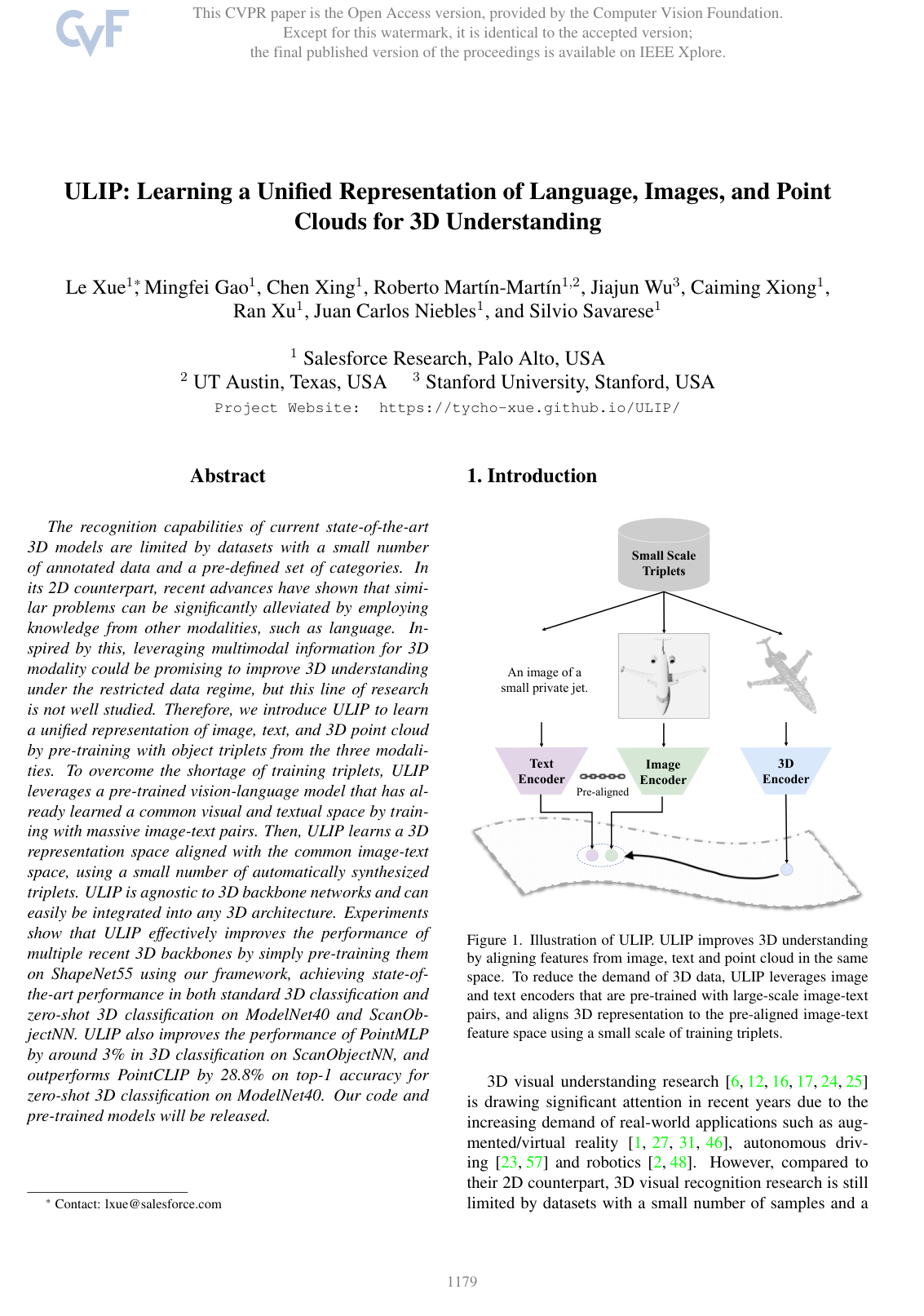
The recognition capabilities of current state-of-the-art 3D models are limited by datasets with a small number of annotated data and a pre-defined set of categories. In its 2D counterpart, recent advances have shown that similar problems can be significantly alleviated by employing knowledge from other modalities, such as language. Inspired by this, leveraging multimodal information for 3D modality could be promising to improve 3D understanding under the restricted data regime, but this line of research is not well studied. Therefore, we introduce ULIP to learn a unified representation of image, text, and 3D point cloud by pre-training with object triplets from the three modalities. To overcome the shortage of training triplets, ULIP leverages a pre-trained vision-language model that has already learned a common visual and textual space by training with massive image-text pairs. Then, ULIP learns a 3D representation space aligned with the common image-text space, using a small number of automatically synthesized triplets. ULIP is agnostic to 3D backbone networks and can easily be integrated into any 3D architecture. Experiments show that ULIP effectively improves the performance of multiple recent 3D backbones by simply pre-training them on ShapeNet55 using our framework, achieving state-of-the-art performance in both standard 3D classification and zero-shot 3D classification on ModelNet40 and ScanObjectNN. ULIP also improves the performance of PointMLP by around 3% in 3D classification on ScanObjectNN, and outperforms PointCLIP by 28.8% on top-1 accuracy for zero-shot 3D classification on ModelNet40. Our code and pre-trained models will be released.
Added
2026-09-26
ABO: Dataset and Benchmarks for Real-World 3D Object Understanding
Jasmine Collins, Shubham Goel, Kenan Deng, Achleshwar Luthra, Leon Xu, Erhan Gundogdu, Xi Zhang, Tomas F. Yago Vicente, Thomas Dideriksen, Himanshu Arora, Matthieu Guillaumin, Jitendra Malik
Why you should read this
Introduces a large-scale dataset pairing real product catalog images with artist-created 3D meshes and physically-based rendering materials to benchmark single-view reconstruction, material estimation, and multi-view retrieval on real-world objects.
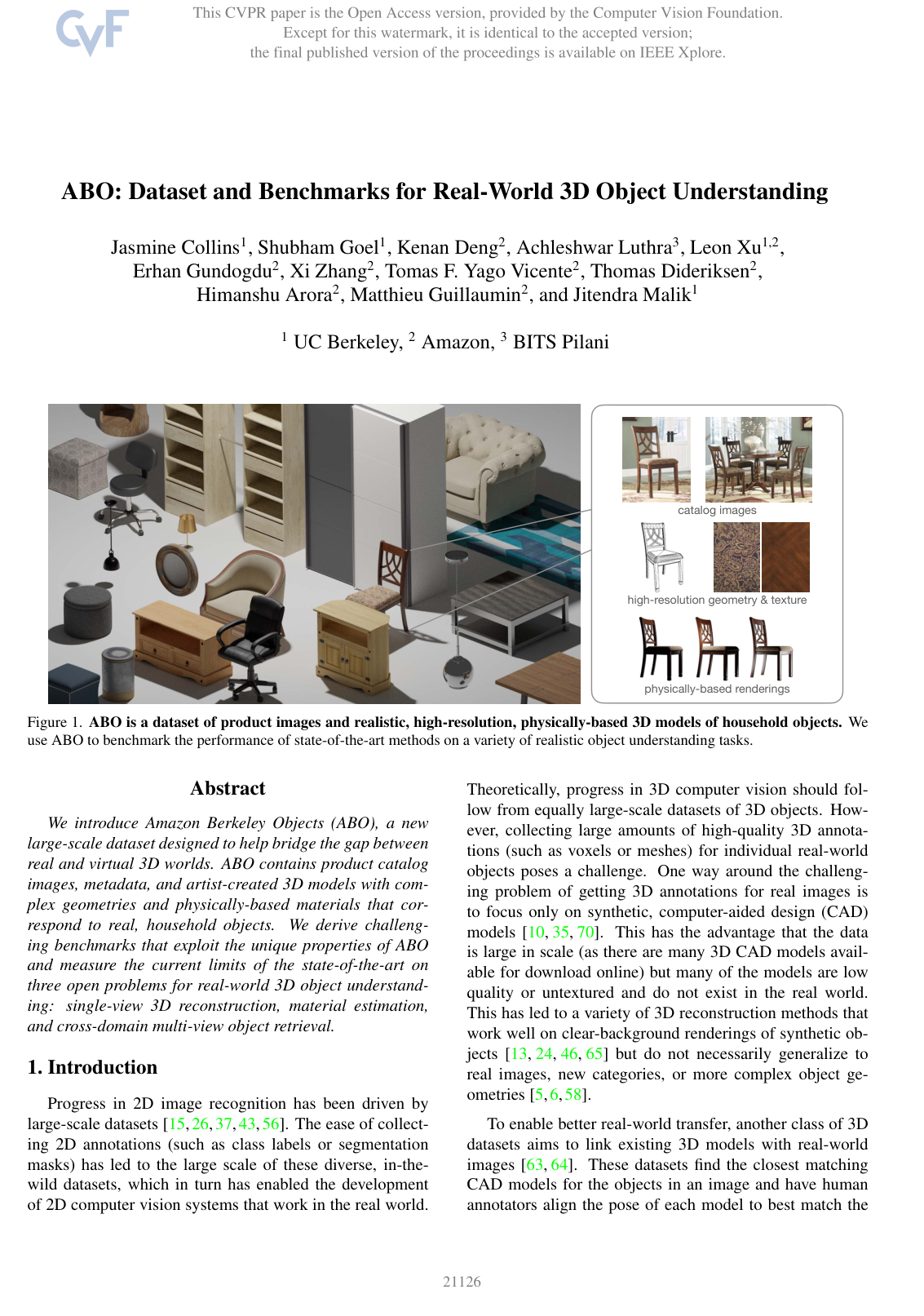
We introduce Amazon Berkeley Objects (ABO), a new large-scale dataset designed to help bridge the gap between real and virtual 3D worlds. ABO contains product catalog images, metadata, and artist-created 3D models with complex geometries and physically-based materials that correspond to real, household objects. We derive challenging benchmarks that exploit the unique properties of ABO and measure the current limits of the state-of-the-art on three open problems for real-world 3D object understanding: single-view 3D reconstruction, material estimation, and cross-domain multi-view object retrieval.
Added
2026-09-26
SAM-6D: Segment Anything Model Meets Zero-Shot 6D Object Pose Estimation
Jiehong Lin, Lihua Liu, Dekun Lu, Kui Jia
Why you should read this
Presents SAM-6D, a framework that couples the zero-shot capabilities of the Segment Anything Model with a two-stage 3D point-matching network using background tokens to detect and estimate 6D poses of unseen objects in cluttered RGB-D scenes.
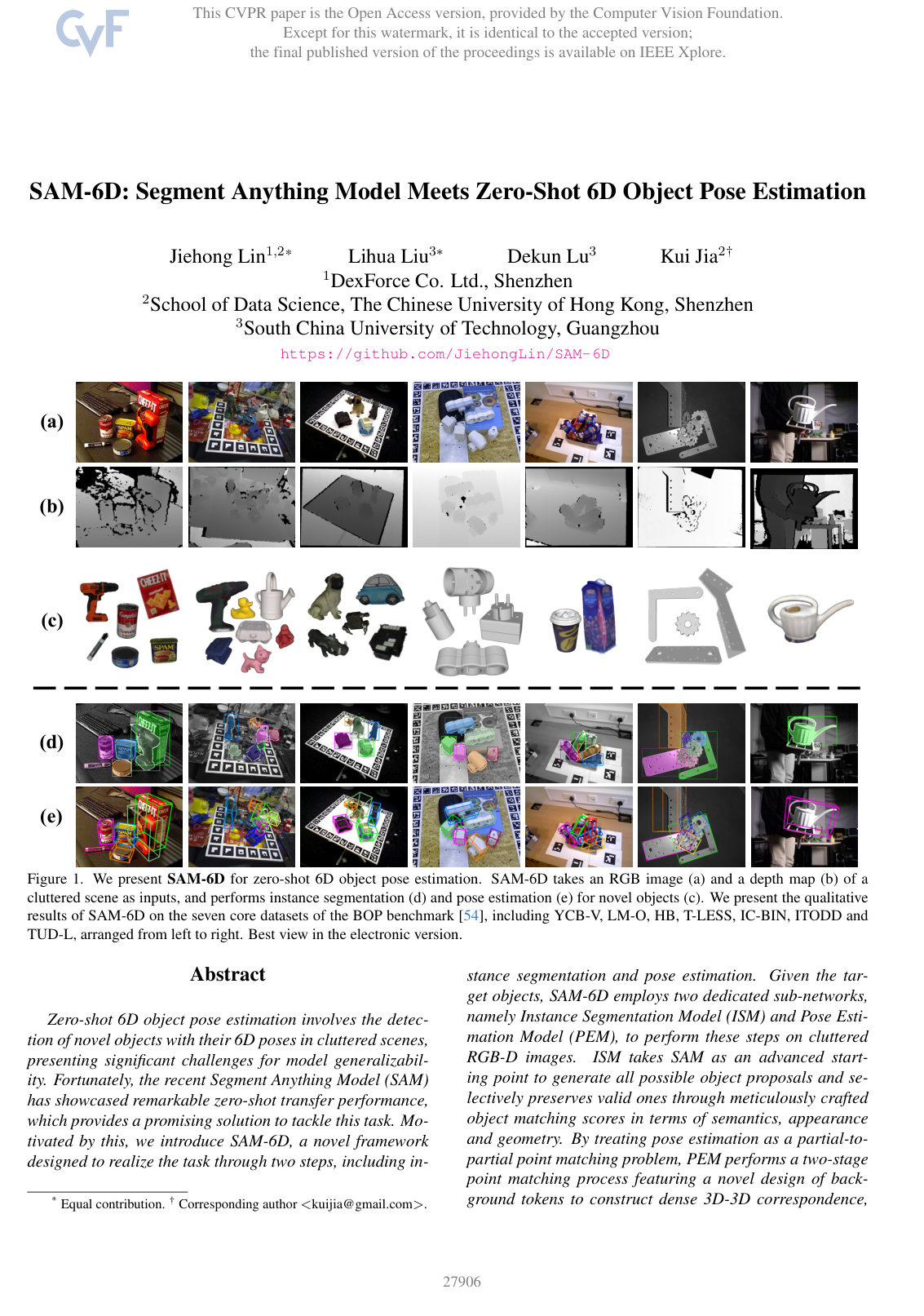
Zero-shot 6D object pose estimation involves the detection of novel objects with their 6D poses in cluttered scenes, presenting significant challenges for model generalizability. Fortunately, the recent Segment Anything Model (SAM) has showcased remarkable zero-shot transfer performance, which provides a promising solution to tackle this task. Motivated by this, we introduce SAM-6D, a novel framework designed to realize the task through two steps, including instance segmentation and pose estimation. Given the target objects, SAM-6D employs two dedicated sub-networks, namely Instance Segmentation Model (ISM) and Pose Estimation Model (PEM), to perform these steps on cluttered RGB-D images. ISM takes SAM as an advanced starting point to generate all possible object proposals and selectively preserves valid ones through meticulously crafted object matching scores in terms of semantics, appearance and geometry. By treating pose estimation as a partial-to-partial point matching problem, PEM performs a two-stage point matching process featuring a novel design of background tokens to construct dense 3D-3D correspondence,
Added
2026-09-26
3D-R2N2: A Unified Approach for Single and Multi-view 3D Object Reconstruction
Christopher B. Choy, Danfei Xu, JunYoung Gwak, Kevin Chen, Silvio Savarese
Why you should read this
Proposes a recurrent neural network that unifies single- and multi-view 3D object reconstruction by generating volumetric occupancy grids from arbitrary 2D images without requiring camera poses, class labels, or dense feature matches.
Inspired by the recent success of methods that employ shape priors to achieve robust 3D reconstructions, we propose a novel recurrent neural network architecture that we call the 3D Recurrent Reconstruction Neural Network (3D-R2N2). The network learns a mapping from images of objects to their underlying 3D shapes from a large collection of synthetic data. Our network takes in one or more images of an object instance from arbitrary viewpoints and outputs a reconstruction of the object in the form of a 3D occupancy grid. Unlike most of the previous works, our network does not require any image annotations or object class labels for training or testing. Our extensive experimental analysis shows that our reconstruction framework i) outperforms the state-of-the-art methods for single view reconstruction, and ii) enables the 3D reconstruction of objects in situations when traditional SFM/SLAM methods fail (because of lack of texture and/or wide baseline).
Added
2026-09-18
Learning a Probabilistic Latent Space of Object Shapes via 3D Generative-Adversarial Modeling
Jiajun Wu, Chengkai Zhang, Tianfan Xue, Bill Freeman, J. Tenenbaum
Why you should read this
Introduces 3D-GAN, a framework that generates realistic 3D volumetric shapes from a probabilistic latent space and produces unsupervised shape descriptors that rival supervised methods in 3D object recognition.
We study the problem of 3D object generation. We propose a novel framework, namely 3D Generative Adversarial Network (3D-GAN), which generates 3D objects from a probabilistic space by leveraging recent advances in volumetric convolutional networks and generative adversarial nets. The benefits of our model are three-fold: first, the use of an adversarial criterion, instead of traditional heuristic criteria, enables the generator to capture object structure implicitly and to synthesize high-quality 3D objects; second, the generator establishes a mapping from a low-dimensional probabilistic space to the space of 3D objects, so that we can sample objects without a reference image or CAD models, and explore the 3D object manifold; third, the adversarial discriminator provides a powerful 3D shape descriptor which, learned without supervision, has wide applications in 3D object recognition. Experiments demonstrate that our method generates high-quality 3D objects, and our unsupervisedly learned features achieve impressive performance on 3D object recognition, comparable with those of supervised learning methods.
Added
2026-09-18
ShapeNet: An Information-Rich 3D Model Repository
Angel X. Chang, Thomas Funkhouser, Leonidas Guibas, Pat Hanrahan, Qixing Huang, Zimo Li, Silvio Savarese, Manolis Savva, Shuran Song, Hao Su, Jianxiong Xiao, Li Yi, Fisher Yu
Why you should read this
Introduces ShapeNet, a large-scale repository of semantically annotated 3D CAD models organized under the WordNet taxonomy, providing an essential standardized benchmark to advance data-driven 3D computer vision and graphics research.
We present ShapeNet: a richly-annotated, large-scale repository of shapes represented by 3D CAD models of objects. ShapeNet contains 3D models from a multitude of semantic categories and organizes them under the WordNet taxonomy. It is a collection of datasets providing many semantic annotations for each 3D model such as consistent rigid alignments, parts and bilateral symmetry planes, physical sizes, keywords, as well as other planned annotations. Annotations are made available through a public web-based interface to enable data visualization of object attributes, promote data-driven geometric analysis, and provide a large-scale quantitative benchmark for research in computer graphics and vision. At the time of this technical report, ShapeNet has indexed more than 3,000,000 models, 220,000 models out of which are classified into 3,135 categories (WordNet synsets). In this report we describe the ShapeNet effort as a whole, provide details for all currently available datasets, and summarize future plans.
Added
2026-09-09