Aligning Large Language Models through Synthetic Feedback
Sungdong KimSanghwan BaeJamin ShinSoyoung KangDonghyun KwakKang Min YooMinjoon Seo
Presents an alignment learning framework that trains language models using synthetic feedback derived from contrasting different model sizes and prompt configurations, eliminating reliance on human annotations or proprietary APIs while outperforming models like Alpaca and Dolly-v2.
Training large language models to produce helpful, honest, and harmless responses traditionally requires substantial investments in manual human feedback or costly API distillation from proprietary models like ChatGPT. As organizations seek cost-effective, self-contained AI deployment pipelines, relying on external proprietary platforms creates data privacy risks, vendor dependencies, and high ongoing operational expenses.
The article demonstrates an end-to-end framework that aligns open-source language models using purely synthetic feedback. The primary objective is to show that foundation models can be aligned effectively with human values without requiring extensive manual annotations or proprietary model outputs.
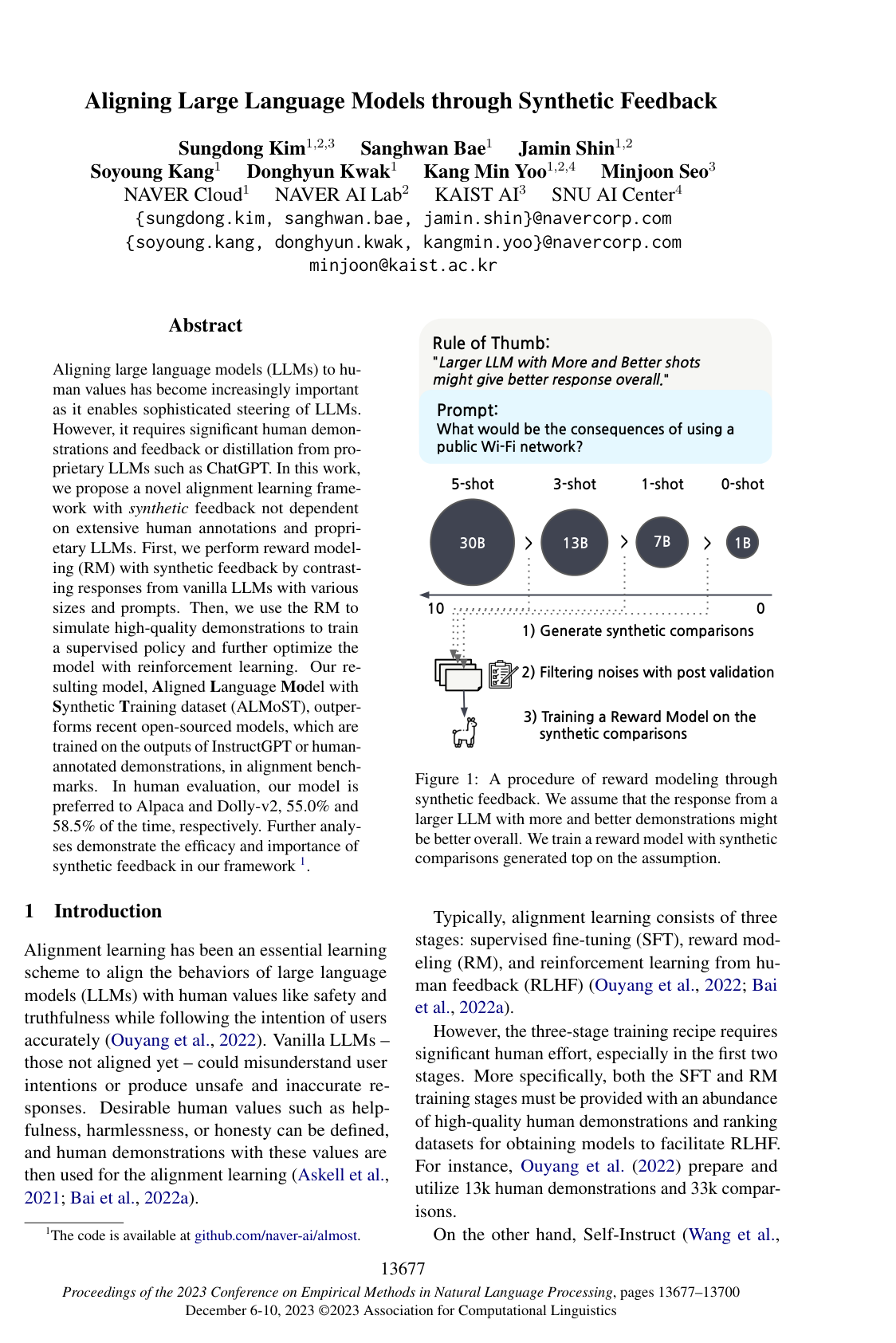
The approach operates in three main steps using open-source base models. First, researchers generate synthetic comparison data by contrasting responses from models of varying sizes and prompt qualities based on empirical heuristics (e.g., larger, well-prompted models generally outperform smaller, less-prompted ones), followed by automated heuristic and community-model filtering to remove noise. Second, the authors train a synthetic reward model on 13,000 synthetic pairs and use it in a guided self-play simulation to create 20,000 high-quality synthetic demonstrations for supervised fine-tuning. Third, the resulting model, named ALMoST, is further refined using reinforcement learning against the synthetic reward model.
Evaluation shows that ALMoST consistently outperforms open-source models trained on human annotations or distilled from proprietary systems. In human preference studies, ALMoST-7B won 55.0% of head-to-head comparisons against Alpaca (distilled from InstructGPT) and 58.8% against Dolly-v2 (trained on human annotations). On standardized alignment benchmarks measuring helpfulness, harmlessness, and honesty, ALMoST achieved a 68.8% overall accuracy, exceeding Dolly-v2 (52.0%) and Alpaca (62.9%). Ablation analyses revealed that prompt design and heuristic length filtering were the most critical factors in training an effective synthetic reward model, with filtering alone preventing a 10 percentage point drop in reward model accuracy.
These findings indicate that organizations can establish competitive, safe language models entirely in-house using open-source foundations. This significantly reduces data annotation costs, shortens development timelines, and mitigates regulatory and compliance risks associated with transmitting internal data to third-party proprietary APIs.
Organizations developing custom language models should transition toward synthetic alignment pipelines with robust data-filtering rules and carefully engineered prompts rather than relying exclusively on costly manual labeling. However, testing also revealed evidence of an alignment tax, where general knowledge and language understanding benchmarks (such as MMLU) degraded post-reinforcement learning. Decision-makers should cautiously pilot this synthetic pipeline on task-specific applications, monitoring domain performance trade-offs, and explore scaling to larger model sizes where alignment tax effects are typically less severe.
- Paper: Training language models to follow instructions with human feedback, Long Ouyang et al. (2022). Read this foundational human-feedback pipeline first: its supervised fine-tuning, reward modeling, and reinforcement-learning stages provide the framework ALMoST replaces with synthetic feedback.
- Paper: Training a Helpful and Harmless Assistant with Reinforcement Learning from Human Feedback, Yuntao Bai et al. (2022). This study establishes the helpfulness-and-harmlessness RLHF setup that ALMoST adapts, making its preference modeling and policy-training choices easier to follow.
- Paper: RLAIF vs. RLHF: Scaling Reinforcement Learning from Human Feedback with AI Feedback, Harrison Lee et al. (2024). This later comparison tests AI-generated preference feedback against human feedback, extending ALMoST’s case for alignment pipelines that reduce reliance on human labels.
- Paper: Self-Alignment of Large Language Models via Monopolylogue-based Social Scene Simulation, Xianghe Pang et al. (2024). MATRIX extends synthetic self-alignment by using simulated social scenes to generate critiques and training data without external supervision.
- Paper: Magpie: Alignment Data Synthesis from Scratch by Prompting Aligned LLMs with Nothing, Zhangchen Xu et al. (2025). MAGPIE carries synthetic alignment-data generation further, producing instruction-response datasets from aligned models without seed prompts or human annotation.
- Paper: Zephyr: Direct Distillation of LM Alignment, Lewis Tunstall et al. (2024). Zephyr develops a later synthetic-data alignment pipeline that combines teacher-generated demonstrations and preferences with direct preference optimization.
- Paper: Self-Play Fine-Tuning Converts Weak Language Models to Strong Language Models, Zixiang Chen et al. (2024). SPIN continues the self-generated training-data direction by iteratively improving a model through comparison with its own earlier responses.